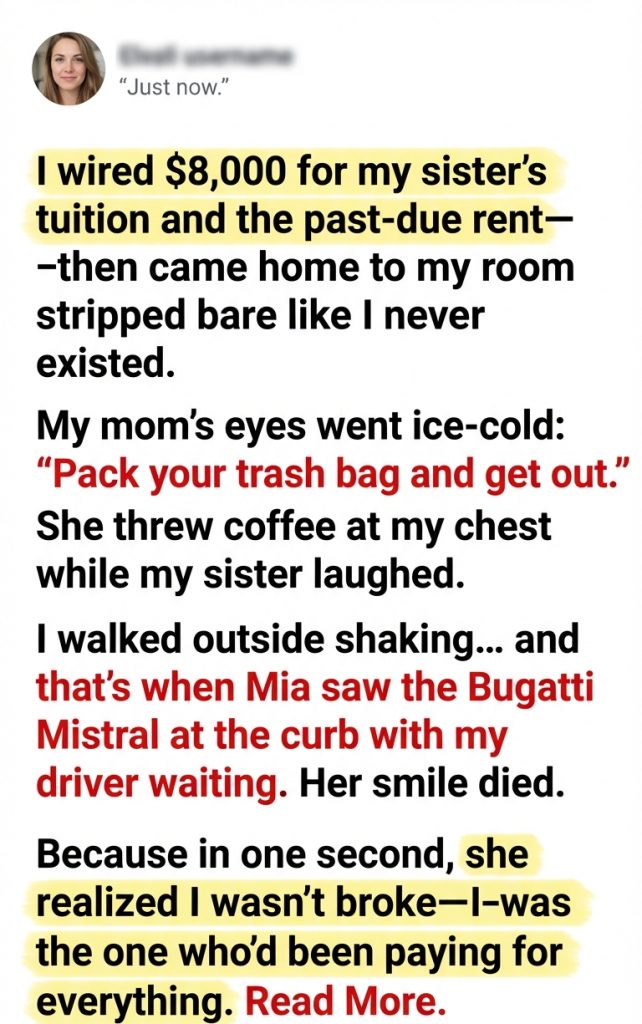
My name is Lauren Parker, and the day my mother kicked me out started like any other exhausted Monday—one of those days where you’re so tired you can’t tell if you’re hungry or just hollow. I’d just wired the last of my savings—eight thousand dollars—to cover my little sister Mia’s community college tuition and the past-due rent on our small two-bedroom house in Columbus, Ohio. I worked double shifts as a nurse at St. Vincent’s, slept in my car between nights, and ate whatever was left over in the hospital cafeteria. But I kept telling myself it was worth it. Mom always said family stuck together. I believed her. I believed her so hard it became a habit.
When I pulled into the driveway that afternoon, my brain was still foggy from twelve hours of beeping monitors and the metallic smell of antiseptic. Our silver Camry—the one I paid for—was gone. Mia’s beat-up Kia was parked crooked in its usual spot, like she’d coasted in without caring what her tires did to the grass. The yard looked the same—patchy lawn, plastic flamingos, a leaning mailbox—but something in my chest felt off. Like the air was already warning me I wasn’t welcome.
I unlocked the front door and froze. The hallway smelled like bleach and cheap floral air freshener, the kind that tries to cover something sour without actually cleaning it. Boxes were stacked against the walls, labeled in black marker in Mom’s sharp handwriting: “Kitchen.” “Bathroom.” “Mia’s Books.” My sneakers squeaked on the freshly mopped floor as I hurried down the hall toward my room.
The door was wide open.
My heart dropped.
Everything was gone. The posters. The thrift-store dresser. The mismatched nightstands I’d collected from Craigslist. Even the old twin bed. The blinds were bare, sunlight pouring onto an empty, vacuum-lined carpet like the room had been staged for someone else. In the center sat a single trash bag, tied shut, like a joke with no punchline.
I was still staring when Mom came up behind me. “Good,” she said, voice flat. “You’re home.”
I turned, expecting an explanation. A mistake. Something I could fix with a conversation.
“Mom… what happened to my stuff?”
She looked straight through me with a hardness I’d never seen, like she’d rehearsed this until compassion stopped working. “Lauren, you can’t carry your burden here anymore,” she snapped. “You’re almost thirty. I’m done waiting for you to figure your life out. Pack up your trash bag and find a new place.”
Her words didn’t land like one big blow. They landed like many small ones. Slap. Slap. Slap.
“I just paid the rent,” I managed. “And Mia’s tuition. You asked me—”
“That money was for this family,” she cut in, cheeks flushed and eyes bright with something cold. “And this family needs space. Mia’s moving into your room. She actually has a future. I’m not going to let you drag her down with your constant drama and bills.”
Mia appeared behind her, leaning on the doorway like she’d been waiting for the show. Phone in hand, lip gloss shining, expression bored and cruel. “You seriously still here?” she scoffed. “Mom, I thought you told her already.”
I felt heat rising behind my eyes—not tears yet, just that painful pressure when your body wants to defend you but doesn’t know how.
“I’ve been working nonstop for you,” I said, voice low. “For both of you.”
Mom rolled her eyes and stalked into the kitchen like my pain was an inconvenience. I followed, still trying to make it make sense. “Mom, please—talk to me. What did I do?”
She yanked a mug from the counter, half full of lukewarm coffee. “I said we’re done,” she shouted, and with a sharp flick of her wrist, she threw it straight at my chest.
The liquid hit my scrubs, hot and bitter, blooming across the fabric like a stain you can’t pretend isn’t there. The cup shattered in the sink. Mia laughed from the doorway—genuinely delighted—like this was the funniest thing she’d seen all week.
Mom pointed toward the hallway. “Trash bag. Now. Out.”
I stood there for a second, soaked and shaking, and something inside me quietly broke—not into rage, not into vengeance, but into clarity. I wasn’t being punished for failing them. I was being discarded because I’d served my purpose.
So I walked back to my empty room, picked up the trash bag, and tied it tighter even though it was already tied—because sometimes you do useless things just to keep your hands from trembling.
As I walked down the hall, Mia called after me, “Don’t forget to shut the door on your way out. Drafts are expensive.”
I didn’t answer. If I opened my mouth, I might have screamed.
I stepped outside into the sharp autumn air and paused on the porch, trying to decide where to go. My car wasn’t in the driveway. Mom had likely taken it, the way she took everything else I offered and then called it “family.” I looked down the street, thinking of my friend Jules, thinking of cheap motels, thinking of the hospital parking garage where I’d slept before.
Then I heard the sound—low, smooth, unmistakably expensive—rolling up the curb like a whisper of thunder.
Mia’s laughter stopped. I felt her behind me, stepping onto the porch.
A Bugatti Mistral sat at the curb, black and glossy, so sleek it looked unreal against our chipped mailbox and plastic lawn flamingos. A driver in a dark suit stepped out and opened the passenger door with the calm precision of someone trained to handle luxury without gawking at it.
Mia’s voice cracked. “What… is that?”
Mom pushed past her, still furious—until she saw the car. Then her face changed. Her mouth opened slightly, like her brain couldn’t file the image into any category that made her feel in control.
I didn’t say anything yet. I just walked down the steps slowly, trash bag in one hand, coffee-stained scrubs clinging to my skin, and stopped on the sidewalk in front of them.
My driver—Mr. Ellis—gave me a discreet nod. “Ms. Parker,” he said quietly. “I’m here.”
Mia stared like she’d seen a ghost driving a supercar. “That’s yours?” she whispered, suddenly smaller.
I turned back to her. “Yes.”
She blinked rapidly. “But you’re— you’re always broke. You’re always complaining about work.”
I almost laughed, but it came out as a tired exhale. “I’m not broke. I’m responsible.”
Mom found her voice first, sharp and accusing. “What is this? Some rental? Some stunt?”
I looked at her, really looked at her, and realized something that hurt in a strange way: she didn’t want the truth. She wanted control.
“It’s not a rental,” I said. “And it’s not a stunt.”
Mia took a step forward, eyes darting between me and the car. “Then why would you live here? Why would you pay our rent? Why would you—”
“Because I thought you loved me,” I said, simply. “And because I thought helping you meant we were a family.”
Silence fell. Even the neighborhood felt quieter, like the world leaned in.
My mother’s eyes narrowed. “Where did you get that kind of money?”
I didn’t answer with a dramatic reveal. I answered with the truth they never bothered to ask about.
“I didn’t just ‘work a boring nursing job,’” I said. “I built a company.”
Mia scoffed, but it sounded weak. “What company?”
I reached into my pocket and pulled out my phone, opened an email thread, and turned the screen toward them.
ParkerCare Staffing — Q4 Contract Renewal — St. Vincent’s Network
Mia’s mouth tightened. Mom’s eyes flickered, reading.
“I started a nursing staffing agency three years ago,” I continued. “Because I watched good nurses burn out while hospitals stayed understaffed. I hired nurses who wanted flexible shifts, and I negotiated fair rates. I kept working bedside because I wanted to stay grounded. But the agency grew. Fast.”
Mom’s expression shifted into something uneasy. “So you’re… rich now?”
I held her gaze. “I’m stable.”
Mia’s voice rose, frantic now. “Then why didn’t you tell us?”
The answer came easily, because it had been building in me for years. “Because every time I tried to share something good, you made it a joke. Because you didn’t ask. Because you only noticed my life when you needed something from it.”
My mother’s face reddened. “Don’t you turn this around on us. You’ve been living under my roof—”
I cut her off calmly. “No. You’ve been living under mine.”
Mia froze. “What?”
I took a slow breath, then said the sentence that changed the air completely.
“The lease is in my name,” I said. “And the security deposit. And the utilities. You didn’t ‘let me live here.’ I kept you from being evicted.”
Mom’s lips parted, then pressed into a thin line. “That’s… that’s not true.”
I nodded toward the front door. “The landlord is an LLC,” I said. “Mine. I bought the property last year. Quietly. Because I wanted you safe. Because you’re my mother.”
Mia’s voice went thin. “You own the house?”
“Yes,” I said. “And you just told the owner to pack a trash bag and leave.”
My sister’s confidence collapsed in real time. “Lauren—wait—”
But Mom tried one last power move, because it’s hard for people like her to accept losing control.
“If you own it,” she snapped, “then you have an obligation to your family.”
I looked at her, my chest still hot from the coffee stain, my hands still shaking around the trash bag.
“No,” I said softly. “I have an obligation to myself first. And I’m done being your emergency fund and your punching bag.”
Mia rushed forward, voice suddenly sweet. “Okay, okay. We were upset. You know how Mom gets. We didn’t mean it.”
I stared at her. “You laughed.”
She swallowed. “I didn’t think—”
“You didn’t think I’d ever stop,” I finished.
Mom’s eyes glistened, but it wasn’t remorse. It was fear. “So what now?” she demanded. “You’re going to throw us out?”
I didn’t smile. I didn’t gloat. I just set boundaries like a person learning how to protect herself.
“Here’s what’s going to happen,” I said, voice steady. “I’m leaving today. Not because you kicked me out—because I choose to. And tomorrow, my attorney will email you a formal notice. You have thirty days to move.”
Mia gasped. “Thirty days? Where are we supposed to go?”
I looked at her, and despite everything, a part of me still cared. “You’re adults,” I said. “You’ll figure it out. Like I had to.”
Mom’s voice broke into anger again. “After everything I’ve done—”
I cut her off, tired to the bone. “You threw coffee at me. Don’t talk to me about what you’ve done.”
Mia’s eyes filled. “But my tuition—”
“It’s paid,” I said. “That was my gift to the sister I thought I had. But from today on, you pay your own way. If you want help in the future, you earn it—with respect.”
She nodded quickly, desperate. “Okay. Okay, I’m sorry.”
I didn’t answer. Apologies said in panic don’t feel like truth. They feel like survival.
Mr. Ellis held the door open. I placed the trash bag on the back seat, then slid into the car in my coffee-stained scrubs, not glamorous, not victorious—just done. As the door closed, the world outside went muffled, like I’d stepped underwater.
Through the tinted glass, I saw my mother standing on the porch, frozen. I saw Mia near the driveway, face pale, finally understanding that the person she mocked had been holding their whole life together.
As we pulled away, I didn’t feel triumphant.
I felt grief.
Because the hardest part wasn’t losing a home. It was realizing I never truly had one there.
That night, I showered at my own condo—clean, quiet, modern, mine. I changed into soft clothes and sat on the balcony with a cup of tea. My phone buzzed with messages from my mother—first angry, then pleading, then suddenly loving in a way that felt rehearsed.
Please, Lauren. We’re family.
You can’t do this to us.
I’m sorry, I was stressed.
Call me.
I stared at the screen and felt the old reflex—the urge to fix, to smooth, to pay, to sacrifice. Then I thought about the coffee. The empty room. The trash bag.
And I did something new.
I didn’t respond.
The next day, I went back to work—because nursing wasn’t a costume I wore to look humble. It was part of who I was. I walked into a patient’s room, adjusted a pillow, and listened to someone talk about fear in a voice that shook. I remembered why I built ParkerCare in the first place: because I didn’t want people to feel disposable.
And somewhere between checking vitals and updating charts, I realized the strangest thing:
I was finally treating myself with the same care I gave strangers.
A week later, Mia called me from an unknown number. Her voice was small. “Lauren… can we talk?”
“About what?” I asked, calm.
She swallowed. “About… me being awful.”
I didn’t soften instantly. “Go on.”
She spoke haltingly, like someone who’d never apologized without a payoff. “I didn’t think you’d leave. I thought you’d always… handle it. I’m sorry.”
I took a breath. “If you’re sorry, show it. Get a job. Keep your grades up. Learn what it means to be grateful without needing a crisis.”
She whispered, “Okay.”
I didn’t promise her anything. I didn’t dangle help like a leash. I simply said, “I hope you become someone I can trust.”
When I hung up, the air felt lighter.
Some families only love you when you’re useful. Some only respect you when you’re untouchable.
But real love—healthy love—doesn’t demand you shrink to keep others comfortable.
That day, my mother taught me something she never intended to teach:
You can give people everything you have and still be treated like you’re nothing.
So I stopped trying to buy belonging.
I chose dignity instead.
And the funny part?
The moment I did, my life finally felt like it belonged to me.