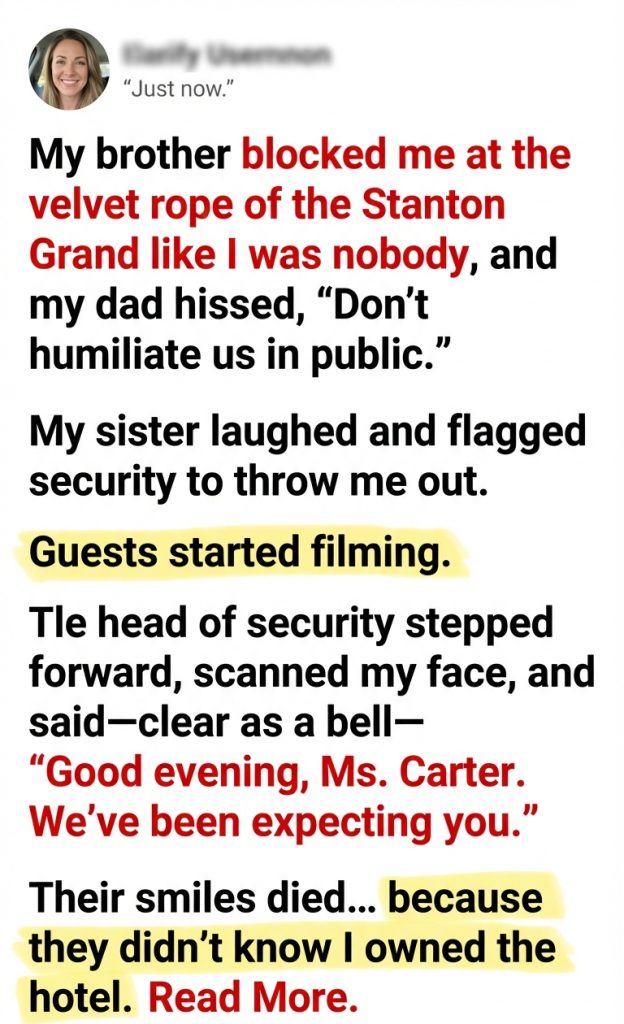
My brother stopped me at the velvet-rope entrance to my own five-star hotel, smirking like I was some random nobody trying to sneak in. My father leaned in beside him, low-voiced and icy, telling me not to humiliate them in public. They kept laughing, sure I couldn’t even afford to stand on the marble floor. What they didn’t know was I owned the property, the brand, and every single room key in the place. Then my head of security stepped out to the front, eyes locked on them. Family blindness always comes with a price.
The revolving glass doors of the Stanton Grand glittered under the evening lights, reflecting cameras, valet uniforms, and the long line of guests heading toward the charity gala upstairs. I stepped out of my rideshare in a plain navy coat, my hair pulled back, no jewelry, no designer clutch—exactly how I liked it when I visited my properties quietly. I didn’t need attention. I needed to see details: the way staff moved, the way guests were greeted, the way the lobby breathed when it was full. The Stanton wasn’t just a hotel to me. It was a living machine, and I was obsessive about keeping it humane.
I didn’t make it three steps before Lauren cut in front of me. My sister planted her heels on the red carpet like she owned it, chin lifted, lips curled into that practiced smile meant for an audience. “Oh my God,” she laughed loud enough for the valet to hear, “you can’t just walk in here.” Her eyes swept over my coat like it offended her. She looked me up and down the way our family always did—measuring worth by shine.
“Move, Lauren,” I said, keeping my voice calm.
She spread her arms wider. “This is a private event. It’s not a food bank. You’re going to embarrass Mom.” As if on cue, my mother, Diane, appeared beside her in a champagne-colored wrap, eyes sharp with that familiar warning. She leaned close to my ear and whispered, “Evelyn, please. Not tonight. People are watching.” Like I was the one about to cause a scene—like their laughter wasn’t already loud enough to echo off the marble.
I looked past them at the lobby where the chandelier hung like a frozen waterfall. I knew the staff schedules. I knew the security rotations. I knew exactly which camera angle would capture this humiliating little scene, and I could already imagine Lauren’s version of it posted online—my “delusional” sister trying to crash the rich. My family loved stories where I was the punchline. They’d mocked my “boring” finance job for years without asking what I actually did. They never cared enough to learn why I traveled so often, or why I always paid for dinners without blinking.
“I’m on the list,” I said.
Lauren’s laugh turned into a snort. “Sure you are. What name did you use? Cinderella?” I tried to step around her. She shifted again, blocking my path. A couple in tuxedos slowed to watch. The valet pretended not to stare but did anyway. My father stepped forward then—Gerald, in a tailored suit, smelling like cologne and control—and murmured, “Don’t do this. Don’t make us look like fools.”
The words landed like a slap. Make us look like fools. Not, “Are you okay?” Not, “Why are you here?” Just: don’t disrupt our performance. My brother, Trevor, leaned in with a grin, enjoying the attention. “Evelyn, be real,” he said. “This place is… expensive. Go home.”
I could have said it right there. I could have ended it with one sentence: I bought this hotel. But I’d learned something about power long ago—especially around people who underestimate you. If you announce it yourself, they call it bragging. If someone else announces it for you, it becomes fact.
Lauren waved a hand at a security guard near the doors. “Excuse me! We have someone trying to get in.” The guard hesitated, eyes flicking between us, already sensing the awkwardness. Then another figure moved from inside—tall, controlled, earpiece visible. Marcus Hale, the Stanton Grand’s security chief, walked straight toward us with purpose. Lauren’s grin widened. “Perfect,” she said sweetly. “Tell her to go.”
Marcus stopped one step away from me, scanning my face, then he gave a crisp nod—formal, unmistakably respectful. “Ms. Carter,” he said, loud enough for the onlookers. “Good evening. We’ve been expecting you.” It wasn’t theatrical. It was professional. The kind of greeting that tells everyone exactly where you stand.
Lauren’s smile froze like glass hit with cold water. My mother went pale. Trevor’s mouth opened slightly, then shut. My father’s eyes darted to my face, searching for the punchline that wasn’t coming.
Marcus turned his attention to them, his tone still calm. “Is there a problem here?”
Lauren recovered first, because she always did. She laughed too loudly and pointed at me like I was a child who’d wandered into traffic. “She’s… she’s not on the list,” she insisted. “She’s confused. She’s my sister and she’s—”
“Ms. Carter is on every list,” Marcus said evenly. “Because Ms. Carter is the owner’s representative.”
The air changed. People stopped pretending not to watch. The couple in tuxedos outright turned. A valet’s eyebrows lifted. Someone’s phone rose a little higher. My father’s face tightened, that old reflex to control the narrative fighting panic.
“My daughter?” he said, voice strained, attempting a laugh. “You mean… Evelyn?”
Marcus gave a short nod. “Yes, sir.”
My brother swallowed. “Owner’s rep… like… a manager?” he tried, desperate to shrink me back down.
I met his eyes. “No, Trevor,” I said quietly. “Not like that.”
Lauren’s voice came out sharp. “That’s not possible.”
It would have been funny, if it didn’t hurt. Not possible. As if my life could only be real if they approved it first.
Marcus shifted slightly, and two more security staff appeared near the doors—no drama, just presence. “Ms. Carter,” Marcus asked me, “would you like me to escort you inside?”
“Yes,” I said, and kept my voice mild. “And please make sure the entrance stays clear. We have guests arriving.”
Lauren flinched as if I’d slapped her. “Guests?” she snapped. “We’re the guests. We’re family.”
Marcus didn’t look at her when he spoke. He looked at me. “Understood.”
I stepped forward, and for the first time, no one blocked me. My mother reached out, fingertips brushing my sleeve as if to pull me back into the old pattern. “Evelyn,” she whispered, eyes pleading, “can we talk first?”
I paused just long enough to meet her gaze. “You’re talking now,” I said softly. “Just not the way you’re used to.”
Inside, the lobby was warm and bright, music drifting from upstairs, staff moving in graceful coordination. Marcus walked beside me, not too close, not too far—the practiced distance of a man trained to protect without making it obvious. At the reception desk, two employees straightened immediately. One of them, a young woman with a name tag reading Alyssa, looked startled, then smiled in recognition.
“Welcome back, Ms. Carter,” she said, and it wasn’t flattery. It was relief.
Because I visited quietly, but I visited often. I asked about overtime. I asked about breaks. I asked whether managers spoke to people respectfully. I’d paid for staff meals during holidays without making a press release about it. I’d quietly approved a $275,000 upgrade last quarter—new security cameras and better lighting for the back corridors—because I cared more about employee safety than marble shine.
The Stanton Grand wasn’t always the Stanton. Years ago, it was a fading luxury property with a gorgeous location and terrible leadership—mismanaged, understaffed, slowly dying. I’d been twenty-nine then, a “boring finance girl” according to my family, sitting in conference rooms while men talked over me. I’d put together the acquisition plan myself. The bank wanted a serious down payment, and I poured everything I had into it—$975,000 I’d saved and raised in my own name—then brought in investors who trusted my spreadsheets more than my smile. We rebranded, rebuilt, and I kept my ownership quiet because I didn’t want to become a headline. I wanted to become stable.
Upstairs, the charity gala was already humming. Crystal glasses. Soft laughter. A string quartet playing something elegant and expensive. The host committee greeted me with the kind of warmth reserved for people who sign checks.
“Evelyn!” Dr. Kline said, smiling. “We were hoping you’d make it.”
“I’m here,” I replied, and slipped into the rhythm of the event like I belonged—because I did. Not because of the dress code. Because the Stanton’s brand partnerships, sponsors, and philanthropic calendar were built into my quarterly goals. I shook hands, exchanged pleasantries, and listened. That’s what my family never understood: the richest people in the room rarely need to shout. They just need to be certain.
I spotted my family through the glass railing near the entrance below. Marcus had guided them a few steps away from the rope. They were arguing—my sister’s hands flying, my father’s posture stiff, my mother twisting her fingers together. My brother kept looking around, as if hoping nobody recognized them. The humiliation they’d tried to hand me was now sitting in their laps like a heavy purse they couldn’t set down.
A board member leaned toward me and said, “Is everything okay?”
I smiled politely. “Yes,” I said. “Just a small misunderstanding at the front.”
But it wasn’t small. Not to me. It was the same misunderstanding my family had carried for years—that my value was something they could decide with a smirk.
Ten minutes later, Marcus appeared beside me. “Ms. Carter,” he said quietly, “your family is asking to speak with you privately.”
I took a sip of water. “Are they causing disruption?”
“No,” he said. “But they’re insisting.”
I nodded once. “Bring them to the conference alcove. Five minutes.”
The alcove was quiet, carpeted, lit softly. When I entered, my father stood as if he were about to lecture me like I was twelve.
“Evelyn,” he began, voice low and furious, “what was that? Why would you do that to us in front of people?”
I stared at him. “Do what?”
“Embarrass us,” he snapped.
I let the silence stretch just long enough to make the point. Then I said, “You embarrassed yourselves. I didn’t even speak until I had to.”
Lauren’s cheeks were flushed. “You set us up,” she hissed.
I almost laughed. “You set yourselves up when you decided the only way I could exist here was as a joke.”
My mother stepped forward, eyes shiny. “We didn’t know, Evelyn.”
“That’s the problem,” I replied. “You didn’t know because you never asked.”
Trevor tried to regain his swagger. “So what, you own it? Big deal. We’re family. You could’ve told us.”
I looked at him, feeling something settle into place. “I didn’t tell you because every time I shared something I was proud of, you found a way to make it small.”
My father’s jaw tightened. “This is not the time for therapy talk.”
“No,” I said, steady. “This is the time for boundaries.”
Lauren’s voice softened suddenly, sugar poured over panic. “Evelyn… okay. I’m sorry. Can we just go upstairs? People saw us. We’ll look ridiculous if we leave now.”
There it was. Not remorse. Damage control.
I shook my head. “You can attend if you behave. But you don’t get VIP access, and you don’t get to attach yourselves to me like a status accessory.”
My father scoffed. “You’re punishing us.”
“I’m protecting myself,” I said. “And I’m protecting the staff you tried to bully.”
My mother whispered, “Please. Just let it go.”
I met her gaze. “You told me not to humiliate you. That’s what you cared about. Not whether I was being humiliated first.”
The words hung in the air, sharp and clean.
My father’s voice dropped. “We deserve respect.”
I nodded. “So do I.”
Lauren’s eyes narrowed. “So what now? You’re just going to… throw us out?”
I breathed in slowly. “No. I’m going to return to my event. Marcus will escort you where you need to be. If you cause any issues, you’ll be asked to leave. And after tonight, if you want a relationship with me, it starts with an apology that isn’t about appearances.”
Trevor muttered, “Unbelievable.”
I turned toward the door. “One more thing,” I added, and they all looked up.
“Yes?” my father asked stiffly.
“Stop using ‘family’ like it’s a key,” I said quietly. “Because in this building, I actually have the keys.”
I walked back into the gala and felt my shoulders loosen a fraction. Not because I’d won. Because I’d stopped shrinking.
Later that night, when I signed the charity pledge—$300,000 toward the shelter’s expansion fund—the board members thanked me. Cameras flashed. People smiled. I kept it brief, because my giving wasn’t about attention. It was about impact. And as I looked over the crowd, I saw my family at the edges, subdued, suddenly careful with their voices.
For the first time in my life, they were watching me the way they watched everyone else: with uncertainty.
When the gala ended and the lobby quieted, I took one last walk through the Stanton Grand. I checked the entrance flow. I greeted the night manager. I thanked a housekeeping supervisor by name. I paused by the velvet rope and let my fingers rest on it for a second, almost amused by how a simple cord could become a battlefield.
Family blindness always comes with a price.
Sometimes the price is money.
Sometimes it’s pride.
But the most expensive price is what you lose when you spend years begging people to see you.
That night, I stopped begging.
And for the first time, standing on my own marble floor, I felt completely at home.