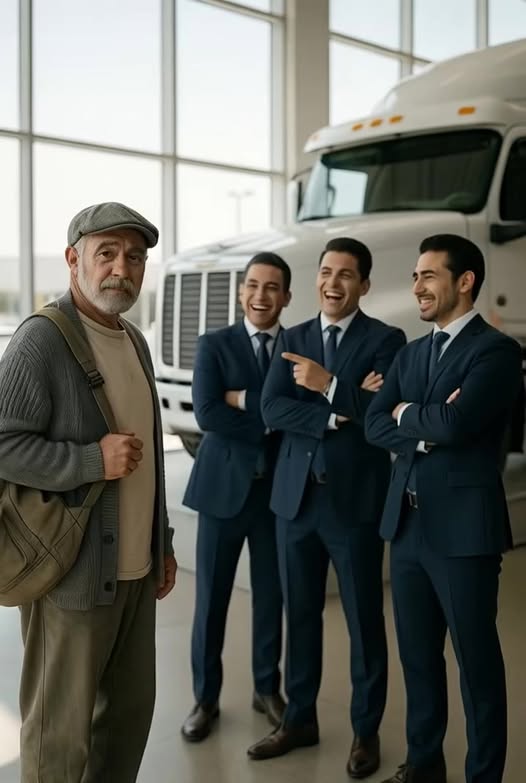
“I’m going to take five Mercedes trucks,” said the ragged man. Everyone laughed. A huge mistake at that precise moment, as Lucas Ferrer burst out laughing so loudly that it made everyone in the dealership turn around. None of the three salesmen imagined that this humble-looking old man was about to close the biggest sale of the month without even blinking.
Don Félix Navarro, 66, with his worn jacket and that old backpack hanging from his shoulder, had something in his wallet that these three would never have expected. And what would happen in the next 30 minutes would prove that judging by appearances can be very costly. The Mercedes truck dealership gleamed like a hangar of metal and glass.
White, blue, and silver tractor-trailers lined up like sleeping giants under powerful halogen lights. The smell of fresh paint and new oil wafted through. The air. It was a place where hundreds of thousands of dollars in deals were closed, where businessmen arrived in luxury cars to expand their fleets. And there was Don Félix with his dusty boots and disheveled gray hair, walking slowly among those imposing machines. Lucas was the first to see him enter.
He exchanged a mocking glance with Héctor Beltrán, the 45-year-old senior salesman who was reviewing papers at his desk. Héctor raised an eyebrow and gave a crooked smile. They both knew that kind of visitor: curious, dreamy, people who came in just to look at things they could never buy.
Javier Peña, the sales manager, was adjusting his Italian tie in front of the bathroom mirror when he heard slow footsteps in the showroom. He came out drying his hands with a paper towel. His trained eyes scanned the newcomer in two seconds. Worn clothes, slumped posture, threadbare backpack. Immediate conclusion: wasted time. Don Félix stopped in front of a white Actros. Shiny. He ran his calloused hand over the chrome fender.
His calm eyes scanned the cab, the new tires, the silver star logo. He’d driven trucks like that for 40 years. He knew every screw, every valve, every secret of those engines. But the three men watching from afar knew nothing of that; they only saw appearances…….
Don Félix leaned in, studying the wheel hubs like a man reading a familiar language. He crouched slowly—knees creaking but steady—then traced a finger along the edge of the tire as if searching for a story in the rubber. He stood again and looked toward the roofline, the mirrors, the steps leading up to the cab. His gaze didn’t sparkle the way a tourist’s would. It was practical. Measuring. Evaluating.
From the desk area, Lucas whispered something that made Héctor snort. Javier, already bored, made a small shooing gesture with his hand, like a person dismissing a fly. But Don Félix didn’t move with the nervousness of someone who expected to be thrown out. He moved like a man who had spent a lifetime in places where machines ruled and men had to earn their respect.
He walked past the Actros, pausing in front of another unit—blue this time—with a slightly different configuration. He checked the chassis length, peered under the frame, and nodded once, as if confirming an internal calculation. Then he continued down the line until he reached the central aisle where, mounted on a glossy stand, sat a laminated price sheet and financing brochure.
That’s when Lucas decided to “help.”
“Hey,” Lucas called out, pushing himself away from the counter with a lazy swagger. He was young—late twenties—hair gelled, shirt tight at the shoulders, smile sharp. “Can I help you with something, sir?”
The word sir came out stretched and sweet, a little too sweet.
Don Félix turned slowly. Up close, his face showed more than age. It showed sun, wind, long nights, and the kind of exhaustion you don’t fix with a vacation. But his eyes were steady. “Yes,” he said. “I want five trucks. Mercedes. New. I want to close today.”
Lucas blinked once. Then he laughed again, louder than he meant to, like a cough he couldn’t swallow. “Five? Five of these?” He pointed grandly at the row as if presenting a museum exhibit. “They’re not toy trucks, you know. These are—these are for companies.”
“I know what they are,” Don Félix replied, and the quiet certainty in his tone stole some of Lucas’s laughter. “That’s why I’m here.”
Héctor finally stood up, sensing either a scene or a chance to humiliate someone in public. He sauntered over, his sales badge catching the light. “Lucas, don’t waste your time,” he said, not even bothering to lower his voice. Then he looked at Don Félix. “Sir, are you looking for… brochures? Maybe used inventory? We have a section outside with older models.”
Javier, the manager, approached with the practiced authority of a man who enjoyed the power of the word no. “Gentlemen,” he said, and his eyes landed on Don Félix’s boots as if they were muddy enough to ruin the floor, “we’re very busy today. If you’re here to browse, please do it quickly. If you’re here to buy—” He paused, letting the silence do the mocking for him. “—we can talk financing.”
Don Félix didn’t flinch. He didn’t defend himself. He simply reached into his worn jacket and pulled out a folded sheet of paper—creased, well-handled. He laid it on the nearest glossy table without ceremony.
It was a list. Not random. Specific.
“Five units,” Don Félix said, tapping the paper with one thick finger. “Two Actros 1851. Two Arocs, heavy duty. One eActros for city deliveries. With those configurations.” He looked at Héctor. “I want the extended warranty package. Fleet maintenance. Telematics. And I don’t want the base seats—my drivers spend twelve hours a day in the cab.”
Lucas’s grin faltered. It wasn’t the request that shook him. It was the precision.
Héctor’s eyebrows rose before he could stop them. Javier leaned in despite himself, eyes scanning the list. The handwriting was tidy but firm. Next to each model were specifications—axle configuration, horsepower range, gear ratios, recommended tire profiles. Someone who had merely “dreamed” wouldn’t know that. Someone who had been inside these machines would.
Javier cleared his throat. “You… you know our lineup.”
“I’ve driven worse and better,” Don Félix said. “But I want these.”
Lucas recovered first, a defensive laugh. “Okay, okay. Let’s say—hypothetically—you want five trucks. That’s still a… substantial amount. Do you have a company name?”
Don Félix nodded. “Navarro Logistics Cooperative.”
Héctor snorted. “Never heard of it.”
Don Félix didn’t react. “That’s not surprising. We started small. Mostly agricultural routes. We don’t put our name on billboards.”
Javier’s manager instincts kicked in. If there was even a one percent chance this was real, he didn’t want Lucas ruining it. “Let’s sit,” Javier said, forcing warmth into his tone. “We can discuss options.”
Don Félix didn’t sit. He stayed standing, like a man in a hurry. “No long talk,” he said. “I need the units reserved today. Delivery schedule matters. My routes are expanding next month.”
“Expanding?” Lucas echoed, half-mocking, half-curious now.
Don Félix looked at him. “Ports. Warehouses. New contracts. We move produce, medical supplies, and industrial parts. The country eats because trucks run. People forget that.”
There was a pause in which the showroom’s quiet became louder—the hum of halogen lights, the distant buzz of an air compressor, the faint clicking of a keyboard from an office behind glass. Javier shifted his weight, suddenly unsure.
“Look,” Javier said carefully, “five trucks is… not a casual purchase. Even with financing, we’d need documentation. Credit checks. Proof of business assets. Your cooperative’s—”
Don Félix reached into his backpack. The zipper rasped, loud in the silence. Lucas watched as if expecting a sandwich, a newspaper, something that would confirm his judgment.
Instead, Don Félix pulled out a thick envelope, worn at the edges, and placed it on the table beside the list. Then he took out a second envelope. Then a third.
Javier’s eyes narrowed. “What is this?”
“Documents,” Don Félix said simply. “And a cashier’s check.”
Héctor laughed once, sharp and disbelieving, but it died quickly when Don Félix slid the first envelope forward and Javier, almost against his will, opened it.
Inside were copies of contracts—some stamped, some signed. Fleet insurance papers. Business registration. And an award certificate from a regional logistics association. Javier’s expression shifted in tiny increments, like a curtain being pulled back.
The second envelope contained bank statements. Not just one month—several. The kind of balances that made a salesman’s throat dry. The third envelope held the cashier’s check.
Javier stared at it. Then he stared again, as if hoping the numbers would rearrange themselves into something smaller.
“Is this… for one unit?” Lucas asked, voice suddenly thin.
“No,” Don Félix said. “It’s a deposit for the five. The rest is wired. My accountant is waiting for your invoice.”
Héctor swallowed. His hands, which had been so confident, now hovered awkwardly at his sides. “This… this is—”
“This is business,” Don Félix cut in. Not harsh, but final. “And I don’t have time for laughter.”
Javier’s face changed completely. The tie, the posture, the superiority—all of it melted into urgent professionalism. “Mr. Navarro,” he said, and the word Mr. sounded almost apologetic, “I apologize for any misunderstanding. Please, come into my office. We’ll take care of everything immediately.”
Lucas opened his mouth, perhaps to offer a joke, perhaps to salvage his pride. But Don Félix’s eyes held him. Not angry. Just disappointed.
“Before we go,” Don Félix said, “I want to know something.”
Javier froze. “Of course.”
Don Félix pointed at Lucas. “If I had come in wearing a suit, would you have laughed?”
Lucas’s face flushed. “No, sir. I mean—”
“And you?” Don Félix asked Héctor. “You told him not to waste his time. Was that your idea of customer service?”
Héctor’s jaw tightened, but he tried to smile. “We… we get a lot of people who—”
“Who look like me,” Don Félix finished calmly.
No one answered.
Don Félix took his list, folded it once, and put it back in his pocket. “I’m not asking for pity,” he said. “I’m asking for respect. Because those trucks out there? They’re not trophies. They’re tools. And the people who drive them keep your shelves full.”
Javier nodded quickly. “You’re right. You’re absolutely right.” His voice was eager now—too eager. “Let’s step into my office. I’ll personally handle your order.”
They walked, and the shift in the showroom was immediate. Salespeople who had been half-asleep at their desks suddenly sat up straighter. A receptionist peeked around the corner. The laughter that had been floating earlier vanished, replaced by curiosity and a subtle panic—because in a dealership, everyone can smell a big sale like rain in the air.
Javier’s office was glass-walled and spotless. He offered Don Félix a chair, then hesitated, as if unsure whether his earlier attitude had disqualified him from offering anything at all. “Coffee?” he asked.
“Water is fine,” Don Félix said, sitting at last.
Javier practically sprinted to pour it.
As Javier began typing, Lucas hovered at the doorway, trying to look useful. Héctor stood behind him, arms crossed, face tight. The power in the room had shifted, and both men felt it.
“Delivery,” Don Félix said, leaning forward. “I want it written. Two units within three weeks. The rest within six. My drivers are training for the new routes.”
Javier nodded, fingers flying. “We can do that. We’ll check inventory and allocation. We can even expedite—”
“And the pricing,” Don Félix added, “should reflect a fleet purchase. I want the bulk discount. And I want the maintenance package included.”
Javier swallowed. “Of course. We’ll structure it in the best way.”
Don Félix’s gaze slid briefly to Lucas and Héctor. “And I want one more thing.”
Javier looked up. “Anything.”
Don Félix held up his calloused hands. “These hands have fixed engines at midnight in the rain. These hands have pulled men out of crushed cabs. They’ve signed paychecks too—more than you’d think.” He paused, letting the words settle. “So here’s what I want: whoever laughed at me will not be my account manager.”
Lucas’s mouth opened. Héctor’s face went pale.
Javier recovered fast. “Absolutely. I will assign our top fleet specialist.”
“No,” Don Félix said, and his voice was still calm, which made it harder to argue with. “I want the youngest one.”
“The youngest?” Javier repeated, confused.
Don Félix nodded toward a desk visible through the glass wall. A young woman sat there, early twenties maybe, hair pulled back, focused on her screen. She had looked up once when the laughter happened, and her expression had tightened—not amused, not mocking, just uncomfortable. Now she pretended to work, but her shoulders were tense.
“Hernández,” Javier murmured under his breath. “She’s new.”
“She didn’t laugh,” Don Félix said. “And she looked like she wanted to apologize. That’s the person I trust.”
Javier hesitated, then forced a smile. “Of course. Sofía will be honored.”
He pressed an intercom button. “Sofía? Can you come in a moment?”
The young woman looked startled, then stood and walked to the office with careful steps. When she entered, she glanced at Lucas and Héctor and understood instantly that something had happened. She turned to Don Félix with polite uncertainty. “Yes, Mr. Peña?”
Javier cleared his throat. “Sofía, this is Mr. Navarro. He’s purchasing a fleet order. Five units. You’ll be handling his account.”
Sofía’s eyes widened. “Five…?” Her gaze flicked to Don Félix and then to the paperwork on the desk. She saw the check. Her expression shifted from surprise to immediate professionalism. “Yes, sir. Thank you. Mr. Navarro, it’s a pleasure.”
Don Félix nodded. “Likewise.”
Sofía sat, took a pen, and began asking the right questions. Not the questions that assumed he couldn’t pay, not the questions that tested him, but the questions that served the order: preferred delivery location, driver training schedules, telematics configuration, service bay requirements. Don Félix answered smoothly, like a man who had rehearsed this in his head for months.
Lucas stood in the doorway, shrinking with every minute. Héctor’s arms were still crossed, but now it looked less like confidence and more like protection.
When the invoice was ready, Javier turned the monitor toward Don Félix. “If this looks correct, we can finalize the deposit now.”
Don Félix scanned it, eyes moving quickly. “Change that,” he said, pointing. “The Arocs need the heavier suspension package. We’re hauling loads that will punish the standard setup.”
Sofía nodded immediately. “Understood.” She clicked and adjusted without complaint, without ego.
Javier watched her, then looked at Don Félix with a tight smile. “You know exactly what you need.”
“I know what keeps a truck alive,” Don Félix said.
The final numbers were printed. Don Félix signed once, then handed over the cashier’s check with the same calm he had used to touch the chrome fender. Sofía placed it carefully in a folder like it was fragile.
Javier extended his hand. “Mr. Navarro, thank you. This will be… one of our largest fleet orders this quarter.”
Don Félix shook his hand. The grip was firm, the kind of grip that came from lifting more than paper. “It will be the largest,” he corrected softly, “if you don’t lose the next one the way you almost lost this.”
Javier’s smile faltered. “The next one?”
Don Félix turned his head slightly toward the showroom, where the trucks stood like silent judges. “I have a partner cooperative,” he said. “They’re watching how I’m treated. They asked me to come first. To test.”
Lucas’s face drained of color.
Héctor’s eyes widened. “Test…?”
Don Félix nodded. “They’re good people. Hardworking. But they don’t like disrespect. They told me: ‘Go in the way you normally look. See what happens.’” He lifted his shoulders, letting the old jacket speak for itself. “I’m glad Sofía was here. Because without her—without at least one person showing basic decency—I would have walked out.”
Javier’s throat bobbed. “I assure you, Mr. Navarro, we value every customer—”
Don Félix raised a hand. “Save it. Learn it.” He looked at Lucas. “When you laughed, you didn’t just laugh at me. You laughed at every driver who walks in here after a twelve-hour run. You laughed at people who keep this whole business moving.”
Lucas swallowed hard. “I’m sorry,” he managed.
Héctor’s mouth opened, closed. “We— I—”
Don Félix didn’t press further. He wasn’t there for revenge. He was there for work. But the lesson had already landed, heavy as a loaded trailer.
He picked up his backpack, slung it over his shoulder, and nodded once to Sofía. “You did well.”
“Thank you,” Sofía said, and her voice was sincere.
Don Félix walked back through the showroom, past the Actros he had first touched. This time, no one laughed. Heads turned, yes—but with a different expression: respect, curiosity, a little fear of having been wrong.
At the entrance, he paused and looked back one last time.
“Javier,” he called.
“Yes?” Javier replied instantly.
Don Félix pointed to the row of gleaming trucks. “Keep them clean,” he said. “They’re beautiful. But remember: beauty doesn’t move freight. People do.”
Then he pushed open the glass doors and stepped out into the sunlight, boots still dusty, jacket still worn, backpack still old—yet carrying the weight of a deal that none of them would forget.
Inside, Lucas stood frozen, staring at the closed doors as if they had slammed on his pride. Héctor’s face tightened with a realization that hurt more than losing commission: that he had revealed exactly who he was in the first ten seconds.
And at her desk, Sofía sat straighter, fingers hovering over her keyboard, feeling something rare in sales—something that wasn’t just money.
It was the quiet reward of being the only one in the room who had seen a man before she saw his clothes.