I found the policy because I was looking for our tax forms.
That’s the part that still makes me feel sick—how ordinary it was. I wasn’t snooping. I wasn’t suspicious. I was doing normal life while my husband was doing something else.
The folder was labeled Insurance in neat handwriting that wasn’t mine.
Inside were the usual things—car, home, health.
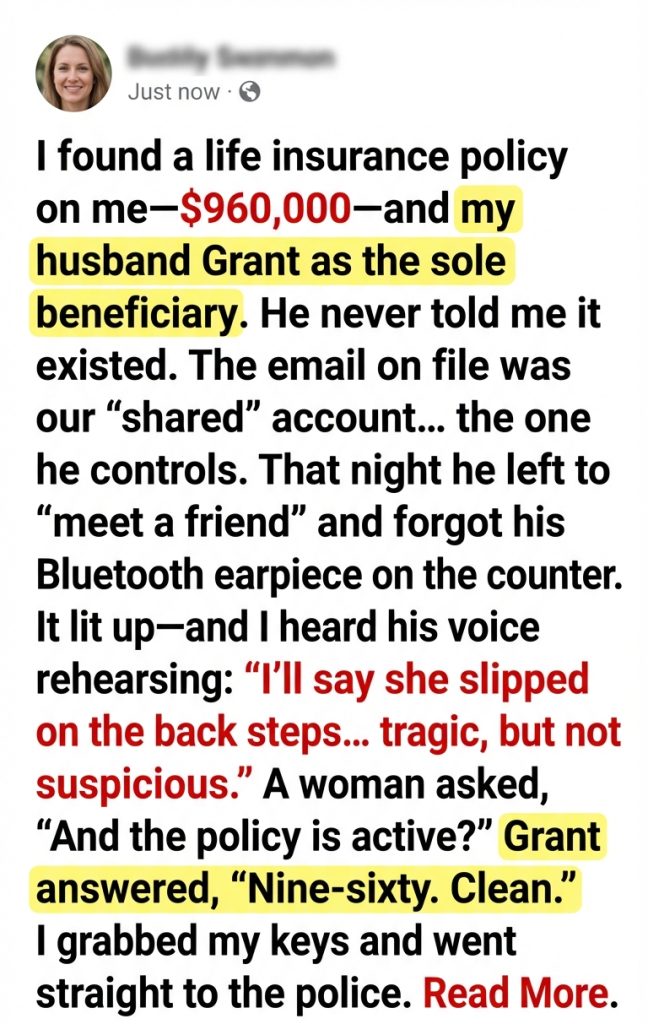
And then a life insurance policy with my name at the top.
Insured: Mariah Ellison
Benefit Amount: $960,000
Owner: Grant Ellison
Primary Beneficiary: Grant Ellison
My throat went dry.
Grant had never mentioned a policy on me. Not once. We’d talked loosely about “getting around to it,” like adults do with unpleasant topics, but we never finalized anything.
I sat down at the dining table and read the issue date.
It was from nine months ago.
Nine months.
I tried to breathe. I tried to make it normal. Maybe he did it as a responsible thing, a caring thing, a loving thing he wanted to surprise me with.
Then I saw the underwriting section.
Accelerated process. No medical exam required.
Policy initiated online.
And under delivery:
Documents delivered electronically.
I felt a strange coldness travel up my arms.
Grant’s phone buzzed in the kitchen. He was in the shower, water running, humming the way he always did when he thought life was fine.
I didn’t touch his phone. Not yet.
I took a picture of the policy. Then another. Then I emailed it to myself.
Because something in me—some quiet survival instinct—was awake now.
When Grant came out, towel around his waist, he kissed my forehead like always.
“Hey,” he said. “You okay? You look pale.”
I forced a small smile. “Just tired.”
He nodded, unconcerned, and went to make coffee.
I watched him move around our kitchen and wondered how a person can look so normal while hiding something that big.
That afternoon, I called the insurance company. I kept my voice calm, the way you do when you’re afraid the wrong tone will trigger alarms.
“Hi,” I said. “I have a question about a policy in my name.”
The representative asked for verification, then pulled it up.
“Yes,” she said. “Policy is active.”
“Did I sign for this?” I asked, voice steady.
“There’s an electronic signature on file,” she said.
My stomach dropped. “Can you confirm the email used?”
She read it out.
It was our “shared” household email—an address Grant controlled, the one he insisted on managing “because he’s better with bills.”
I felt cold. “And the beneficiary is my husband.”
“Yes,” she said.
I swallowed. “Can you tell me who initiated the application?”
She hesitated—likely not supposed to say—then said carefully, “The owner of the policy.”
Grant.
I thanked her and hung up.
That evening, Grant said he needed to “run out” and meet a friend.
He left around 8:40 p.m., too late for anything practical.
I didn’t follow him. I didn’t confront him. I didn’t do anything dramatic.
I did what fear makes you do when you’re trying to stay alive:
I listened.
Grant forgot his Bluetooth earpiece on the kitchen counter. It was small, black, easy to miss.
When it lit up with a connection request, my heart started pounding so hard I could hear it in my ears.
I stared at it.
Then I heard his voice—faint, tinny—coming through it.
He was on a call.
I didn’t want to hear. I really didn’t.
But then I heard my name.
“…just say she was tired,” Grant murmured. “You know, she’d been working too much. And then the stairs—”
My stomach clenched.
“What stairs?” a woman’s voice asked.
Grant exhaled softly, like he was rehearsing lines. “The back steps. It’ll sound normal. People fall all the time. I’ll say I heard a thud and found her. It’ll be tragic. But it won’t look suspicious if I act shocked.”
I felt my entire body go cold.
The earpiece sat there glowing faintly, like a little window into a nightmare.
The woman’s voice again, low and intimate. “And the policy is active?”
Grant chuckled quietly. “Yes. Nine-sixty. Clean. I’m listed. It’s… finally going to fix everything.”
Fix everything.
I couldn’t breathe.
The woman said, “Just don’t get messy. You promised.”
Grant’s voice softened. “I won’t. I’ll be careful. I’ve thought it through.”
My hands were shaking so badly I had to grip the edge of the counter to stay upright.
I didn’t wait to hear more. I didn’t need more.
I grabbed my keys and left the house.
I drove to a police station with my throat tight and my heart hammering like it wanted out.
At the front desk, I said, “I need to report something, and I need it documented tonight.”
They brought me into a small room. I told the officer about the policy, about the call, about the rehearsing.
I didn’t use dramatic words. I didn’t accuse with emotion. I gave facts.
The officer’s face changed—professional focus sharpening into concern.
“Do you have proof?” he asked.
I nodded, hands trembling, and showed him the photos of the policy. I told him about the earpiece and that the call had happened through it. I admitted I didn’t record it, because I’d been frozen.
He didn’t scold me. He nodded as if he’d seen fear before. “You did the right thing coming in.”
They helped me take immediate steps: a safety plan, a temporary relocation, and instructions to preserve evidence.
I called my sister and told her I needed to stay with her. I didn’t explain everything over the phone. I just said, “Please. Right now.”
That night, I didn’t sleep. I watched the dark ceiling and replayed Grant’s calm voice describing my death like it was an inconvenience.
The next morning, I went back to the house with an officer to retrieve essentials—clothes, documents, medication. Grant wasn’t home. Which was a relief and a warning at the same time.
I collected the earpiece and put it into an evidence bag like it was poisonous.
Then I met with an attorney who specialized in protective orders and financial abuse. She moved fast—because when someone is planning harm, slowness becomes risk.
We filed for a restraining order.
We froze shared accounts.
We changed beneficiaries on my existing policies.
We notified the insurance company that the policy was contested and requested review for fraud/forgery.
Grant called me fifty times.
Text after text.
Where are you?
You’re scaring me.
Stop being dramatic.
Come home so we can talk.
I didn’t respond.
Because “talk” was no longer a safe word.
Two days later, the police informed me they’d contacted Grant. His story shifted—first he claimed the policy was a “surprise,” then he claimed he “forgot to mention it,” then he got angry and said I was “trying to ruin him.”
Ruin him.
The way he’d tried to ruin me.
The investigation took weeks, and I learned more than I ever wanted: Grant had debt. He had an affair. He had messages with the same woman from the call—messages that talked about “timelines” and “keeping it simple.”
Not detailed instructions. But enough to show intent.
Enough to show I wasn’t imagining things.
One night, months later, I sat in my sister’s guest room with a cup of tea I couldn’t taste and looked at the restraining order paperwork on my phone.
My hands were steady now.
I thought about the Mariah who had believed that love meant letting your husband handle the bills.
I thought about the Mariah who had trusted a shared email without thinking.
And I realized something brutally simple:
A person who loves you doesn’t practice your death like a speech.
They practice your safety.
The last time I saw Grant in person was in court. He looked smaller, angry, wounded—like he was the one betrayed.
He whispered as I passed, “You’re destroying everything.”
I didn’t look at him.
I only said, quietly, “You already did. I’m just surviving it.”