My grandmother’s last gift to me arrived in a plain envelope.
No glitter. No flowers. Just a heavy, official-looking check and a short letter from the estate attorney that said, Your grandmother wanted you to have a fresh start.
I held that check like it was fragile, like money could bruise if you gripped it too hard.
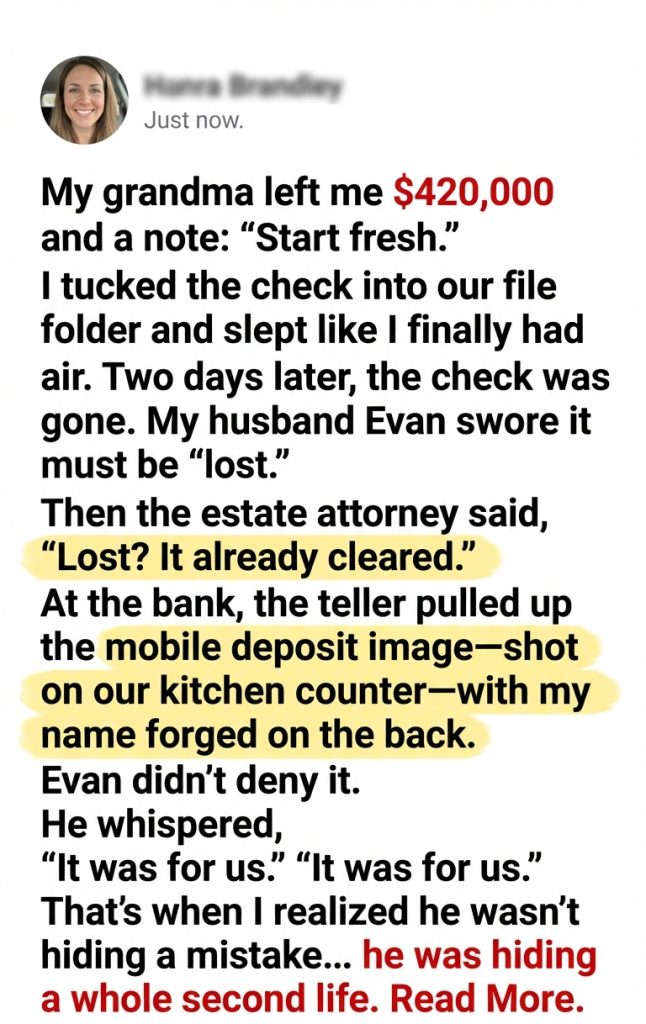
$420,000
Not lottery money. Not mansion money. But enough to change things. Enough to breathe.
I told my husband, Evan, immediately, because I believed marriage meant sharing good news the way you share bad.
He hugged me in the kitchen and said, “She loved you so much.”
Then he added, careful and warm, “We’ll be smart. We’ll plan.”
That night, I tucked the check into the folder where we kept important papers, and I slept like a person who thought her future had finally stopped being a fight.
The next morning, the folder was slightly out of place.
A small detail. The kind most people would miss.
But my grandmother raised me. She taught me the value of noticing small details, because small details are where truth likes to hide.
“Did you move the folder?” I asked Evan casually while he poured coffee.
He didn’t look up. “No.”
His voice was too smooth.
I shrugged it off anyway, because love has a way of talking you out of your instincts.
Two days later, I went to deposit the check.
The folder was there. The letter was there.
The check was not.
My stomach went cold in slow motion.
I tore through drawers. I checked the trash. I opened every cabinet like the check might have slipped into a place checks don’t go.
Nothing.
I stood in the hallway with my hands shaking and called Evan.
He answered on the second ring. “Hey, babe.”
“The check is gone,” I said.
There was a pause, then a sigh that sounded almost… staged. “What?”
“My inheritance check,” I repeated. “It’s gone.”
Evan’s tone turned concerned. “Are you sure you didn’t misplace it?”
I felt anger flare, quick and sharp. “I didn’t misplace $420,000.”
He made a sympathetic noise. “Okay. Okay. Maybe it got thrown out by accident. Maybe it slid behind—”
“It was in the folder,” I said, voice shaking now. “It’s gone.”
Evan’s voice softened. “I’ll come home early. We’ll figure it out.”
He came home with flowers.
Flowers.
Like the solution to missing money was petals.
He wrapped his arms around me and said, “We’ll call the attorney. We’ll request a reissue.”
Then he said, “It might take time.”
Time. Another soothing word.
When I called the estate attorney, she sounded surprised.
“A reissue?” she repeated. “Why would you need a reissue? The check was deposited.”
My blood turned to ice. “Deposited?”
“Yes,” she said gently. “It cleared yesterday.”
I couldn’t breathe.
“I didn’t deposit it,” I whispered.
There was a quiet pause on the line. Then: “Ma’am… are you okay?”
I hung up and turned slowly to Evan.
He was standing in the kitchen doorway, watching my face like he was reading a verdict.
“Evan,” I said, voice thin, “the check was deposited.”
His eyes widened, then narrowed. “What are you talking about?”
“It cleared yesterday,” I said. “So tell me where it went.”
Evan’s mouth opened. Closed. Opened again.
Then he did something that made the room feel colder.
He lied.
“That’s impossible,” he said. “Maybe the attorney’s confused.”
I stared at him. “No.”
Evan’s jaw tightened. “Don’t accuse me.”
I felt my heart thud in my throat. “I’m not accusing. I’m asking. Where is the money?”
Evan stepped forward, voice sharpening. “You’re being paranoid.”
Paranoid. The word people use when they want you to doubt yourself more than you doubt them.
I grabbed my keys and drove to our bank with my hands shaking so hard I had to grip the steering wheel with both palms.
The teller pulled up our accounts, frowned, and said, “I don’t see a deposit into your checking.”
My stomach dropped. “Then where did it go?”
She hesitated. “There was a mobile deposit… into a different account.”
“A different account?” I repeated.
She looked uncomfortable. “In your husband’s name.”
My vision tunneled. “Show me.”
She turned the monitor slightly—enough to let me see the deposit image: the check photographed from a kitchen counter.
Our kitchen counter.
The same scratch mark near the edge.
The same gray granite.
And there was the endorsement line on the back.
My name… written in a version of my handwriting that felt like a mockery.
Under it: Evan’s signature.
I felt like I was going to throw up.
I walked out of the bank and sat in my car, breathing like I’d just run from something.
Then I did the most important thing: I took a screenshot of the deposit image they emailed to me for records, and I sent it to myself in three places.
Because betrayal makes you smarter fast.
When I got home, Evan was sitting on the couch like a man waiting to be forgiven.
I held up my phone. “I saw the deposit image.”
Evan’s face drained. “Babe—”
“You forged my signature,” I said, voice steady now. “You stole from me.”
Evan’s eyes filled quickly, but his tears didn’t soften me anymore. Tears are easy. Theft is deliberate.
“It was for us,” he whispered.
“For us?” I repeated. “It went into your personal account.”
He looked down. “I panicked.”
“No,” I said. “You planned.”
Evan stood abruptly. “You don’t understand what was happening.”
“What was happening?” I demanded. “Tell me.”
He rubbed his face. “I owe money.”
My stomach dropped again. “How much?”
Evan whispered, “A lot.”
“Say it.”
He flinched. “Six figures.”
I stared at him. “So you solved your secret with my inheritance.”
Evan’s voice rose, desperate now. “If I didn’t pay, they were going to expose me. They were going to ruin us.”
“Ruin us?” I snapped. “You already did.”
He reached for me. I stepped back. “Who is ‘they’?”
Evan hesitated too long.
My skin prickled. “Who?”
He swallowed. “A woman.”
There it was.
Not just debt. Not just money.
A second life.
“She said she’d tell you,” he whispered. “She said she’d tell everyone.”
My chest tightened. “You cheated.”
Evan’s eyes filled again. “It was a mistake.”
“A mistake you paid off with my grandmother’s last gift,” I said, voice low and shaking with fury.
I didn’t scream. I didn’t throw anything. I did what I’d started doing the moment the truth cracked open: I protected myself.
I filed a police report for check fraud and forgery. I reported it to the bank as an unauthorized endorsement. I contacted the estate attorney and documented everything.
Evan begged. He promised he’d return it. He swore he’d fix it.
But the money was already moving—spent on debts I didn’t know, choices I didn’t make, lies I didn’t consent to.
The bank investigation took time, but the deposit image was undeniable. The signature logs, the device used, the IP address—everything pointed back to Evan.
And in that process, I learned an ugly truth about betrayal:
People who steal from you don’t just want your money.
They want your silence.
Evan tried to bargain for mine. “If you drop it,” he whispered one night, “we can start over.”
I looked at him, exhausted. “Start over with what? You spent my fresh start.”
In the end, I recovered part of the money through fraud claims and restitution orders. Not all. Never all. There are losses you carry even after courts decide you’re right.
But I gained something I didn’t realize I needed until I had it:
A life where my future wasn’t held hostage by someone else’s secrets.