The paper was already on the kitchen table when I came in, weighted down by our fruit bowl like it was just another bill.
“Babe,” Noah said, too cheerful, “I need your signature real quick. It’s nothing scary—just a formality.”
I was still in my work clothes, still half in the world outside, and I almost believed him. That’s the thing about marriage: you don’t expect a trap to be waiting beside the salt and pepper.
“What is it?” I asked, leaning over the page.
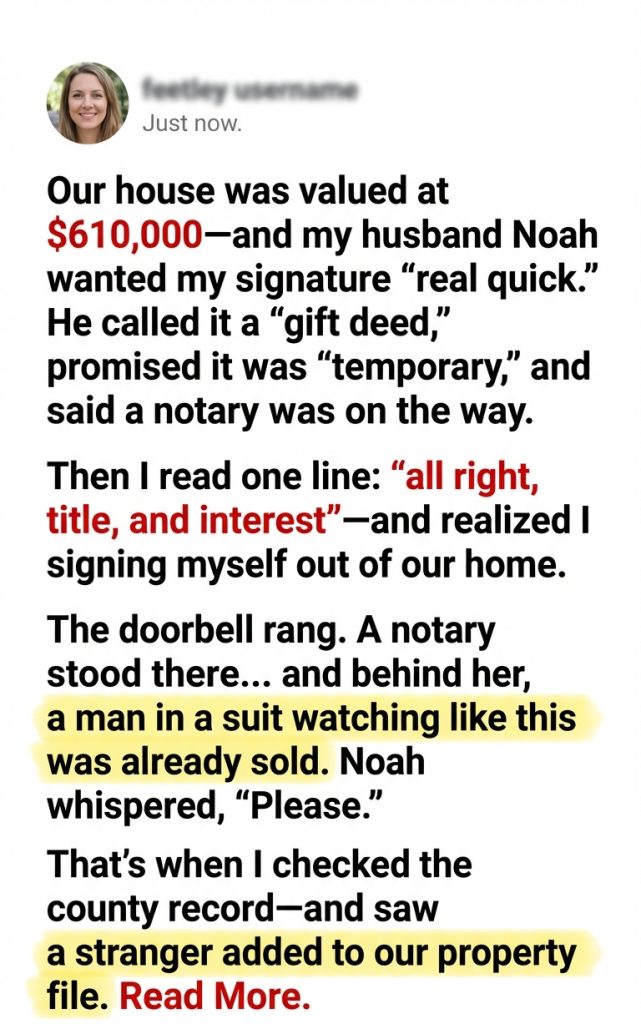
He slid it closer. “It’s for the house. The bank said we can lock a better rate if we clean up the title. It’s basically a gift deed. Super normal.”
The words gift deed didn’t register as danger until I saw the bold line near the bottom.
Property Value: $610,000
I blinked. “Why is the value listed like that?”
Noah waved a hand. “Standard. Paperwork loves numbers.”
He stood behind me, hands lightly on my shoulders, like he was guiding me into something safe. “Just sign and we’ll be done. I’ve been on the phone all day with this. I’m exhausted.”
I felt the familiar tug of guilt. Noah was always “handling” things. I did the day-to-day; he did the big stuff. That’s what we’d told ourselves. That division had felt like trust.
Until that moment.
I stared at the signature line. The page was full of dense text, all legal language that made your eyes slide off it.
“Who’s the notary?” I asked.
Noah pointed toward the living room. “She’s coming by in twenty minutes.”
“She?” I repeated.
He smiled. “Yeah. It’s a mobile notary. Saves time.”
My stomach tightened—small, quiet alarm bells. “Why does a notary need to come to our house for a refinance?”
Noah’s smile held, but it thinned. “Because that’s how it works. Don’t overthink it.”
Don’t overthink it. The phrase people use when they want your compliance more than your understanding.
I flipped the page.
And there it was: a line that made my blood go cold.
Grantor hereby conveys all right, title, and interest…
Conveys.
All right, title, and interest.
I turned toward Noah. “This isn’t a refinance form.”
His eyes widened slightly, then narrowed. “You’re misreading it.”
“Noah,” I said slowly, “this looks like I’m transferring my ownership.”
He laughed once, the kind of laugh meant to make you feel silly. “That’s not what it means. It’s just wording.”
I stood straighter. “To who?”
He hesitated. Just a beat. Then he said, “To me. Temporarily. So the bank can process it cleaner.”
I felt my throat go dry. “Temporarily?”
He nodded quickly. “Then we add you back. It’s… administrative.”
Something hard and clear formed in my chest. I didn’t know the exact law, but I knew one truth: you don’t sign away your home because someone tells you they’ll give it back later.
I pushed the papers away. “I’m not signing this.”
Noah’s face changed. The warmth dropped off him like a mask slipping.
“Are you serious?” he snapped. “After everything I’ve done to keep this place afloat?”
That word—afloat—hit me. Our mortgage had never been a problem. Our payments were automatic. Our finances were steady.
So why was he suddenly acting like the house was a sinking ship?
“I want the bank’s email,” I said. “And the lender’s name. I want to verify.”
Noah’s jaw tightened. “You don’t trust me?”
I looked at him for a long moment. “Trust isn’t blind. It’s earned.”
He stared back, angry now, because anger is what people use when persuasion fails.
“This is why nothing gets done,” he said bitterly. “You always complicate things.”
“No,” I said, voice calm. “I’m preventing you from doing something permanent.”
He stepped closer. “You’re embarrassing me. The notary is coming.”
“Then she can turn around,” I replied.
Noah’s eyes flashed. “You’re making a huge mistake.”
I didn’t argue. I walked past him and grabbed my laptop.
I logged into our county recorder’s website—the public record search I’d never used before because I’d never needed to.
I typed our address.
The results loaded.
And my breath caught.
There were recent filings I didn’t recognize—documents submitted within the last two weeks. A preliminary notice. A title request. A new “authorized party” attached to our property file.
My hands trembled as I clicked the details.
The authorized party wasn’t Noah.
It was a name I’d never seen.
Daphne L. Mercer.
I turned to Noah, heart hammering. “Who is Daphne Mercer?”
His face went pale so fast it looked like his blood drained out.
He opened his mouth. Closed it. Opened it again.
“It’s… a title person,” he said weakly.
I stared at him. “A title person needs to be authorized on our property record?”
He swallowed. “It’s normal—”
I cut him off. “Noah. Who is she?”
The doorbell rang.
Once. Calm.
Then again.
Noah flinched.
I walked to the door, looked through the peephole, and saw a woman in a smart blazer holding a folder and a notary stamp bag. She looked professional, pleasant, like she’d been trained to smile at nervous homeowners.
But behind her, down the walkway, I saw a second figure standing near the curb—leaning against a car like he had time.
A man in a suit, watching the house.
Watching me.
I opened the door just enough to speak. “Hi.”
“Hello!” the woman chirped. “I’m Melissa, the mobile notary. We’re here for the signing.”
“We?” I echoed.
She gestured toward the suited man. “Oh—he’s with the title company. Just observing. Standard.”
My skin prickled. “What title company?”
Melissa blinked, surprised by the question. “Mercer Title Services.”
Mercer.
Daphne Mercer.
I turned my head slightly and looked back at Noah. His expression wasn’t confusion. It was resignation.
He knew exactly who they were.
I opened the door wider and stepped outside, keeping my body between them and the doorway.
“Can I see the closing disclosure?” I asked.
Melissa smiled politely. “Of course.” She opened her folder and held out a packet.
I flipped quickly until I found the key line.
New Vesting: Noah Trent Carter, a married man as his sole and separate property.
Sole.
Separate.
Not community. Not joint. Not with spouse.
I felt the world sharpen into a single point.
“You’re removing me,” I said, staring at the page.
Melissa’s smile faltered. “Ma’am, I’m just here to notarize.”
I looked at the suited man. “And you’re here to watch me sign away my house.”
He gave a small, practiced smile. “We’re here to complete a transaction.”
I turned back to Noah through the doorway. “You were going to steal my half.”
Noah’s voice came out rough. “I wasn’t stealing. I was protecting us.”
“From what?” I demanded.
He stepped toward the door, eyes desperate. “From losing it.”
I laughed once, disbelieving. “We’re not losing it.”
His face twisted. “We would have.”
That sentence landed like a confession.
I looked at the suited man again. “Why would my husband need to transfer my rights to ‘protect’ us?”
The man’s smile stayed, but his eyes narrowed. “Ma’am, if you’re refusing to sign, we’ll note that and reschedule.”
“Reschedule?” I repeated. “So you can pressure me again?”
Melissa shifted uncomfortably. “Let’s all take a breath—”
“No,” I said, voice steady. “I’m done breathing around this.”
I pulled out my phone and called my friend Serena—an attorney who’d helped her sister through a divorce years ago.
Serena answered and I said, “I have a mobile notary at my door for a deed transfer that removes me from my house. My husband arranged it. What do I do?”
Serena’s voice went sharp. “Do not sign. Tell them to leave. Then change your passwords and put a fraud alert on your title immediately. I’ll text you the steps.”
My knees felt weak, but my voice didn’t. “You heard her,” I told the notary and the suited man. “You need to leave.”
The suited man’s smile hardened. “We can’t discuss legal advice with you.”
“I’m not asking you to,” I said. “I’m ordering you off my property.”
Melissa looked relieved, like she’d been hoping I’d cancel. “Okay,” she said quickly. “We’ll document refusal.”
They walked away.
I closed the door and turned to Noah.
His shoulders slumped, and he looked suddenly smaller—less like a husband, more like a man who’d gambled and lost.
“How long?” I asked quietly.
Noah’s eyes filled. “It’s not what you think.”
I held up a hand. “Don’t. Just tell me how long you’ve been planning this.”
He sat at the table heavily. “A month.”
“A month,” I repeated, feeling sick. “A month you kissed me goodbye every morning while you set up paperwork to erase me.”
Noah rubbed his face. “I got in trouble.”
“What kind of trouble?”
He hesitated, then whispered, “Debt. Big debt.”
My stomach dropped. “How big?”
He swallowed. “Enough that if I defaulted, they could attach liens. I thought if I put the house in my separate property… they couldn’t touch it.”
I stared at him. “So you tried to protect yourself by taking my legal rights.”
“I was protecting us,” he insisted, voice cracking.
“Noah,” I said, voice low, “you weren’t protecting me. You were using me.”
His tears fell. “I didn’t want you to hate me.”
I felt something in me go still. “You didn’t mind if I lost my home. You just didn’t want to lose my approval.”
Serena’s text came in with a list of instructions. I followed them like a lifeline: I filed a property fraud alert with the county, placed a title lock, and contacted our lender directly.
When I called the bank, the representative sounded confused.
“Ma’am,” she said, “we have no refinance application on file from you.”
I closed my eyes. “Then he lied.”
She hesitated. “If you believe there’s attempted fraud, we recommend you file a police report.”
I did.
Noah watched me from the couch, devastated, as if he hadn’t created the exact situation he feared.
Over the next week, the truth unfolded. The “deed transfer” wasn’t for a refinance. It was for a private sale.
Noah had planned to list the house quietly, sell it quickly, pay his debts, and present me with the aftermath like it was unavoidable.
And Daphne Mercer?
She wasn’t a title person. She was the woman Noah had been seeing.
The one who stood near the curb while I almost signed myself into homelessness.
When Noah finally admitted it, the words fell out like stones. “She said it was the only way.”
I looked at him and realized the betrayal wasn’t just sexual or financial.
It was strategic.
He’d tried to move pieces around me like I wasn’t a person, only a name on a document.
In the end, the house stayed mine—because paper trails don’t lie the way people do. I protected my title. I protected my credit. I protected my future.
And when I walked into the kitchen weeks later and saw that empty spot on the table where the “gift deed” had been, I understood something I wish I’d learned sooner:
If someone needs you to sign fast, without reading, without questions…
It’s not a favor.
It’s a theft with polite packaging.