When my mother died, the house became a kind of ache you could walk through.
Every room held her—her lemon cleaner, her stitched pillows, the tiny dents in the hallway wall where she’d bumped furniture over the years. Selling it felt like tearing off a bandage that had fused with skin.
But I needed to. The estate was simple, and the house was the biggest asset. I planned to use the money to pay off debt, start a college fund for my niece, and finally breathe.
My husband, Callum, said all the right things during the process.
“I’ll handle the paperwork,” he said gently. “You’re grieving. Let me take this.”
I let him. Because grief makes you tired. And marriage is supposed to mean you can hand someone the heavy things and trust they won’t drop them.
The closing day was bright and clinical. A conference room. A notary. A stack of documents. Callum sat beside me, hand on my knee, rubbing slow circles like he was anchoring me.
When the title officer said, “Wire instructions are confirmed,” I nodded, barely listening through the fog of loss.
I signed. I initialed. I signed again.
At the end, the officer smiled. “Funds will be wired today. You’ll see it within a few hours.”
Callum squeezed my hand. “We did it,” he whispered.
I went home and waited.
Two hours. Nothing.
Three hours. Nothing.
By late afternoon, my stomach had twisted itself into a knot.
I called the title company. “Hi,” I said, trying to sound calm. “I’m checking on the wire.”
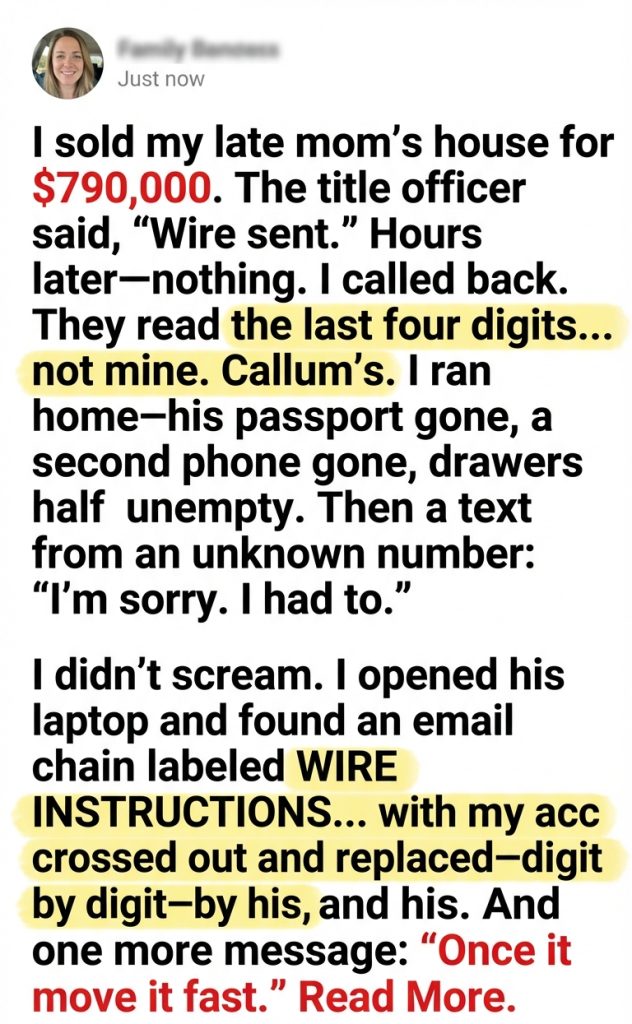
The representative clicked keys. “Yes, it was sent. Completed at 1:26 p.m.”
My throat tightened. “To my account?”
There was a pause. “To the account on file.”
I stared at the wall. “Can you read the last four digits?”
She did.
They weren’t mine.
My blood turned to ice. “That’s not my account.”
A longer pause now—the kind that signals danger. “Ma’am, those were the wire instructions provided. They were confirmed in writing.”
My mouth went dry. “Confirmed by who?”
The representative hesitated. “By the authorized contact listed in the file… Callum Price.”
I couldn’t breathe for a second.
I hung up and called Callum.
No answer.
I called again.
No answer.
I walked into our bedroom and opened his drawer. It was half-empty. His passport—gone. His second phone—gone. The small black duffel he used for weekend trips—gone.
My hands started shaking so hard I couldn’t unlock my own phone.
Then a text arrived.
From an unknown number.
I’m sorry. I had to. Don’t look for me.
The world tilted.
I slid down the wall and sat on the floor, staring at that message until the letters blurred.
I called the title company back, voice shaking. “I need an emergency recall on the wire.”
They moved quickly—because once money is gone, it becomes smoke. They contacted the bank. They requested a recall. They asked me for police involvement.
I filed the report. I told the officer everything: the closing, the wire, the missing husband, the text.
The officer’s expression shifted into something careful and grim. “Do you have any proof he altered the wire instructions?”
Proof. The word felt like salt in a wound. I’d trusted him so completely I hadn’t thought to collect evidence.
Then I remembered something small: Callum’s laptop, still on the desk. He’d rushed out. He’d left it behind.
I opened it with trembling hands.
Password-protected.
But Callum had always used the same password pattern: my birthday, then a symbol, then his first initial. He’d never been creative.
It worked.
My stomach clenched as the screen loaded.
I searched his email for “wire instructions.” A thread popped up with the title company—documents attached, including the wire form.
I opened the attachment.
My name at the top.
My account details… crossed out.
And replaced—digit by digit—with another account number.
Callum’s handwriting.
I took photos with my phone, then screenshots, then forwarded everything to myself.
Then I saw another email, sent late at night, from an address I didn’t recognize.
Did you do it?
Once the wire hits, don’t hesitate. Move it immediately.
My skin prickled. It wasn’t just Callum. Someone had coached him.
I dug deeper and found the ugly backbone of his secret life: gambling account confirmations, wire transfers labeled “settlement,” hotel receipts, and a sequence of messages that made my mouth go dry:
I can’t tell her. She’d leave.
Better she hates you later than you’re broke now.
Just take it.
Take it.
As if my mother’s house—her entire life—was a snack on a plate.
By midnight, my grief had transformed into a hard, clean focus.
I called an attorney who specialized in fraud and emergency injunctions. I didn’t cry on the phone. I spoke in facts.
She listened, then said, “We move fast. We file to freeze assets. We notify banks. We notify the receiving institution. We request an emergency hold if the funds are still in transit or newly deposited.”
“Can we get it back?” I asked, voice thin.
“We can try,” she said. “Time matters.”
The next 48 hours were a blur of forms and phone calls and sleeplessness. The banks confirmed the wire had landed, then moved again—split into smaller transfers, like someone scattering money to make it harder to catch.
But not all of it moved.
Because thieves are rarely as careful as they think.
A portion—large enough to matter—was still sitting in an account flagged by the recall request.
The bank froze it pending investigation.
When my attorney told me, “We have a hold on $310,000,” I gripped the edge of my table so hard my knuckles hurt.
Not all. But something.
Callum’s family called me like I was the criminal.
His mother sobbed and said, “He would never do this.”
His brother snapped, “You must’ve pushed him.”
I didn’t argue. I didn’t defend myself.
I simply said, “He took my mother’s house money and disappeared.”
Silence followed—because even denial has limits when numbers are that blunt.
Weeks passed. Investigators traced IP addresses. The title company filed its own reports. The receiving bank complied with subpoenas. The person who coached Callum turned out to be someone he met in an online gambling group—another man drowning, teaching others how to drown differently.
Callum was found three months later in a small rental two states away. Not glamorous. Not thriving. Just hiding. The kind of hiding that looks like a man sitting in a dark room with the TV on, pretending the noise can keep guilt out.
When the police called me to confirm they’d located him, my first feeling wasn’t triumph.
It was a deep, aching sadness—because I realized the man I married had chosen the worst possible version of survival: one that required destroying me.
The legal process was slow. Pieces of money were recovered. Some were gone forever, spent like gasoline poured on a fire. But enough came back that my mother’s life wasn’t fully stolen.
And when the divorce was finalized, the judge looked at Callum and said words I will never forget:
“You didn’t just steal money. You stole trust. That is harder to repay.”
After it was all over, I drove past my mother’s old street. The house belonged to someone else now. New curtains. New plants. New life.
I parked and sat there quietly, not to torture myself, but to say goodbye the right way.
In the end, I learned something painful and necessary:
Grief will soften you.
But you still have to protect yourself—because the wrong person will use your softness as a doorway.
And if your husband can take your mother’s legacy, reroute it with a pen, and disappear…
Then what you had wasn’t love.
It was access.