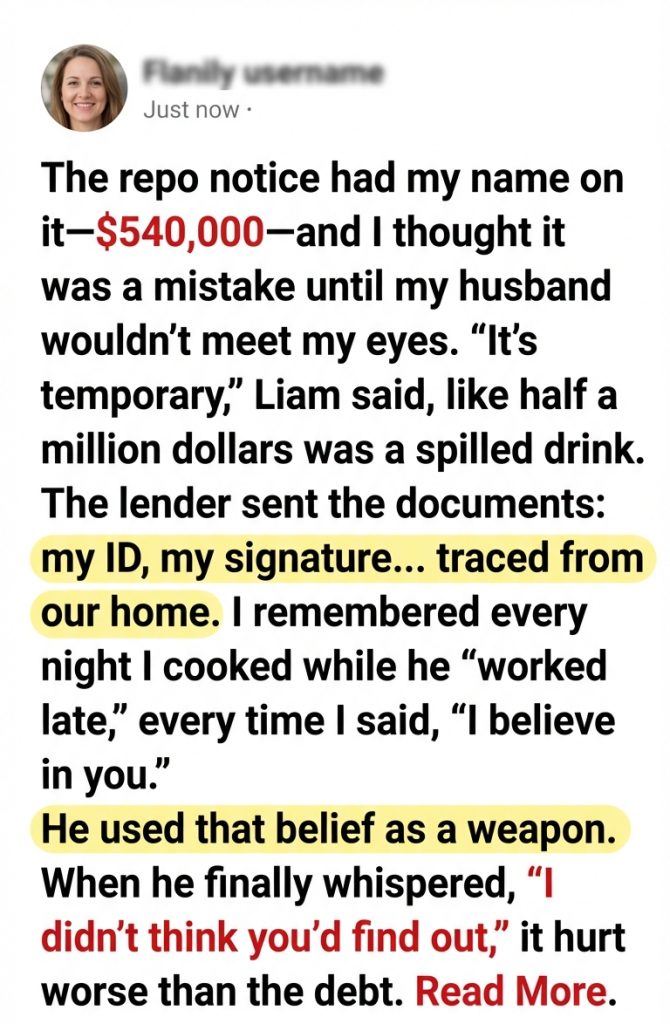
The repo notice came in a bright yellow envelope, like it wanted attention.
I thought it was a scam at first—one of those official-looking letters designed to scare you into calling a number. I nearly tossed it into the recycling bin without opening it.
Then I saw my name printed in thick black ink and the words FINAL NOTICE stamped across the top.
I opened it in the entryway, still wearing my coat, and felt my stomach turn.
Borrower: Naomi Park
Amount: $540,000
Collateral: Vehicle + Business Assets
Delinquency: 90 days
My hands went numb. I didn’t own a business. I didn’t have a $540,000 loan. I didn’t even know how a person gets a loan like that without signing a small forest of documents.
I read it again, slower.
There was a reference number, a lender name, and a sentence that made my throat go dry:
“Failure to remit payment will result in repossession.”
Repossession of what?
Then I remembered Liam’s new truck.
The black one he’d brought home six months ago, grinning like a kid. “Company vehicle,” he’d said. “Perks of growth.”
He’d kissed my cheek and added, “We’re finally leveling up.”
I’d believed him. I’d been proud of him. He’d started a contracting business two years earlier, and I’d watched him work late, stress, dream, hustle. I’d supported him in all the ways wives are taught to support—meals, encouragement, patience, the silent acceptance of living around someone else’s ambition.
Now my name was on a half-million-dollar debt.
I called Liam immediately.
He answered on the fourth ring, voice breezy. “Hey, babe.”
“What is this?” I asked, holding the notice like it might bite.
A pause. “What is what?”
“The loan,” I said. “The $540,000 loan in my name.”
Silence—thick, heavy.
Then Liam exhaled slowly. “Okay. Don’t panic.”
My voice went sharp. “I didn’t sign for anything.”
“I know,” he said quickly. “But it was just paperwork. A formality.”
“A formality?” I repeated. “A half million dollars is not a formality.”
He lowered his voice. “I’m at a job site. Can we talk later?”
“No,” I said. “We talk now.”
Liam sighed, annoyed now that I wouldn’t be managed. “I used your credit. Mine wasn’t strong enough. It was temporary.”
“Temporary,” I said, tasting the word. “Then why is it 90 days delinquent?”
He hesitated. “Cash flow got tight. A couple clients delayed payments.”
My hands shook. “So you hid it. You hid the loan, hid the delinquency, hid the risk, and put my name on it.”
“I was going to fix it,” he insisted. “I’m fixing it.”
“With what?” I asked. “Hope?”
Liam’s voice hardened. “Naomi, don’t do this. You’re making it worse.”
I felt something cold settle in my chest. “I’m making it worse?”
“You’re acting like I did it to hurt you,” he snapped.
“Then why did you do it behind my back?” I asked. “Why didn’t you ask?”
“Because you would’ve said no,” he admitted.
The truth landed clean and ugly: Liam didn’t want a partner. He wanted permission without asking.
I hung up.
Not dramatically. Just… decisively. Because I needed quiet to think.
I called the lender. I gave them the reference number. I asked them to confirm the borrower information.
The representative was polite, clinical. “Yes, Ms. Park. The loan was originated nine months ago. Documents were signed electronically.”
“I did not sign,” I said.
There was a brief pause, then a scripted tone shift. “If you believe there’s fraud, we can open a dispute. We’ll need a police report.”
I asked for copies of everything.
They emailed them within minutes: an application, an electronic signature audit, identity documents.
My driver’s license.
My social security number.
A signature that looked like mine if you didn’t know the way my hand curves on the last letter.
And a verification email sent to an address I recognized: the “shared” household account Liam had access to.
My chest tightened with a sick realization.
He hadn’t hacked anything.
He’d simply used marriage like a master key.
When Liam came home that evening, he tried to act normal—kissing my cheek, asking about dinner, talking about a job.
I didn’t respond.
I sat at the table with the printed documents stacked neatly in front of me.
He stopped mid-sentence when he saw them. “What’s that?”
“Sit,” I said.
He sat slowly, cautious. “Naomi, I told you. It’s temporary.”
I slid the delinquency statement toward him. “You’re 90 days behind.”
Liam’s jaw tightened. “It’s been a rough quarter.”
“And you didn’t tell me,” I said.
He leaned forward, eyes pleading. “I didn’t want to stress you.”
I laughed once, bitter. “You didn’t want me to stop you.”
He shook his head. “I’m building for us.”
“No,” I said quietly. “You’re gambling with me.”
Liam’s voice rose. “You don’t understand business.”
I looked at him calmly. “I understand consent.”
His eyes flashed with anger—then fear, when he realized anger wouldn’t work.
“Okay,” he said, softer. “We’ll fix it.”
“How?” I asked.
He hesitated. “I have someone helping.”
That word again. Someone.
“Who?” I asked.
Liam’s gaze darted away. “A consultant.”
“Name.”
He swallowed. “Drew.”
I watched his face carefully. “Is Drew the reason you’re behind?”
Liam flinched. “He’s trying to restructure—”
“Is Drew the reason you took the loan?” I pressed.
Liam’s silence answered louder than words.
I stood and walked to the bedroom, opened Liam’s desk drawer, and pulled out a folder I’d noticed but never touched.
Inside were invoices labeled Consulting Fee.
Amounts that made my stomach lurch: $7,500, $12,000, $15,000—every month.
I carried them back and dropped them on the table.
Liam’s face went pale. “You went through my stuff.”
“You went through my identity,” I replied.
He stared at the invoices, then whispered, “He said he could help me land bigger contracts.”
“Did he?” I asked.
Liam’s eyes filled. “He said we were close.”
I leaned closer. “Liam. Look at me. Is this business failing?”
He swallowed hard. “Not failing. Just… drowning.”
There it was.
And in that drowning, Liam had tied a rope around my waist and pulled me in with him.
That night, I called a lawyer. The next day, I filed a police report for identity fraud. Not because I wanted revenge—because I needed protection. I needed a paper trail that said I didn’t consent to being used.
Liam cried when he got served with the legal separation notice. “You’re abandoning me,” he said.
I looked at him, exhausted. “You abandoned me when you signed my name.”
The lender investigation took time. They reviewed IP logs, device fingerprints, electronic signature audits. The patterns were clear: the loan was signed from Liam’s phone, from our home Wi-Fi, using the email he could access.
When the lender finally called and said, “We’ve determined the signature was unauthorized,” my knees almost buckled with relief.
But relief didn’t erase the betrayal.
Liam tried to repair us with promises. He offered full transparency, counseling, a written apology.
Then he tried guilt. “If you leave, I lose everything.”
I stared at him. “You already tried to make me lose everything.”
In the end, the loan was reassigned to Liam and his business. The repo action moved toward him, not me. The truck got taken a week later—because reality collects what denial doesn’t pay.
And one evening, after the tow truck left and Liam stood in the driveway staring at the empty space like it was a grave, he looked at me and whispered, “I didn’t think you’d actually do it.”
“Do what?” I asked.
“Choose yourself,” he said.
I didn’t answer. I just walked back inside, closed the door, and felt my life grow quiet again—quiet enough to hear the truth clearly:
A husband who loves you doesn’t build his dreams by using your name as collateral.