The first sign wasn’t the missing money.
It was the way Miles said my name like he was smoothing a wrinkle.
“Lena,” he said, stepping into the kitchen with that careful voice, “don’t freak out. It’s just a bank issue.”
I was rinsing blueberries in a colander, half-listening, still in the soft haze of a normal Saturday. The word bank snapped me awake.
“What kind of issue?” I asked.
He set his phone on the counter face-down, like it had teeth. “A transfer didn’t go through right. The retirement account is showing… weird.”
My stomach tightened. “Weird how?”
Miles rubbed the back of his neck, the gesture he used when he wanted sympathy before facts. “It’s probably a glitch. I already called. They said it happens sometimes with—like—internal systems.”
I dried my hands slowly. “Show me.”
He hesitated. Just a beat. But I saw it. I’d been married long enough to recognize the micro-moments where truth decides whether to appear.
He flipped his phone over and opened an app. The screen loaded. The account overview popped up.
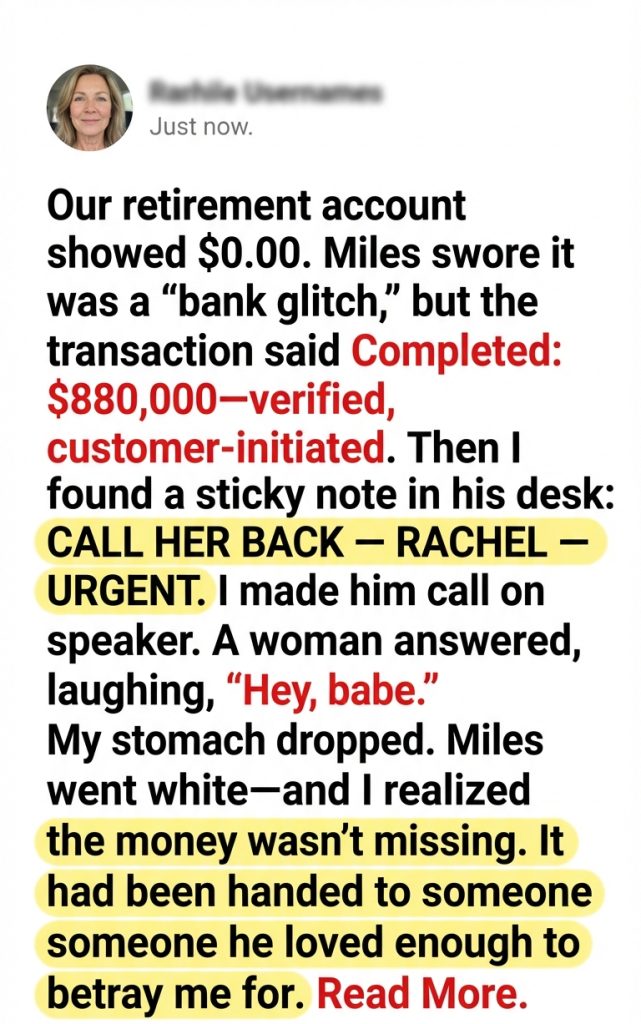
Balance: $0.00
I stared at it until my eyes burned. “Where’s the money?”
Miles’ voice softened, almost soothing. “That’s what I’m saying. It’s the bank. It’s—”
“How much was in there yesterday?” I asked, already knowing.
He swallowed. “Eight hundred eighty thousand.”
The number felt like a floor dropping away. Not because we were rich—because we were careful. That money wasn’t a luxury. It was fifteen years of discipline. Skipped vacations. Cheap cars. Sunday meal-prep. The kind of adulthood you do when you believe stability is possible if you do everything right.
I looked at Miles. “You’re telling me the bank lost $880,000.”
He nodded too quickly. “Temporarily. They’ll fix it.”
I walked past him to the dining table, opened my laptop, and logged in to the retirement portal myself. My hands were steady in the strange way hands get when shock takes over. The page loaded.
A transaction list. One line, neat and unforgiving:
Distribution — $880,000 — Completed.
My throat went dry. “Completed,” I whispered.
Miles’ jaw tightened. “That’s just how it shows before it reverses.”
I clicked the details.
A destination account number I didn’t recognize. A confirmation time stamp from three days ago. And a note under method:
Customer-initiated withdrawal — Verified.
Verified.
I turned the laptop toward him. “This isn’t a glitch.”
Miles’ eyes flicked across the screen like he was scanning for an exit. “Lena, listen—”
“No,” I said, voice flat. “You listen. That says customer-initiated. Verified. That means someone authorized it.”
He stepped closer, palms open. “I’m trying to fix it.”
“Fix what?” I asked. “Tell me what happened.”
Miles’ face twisted into the expression he used when he wanted to look like a victim of circumstances. “I did something stupid,” he said. “But it wasn’t like—what you’re thinking.”
I almost laughed. “What I’m thinking is you stole our retirement.”
He flinched hard. “I didn’t steal it.”
“Then where is it?”
His gaze dropped to the counter. “I moved it.”
“To where?” I pressed.
He took a breath, trembling. “A short-term thing. An opportunity. I was going to put it back.”
My chest felt tight, but my mind sharpened. “So you withdrew it. You transferred it. Without telling me.”
Miles’ voice cracked. “I didn’t want to worry you.”
I stared at him for a long second, and something in me chilled into clarity: he wasn’t sorry it happened. He was sorry I saw it.
I didn’t yell. I didn’t cry. I asked the question that matters.
“Who helped you do this?”
Miles blinked. “No one.”
The answer came too fast. Too clean.
I stood, walked into our bedroom, and opened the drawer where we kept important documents: passports, mortgage statements, the folder labeled RETIREMENT in my handwriting.
It was slightly out of place, as if someone had rushed it back.
I flipped through. At the back was a printed form I’d never seen—beneficiary update paperwork. And behind it, a page with a sticky note in Miles’ handwriting:
CALL HER BACK — RACHEL — URGENT
Rachel wasn’t his coworker. Rachel wasn’t his sister. Rachel wasn’t anyone I knew.
I carried the paper back into the kitchen and held it up.
Miles’ face drained.
“Who’s Rachel?” I asked.
His lips parted, then closed. “A financial consultant.”
“You don’t use consultants,” I said. “We have a planner. A real one. With a license. A contract.”
Miles’ eyes darted away. “She’s… private.”
Private. The word people use when they mean hidden.
I set the paper down gently. “Call her. On speaker.”
Miles shook his head. “No.”
I smiled once, cold. “Then I call the police.”
His shoulders collapsed. “Please don’t.”
“You already made a police-worthy choice,” I said. “Now you choose what happens next.”
Miles’ hands trembled as he picked up his phone. He scrolled. He hesitated. Then he hit call and put it on speaker.
It rang twice.
A woman answered with a bright voice that sounded like she was smiling. “Hey, babe.”
I felt something snap quiet inside me.
Miles froze. “Rach—”
Her tone shifted, still playful. “Did you fix it? Did you move it like I said?”
My heart thudded slow and heavy. I watched Miles’ face crumble.
“Who is this?” I asked calmly, leaning closer to the phone.
Silence. Then the woman’s voice sharpened. “Who’s that?”
Miles swallowed. “Lena—”
“Lena?” the woman repeated, and there it was—the quick inhale of someone realizing the lie they’re standing in. “Oh.”
The line went dead.
I didn’t move for a moment. I didn’t breathe. My body was strangely still, like it had stepped outside itself to observe.
Miles reached for me. “Lena, I can explain—”
I stepped back. “Don’t touch me.”
He looked like a man watching his own life burn, shocked by heat he started. “It wasn’t supposed to be like this.”
“It never is,” I said.
That night, while Miles sat on the couch staring at the wall, I did what I always did when panic tried to take my mind hostage: I made a list.
Call the retirement provider. Freeze transfers. File fraud alert. Contact attorney. Document everything. Screenshot everything.
Miles tried to follow me around the house like remorse could be proximity.
“Please,” he whispered. “I’ll get it back.”
I turned toward him, exhaustion sharpening my words. “Where is it?”
He hesitated, then said softly, “In an account under Rachel’s company.”
“Company,” I repeated. “Or her personal account?”
Miles flinched. “I don’t know.”
That answer landed like a second betrayal. He didn’t just risk our money—he did it with someone he couldn’t even verify.
The next morning, I called the retirement provider and asked for the fraud department. I spoke in a steady voice that didn’t match my shaking knees. I gave them the transaction ID. I told them the withdrawal was unauthorized by me and executed without spousal consent.
They asked me questions. Dates. Devices used. Verification methods.
When the representative said, “We have record of two-factor verification,” my stomach turned.
Miles had used our shared email and his phone. He hadn’t hacked the system. He’d simply used what marriage gave him: access.
I met with a lawyer that afternoon. She listened without interrupting, then said something that cut clean through my denial.
“This is financial abuse,” she told me. “Even if he planned to return it.”
I swallowed. “What can I do?”
“We document,” she said. “We freeze,” she said. “We file,” she said. “And we separate your financial life from his immediately.”
Miles called me twenty times that day. I didn’t answer. I wasn’t punishing him. I was protecting my mind from being softened by his voice.
That night, I came home early and found his jacket draped over a chair in the bedroom. I reached into the pocket—almost without thinking—and my fingers brushed metal.
A ring.
Not his wedding band. A second one. Thicker. Newer. Engraved on the inside with initials I didn’t recognize.
My stomach dropped.
It wasn’t just money.
It was a double life.
When Miles came home, I was sitting at the kitchen table with the ring in front of me, the way you lay evidence on a witness stand.
His face changed in the doorway. “Where did you—”
“Tell me the truth,” I said quietly. “All of it.”
Miles’ throat bobbed. He sat slowly, like a man preparing for impact.
“Rachel and I…” he started.
I held up a hand. “No romance speech. Facts.”
He blinked hard. “She works at a boutique investment office. We met at a conference. She told me I was wasting time with conservative planning. She said we could double it. Triple it. She said she’d help me ‘unlock’ our future.”
“And you believed her,” I said.
He nodded, tears forming. “I wanted to be… more. I wanted to be the guy who gives you everything.”
I stared at him. “You could’ve given me honesty.”
He shook his head. “Then you would’ve stopped me.”
“Yes,” I said. “Because I love us more than I love a fantasy.”
Miles’ voice dropped. “She told me to move it. She said she’d put it in a short-term vehicle and return it with profit. Then she started asking for more. For ‘fees.’ For ‘timing.’ And then…”
“And then you realized you’d been played,” I finished.
He nodded, devastated. “She won’t answer.”
I sat back, the weight of the truth settling into my bones. “So the $880,000 is gone.”
Miles whispered, “Not all of it. I think some is… held.”
“Think?” I repeated.
He looked at me, and I saw it clearly: the man in front of me wasn’t evil. He was weak. And weakness can do more damage than cruelty, because it hides behind excuses.
In the months that followed, the fight became legal and slow. There were investigations. There were subpoenas. There were letters that arrived in thick envelopes like bricks.
The retirement provider recovered a portion through a stop-payment action and a clawback process once we proved irregularities. Not all. Not enough to erase what happened. But enough to keep my future from becoming a crater.
Miles begged for reconciliation every step of the way. He offered counseling. He offered transparency. He offered tearful apologies like they were currency.
But I couldn’t unlearn what my body had learned: that trust isn’t a feeling. It’s a structure. And he’d smashed the foundation.
The last time we sat across from each other, in a mediator’s office that smelled like stale coffee, Miles whispered, “I didn’t mean to hurt you.”
I looked at him and felt something strangely calm.
“I believe you,” I said. “But you hurt me anyway. That’s the part you don’t get to undo.”
When I walked out, I didn’t feel triumphant. I felt free.
Not because I won money back.
Because I stopped living with a man who could gamble my life and call it love.