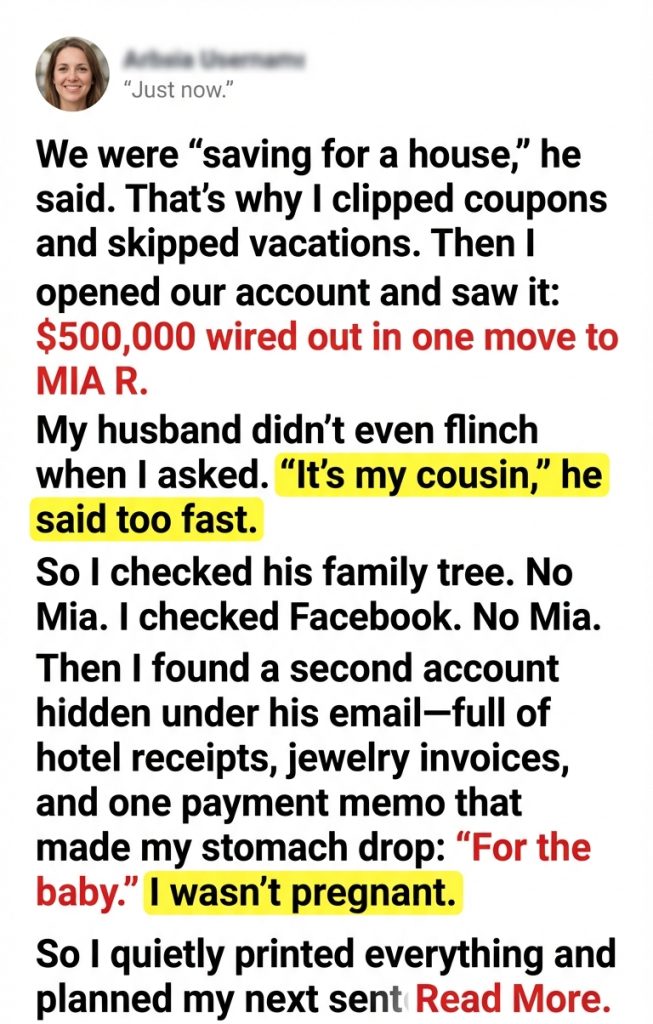
We were “saving for a house,” he said.
That was his favorite phrase—soft, responsible, comforting. It explained why we skipped vacations. Why we cooked at home. Why I stopped buying little things that made me happy because “we’re building something.”
I believed him.
Then on a random Tuesday night, I opened our joint account because the electricity bill didn’t look right.
The balance made my stomach drop.
I scrolled.
And saw it.
WIRE TRANSFER: $500,000 — MIA R.
For a full second, my brain refused to assign meaning to the words. It was like staring at a sentence in a language you don’t speak, even though every letter is familiar.
Half a million dollars.
Gone.
My hands went cold. I refreshed the app like refreshing could undo reality.
The entry stayed.
I walked into the living room where my husband, Nolan, was watching TV like the world was fine.
“Nolan,” I said, voice calm in a way that felt unnatural, “what is ‘Mia R’?”
He didn’t look away from the screen. “Huh?”
“The account,” I repeated. “The wire transfer. Five hundred thousand dollars.”
His eyes flicked toward me, and I watched him decide, in real time, whether to tell the truth.
“It’s my cousin,” he said too fast.
I blinked. “Your cousin.”
“Yeah,” he nodded, too quickly. “Mia. It’s—family stuff.”
I stared at him. “I’ve met your family.”
He swallowed. “She’s… on my dad’s side.”
“You don’t talk to your dad’s side,” I said.
Nolan’s jaw tightened. “Why are you interrogating me?”
Because I’m watching my life drain out of our account, I thought. But I kept my voice steady.
“If you can move half a million dollars without telling me,” I said, “I get to ask questions.”
Nolan stood up, defensive now. “It’s not your money alone.”
“It’s our money,” I corrected.
He rubbed his face. “She needed help.”
“Then why lie?” I asked.
Nolan’s eyes flashed. “I’m not lying.”
I didn’t argue. I simply did what liars hate:
I checked facts.
That night, while Nolan slept, I opened my laptop and searched through everything. I looked for “Mia” in emails, messages, contact lists, social media. I checked family photos. I checked old Christmas tags. I checked his mother’s Facebook, where she documented every birthday like she was running a museum.
There was no Mia.
No cousin.
No mention.
My stomach clenched.
I logged into Nolan’s email—something I’d never done before, not because I couldn’t, but because I believed marriage didn’t need surveillance.
I searched: “Mia.”
Nothing.
Then I searched: “wire.”
A few results.
One thread caught my eye, buried under spam-like subject lines.
The sender name was unfamiliar. The tone wasn’t.
Short. Urgent.
Do it now. Don’t discuss. Delete after.
I clicked, heart pounding.
The email contained bank details and a line that made my mouth go dry:
For the baby. Don’t mess this up.
I wasn’t pregnant.
I sat there in the dark, laptop glow on my hands, feeling something inside me go still.
There’s a moment when your reality breaks cleanly—like glass cracking—and you realize you’ve been living inside a story someone else wrote.
I didn’t confront Nolan immediately.
I waited.
I watched.
For three days, I acted normal. I cooked dinner. I asked about his day. I laughed at a joke I didn’t find funny. I kissed him goodnight with a mouth that felt like it belonged to someone else.
And I gathered evidence.
I took screenshots. I forwarded emails to myself. I photographed our bank transfers. I pulled our tax returns and noticed something I’d never paid attention to before: Nolan’s “contract work” income had spikes that didn’t align with his job.
Something else was happening.
On the fourth day, Nolan’s phone lit up while he was in the shower.
A message preview:
She still doesn’t know, right?
My hands shook as I picked up his phone. I didn’t open the message. I didn’t need to. I took a photo of the screen and put the phone down.
When Nolan came out, hair damp, relaxed, I looked at him and thought: How long can a person lie like this and still call it love?
That night, I asked one question, carefully chosen.
“Who’s the baby for?” I said softly.
Nolan froze.
“What?” he said, too loud.
“The baby,” I repeated. “You’ve mentioned it twice now. In emails. In transfers. Who is it for?”
His face drained. “You went through my email.”
“You went through our money,” I replied.
He opened his mouth, then closed it. His shoulders sagged.
And then he said it—the truth he’d been carrying like a secret disease.
“I have a son,” Nolan whispered.
My body went cold. “You have a son.”
He nodded, eyes wet. “He’s six months old.”
I stared at him, unable to make my brain fit the words into the life I thought we had.
“With who?” I managed.
Nolan swallowed. “Her name is Tessa.”
The name hit like a slap. Not because I knew her—because I didn’t. Because I was realizing how huge his hidden world must be if I didn’t even recognize the names.
“You cheated,” I said, flat.
Nolan’s voice shook. “It was a mistake.”
“A six-month-old isn’t a mistake,” I said. “It’s a whole other life.”
He stepped toward me. “I love you.”
I laughed—a small, broken sound. “No, Nolan. You love what I provide. You love my stability. My savings. My trust. You love that I made it easy to hide.”
His eyes filled. “I was scared to tell you.”
“You were scared I’d leave,” I corrected. “So you stole my choice.”
Nolan tried to explain the transfer. “Tessa threatened me. She said she’d tell you, tell everyone, ruin my life. She said she needed money for the baby.”
“So you wired half a million dollars,” I said, voice rising. “From our account.”
Nolan’s face twisted with shame. “I panicked.”
I stood up, my hands trembling now, the calm finally burning off. “You didn’t panic. You decided my future was negotiable.”
Nolan reached for me. “Please—don’t throw us away.”
I stepped back. “You threw us away the first time you lied.”
The next day, I met with a lawyer. I brought everything—screenshots, emails, bank statements. The lawyer listened quietly, then said words that made my stomach drop again:
“Because it was a joint account, he had access. But the deception matters in divorce. And the transfers can be argued as dissipation of marital assets.”
Dissipation. A cold word for a warm kind of betrayal.
I filed.
Nolan begged. He cried. He promised. He swore he’d cut ties.
But the problem wasn’t Tessa.
It was Nolan.
It was the part of him that could look into my face, say “we’re saving for a house,” and then send our house money to a woman he pretended was a cousin.
The divorce was brutal. Nolan tried to paint himself as “a good father.” He tried to paint me as “cold.” He tried to convince the court I was “overreacting.”
Then my lawyer presented the email thread with the subject line Nolan thought I’d never find.
For the baby. Don’t mess this up. Delete after.
The judge’s expression changed.
The court doesn’t care about heartbreak.
It cares about proof.
In the end, I didn’t get all the money back. Life doesn’t always refund you for being loyal.
But I got enough to start over, and I got something even more valuable:
Freedom from a man who treated truth like an inconvenience.
Months later, I walked past a real estate office and saw a house listing in the window—clean lines, bright kitchen, “perfect starter home.”
I thought about how badly I’d wanted that dream.
Then I realized: I didn’t want a house with Nolan.
I wanted a life where my partner didn’t have a secret family and a fake cousin named Mia.
And that life—quiet, honest, mine—was finally possible.
Because once you see betrayal in black-and-white numbers, you stop arguing with it.
You start leaving it behind.