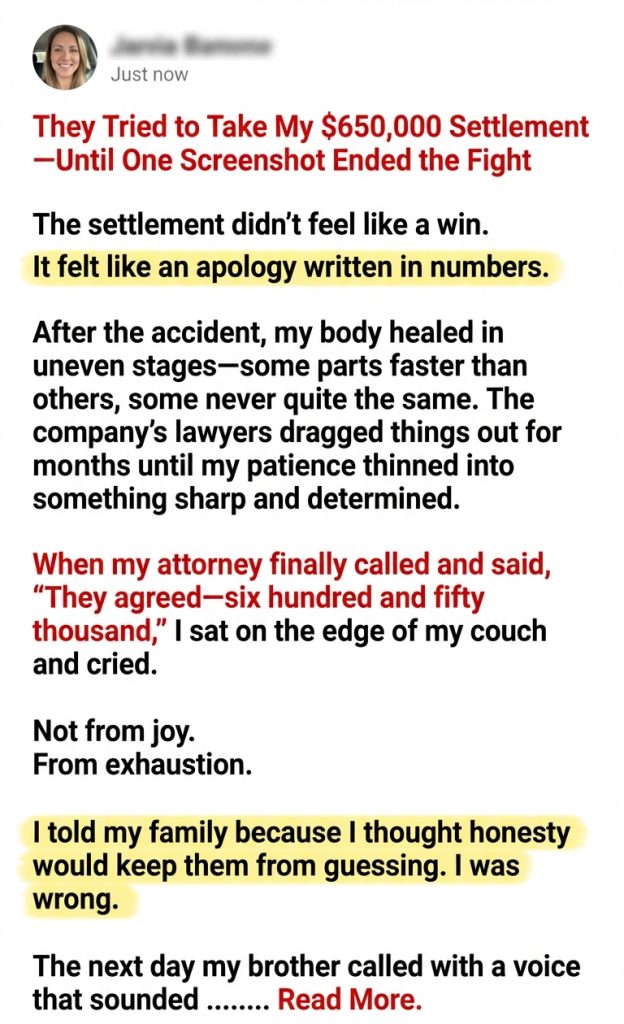
The settlement didn’t feel like a win.
It felt like an apology written in numbers.
After the accident, my body healed in uneven stages—some parts faster than others, some never quite the same. The company’s lawyers dragged things out for months until my patience thinned into something sharp and determined.
When my attorney finally called and said, “They agreed—six hundred and fifty thousand,” I sat on the edge of my couch and cried.
Not from joy.
From exhaustion.
I told my family because I thought honesty would keep them from guessing.
I was wrong.
The next day my brother called with a voice that sounded like celebration.
“That’s amazing,” he said. “So… what are you doing for us?”
“For you?” I repeated, confused.
He chuckled. “Come on. We helped you. Mom drove you to appointments. I took your dog that one weekend. We were there.”
“We were there” quickly became “we’re owed.”
Within 48 hours, my aunt messaged me a list of her bills. My cousin hinted at a “business opportunity.” My brother suggested I “invest” in his plan—again.
Then my mother sat across from me at the kitchen table and said the sentence that made my chest go tight:
“You should share it,” she said gently. “To keep peace.”
I stared at her. “Peace for who?”
She flinched. “Don’t make it ugly.”
That’s how it started: family trying to turn my pain into a group prize.
Then it escalated.
My brother claimed I’d promised him money “years ago.” My aunt told relatives I was “acting rich.” Someone suggested I wasn’t even injured “that badly.”
The ugliest part wasn’t the greed.
It was the rewriting of reality, as if my suffering was just a lottery they missed out on.
I refused. Calmly. Repeatedly.
And then my brother did what desperate people do when “please” doesn’t work.
He threatened legal action.
“I talked to someone,” he said. “If you don’t share, we’ll make a claim.”
“A claim for what?” I asked.
He hesitated. “For… family support. For contributions. For—”
“For driving me to appointments?” I said.
“For being there!” he snapped.
I could’ve panicked.
Instead, I went quiet—because quiet is what you do when you’re about to end a game.
I opened my phone and searched for one thing: a conversation from the week after my accident, when my brother had called me late at night asking for money.
I remembered it because I’d said no.
And because he’d replied with something so cruel it burned into my memory.
I found it. A thread of texts.
There it was: him demanding a loan, me refusing because I couldn’t work, and his final message—sent at 11:43 p.m.:
“Don’t ask me for anything. Your lawsuit money will come. I’m not helping you.”
I took a screenshot.
One screenshot, one sentence, one piece of proof that he wasn’t a supporter—he was a spectator waiting for payout.
I called him. “Go ahead,” I said calmly. “File your claim.”
He scoffed. “I will.”
“Great,” I replied. “Because I’m sending your text to my attorney.”
Silence.
“What text?” he asked, suddenly cautious.
“The one where you said you weren’t helping me,” I said. “The one where you admitted you were waiting for settlement money. The one where you told me not to ask you for anything.”
His voice dropped. “That was out of context.”
“It’s in perfect context,” I said.
He started to swear, to threaten, to spin.
I didn’t argue anymore. I simply forwarded the screenshot to my lawyer and asked for a formal cease-and-desist letter.
Two days later, my brother’s tone changed from fury to pleading.
“Why are you doing this?” he asked. “We’re family.”
I stared at the wall while he spoke, feeling something settle inside me like a final decision.
“I’m doing this,” I said, “because you turned my recovery into your opportunity.”
He tried to guilt me. Then he tried to charm me. Then he tried to scare me again.
None of it worked.
I paid off my medical debt. I set aside savings. I invested in a quiet, stable future. And I did one more thing—something my old self would’ve been too afraid to do:
I set boundaries so firm they finally felt like safety.
When my mother asked again, softer this time, “Couldn’t you just give them a little?”
I looked her in the eye. “If peace requires me being used,” I said, “then peace isn’t peace. It’s surrender.”
She didn’t like that answer.
But months later, when the noise faded and the demands stopped, she admitted something she’d never said out loud before:
“They do this to you,” she whispered. “Because you always let them.”
I nodded. “Not anymore.”
The $650,000 didn’t fix my body.
But it did fix something else.
It taught me that the hardest part of healing isn’t pain.
It’s learning you’re allowed to protect what you worked so hard to survive.