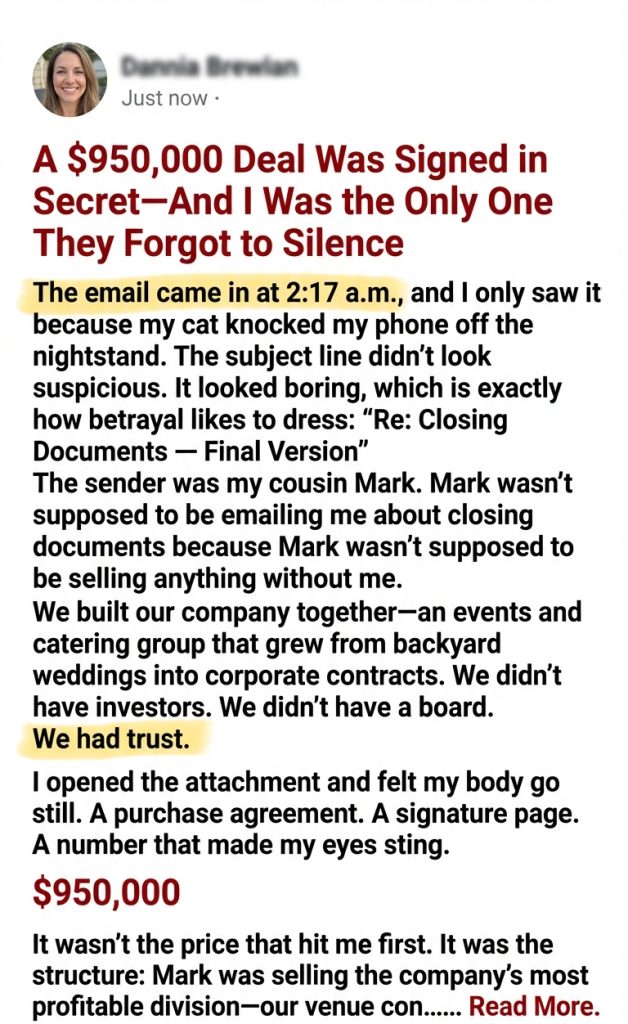
The email came in at 2:17 a.m., and I only saw it because my cat knocked my phone off the nightstand.
The subject line didn’t look suspicious. It looked boring, which is exactly how betrayal likes to dress:
“Re: Closing Documents — Final Version”
The sender was my cousin Mark.
Mark wasn’t supposed to be emailing me about closing documents because Mark wasn’t supposed to be selling anything without me. We built our company together—an events and catering group that grew from backyard weddings into corporate contracts. We didn’t have investors. We didn’t have a board.
We had trust.
I opened the attachment and felt my body go still.
A purchase agreement. A signature page. A number that made my eyes sting.
$950,000
It wasn’t the price that hit me first. It was the structure: Mark was selling the company’s most profitable division—our venue contracts—to a competitor. Quietly. Quickly. Without me.
And the signature line where my name should’ve been?
Blank.
I scrolled down further and saw the clause that made my stomach turn:
“Seller represents they have full authority to execute.”
He was lying on paper.
I called Mark the next morning. He answered like nothing was wrong.
“Hey!” he said, bright. “What’s up?”
“I got your email,” I replied.
A pause so small most people would miss it. I didn’t.
“What email?”
“The closing documents,” I said. “The $950,000 deal you signed in secret.”
Silence.
Then Mark sighed like I’d inconvenienced him. “Okay. So you saw.”
“You were going to sell without me.”
“It was time,” he said, calm now. “You’re too cautious. You overthink. This is a clean exit.”
“It’s theft,” I said.
Mark’s tone hardened. “Don’t be dramatic. You’ll get paid.”
“Not according to the document,” I replied. “I’m not even listed.”
He cleared his throat. “That’s… temporary. The lawyer said it’s easier this way. We’ll square up after.”
That’s when I knew he thought I was stupid.
“Who’s the buyer?” I asked.
“Does it matter?”
“Yes,” I said. “Because I’m calling them.”
Mark laughed once. “You can’t stop it.”
I didn’t argue anymore. I didn’t threaten. I just did the thing people like Mark never expect:
I got quiet.
Within an hour, my attorney filed an emergency motion for an injunction—because I wasn’t just a “partner,” I was a documented owner. Mark couldn’t sell anything without my consent. Not legally. Not cleanly. Not without consequences.
Mark called me screaming when he got served.
“You’re ruining everything!” he shouted.
“No,” I said evenly. “You tried to ruin me. I’m just refusing.”
He switched tactics fast. “Listen… we can talk. I’ll give you two hundred grand. Just sign the release.”
There it was—the silence attempt.
I almost laughed. “So you did plan to cut me out.”
Mark’s voice turned sharp. “You’re being selfish.”
I looked around my office—photos of our first event, our staff group picture, the handwritten thank-you notes from clients. The company wasn’t just money. It was people’s livelihoods.
“You forgot one thing,” I said.
“What?” he snapped.
“I’m the one who owns the client relationships,” I replied. “I’m the one whose signature is on the contracts you’re trying to sell.”
Mark went quiet.
By the end of the week, the buyer backed out. No one wants to buy an asset wrapped in legal fire.
Mark tried one last move: he sent a mutual friend to “mediate,” offering me a small payout if I promised to “stay quiet.”
I didn’t take it.
Instead, I did something stronger than revenge:
I bought Mark out.
Not because I wanted to win. Because I wanted to protect what we built from someone willing to sell it like scrap metal.
The final settlement gave Mark money and gave me control. He left our group chat, left the company’s story, left the identity he’d been wearing.
And I stayed—with the staff who’d looked at me with worried eyes and asked, “Are we okay?”
“We’re okay,” I told them. “And we’re going to be better.”
A $950,000 deal almost took my work, my stability, my pride.
But it also handed me a gift:
It showed me exactly who needed to be removed before they could burn the house down.