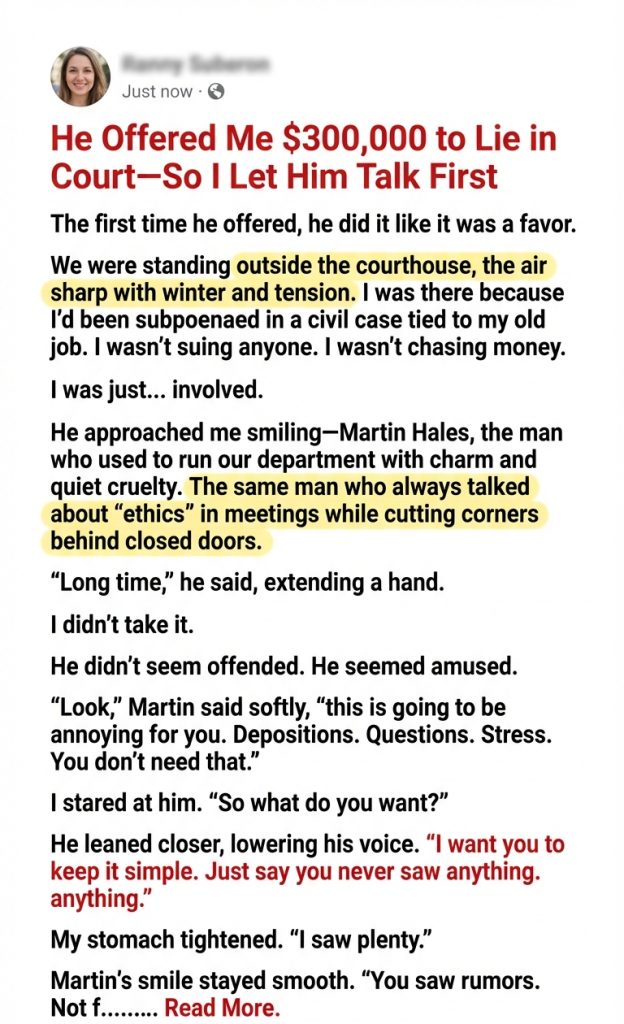
The first time he offered, he did it like it was a favor.
We were standing outside the courthouse, the air sharp with winter and tension. I was there because I’d been subpoenaed in a civil case tied to my old job. I wasn’t suing anyone. I wasn’t chasing money.
I was just… involved.
He approached me smiling—Martin Hales, the man who used to run our department with charm and quiet cruelty. The same man who always talked about “ethics” in meetings while cutting corners behind closed doors.
“Long time,” he said, extending a hand.
I didn’t take it.
He didn’t seem offended. He seemed amused.
“Look,” Martin said softly, “this is going to be annoying for you. Depositions. Questions. Stress. You don’t need that.”
I stared at him. “So what do you want?”
He leaned closer, lowering his voice. “I want you to keep it simple. Just say you never saw anything.”
My stomach tightened. “I saw plenty.”
Martin’s smile stayed smooth. “You saw rumors. Not facts.”
I held his gaze. “And you’re here because you’re scared those facts will get spoken out loud.”
His eyes flashed, then softened again. “I’m here because I can make your life easier.”
He reached into his coat and slid an envelope into my hand like a secret handshake.
“Three hundred thousand,” he whispered. “For your trouble.”
My skin prickled. The number was heavy even before I confirmed it.
I didn’t open the envelope. I didn’t throw it back. I did something that felt almost unnatural:
I kept my face calm.
“Okay,” I said quietly.
Martin exhaled, relief blooming too fast. “Good. Smart.”
He patted my shoulder, like we were friends, and walked away.
As soon as he turned the corner, I walked straight to my attorney.
I didn’t act brave. I acted careful. My lawyer’s face went tight as I explained, and he didn’t touch the envelope with his bare hands.
“This is witness tampering,” he said.
I nodded. “I figured.”
He looked at me. “Did you agree to anything?”
“I said ‘okay,’” I admitted. “So he’d keep talking.”
My lawyer studied me for a beat, then nodded once. “Good. Don’t contact him. Don’t spend anything. We do this clean.”
The next part wasn’t cinematic. It was methodical. Controlled. The kind of justice that doesn’t trend online but changes outcomes quietly.
We notified the court. We documented the approach. We preserved the envelope.
And then we waited.
Because Martin, like most people who try to buy truth, couldn’t resist talking.
He texted me later that night: “Appreciate you. Just keep it simple tomorrow.”
Then: “Remember: you never heard me say ‘alter the reports.’”
That second text was the crack in the wall he didn’t realize he’d made.
In court, Martin testified first.
He spoke with calm confidence, calling me “confused” and “emotional.” He insisted he had “never asked anyone to misrepresent anything.”
He looked at the jury like he expected applause.
When it was my turn, I walked to the stand with my hands steady and my stomach in knots.
I answered questions plainly. No speeches. No drama.
Then my attorney asked one question that shifted the room:
“Did Mr. Hales attempt to influence your testimony?”
Martin’s lawyer stood. “Objection—”
The judge cut him off. “Overruled.”
I looked at Martin and watched his smile tighten.
“Yes,” I said. “He did.”
The judge’s eyes sharpened. “Explain.”
I explained. The envelope. The amount. The phrasing. The texts.
My attorney held up printed screenshots.
Martin’s face went pale so quickly it looked like his blood had left out the back door.
His lawyer’s hands trembled as he objected again, but the judge’s expression had changed to something colder than disbelief.
In that moment, Martin didn’t look powerful.
He looked small.
Afterward, outside the courthouse, Martin hissed my name like a curse.
“You think you won?” he snapped.
I stared at him, calm. “No,” I said. “I think you lost the moment you believed truth had a price tag.”
The case ended weeks later. Settlements were reached. Investigations expanded. People who’d been afraid to speak suddenly found their voices—because once one person refuses the envelope, other people remember they can refuse too.
I never kept the $300,000.
But I kept something better:
My integrity, intact.
And the quiet satisfaction of watching a man who sold fear for a living finally realize he couldn’t buy his way out of the consequences.