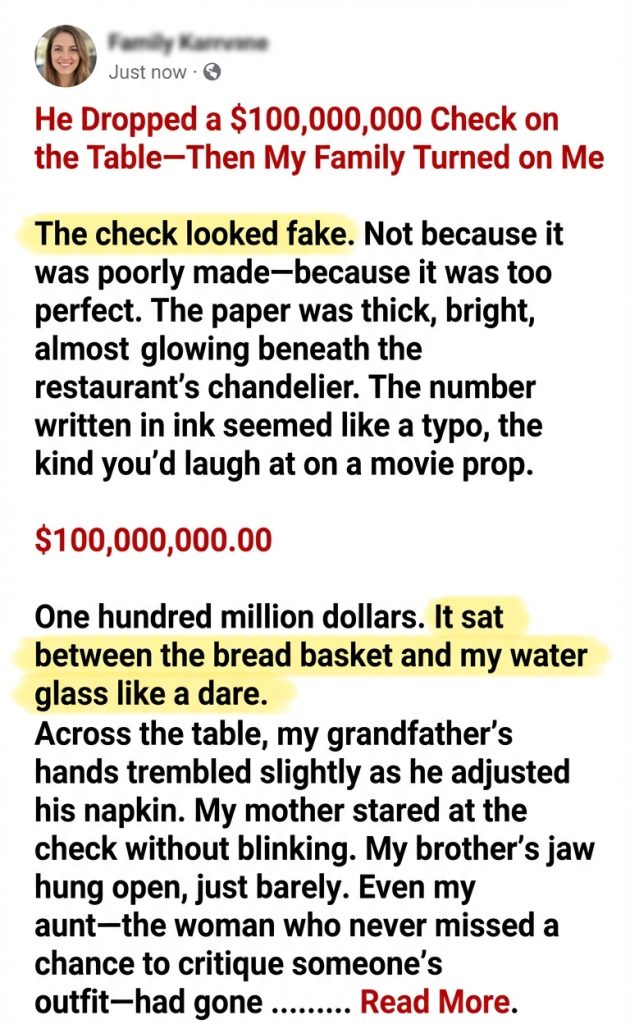
The check looked fake.
Not because it was poorly made—because it was too perfect. The paper was thick, bright, almost glowing beneath the restaurant’s chandelier. The number written in ink seemed like a typo, the kind you’d laugh at on a movie prop.
$100,000,000.00
One hundred million dollars.
It sat between the bread basket and my water glass like a dare.
Across the table, my grandfather’s hands trembled slightly as he adjusted his napkin. My mother stared at the check without blinking. My brother’s jaw hung open, just barely. Even my aunt—the woman who never missed a chance to critique someone’s outfit—had gone silent.
And at the head of the table, smiling like he’d just told a pleasant joke, was Everett Shaw.
The billionaire.
The man whose name was on buildings, scholarships, hospitals. The man I’d met only twice before, both times in the sterile air of charity events where everyone smiled too hard and shook hands like they were exchanging power instead of greetings.
He leaned back in his chair, relaxed. “So,” he said, voice smooth as polished wood, “that’s my offer.”
My fork slipped from my fingers and clinked against the plate.
“Offer,” I repeated, because my brain needed to anchor to a real word.
Everett nodded once. “You’ve been taking care of your family for years, Jordan. I’m aware.”
I didn’t know how he could be aware of anything about me. I was a mid-level operations manager who kept spreadsheets neat and my head down. I didn’t belong in the same sentence as a billionaire, let alone at the same table.
“I don’t understand,” I said.
Everett’s eyes—light, unreadable—moved to my mother. Then my brother. Then back to me.
“You have something I respect,” he said. “Loyalty. Persistence. You kept them afloat when they were sinking.”
My mother made a small noise, like she was about to agree and then remembered she was in shock.
Everett continued, “I’m offering you a chance to change your life. Permanently. A hundred million, placed into a trust under your name.”
My throat went dry. “Why?”
He smiled, as if he’d been waiting for that. “Because I’m tired of giving money to people who say the right things and do the wrong ones. And because—” he glanced at my family again “—I’m curious.”
My brother finally found his voice. “Curious about what?”
Everett turned to him, polite. “About who you all really are when the number is large enough to strip away manners.”
A silence fell, heavy as velvet.
I laughed once, nervous. “This is a test?”
“Call it an experiment,” Everett said. “One you can decline.”
Decline.
My brain tried to picture the act of pushing a hundred million dollars away like a plate of food I didn’t want.
I looked at my mother, expecting her to say something like, Jordan, be careful, or this is too much, or we should talk privately.
Instead, she reached out—slowly, reverently—and touched the edge of the check with one finger.
“As your mother,” she said, voice quivering, “I just want what’s best for you.”
The way she said “you” didn’t sound like me.
It sounded like the check.
Everett watched her with the calm interest of a man observing weather.
My aunt cleared her throat. “Mr. Shaw,” she said, switching on charm like a light, “this is… generous. Truly. Jordan has always been… responsible.”
I felt something twist inside me. Responsible. The word my family used when they wanted to imply I existed for their stability.
Everett nodded. “Yes. I’ve heard.”
My brother leaned forward, eyes locked on the number. “So what’s the catch?”
Everett folded his hands. “No catch. Only a condition.”
My heartbeat stuttered.
He looked directly at me. “You can have the money if you choose it. But you must decide tonight, in front of them.”
My mother’s hand tightened on her napkin. “Tonight?”
Everett nodded. “And here’s the other part of the experiment. If you accept, you may give them as much or as little as you want… but you must say it out loud. Who gets what. In front of everyone.”
My brother let out a breathy laugh, already tasting victory.
My aunt’s eyes shone, greedy behind politeness.
My mother pressed her lips together like she was fighting tears—though I couldn’t tell if they were tears of pride or relief or hunger.
I stared at Everett. “Why would you do this?”
His gaze didn’t waver. “Because money doesn’t make monsters,” he said quietly. “It only feeds them.”
I felt my stomach dip.
I could feel my family’s attention narrowing like a spotlight.
In my mind, I saw the last ten years—my paycheck stretched, my savings drained, my weekends spent fixing their problems. The time my brother “borrowed” my car and returned it with an empty tank and a dent. The time my mother cried because rent was due and then bought new furniture two months later. The time my aunt asked me to co-sign a loan and called me selfish when I refused.
And I heard their voices, layered over each other like a chorus:
You’re the stable one.
You don’t need much.
Family helps family.
Don’t make this hard.
Everett waited patiently, like a man who knew time would do his work for him.
My mother turned to me, eyes glossy. “Jordan,” she whispered. “This is… this is God.”
My brother’s grin widened. “Bro, you can set us all up.”
My aunt leaned in, lowering her voice. “Just remember who believed in you.”
My grandfather said nothing, but his eyes held mine—tired, wary, as if he wanted to warn me without making a scene.
I swallowed. “If I accept… you’re saying I have to decide right now how to distribute it.”
Everett nodded. “Yes.”
My brother slapped the table lightly. “Easy. Fifty to you, fifty to the family.”
My mother nodded immediately, as if this were obvious. “That’s fair.”
I stared at them. Fifty million dollars.
They were dividing my life like it was already theirs.
Something in me hardened—not into cruelty, but into clarity.
I looked at Everett. “What happens if I don’t accept?”
Everett shrugged. “Then you walk out with your integrity intact. And I walk out knowing the experiment ends.”
My brother scoffed. “Integrity doesn’t pay bills.”
My mother shot him a look that was supposed to be stern but lacked real force. Then she turned back to me, soft again. “Honey… you’ve carried so much. Let us carry something now.”
I almost laughed. The truth was, they didn’t want to carry anything. They wanted to hold it.
I thought about what a hundred million could do. Freedom. Safety. A home with no fear behind the walls. Therapy. Travel. Quiet. A future where I didn’t flinch every time my phone rang.
But I also thought about what it would do to my family.
It would not heal them.
It would amplify them.
Everett’s eyes stayed on my face, as if he could see the math happening inside me. Not the financial math—the emotional math.
I took a slow breath and lifted the check carefully with two fingers, feeling the weight of paper pretending to be destiny.
I looked at my mother. “If I accept this,” I said, voice calm, “it will be mine. Not ours.”
Her smile froze.
My brother’s expression tightened. “What do you mean?”
I continued, “And if I give anything, it will be based on trust. On past behavior. On respect.”
My aunt’s voice went sharp. “Jordan, don’t be like that. This is life-changing.”
“Yes,” I said. “For me.”
My mother’s eyes filled, her tone turning wounded. “After everything we’ve been through—”
I held up a hand gently. “Stop. Don’t turn this into a debt.”
My brother leaned back, eyes narrowing. “So you’re gonna get rich and forget us.”
There it was.
Not gratitude. Not pride.
A threat wearing an accusation.
Everett watched quietly, not interrupting, not rescuing me.
I realized then that this wasn’t really about him. Everett Shaw was just the mirror.
My family was looking at themselves, and they didn’t like the reflection.
I set the check back down on the table, right in the center, like a small white sun.
“I’ll accept,” I said.
Every face lit up in a different way—hope, triumph, entitlement.
And then I added, “But I will not give you what you think you deserve. I will give you what you’ve earned through how you’ve treated me.”
Silence.
My mother’s smile cracked. “Jordan…”
My brother’s voice went low. “Don’t embarrass us.”
I nodded once. “Okay. Here’s the truth, out loud.”
I turned to my mother first. “Mom, I will pay off your mortgage. Directly. No cash. No access. I’ll also set up a monthly budget you can’t exceed without my approval.”
Her mouth opened, offended. “You can’t control me—”
“I can,” I said softly. “Because I’m the one funding it.”
Then I looked at my brother. “You’ll get nothing. Not because I don’t love you. Because you’ve shown me what you do when you’re handed help.”
His chair scraped. “Are you serious?”
“I am.”
My aunt sputtered, outraged. “How dare you—”
“And you,” I said, turning to her, “will also get nothing. You’ve tried to use me like a ladder for years.”
Her face reddened. “Mr. Shaw,” she snapped, trying to recruit him, “this is—”
Everett lifted a hand, calmly. “This is exactly the point.”
My grandfather cleared his throat, the first sound he’d made all night. “Jordan,” he said quietly. “What about you?”
I looked at him and felt a sudden sting behind my eyes. He had been the only one who ever slipped me twenty dollars without making it a sermon. The only one who’d told my brother to apologize when he was wrong. The only one who’d ever asked me how I was doing and waited for the answer.
I swallowed. “Grandpa,” I said, voice rough, “you get a home health plan. The best. And a small account for whatever you want. No questions.”
He nodded once, eyes wet. “That’s enough.”
My mother stood, shaking. “You’re tearing this family apart,” she whispered, as if I were the villain.
My brother laughed bitterly. “You think you’re better than us now.”
I stared at them, feeling a strange steadiness settle in my bones.
“No,” I said. “I think I’m done being smaller so you can feel bigger.”
Everett picked up his water glass and took a sip like he’d just watched a good performance.
My mother grabbed her purse. “If you do this,” she said, voice trembling with fury, “don’t come crying when you’re alone.”
I almost said, I’ve been alone in this family for years.
Instead, I said, “I’m not alone. I’m just no longer surrounded by people who only love me when I’m useful.”
My brother shoved back his chair, face dark. “Keep your money. You’ll regret it.”
They left in a storm of offended footsteps.
Only my grandfather remained, sitting quietly, hands folded.
Everett watched them go, then looked back at me.
“Congratulations,” he said softly.
I let out a shaky breath. “On what? Becoming the villain?”
Everett smiled, not unkindly. “On surviving the part most people fail,” he replied. “The part where you learn your worth is not a group project.”
I stared at the check again, the number absurd and real.
Everett slid it toward me with two fingers. “You made the hardest choice,” he said. “Not accepting the money. Accepting the consequences.”
I nodded slowly, feeling grief and relief braided together.
After Everett left, my grandfather reached across the table and squeezed my hand.
“You did right,” he murmured. “They’re just loud about wrong.”
I laughed softly through a sudden burn of tears. “I don’t feel right.”
“You will,” he said. “When the noise dies down.”
Outside, the city lights glittered like a thousand small possibilities.
I realized something then, something I’d never understood before:
The money wasn’t the gift.
The gift was the moment I stopped negotiating my dignity.