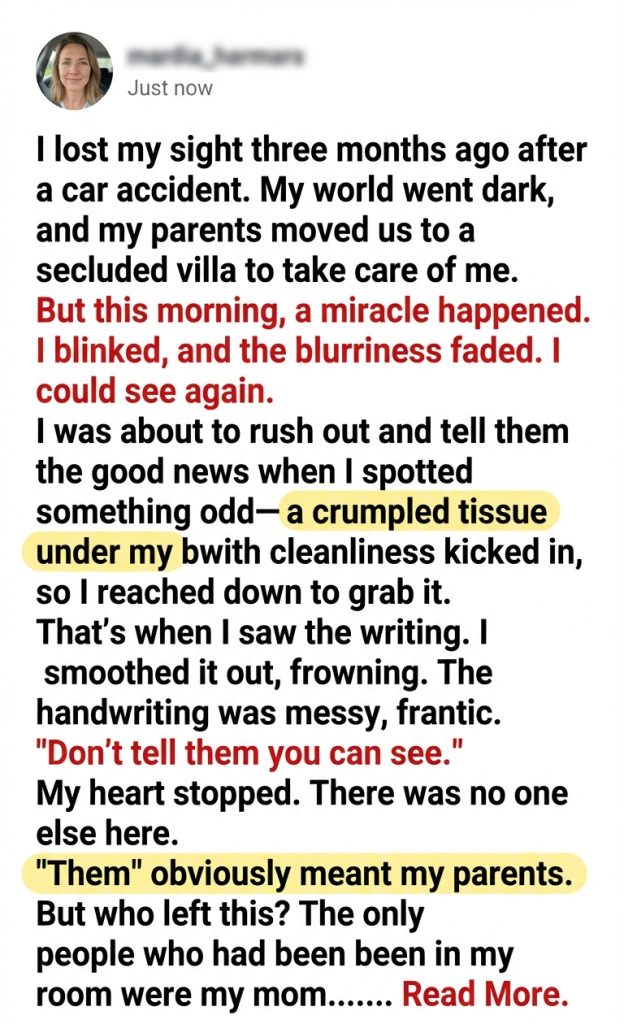
“I lost my sight three months ago after a car accident. My world went dark, and my parents moved us to a secluded villa to take care of me. But this morning, a miracle happened. I blinked, and the blurriness faded. I could see again.
I was about to rush out and tell them the good news when I spotted something odd—a crumpled tissue under my bed. My obsession with cleanliness kicked in, so I reached down to grab it. That’s when I saw the writing.
I smoothed it out, frowning. The handwriting was messy, frantic.
“Don’t tell them you can see.”
My heart stopped. There was no one else here. “Them” obviously meant my parents. But who left this? The only people who had been in my room were my mom, dad, and my husband, Noah.
Just then, a knock echoed on the door.
“Ella? I made you some soup.”
It was my mom’s kind voice. I casually threw the tissue in the bin, but when the door opened, I froze.
A woman stood there holding a bowl, smiling at me. Her lips were bright red, her smile eerie and stretched too wide.
She was not my mom.
I jerked back, shock written all over my face. My mom was a soft, kind-looking woman. This woman looked sharp, shrewd, almost predatory. But the most terrifying part? Her voice was identical to my mother’s.
“Ella, what’s wrong? Not feeling well?” The stranger stepped closer, concern dripping from that familiar voice.
I remembered the note. Don’t tell them you can see.”
So I forced myself to blink hard and look past her shoulder.
I let my hand drift over the blanket like I was trying to find the edge of the bed. “I’m okay,” I whispered. “Just dizzy.”
She paused.
It was a tiny pause, but I saw it. A flash of suspicion, then a smooth smile sliding back into place.
“That happens,” she said in my mother’s voice. “Here, careful. The soup is hot.”
She came closer, and I kept my eyes unfocused. Up close, the differences were worse. My mother had a faint scar near her left eyebrow from a childhood bike crash. This woman had flawless skin there. My mother wore a gold ring with a tiny emerald. This woman wore nothing. Her perfume was too sharp, too expensive, and completely wrong.
But the voice was perfect.
I took the bowl with shaking hands and pretended to sip. She watched me like she was studying a test result.
Then she smiled again. “Your father will come check on you later. Rest, sweetheart.”
Sweetheart.
My mother called me “Ellie” when she was being gentle. Never sweetheart.
When she left, I waited for the lock to click.
It did.
I set the soup down and stood so fast the room spun. I grabbed the dresser until my balance returned and looked around properly for the first time in three months.
At a glance, it looked like my room.
At a glance.
The framed photo of Noah and me on our wedding day was there, but it was a cheap print, slightly blurry. My books were the right colors but the wrong titles. My lotion bottle was empty. My bedside drawer held tissues, pills, and a brush—but not the silver bracelet my grandmother gave me that I always kept there.
It wasn’t my room.
It was a copy made for a blind woman.
A chill ran through me.
I rushed to the trash bin, dug out the crumpled tissue, and smoothed it again. My heart was pounding so hard I could hear it in my ears.
The back side had faint marks I hadn’t noticed before. I tilted it toward the light.
One more line.
Trust Noah.
I stared at those words until tears burned my eyes.
Unless it was a trap.
Unless they wanted me to trust him.
I heard footsteps in the hallway and shoved the tissue under the mattress just before the door opened again.
A man stepped in wearing my father’s gray sweater.
My throat tightened.
He looked close enough that a blind woman might believe it. Same height. Similar build. Same glasses. But my father’s hair was mostly white now, and this man’s was dyed too evenly. My father walked with a slight limp from an old knee injury. This man moved smoothly.
“Morning, pumpkin,” he said.
My blood went cold.
My father had called me “peanut” since I was six.
“Morning, Dad,” I said, hating how much my voice shook.
He touched my shoulder. His hand was heavy and unfamiliar. “You eat?”
“A little.”
“Good girl.” He glanced at the soup, then back at me. “Doctor says no improvement yet, but we keep trying.”
He and the fake mother exchanged a look I was never meant to see.
Then they left me alone.
I sat on the bed, gripping the blanket, and tried to think.
The accident was real. I remembered the rain, the headlights, the impact. After that, pain, darkness, voices. Noah crying. Someone telling me I might lose my sight temporarily. Then weeks—maybe months—of pills, sleep, and this villa.
Had I ever actually touched my parents’ faces after the accident?
No.
They always held my hands. They always spoke softly from a little distance. They always said the doctors wanted me to rest.
My stomach turned.
At noon, Noah came in.
He carried a tray and looked exhausted, like he hadn’t slept in days. His beard was longer than usual. His eyes were red. The second he saw me, his face softened in a way so real it almost made me cry.
“Hey,” he said quietly.
I kept my gaze low. “Hey.”
He sat beside me and took my hand.
Then his thumb tapped my palm once, twice, three times.
Our old code.
We used it when we were dating and stuck at boring dinners. Three taps meant I love you.
I fought the urge to look at him directly.
His thumb moved again, tracing quick letters into my skin.
P-R-E-T-E-N-D.
I nearly broke right there.
I squeezed his hand once to let him know I understood.
Out loud, he said, “I brought your meds.”
I nodded and held out my hand. He dropped the pills into my palm, then passed me the water.
As he leaned closer, adjusting my blanket, he whispered so softly I barely heard him: “Don’t swallow.”
Then he stood and spoke in a normal voice. “I’ll come back tonight.”
After he left, I hid the pills in the hem of my pillowcase.
By evening, I had learned three things.
First: there was a camera hidden in the air vent above the dresser.
Second: the fake mother checked my eyes with a flashlight every visit, probably looking for reactions.
Third: they were giving me something to keep me slow and sleepy.
I stayed blind on purpose.
I counted footsteps. Timed door locks. Listened.
At 8:00 p.m., the fake father said in the hallway, “Tomorrow. We finish it tomorrow.”
The fake mother answered, “She’ll sign if Noah keeps her calm.”
Sign what?
At 1:47 a.m., my bedroom door opened.
I kept my breathing even.
Noah’s hand touched my wrist. Three taps.
I sat up. He pressed a phone into my hand, the screen already dimmed and opened to a note. He pointed to the vent, then typed while I read.
They kidnapped your parents after the crash. These people work for Viktor Hale (former partner your dad fired). They need access to company accounts and offshore backups. They’ve been using your voice + signatures. They need one final authorization tomorrow. I couldn’t call police. They threatened your parents.
I looked up at him, shaking.
He typed again.
Your parents are alive. I saw video today. In a basement on this property. We have one chance.
My hands trembled so hard I almost dropped the phone.
I typed back: How?
He swallowed and typed fast.
I planted note. I guessed your sight came back when you reacted this morning. I found service tunnel outside kitchen. One guard at night. If we get proof and location out, police can raid.
I nodded, tears slipping down my face.
Noah squeezed my hand. “Can you walk?” he whispered.
“Yes.”
He gave me a dark hoodie and helped me out of bed. My legs were weak, but rage is a powerful medicine.
We moved silently into the hallway. The villa looked nothing like the warm, safe place I had pictured in the dark. It was all polished stone and expensive emptiness. Security panels near every door. Cameras in corners. No family photos except staged ones.
In the study, Noah opened a drawer and pulled out a laptop and keycard.
“I stole this from the fake father,” he whispered.
The laptop woke with a camera grid.
My breath stopped.
One feed showed my parents.
They were in a concrete room, tied to chairs, alive but pale and exhausted. My mother’s real face. My father’s real limp as he shifted.
I bit my fist to keep from making a sound.
Noah recorded the screen on the hidden phone and sent it to one contact labeled Ramos.
“He’s the detective from your crash case,” Noah whispered. “I trusted one person. I sent him pieces for weeks. He needed proof.”
A sound snapped through the hallway.
Footsteps.
Noah closed the laptop, but too late.
The fake father filled the doorway, gun in hand.
“Well,” he said, voice flat now, no more gentle-parent act. “Looks like the blind girl can see.”
My whole body went cold.
Noah stepped in front of me. “Let her go.”
The man smiled. “You were useful, Noah. Don’t become brave.”
Behind him, the fake mother appeared, lips bright in the dim light. “I told you she looked wrong this morning.”
She raised a syringe.
Instinct took over.
I grabbed the heavy bronze horse statue from the desk and threw it.
It hit the fake mother’s wrist. The syringe flew. She screamed.
Noah lunged at the man with the gun. They crashed into the bookshelf. I ran—not away, but toward the wall panel Noah had shown me, the one that controlled the study doors. I hit the red button.
Metal shutters slammed halfway down.
The fake father shouted. The gun fired once, deafening in the room. Glass shattered above my head.
Then the house exploded with alarms.
Not theirs.
Police.
“Federal agents! Drop your weapons!”
The next thirty seconds were chaos—boots, shouting, the fake mother crying, Noah on the floor, my hands over my ears, bright flashlights cutting through the dark.
Then someone grabbed my shoulders and said, “Ella—Detective Ramos. You’re safe. Do you understand? You’re safe.”
I didn’t believe it until I saw my mother.
The real one.
She was wrapped in a blanket, face bruised, hair tangled, eyes swollen with tears. But it was her. Scar on her eyebrow. Emerald ring. Hands shaking as she reached for me.
“Ellie,” she sobbed.
I collapsed into her arms.
My father came next, limping hard, crying openly, repeating, “I’m sorry, I’m sorry, I’m sorry,” like he could make up for every second we lost.
At dawn, sitting in the back of an ambulance with Noah’s hand locked in mine, I watched the villa fade into blue morning light while officers moved in and out carrying evidence boxes.
Three months of darkness had taught me how to listen.
That night taught me something else.
Sight is not just seeing what’s in front of you.
It is recognizing what feels wrong, even when the voice sounds familiar. It is trusting the hand that warns you. It is staying still long enough to survive, then moving fast when the moment comes.
People asked later what scared me most—the fake faces, the copied voices, the locked doors, the gun.
But the truth was simpler.
The worst part was how close comfort can look to love when you cannot see.
And the best part?
The moment I finally could.