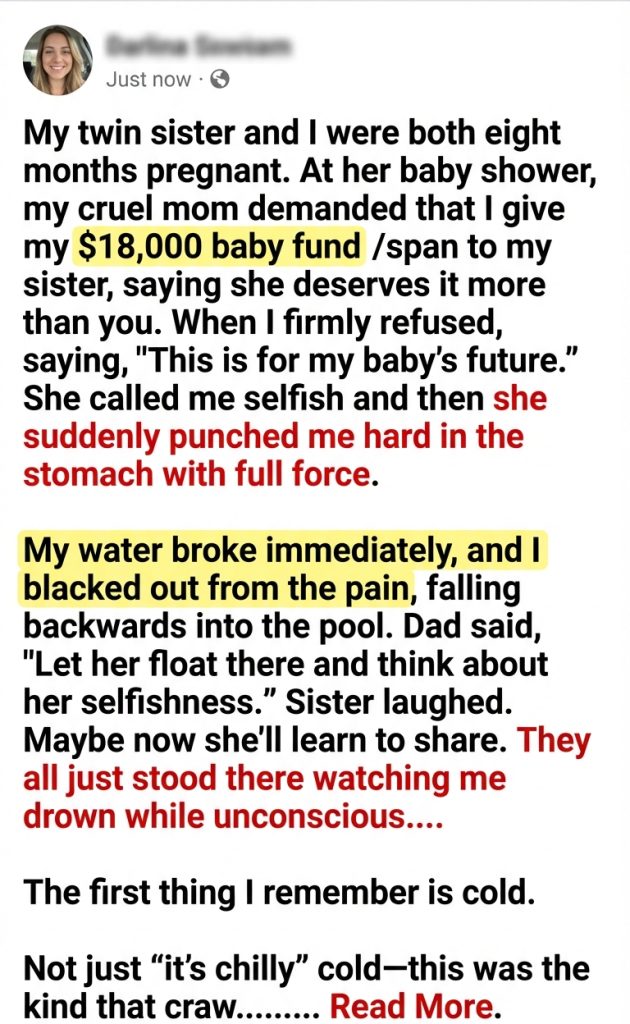
My twin sister and I were both eight months pregnant. At her baby shower, my cruel mom demanded that I give my $18,000 baby fund to my sister, saying she deserves it more than you. When I firmly refused, saying, “This is for my baby’s future.” She called me selfish and then suddenly punched me hard in the stomach with full force.
My water broke immediately, and I blacked out from the pain, falling backwards into the pool. Dad said, “Let her float there and think about her selfishness.” Sister laughed. Maybe now she’ll learn to share. They all just stood there watching me drown while unconscious….
The first thing I remember is cold.
Not just “it’s chilly” cold—this was the kind that crawled under your skin and made your bones feel hollow. The kind that doesn’t belong at a baby shower full of pastel decorations and bright laughter.
When consciousness returned, I was lying on the poolside concrete. My hair was soaked. My clothes clung to me like they were trying to drag me back into the water. My mouth tasted metallic. My ears rang as if the world were underwater even though I wasn’t.
A woman I barely recognized was kneeling over me, hands shaking as she pressed a towel against my stomach.
“Don’t move,” she said urgently. “Someone called 911. Stay with me, okay?”
My eyes struggled to focus.
The backyard lights above—string lights looped along the pergola—twinkled like everything was still a party.
And in the distance, near the gift table, I saw my twin sister Natalie standing beside our mother like nothing had happened. My father sat in a chair near the back door, staring away as if my body on the ground was just an inconvenience to his evening.
I lifted my hands to my belly.
And the sound that came out of my throat wasn’t a word.
It was a raw, instinctive scream.
Because something felt wrong.
Not the normal “eight months pregnant” heaviness.
Not the normal ache.
Wrong in a way that made my mind panic before my body could catch up.
“My baby,” I whispered, tears pouring without permission. “Please—my baby.”
The woman leaned closer.
“You’re going to be okay,” she said—too quickly, too desperately, like she was trying to convince herself as much as me.
Then the sirens came.
They didn’t sound real at first. They sounded distant, swallowed by the ringing in my ears and the shrill pulse of fear in my chest. But then hands were everywhere—paramedics, questions, bright flashlight beams, a neck brace I fought against because all I wanted was one answer.
“Is my baby okay?”
No one answered directly.
That was answer enough to terrify me.
As they lifted me onto the stretcher, I saw Natalie glance over. Just once. Her hand rested on the mound of gifts on the table—designer diaper bag, imported stroller, the kind of things my mother thought proved a child would be loved properly.
Our mother, Denise, had always loved a performance.
And tonight had been Natalie’s show.
The whole backyard had been curated for her: blush balloons, gold script banners, catered finger foods, a three-tier cake with sugar peonies. She had a photographer. A custom mocktail station. Matching robes for the “grandmas-to-be” photo.
I had almost not gone.
But my father had called that morning and said, “Don’t start drama. Just come support your sister for one day.”
Support Natalie. That had been my role my entire life.
We were twins, but my mother never let us forget which one she considered the investment.
Natalie was charming, polished, social. She knew how to tilt her head and sound fragile at exactly the right moment. She married a man with a lucrative family business and posted filtered videos about “manifesting abundance.”
I was the practical one. The saver. The planner. The one who worked overtime while pregnant because my husband and I wanted a real cushion before the baby came. We didn’t have family money. We had spreadsheets.
That $18,000 baby fund wasn’t glamorous. It was diapers, medical bills, a crib, unpaid maternity leave, emergency savings. It was peace of mind I had built dollar by dollar.
My mother called it “hoarding.”
She waited until everyone had eaten to bring it up.
I had been sitting near the pool, one hand on my belly, talking to an old family friend, when Denise clinked a spoon against her glass and smiled the smile she used when she was about to humiliate someone “for their own good.”
“Before we open gifts,” she said, loud enough for the whole backyard, “I think family should help family.”
My stomach tightened. I knew that tone.
She turned toward me, eyes bright. “Your sister has had a lot of unexpected expenses. And since you’ve been bragging about your savings…” She gave a little laugh. “I think it would be beautiful if you gave Natalie your baby fund.”
The yard went quiet.
I felt heat rush up my neck. “What?”
“Your eighteen thousand,” she said, as if clarifying a dinner order. “Natalie deserves it more than you. She needs the right start.”
I remember hearing someone suck in a breath. Someone else murmured, “Denise…”
Natalie looked down, pretending embarrassment, but she didn’t say no.
That told me everything.
I stood slowly, one hand on the back of my chair. “This is for my baby’s future.”
My mother’s face hardened instantly. “Selfish.”
I had spent my entire life folding myself small to survive her moods. Smiling through insults. Handing over money. Apologizing when she crossed lines she denied existed.
But something about being that pregnant—about feeling my daughter shift inside me while my mother publicly tried to strip away her safety—cut through years of conditioning in one clean motion.
“No,” I said. “I’m not giving you my child’s savings.”
The next second happened too fast to process and too slowly to forget.
Her hand came across with full force.
A punch. Not a shove. Not an accident.
A punch straight into my stomach.
The impact exploded through me. A white-hot burst of pain. Then wetness. Then the sick, impossible sensation of my body giving way.
I remember gasping.
I remember falling.
I remember the blue of the pool rising toward me.
And then nothing.
In the ambulance, a paramedic with kind eyes kept telling me to breathe while another pressed monitors to my skin. I was shaking so badly my teeth chattered.
“Ma’am, do you know how far along you are?”
“Thirty-four weeks,” I whispered.
“Any bleeding?”
“I—I don’t know.”
They asked about the fall. I tried to speak. My throat closed.
“My mother hit me,” I said finally.
The words hung in the air, sharp and unbelievable, even to me.
The paramedic’s expression changed in a way I’ll never forget—not pity, not shock exactly, but a sudden professional focus that meant this had just become more than an accident.
At the hospital, everything turned fluorescent and fast.
Nurses cut away my wet clothes. Someone started an IV. Someone strapped monitors around my belly. A doctor spoke to me calmly while looking at a screen, and I searched his face for clues I couldn’t bear to hear out loud.
Then I heard it.
A heartbeat.
Fast. Steady. Beautiful.
I started sobbing so hard the nurse had to hold my shoulder.
“Baby is still with us,” she said gently. “Stay still. We’re watching both of you closely.”
Still with us.
Not safe. Not yet. But alive.
My husband, Aaron, arrived twenty minutes later looking like he had run through walls to get there. His shirt was inside out. He dropped to my bedside, took one look at my face, and went white.
“Who did this?”
I had never seen him like that—his usual calm stripped down to something raw and shaking.
“My mom,” I whispered.
For a second, he didn’t speak. His hand tightened around mine until it almost hurt. Then he kissed my forehead and said, voice breaking, “You and our baby are all that matters tonight. The rest can burn.”
That sentence held me together.
The police came before midnight.
Because of the injury. Because witnesses had called 911. Because more than one guest had seen me fall into the pool while unconscious. And because, as one officer gently explained, several people were “very disturbed” by what my parents said afterward.
I learned then that cruelty survives on silence—and sometimes it dies the moment one person refuses to stay quiet.
The woman who knelt beside me by the pool was named Teresa. She wasn’t a close friend. She was the photographer’s assistant. She told police she had heard my father say, “Let her float there and think about her selfishness,” and thought she must have misheard because no father could mean that.
Then she saw no one move.
So she jumped in herself.
Another guest, one of Natalie’s husband’s cousins, recorded part of the argument when my mother demanded the money because she thought it was “wild family drama.” That video caught my voice saying, “This is for my baby’s future,” and my mother stepping toward me. It didn’t catch the full punch clearly—but it caught enough.
Enough for charges.
Enough for everyone’s fake confusion to collapse.
I was admitted overnight for observation. Then another night. Early labor started and stalled. They gave me medication, monitored contractions, checked the baby again and again. Every hour felt like standing on a cliff waiting to hear if the ground would hold.
Natalie texted once.
Mom didn’t mean it like that. You know how emotional she gets. Please don’t ruin the family.
I stared at the message until the screen dimmed.
Then I blocked her.
The hardest part wasn’t the pain. It was the clarity.
Lying in that hospital bed, feeling my daughter kick against the monitors, I realized this wasn’t a sudden tragedy. It was an ending. A violent one, yes—but an ending to a story that had been training me to accept abuse as “family personality” my whole life.
My mother had always taken. My father had always watched. Natalie had always benefited.
I had always explained it away.
Not anymore.
Three weeks later, I delivered a baby girl by emergency C-section after complications from preterm labor.
She was small and furious and perfect.
When they placed her against my chest, warm and alive, I looked at her tiny face and felt something settle in me that no therapy quote had ever managed to reach.
This is where it stops.
We named her Hope.
Not because I was feeling poetic.
Because I wanted a daily reminder that survival is not the same as returning to what hurt you.
The legal process was ugly. My mother cried in court. My father claimed he “froze” and didn’t understand the severity. Natalie avoided eye contact and told anyone who would listen that stress and hormones had “distorted” my memory.
But witnesses testified. The paramedics testified. Teresa testified. Video was reviewed. Medical reports spoke without emotion, which somehow made them more powerful.
I didn’t go to court for revenge.
I went because one day my daughter will ask why we don’t visit Grandma.
And I want to be able to answer without shame.
I want to say: Because when it mattered most, I chose you.
People think the most shocking part of my story is the punch.
It isn’t.
The most shocking part is what came after—that they watched. That they stood there while I sank. That the people who should have loved me most treated my life like a lesson.
But that’s not the ending I keep.
I keep the cold concrete under my back and the stranger’s shaking hands refusing to let me disappear.
I keep the paramedic saying, “Baby is still with us.”
I keep Aaron’s voice at my bedside.
I keep my daughter’s first cry.
And I keep the woman I became after that night—the one who finally understood that protecting your child sometimes means grieving the family you came from.
If there is any mercy in a story like mine, it is this:
The night they showed me exactly who they were… I finally did too.