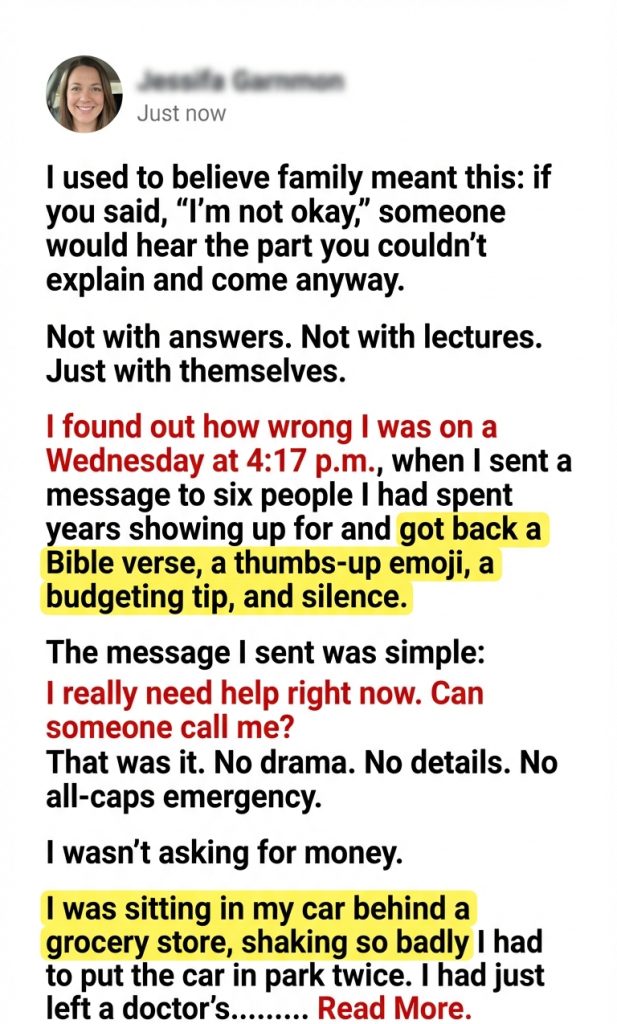
I used to believe family meant this: if you said, “I’m not okay,” someone would hear the part you couldn’t explain and come anyway.
Not with answers. Not with lectures. Just with themselves.
I found out how wrong I was on a Wednesday at 4:17 p.m., when I sent a message to six people I had spent years showing up for and got back a Bible verse, a thumbs-up emoji, a budgeting tip, and silence.
The message I sent was simple:
I really need help right now. Can someone call me?
That was it. No drama. No details. No all-caps emergency.
I wasn’t asking for money.
I was sitting in my car behind a grocery store, shaking so badly I had to put the car in park twice. I had just left a doctor’s appointment where the woman in the white coat said words like biopsy, further testing, and we need to move quickly. She was kind. I remember that. I also remember staring at her mouth and understanding none of it after the word “mass.”
By the time I got to the parking lot, my thoughts had turned to static.
I didn’t know who to call first, so I sent the group text.
My father replied first.
👍
I stared at it so long I thought maybe there was another message coming. There wasn’t.
Then my aunt Marlene sent:
“Cast all your anxiety on Him because He cares for you.” – 1 Peter 5:7
Then my younger sister, Paige:
What kind of help? I’m in line at Target
Then my brother Kevin:
If this is money, I can’t. Rent’s due
I sat there in my car with my hands gripping the steering wheel and felt something in me split right down the middle.
On one side: panic, fear, the urge to scream.
On the other: this cold, almost scientific clarity.
Oh.
This is what I am to them when I’m scared.
A task that needs categorizing.
My husband, Mark, saw the text twenty-three minutes later and called.
Relief hit me so fast I started crying before I answered.
“Hey,” he said. “What’s going on? I’m heading into a meeting, so make it quick.”
The words knocked the breath out of me.
I swallowed hard. “I’m at the grocery store parking lot. I had a doctor’s appointment and I—”
“What doctor’s appointment?” he cut in.
“I told you yesterday.”
A pause. Then, distracted: “Right. The follow-up thing.”
The follow-up thing.
I closed my eyes. “Mark, they found something.”
Silence for one beat, two.
Then: “Okay. Found what?”
“I don’t know yet. They said I need more tests. I’m scared.”
He exhaled. I could hear voices in the background, office noise, chairs moving. “Do you want me to come?”
I waited for the concern underneath the question.
It didn’t come.
It sounded like logistics. Calendar management. Route planning.
“I don’t know,” I whispered. “I just needed someone.”
He was quiet, then said, “I can’t leave right now. We’re presenting in ten. Can your mom come?”
I laughed once, a broken sound I didn’t recognize as mine.
“Sure,” I said. “I’ll ask the thumbs-up emoji.”
He missed the bitterness entirely. “Okay. Let me know what the next steps are.”
The line disconnected.
I sat there with my forehead against the steering wheel and cried until someone tapped on my window.
I flinched so hard I hit my knee on the dashboard.
It was Mrs. Hanley, my neighbor from three houses down, standing there with two grocery bags and concern written all over her face.
I rolled the window down, wiping my face too fast. “I’m sorry—”
She frowned. “Why are you apologizing?”
I stared at her. “I guess… reflex?”
She shifted the grocery bags to one arm. “I saw you pull in ten minutes ago and not get out. Then I came out and you were still here.” She looked me over, gentle but direct. “Honey, are you safe to drive?”
And there it was. The right question.
Not what did you do?
Not how much does it cost?
Not can this wait?
I shook my head.
She nodded once. “Okay. Move over.”
I blinked. “What?”
“I’m driving. You can cry or not cry, and then you’re coming to my house until you tell me what’s happening.”
I should have protested. I barely knew her. We talked over hedges and holiday mail. But my body had already decided before my pride could catch up.
I unlocked the door.
In her kitchen, she made tea I didn’t drink and sat me down at a table covered in flour because she’d been rolling dough when she saw me in the parking lot.
“Start where you can,” she said.
So I did.
I told her about the appointment, the doctor’s voice, the parking lot, the texts. I told her how stupid I felt for needing comfort without a neat diagnosis to present. I told her I couldn’t stand the idea of going home and acting normal until someone else had time for me.
She listened without interrupting, except once to ask, “Do you want me to take notes?” and I almost laughed.
When I finished, she reached across the flour-dusted table and took my hand.
“You are not stupid,” she said. “You are scared. Those are not the same thing.”
Then she stood and grabbed her car keys.
“Where are we going?” I asked.
“To your house,” she said. “You’re not getting news like this and then cooking dinner for everybody.”
At six o’clock, Mark came home to find me on the couch with Mrs. Hanley, a blanket, a cup of reheated tea, and a legal pad full of questions she had helped me write for the next doctor’s appointment.
He looked confused. Then embarrassed.
“Hi,” he said carefully. “I didn’t realize—”
Mrs. Hanley stood up, all polite smile. “Your wife needed someone. I was available.”
The sentence wasn’t rude. That made it worse.
After she left, Mark sat in the chair across from me and rubbed his face.
“I’m sorry,” he said. “I didn’t know it was that serious.”
I looked at him for a long moment.
“I told you I was scared.”
He nodded, but I could see him trying to sort intent from impact, as if he could solve this by proving he wasn’t technically wrong.
That’s the thing about obligation. It can look so much like love from a distance.
Obligation asks, What exactly do you need from me?
Love asks, Where are you? I’m coming.
One wants a task. The other wants you.
Over the next month, while I waited for scans and biopsies and results, the difference became impossible to ignore.
My aunt sent daily prayer chain updates with my name spelled wrong.
My father called twice, both times to ask if I’d “heard anything yet” and once to remind me to compare insurance billing codes.
My sister offered to “watch the kids if things get really bad,” then canceled because Paige got soccer tickets.
Mrs. Hanley drove me to two appointments, sat in the waiting room knitting aggressively, and handed me crackers after one test because she noticed I hadn’t eaten.
Mark got better. To his credit, he did. Not instantly, not elegantly. But he started showing up in ways that weren’t efficient, just human. He took a half day and sat through an appointment where nothing happened. He asked, “Do you want company or quiet?” instead of pretending those were the same thing. The first time he cried in front of me, I knew he had finally understood this wasn’t a scheduling issue.
In the end, the biopsy came back benign.
People said things like, “See? It all worked out.”
I smiled because I didn’t have the energy to explain that no, not exactly.
My health scare ended.
My illusions did not survive.
I still love my family. That’s the messy truth. This wasn’t a movie where I cut everyone off and drove into the sunset with perfect boundaries and a better haircut.
But I see clearly now.
I know who responds with scripture because they don’t know how to sit in discomfort. Who answers with emojis because they think acknowledgment is support. Who asks for details because they don’t know how to offer presence without a problem to solve.
And I know who sees a car sitting too long in a grocery store parking lot and decides no one should cry alone.
One simple cry for help taught me more than a hundred family holidays ever did.
Blood can make people related.
But love—real love—shows up before it has all the information.