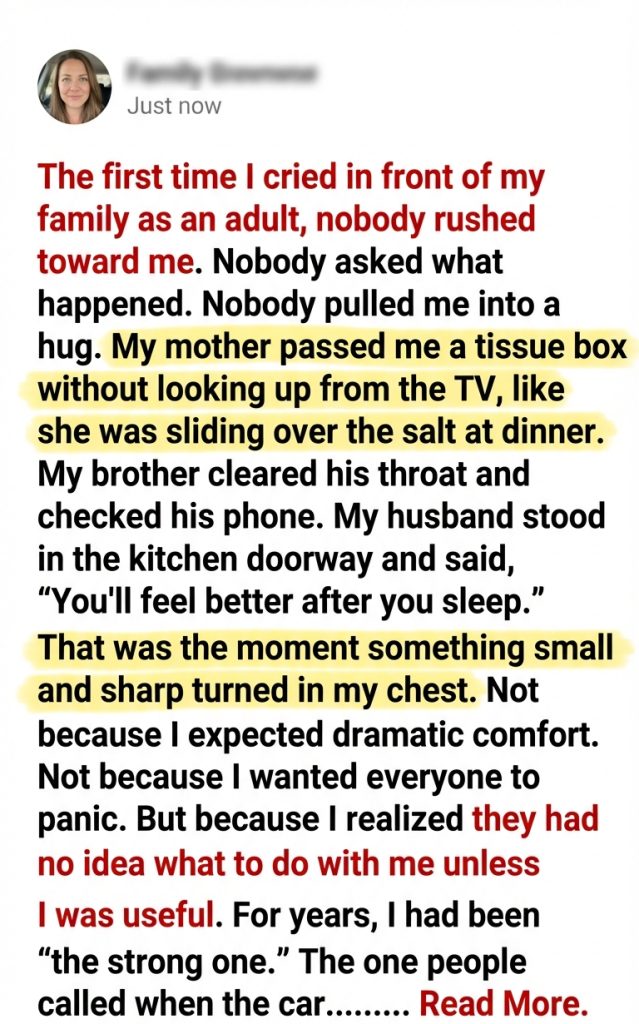
The first time I cried in front of my family as an adult, nobody rushed toward me.
Nobody asked what happened. Nobody pulled me into a hug. My mother passed me a tissue box without looking up from the TV, like she was sliding over the salt at dinner. My brother cleared his throat and checked his phone. My husband stood in the kitchen doorway and said, “You’ll feel better after you sleep.”
That was the moment something small and sharp turned in my chest.
Not because I expected dramatic comfort. Not because I wanted everyone to panic.
But because I realized they had no idea what to do with me unless I was useful.
For years, I had been “the strong one.” The one people called when the car wouldn’t start, when rent was short, when somebody needed a babysitter, a ride, a translator, a mediator, a backup plan, a calm voice, a little cash, a big favor, a soft place to land. I brought casseroles to funerals and cupcakes to school events. I remembered birthdays, doctor appointments, refill dates, and who wasn’t speaking to whom. I sent apology texts on behalf of people who should’ve sent their own.
I thought that made me loved.
It made me reliable.
There’s a difference, and you don’t always see it until the day you stop carrying everyone else.
My breaking point wasn’t one huge betrayal. It was a thousand tiny ones.
It was my husband, Tom, volunteering me to host his cousin’s baby shower after I had already worked six days straight. It was my younger brother, Nate, texting me “u up?” at midnight because he needed gas money again. It was my mother saying, “You’re just better at these things,” whenever I asked why I was the only one helping with her appointments.
I said yes so often that no one heard me when I started saying “I’m tired.”
Then one Saturday morning, I woke up and couldn’t move.
Not physically. I could move. I just lay there staring at the ceiling fan, listening to it click every fourth turn, and felt something in me go completely quiet. My body was heavy. My thoughts felt slow, like walking through water. I wasn’t sick. I wasn’t injured. I was emptied out.
Tom came in from his run, sweating and cheerful, and frowned when he saw me still in bed.
“You okay?” he asked.
It should have sounded caring. Maybe it did. But I heard what he meant: Are you still on schedule?
I sat up and tried to smile. “I don’t think I can do brunch today.”
He blinked. “With my sister?”
“I know. I just… I can’t.”
He pulled off his watch and set it on the dresser. “What do you mean, you can’t? You planned it.”
The room felt too bright. “I know I planned it. I’m saying I can’t do it.”
He stood there for a second, clearly waiting for a more acceptable explanation—fever, migraine, emergency, anything he could repeat to other people.
When none came, his face changed.
“Are you serious right now?”
That question did more damage than yelling would have.
Because it told me what my no meant in this house: inconvenience.
I started crying before I could stop myself. Quiet at first, then harder, the kind of crying that makes you angry because you know it’s only going to be used against you later as proof you were “emotional.”
Tom looked uncomfortable. “Hey, okay, don’t do this.”
This.
Not what happened?
Not you scared me.
Not sit down, tell me what’s going on.
Just don’t do this.
By noon, my mother had called three times, my brother had texted asking if I could still pick up his dry cleaning, and Tom’s sister had sent me a passive-aggressive “No worries, hope you’re feeling better :)” that somehow made me want to throw my phone into the wall.
So I did something I’d never done before.
I turned it off.
Not forever. Just for the weekend.
I texted one sentence first:
I’m not okay and I need some time. Please don’t ask me for anything today.
Then I set the phone face down and left it on the kitchen counter.
The silence that followed felt illegal.
At first, I paced. I cleaned the same mug twice. I folded and refolded a blanket. I kept expecting the front door to open and someone to come in worried. To hear footsteps running up the porch. To hear my name called in that tone that means you matter more than the plans.
No one came.
Around two o’clock, Tom left for brunch alone. He kissed the top of my head like he was heading to work and said, “Try to reset, okay?”
Reset.
Like I was a router.
When he was gone, I sat on the floor in the hallway and looked at the framed family photos lining the wall. Birthday dinners I organized. Beach trips I packed for. Christmas mornings where I was behind the camera because I was the one timing the food and wrapping the gifts and making sure everyone else got their moment.
I started to see something I had spent years missing.
In almost every memory, I was working.
That evening, there was a knock at the door.
Not pounding. Not impatient. Just a steady knock, then another.
I opened it expecting Tom, but it was Mrs. Alvarez from two houses down. Seventy if she was a day, silver hair braided down her back, always wearing house slippers and carrying herself like she had survived enough life to stop being impressed by anyone.
She held up a dented pot wrapped in a towel.
“Soup,” she said. “Open the door wider before I spill.”
I stepped back, confused. “Mrs. Alvarez—”
“I saw your husband leave. Then I saw you sit on your porch steps for twenty minutes staring at nothing.” She walked straight to the kitchen like she owned it, set the pot down, and turned to me. “That’s not a good sign.”
I laughed once, then started crying again.
She didn’t flinch.
She pulled out a chair and pointed to the one across from it. “Sit.”
I sat.
She ladled soup into a bowl, pushed it toward me, and said, “You don’t have to tell me if you don’t want to. But eat while you fall apart. It helps.”
I stared at her. “I’m embarrassed.”
She snorted. “For being human?”
“For not handling things.”
She gave me a look so sharp it could have cut string. “Who told you your only value is handling things?”
That question sat between us like a struck bell.
I ate because she told me to. Then I talked because she let me. Not all of it. Not the whole history. Just enough. How tired I was. How everyone expected me to keep being the calm one. How ashamed I felt for wanting care without having to earn it first.
Mrs. Alvarez listened, then nodded slowly.
“Ah,” she said. “You became useful before you became loved.”
I looked at her, stunned.
She tapped the table. “Many women do. Family gets very comfortable. They don’t always mean harm. But comfort can be cruel if no one pays attention.”
Tom came home around seven, carrying leftovers and an expression that shifted from annoyance to confusion when he saw Mrs. Alvarez at our table.
“Oh. Hi,” he said.
She smiled politely. “Your wife needed company.”
He glanced at me. “I was only gone a few hours.”
Mrs. Alvarez’s smile didn’t move. “Yes. And?”
The silence that followed was so clean it almost made me laugh.
Tom set the takeout down and mumbled something about changing clothes. When he went upstairs, Mrs. Alvarez leaned toward me and lowered her voice.
“Listen carefully,” she said. “The day you stop being the strong one, people show you exactly what they were taking for granted. Do not ignore that gift.”
Gift.
It didn’t feel like one yet. It felt like grief. But she was right.
Over the next few weeks, I started making changes so small they looked invisible from the outside.
I stopped answering every call immediately.
I stopped saying yes before checking how I felt.
I stopped fixing messes I didn’t make.
When my brother texted, Can you grab Mom’s prescription?, I wrote back, I can’t today. Try Nate—then stared at my phone like I’d committed a felony. He responded with three question marks and a guilt trip. I didn’t reply.
When Tom said, “Can you just handle dinner with my parents Friday?” I said, “No. I’m tired.” He looked at me like I was speaking another language.
Maybe I was.
The first honest conversation we had came two weeks later, after he finally stopped reacting to my boundaries like personal attacks.
We were in the kitchen again, of course. Most marriages rise or collapse there.
He leaned against the counter and asked, quieter this time, “Were you really that unhappy?”
I looked at him for a long moment.
“I was exhausted,” I said. “And I don’t think anyone noticed because I was still functioning.”
He flinched.
That didn’t fix everything. It didn’t turn him into a different man overnight. But it was the first time he listened without trying to schedule my feelings around his day.
My mother still calls me dramatic sometimes. My brother still jokes too much. I still feel guilty when I say no. Healing isn’t a straight line; it’s a muscle you train while shaking.
But now, when people praise me for being “so strong,” I pay attention to what they mean.
Do they mean resilient? Or convenient?
There’s a difference.
And if you ever stop carrying the weight and the room suddenly gets colder, don’t panic.
You didn’t become harder to love.
You just stopped making it easy for people to forget that you need love too.