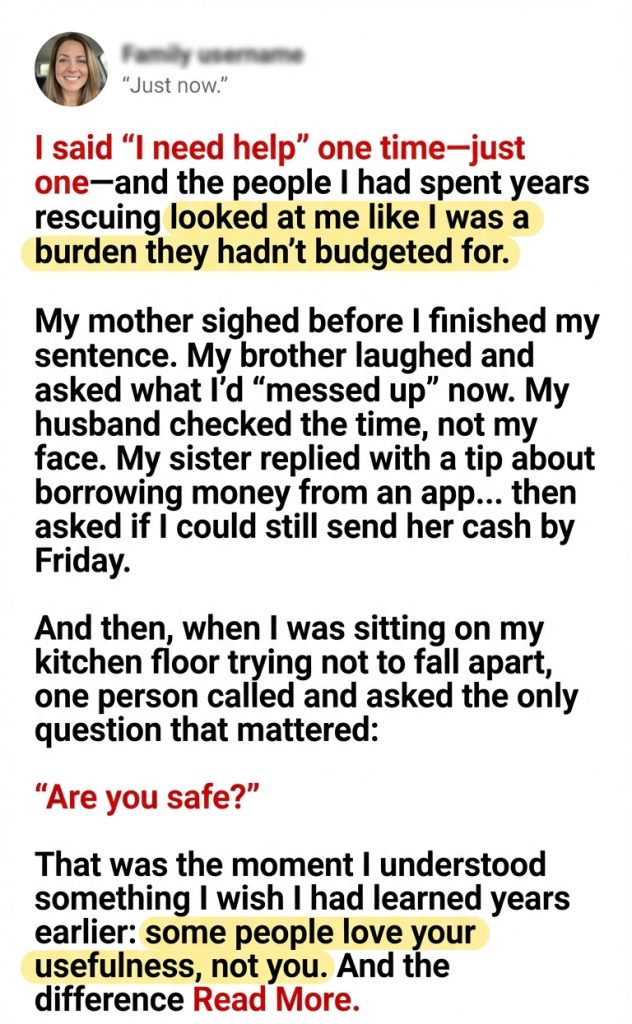
I said “I need help” one time—just one—and the people I had spent years rescuing looked at me like I was a burden they hadn’t budgeted for.
My mother sighed before I finished my sentence. My brother laughed and asked what I’d “messed up” now. My husband checked the time, not my face. My sister replied with a tip about borrowing money from an app… then asked if I could still send her cash by Friday.
And then, when I was sitting on my kitchen floor trying not to fall apart, one person called and asked the only question that mattered:
“Are you safe?”
That was the moment I understood something I wish I had learned years earlier: some people love your usefulness, not you. And the difference only shows when you stop performing strength.
For most of my life, I was the dependable one.
I was the daughter who answered every call, even when I knew it would end in a request. The sister who covered small emergencies that somehow became monthly habits. The wife who “held things together” so often that people forgot I was a person and started treating me like a system.
Need groceries before payday? Call Claire.
Need rent “just for this month”? Ask Claire.
Need someone to host dinner, calm everyone down, remember birthdays, fill out forms, lend gas money, pick up prescriptions, and stay polite while doing it? Claire.
I did it so well that eventually everyone assumed I needed nothing in return.
I used to call that love.
Now I call it training.
The morning everything changed started like any other—coffee cooling on the counter, laundry in the dryer, phone buzzing with messages I didn’t want to read yet. Except that morning, my chest felt tight in a way I couldn’t explain. Not a panic attack. Not exactly. More like the sudden certainty that if I kept living the way I was living, I would disappear inside it.
The night before, my husband Ryan and I had argued in that careful, civilized way that hurts more than shouting.
I had asked him—again—not to volunteer my time and money to his family without talking to me first.
He leaned against the kitchen counter, loosened his tie, and said, “You’re better at handling this stuff than I am.”
Handling this stuff.
That’s what my exhaustion was to him. A skill set.
I didn’t sleep much after that. By morning, I wasn’t angry anymore. I was clear.
So I did something I had never done before.
I sent one text in the family group chat:
I need help today. I’m not okay. Please call me.
I stared at the screen after sending it, pulse pounding harder than it should have. I told myself this wasn’t a test. I told myself I was just being honest.
That was only half true.
The first reply came from my sister Megan.
What happened??
For one brief second, relief flooded me.
Then the next message came.
Actually nvm I’m heading into work. Is this about money?
And then, twenty seconds later:
Also can you spot me $80 till Friday if it’s not too bad?
I looked at the screen and felt something inside me go very quiet.
My mother called next.
I answered on the second ring. “Mom?”
A long sigh. “Claire, what now?”
No hello. No concern. No what’s wrong, sweetheart?
I swallowed. “I’m having a hard day. I really need help.”
“With what?” she asked immediately. “Be specific.”
I sat down slowly at the kitchen table. “I don’t even know where to start.”
“Well, I can’t help if you’re going to be dramatic,” she snapped. “You always do this—send vague messages and make everyone panic.”
My fingers tightened around the phone. “I said I’m not okay.”
“And I’m telling you I’m too old to keep managing grown adults’ emotions before breakfast.”
I stared at the sunlight on the floor tiles while her words settled over me like cold dust.
“Mom,” I whispered, “I wasn’t asking you to manage me. I was asking if you cared.”
She went silent for one second too long.
Then she said, flatly, “I do care. I just don’t have time for theatrics.”
The line went dead.
I kept holding the phone to my ear, listening to the emptiness.
My brother Derek called ten minutes later. I almost didn’t answer, but some stupid part of me still hoped.
“What’s with the emergency text?” he said by way of greeting. I could hear a game on in the background, men yelling, a whistle blowing. “You okay or just spiraling again?”
I laughed once, and it sounded wrong even to me. “I asked for help, Derek.”
“With what?” he said. “If this is money, I’m tapped.”
“It’s not just money.”
“Then what is it?”
I opened my mouth and realized I had no language for the thing I needed. Rest? Kindness? Someone to sit in the room and not make me explain why I was tired all the way down to my bones?
“I don’t know,” I said honestly. “I just need someone.”
He was quiet for a second, and I thought—there, maybe there it is, maybe he heard me.
Then he snorted.
“You need a therapist, not a family group chat.”
He laughed like he’d solved something and hung up.
I sat there staring at my reflection in the dark microwave door.
I wasn’t even crying yet. I think I was too stunned by how familiar it all was.
That was the hardest part: none of it was surprising.
My husband came downstairs around noon, freshly showered, half-dressed for work, knotting his tie. He glanced at me, then at the untouched coffee and my phone on the table.
“You still upset?” he asked.
The phrasing hit me in the throat. Still upset—like my feelings were a weather delay.
I looked up at him. “I texted my family that I needed help.”
He nodded, distracted, reaching for his keys. “Okay?”
“And no one asked if I was okay.”
Ryan paused, finally meeting my eyes. “Claire, people have their own stuff.”
I stared at him.
He shifted his weight. “What do you want me to say?”
There it was again. The same question everyone asked, as if compassion required instructions.
“I want you to care without making me draft a plan first,” I said quietly.
He exhaled, impatient now. “That’s not fair.”
“Neither is this.”
He looked at the clock on the stove. “I have a meeting in twenty minutes. Can we do this tonight?”
Not Are you okay?
Not Do you want me to stay?
Not What happened?
Just a reschedule.
Something in me broke cleanly then—not explosively, not dramatically. More like a thread pulled free after years of tension.
I nodded once. “Go.”
He left with a quick kiss on my head that felt like habit, not comfort.
The front door clicked shut.
The house went silent.
I lasted maybe thirty seconds before I slid down the kitchen cabinet and sat on the floor with my knees pulled to my chest, crying so hard I could barely breathe. Not because of one bad day. Because of years. Because I had spent so long being “the strong one” that the first time I asked for softness, everyone treated me like a problem.
My phone buzzed again.
I almost ignored it, but I looked.
It was from my cousin Naomi.
We weren’t close in the way people define closeness. We didn’t talk every week. We didn’t trade secrets. But she was the kind of person who sent me sunrise photos sometimes with no caption, as if to say I saw something beautiful and thought of you.
Her message was short.
Saw your text. Are you safe?
I stared at those three words until my vision blurred.
Not What happened?
Not How much do you need?
Not What did you do?
Are you safe?
My hands shook as I typed back.
I don’t know. I think I just realized I’m not okay.
She called immediately.
I answered on the first ring, but I couldn’t speak.
“Claire?” Naomi said softly. I could hear quiet hospital sounds in the background—distant wheels, a soft overhead page. She worked nights as a hospice nurse. Her voice always sounded like she knew how fragile people could be and didn’t resent them for it.
I made some broken sound that might have been my name.
“It’s okay,” she said quickly. “You don’t have to explain yet. Just tell me this—are you alone?”
“Yes.”
“Do you want to be?”
I looked around my kitchen: the bills stacked neatly, the fruit bowl I kept full, the calendar I managed for two families, the life I maintained so well no one noticed I was exhausted inside it.
“No,” I whispered.
“Okay,” she said. “I’m coming.”
That was it.
No lecture. No diagnosis. No conditions.
I cried harder.
When Naomi arrived forty minutes later, she came in wearing scrubs under a gray hoodie, hair twisted into a loose bun, tote bag over one shoulder. She took one look at my face and opened her arms.
I stepped into the hug and held on like someone pulled from deep water.
We sat at the kitchen table for a long time. She didn’t force me to talk. She put a granola bar in front of me, then a glass of water, then waited.
When I finally spoke, everything came out.
Not just today. Everything.
How Mom called me dramatic whenever I needed comfort. How Derek mocked anything he couldn’t fix with sarcasm. How Megan only texted when she needed money. How Ryan praised me for being “practical” whenever he meant convenient. How tired I was of being useful. How ashamed I felt for needing proof that I mattered beyond what I provided.
Naomi listened without interrupting, elbows on the table, eyes steady on mine.
When I finished, she was quiet for a minute.
Then she said, “You know what hurts the most?”
I gave a wet laugh. “Pick one.”
She shook her head. “It’s not that they failed you today. It’s that they trained you to think asking for basic care was asking for too much.”
The words landed so hard I had to look away.
No one had ever said it like that.
Naomi reached across the table and squeezed my hand. “You’re not hard to love, Claire. You’re surrounded by people who got used to receiving.”
I started crying again, but this time it felt different. Less like collapsing. More like something leaving my body.
By late afternoon, my phone was full of missed calls and messages.
Mom: Call me when you calm down.
Derek: If this is another meltdown, don’t drag me into it.
Megan: So… is the $80 a no?
Ryan: We’ll talk tonight. Don’t make this bigger than it is.
Naomi read them, set the phone down, and looked at me. “Do you want me to stay when he gets home?”
I should have said no. Old habits die loud.
Instead, I said, “Yes. Please.”
Ryan walked in at six, loosened tie, controlled expression, and stopped when he saw Naomi at the table.
“Oh,” he said. “Didn’t know we had company.”
Naomi stood. “Hey, Ryan.”
He nodded but kept his eyes on me. “Can we talk privately?”
I looked at him, really looked. At the man I had spent eight years translating, accommodating, defending. At the man who could always explain why my needs should wait until after the meeting, after the trip, after the month got less busy.
“No,” I said. “Not tonight.”
His jaw tightened. “Claire—”
“I asked for help today.”
“I know, and I said we’d talk.”
“You said we’d talk later.”
He gave a short, frustrated laugh. “Because I was working.”
I stood up. My hands were shaking, but my voice was steady. “That’s exactly the point. I was drowning, and you offered me a calendar slot.”
The room went still.
Naomi didn’t move. Didn’t speak. Just stayed.
Ryan looked between us, suddenly aware of himself. “So what, this is an ambush?”
“No,” I said. “This is the first time I’ve said the truth out loud while someone kind was in the room.”
He stared at me, anger and confusion fighting across his face.
I expected myself to backtrack. To soften. To explain it in a way that protected everyone, including the people hurting me.
I didn’t.
That was the miracle.
The next few weeks changed my life, but not in one dramatic explosion. More like a series of doors opening quietly.
I found a therapist. A good one. On my second session, she asked, “When did you learn that being needed was safer than being known?” and I sat there speechless for what felt like an hour.
I stopped answering every call immediately.
I stopped lending money without written terms.
I stopped translating my feelings into bullet points to make them easier for other people to tolerate.
Ryan and I tried counseling. Some truths can be repaired. Some can only be acknowledged. We are still figuring out which ours are.
Mom still calls me dramatic sometimes. Now I say, “If that’s what you call honesty, okay,” and end the call.
Derek makes fewer jokes around me.
Megan still asks for money. The answer is usually no.
Naomi comes by on Sundays. We drink coffee on the porch and watch the light change. Sometimes we talk. Sometimes we don’t. She never makes silence feel like failure.
People think the biggest turning points in life are loud—accidents, betrayals, funerals, miracles. Sometimes they are.
But sometimes the moment that changes everything is smaller.
Sometimes it’s just this:
You finally say, I need help.
And in the silence that follows, you learn who loved your heart… and who only loved your hands.