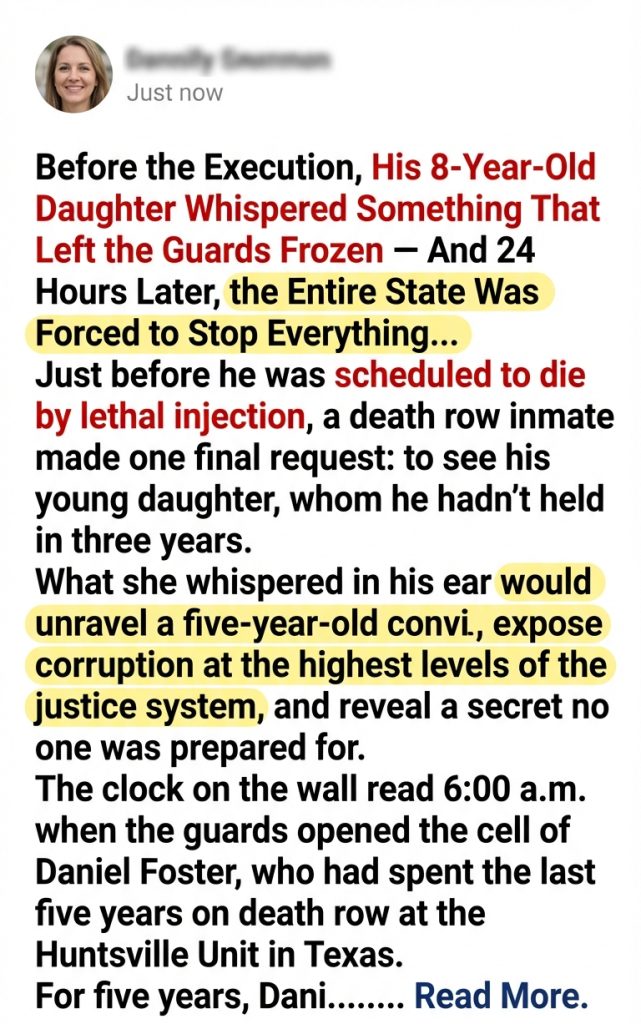
Before the Execution, His 8-Year-Old Daughter Whispered Something That Left the Guards Frozen — And 24 Hours Later, the Entire State Was Forced to Stop Everything…
Just before he was scheduled to die by lethal injection, a death row inmate made one final request: to see his young daughter, whom he hadn’t held in three years.
What she whispered in his ear would unravel a five-year-old conviction, expose corruption at the highest levels of the justice system, and reveal a secret no one was prepared for.
The clock on the wall read 6:00 a.m. when the guards opened the cell of Daniel Foster, who had spent the last five years on death row at the Huntsville Unit in Texas.
For five years, Daniel had shouted his innocence into concrete walls that never answered back. Now, with only hours left before his scheduled execution, he had just one request.
“I want to see my daughter,” he said, his voice hoarse. “Just once. Please let me see Emily before it’s over.”
One guard looked at him with sympathy. Another shook his head.
But the request reached the desk of Warden Robert Mitchell, a 60-year-old veteran who had overseen more executions than he cared to remember. Something about Daniel’s case had always unsettled him. The evidence had seemed airtight—his fingerprints on the weapon, blood on his clothes, a neighbor claiming to see him leaving the house that night.
Yet Daniel’s eyes never looked like those of a killer.
After a long pause, Mitchell gave the order. “Bring the child.”
Three hours later, a white state vehicle pulled into the prison lot. A social worker stepped out, holding the hand of an eight-year-old girl with blonde hair and solemn blue eyes.
Emily Foster walked through the prison corridor without crying. Without trembling. Inmates fell silent as she passed.
When she entered the visitation room, Daniel was shackled to the table, thinner than she remembered, wearing a faded orange jumpsuit.
“My baby girl…” he whispered, tears filling his eyes.
Emily stepped forward slowly. She didn’t run. She didn’t cry.
She climbed onto the chair across from him, studied his face for a long second, then leaned in as far as the chain on his wrists would allow.
The guards turned away out of habit, giving them a fragment of privacy in a room built to deny it.
Emily cupped her small hand to Daniel’s ear and whispered.
Daniel’s face went white.
Not pale from grief. Not the trembling collapse of a man saying goodbye.
This was shock.
A hard, instant shock that seemed to knock the breath out of him.
He jerked against the shackles so suddenly one guard stepped forward, hand near his belt. “Foster!”
Daniel ignored him. He stared at Emily as if seeing her for the first time.
“Who told you that?” he whispered.
Emily’s voice was soft, almost matter-of-fact. “I heard them. In the garage. Uncle Ray said if you talked, they’d make me disappear too.”
The room changed.
One guard stopped moving.
The other looked at the warden’s aide standing near the door.
Daniel’s lips trembled. “Emily… when?”
“The night Mommy died,” she said. “I was hiding in the laundry basket like I always did when they fought.” She looked down at her hands. “I saw the blue truck. Uncle Ray was there. And the policeman. The one with the snake tattoo.”
Daniel shut his eyes and made a sound that was half sob, half gasp.
Warden Mitchell, who had entered quietly moments earlier to observe the visit, stepped fully into the room. “What did she say?”
Daniel looked up, raw panic in his face now. “She knows. She remembers that night. She saw Raymond. My wife’s brother. And a cop.”
The social worker went rigid. “Warden—”
Mitchell raised a hand, silencing everyone.
He had heard hundreds of last-minute claims. Confessions, denials, accusations thrown like sparks against a storm. Most came from desperation. But this was different. The child hadn’t come in crying. She hadn’t asked for promises. She had delivered a detail—a specific one.
Snake tattoo.
Mitchell’s mind moved fast.
There had been an officer on scene that night before detectives sealed the house. Patrolman Curtis Bell. Transfer from narcotics. Mitchell remembered because Bell later left the department under “medical retirement” after an internal complaint disappeared.
“Clear the room,” Mitchell said.
The aide blinked. “Sir? The execution protocol—”
“I said clear the room except the social worker and one camera operator. Now.”
Within minutes, the visit room became an improvised interview space. Mitchell crouched to Emily’s eye level, his voice low and careful.
“Emily, do you know what a lie is?”
She nodded.
“Are you telling me the truth right now?”
She looked offended. “Yes.”
“Can you tell me exactly what you saw?”
And she did.
Not like a coached child. Not in polished sentences. In fragments, pauses, sensory pieces children remember because terror brands details differently than adults understand.
Her mother screaming.
The smell of gasoline from the garage.
Her uncle Raymond’s boots.
A police flashlight beam moving across the kitchen wall.
Her father arriving later, shouting, slipping in blood.
The shiny thing put in Daniel’s hand while he was on his knees.
Mitchell listened without interrupting, his stomach tightening with each detail.
The original conviction hinged on timing. Prosecutors argued Daniel killed his wife during a violent argument, then staged panic. But if Raymond and a responding officer were inside before Daniel touched the weapon…
The fingerprints, the blood, the eyewitness timeline—it all shifted.
At 11:14 a.m., two hours before the scheduled execution, Warden Mitchell made a call he had never made in his career.
“To the Governor’s legal office,” he said. “Emergency stay request. New witness testimony. Minor child. Possible law enforcement contamination of scene.”
The line went silent.
Then the clerk said, “Warden, the execution is set for 1:05.”
Mitchell looked through the glass at Daniel, who sat staring at Emily like she had dragged him back from the edge of a cliff.
“I know exactly what time it is,” Mitchell said. “Stop everything.”
The next hour moved like a fire through dry grass.
The attorney general’s office demanded recordings. Mitchell sent them.
The district attorney called the claim “a manipulative delay tactic.” Mitchell sent Emily’s full statement, timestamped, with no edits.
A retired investigator Mitchell trusted watched the footage and called back in under ten minutes.
“Bob… the kid mentions Bell’s tattoo before anyone asks about police. That detail was never public.”
At 12:37 p.m., twenty-eight minutes before the execution, the Governor’s office issued a temporary 72-hour stay pending emergency review.
The order reached the chamber while staff were already preparing the IV lines.
For the first time in years, Daniel Foster was walked away from the execution room.
He broke down only when he reached the holding cell.
Not from fear.
From hearing the steel door close while he was still alive.
By nightfall, every major station in Texas had the story.
DEATH ROW EXECUTION HALTED AFTER CHILD WITNESS CLAIM
8-YEAR-OLD’S STATEMENT TRIGGERS EMERGENCY REVIEW
But the real earthquake came the next morning.
A state investigator reopened internal personnel files and found that Officer Curtis Bell’s “medical retirement” had followed an unpursued complaint about evidence handling. Another buried file connected Bell to gambling debts. A subpoena hit Bell’s bank records before noon.
At 10:09 a.m., Raymond Hale—Emily’s uncle—tried to flee from a motel outside Lufkin.
He was arrested with cash, a burner phone, and a handgun registered to a dead man.
Under questioning, he denied everything for four hours.
Then investigators showed him the revived forensic timeline, Bell’s financial records, and the prison video of Emily calmly describing the garage.
Raymond asked for a lawyer.
Bell never got that far.
At 4:22 p.m., state police found Curtis Bell in his truck behind an abandoned feed store. Alive, drunk, and talking too much. By the time the interview was recorded, he had admitted to entering the Foster home before detectives arrived and “fixing” the scene at Raymond’s request in exchange for money.
What no one was prepared for was why.
Daniel’s wife, Sarah Foster, had discovered Raymond skimming funds from their late father’s construction business. She threatened to expose him. Raymond confronted her that night. The argument turned violent. Sarah hit her head on the workbench in the garage and died within minutes.
Panicked, Raymond called Bell, a friend from high school with debts and a badge.
They staged the scene to point to Daniel, knowing he and Sarah had argued recently and that Daniel was driving home from a work trip with no witness for part of the night.
Daniel arrived to a nightmare already arranged.
And for five years, the state nearly killed the wrong man.
Twenty-four hours after Emily’s whisper, the state did what it almost never does once the machinery is moving:
It stopped.
The governor ordered a full review of the case.
The district attorney announced an “independent reassessment,” his face stiff under camera lights.
The prison suspended two internal procedures related to last-minute witness handling.
And in a rare statement, the Texas Department of Criminal Justice confirmed that Daniel Foster’s execution would remain halted “until all evidentiary and procedural concerns are resolved.”
Warden Mitchell watched the announcement from his office, jacket off, tie loosened, eyes fixed on the screen.
One of his officers stood in the doorway and said quietly, “You did the right thing.”
Mitchell didn’t answer right away.
He was thinking of all the other men he had watched walk the same corridor. Thinking of concrete walls, closed files, and how close this one had come.
Finally, he said, “A child did the right thing. I just listened.”
Three weeks later, Daniel’s conviction was vacated.
Three months after that, charges were dismissed.
When Daniel walked out of Huntsville under a pale morning sky, he paused at the gate like he didn’t trust the world to stay open. Emily stood beside the social worker in a yellow dress with a missing button and a stuffed rabbit tucked under one arm.
This time, she ran.
Daniel dropped to his knees before she reached him, arms open, sobbing into her hair as she wrapped herself around his neck.
Cameras clicked. Reporters shouted questions. Lawyers crowded close.
Emily ignored all of them.
She pulled back just enough to look at him and whispered something again in his ear.
Daniel laughed through tears.
Later, when a reporter asked what she had said the first time—the words that stopped an execution and shook the state—Daniel only shook his head and looked at his daughter.
“That was for me,” he said.
But years later, when he finally spoke about it at a justice reform hearing, his voice broke as he repeated the sentence that saved his life:
“Daddy, I remember the blue truck. You didn’t do it.”
Sometimes truth arrives with sirens, confessions, and headlines.
And sometimes it arrives in a child’s whisper—soft enough to miss, powerful enough to stop a state in its tracks.