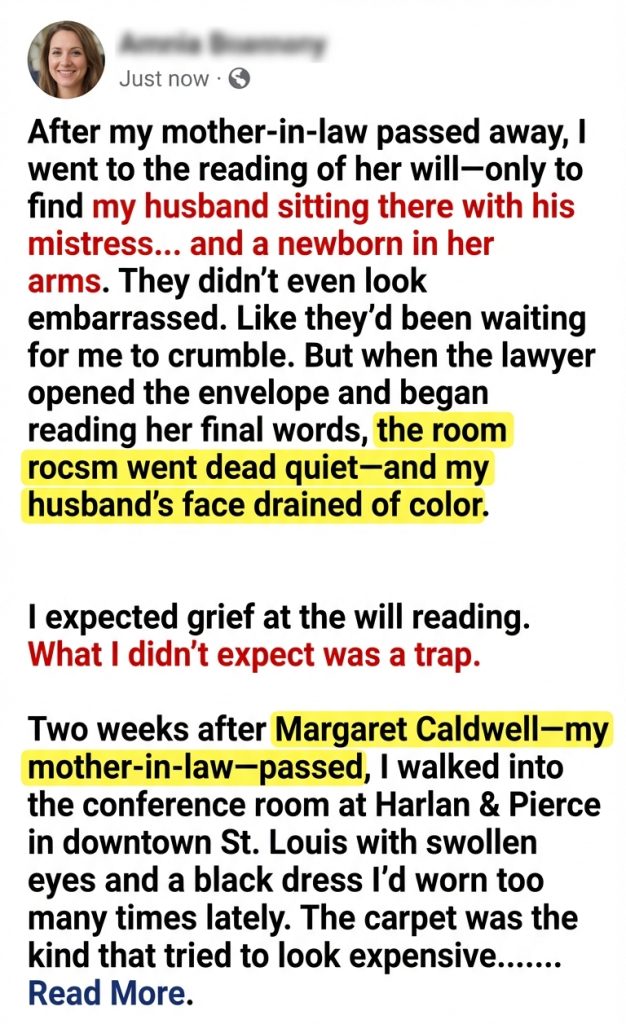
After my mother-in-law passed away, I went to the reading of her will—only to find my husband sitting there with his mistress… and a newborn in her arms. They didn’t even look embarrassed. Like they’d been waiting for me to crumble. But when the lawyer opened the envelope and began reading her final words, the room went dead quiet—and my husband’s face drained of color.
I expected grief at the will reading. What I didn’t expect was a trap.
Two weeks after Margaret Caldwell—my mother-in-law—passed, I walked into the conference room at Harlan & Pierce in downtown St. Louis with swollen eyes and a black dress I’d worn too many times lately. The carpet was the kind that tried to look expensive and still smelled like old coffee. A framed print of the Gateway Arch hung crooked behind the head of the table.
And at the far end, already seated like they owned the place, were my husband and the woman I’d spent the last year denying existed.
Ethan didn’t stand. He didn’t even flinch. He just rested a hand on the chair beside him—like he was saving a spot.
For her.
Lauren Whitaker looked up and smiled, calm as a Sunday brunch. She wore a pale blue wrap dress, hair curled neatly, and in her arms was a newborn bundled in a gray knit blanket. The baby’s tiny fist flexed against her chest.
My mouth went dry. My fingers tightened around my purse strap until the leather creaked.
“You brought a baby,” I managed.
Lauren’s smile didn’t change. “He’s Ethan’s,” she said, like she was reading off a menu.
Ethan finally looked at me. Not guilty. Not apologetic. Just tired—like I was the problem that wouldn’t stop showing up.
“We didn’t want you to hear it from anyone else,” he said.
I laughed once, sharp and ugly. “At my mother-in-law’s will reading. How thoughtful.”
The door opened behind me, and Attorney James Harlan entered with a folder and a careful expression. He paused when he saw the baby, then recovered fast—the kind of man trained to keep his face neutral.
“Mrs. Caldwell requested everyone be present,” he said, nodding at me. “Ms. Whitaker is… included.”
Included. The word hit like a slap. Margaret hadn’t just known. She’d planned for this.
I sat, slowly, because my legs were suddenly unreliable. I stared at Ethan’s wedding ring, the gold catching the fluorescent light. He’d worn it. He’d worn it here.
Harlan opened the folder and cleared his throat. “Margaret Caldwell executed her final will and testament on March 3rd,” he began. “She also left a personal statement to be read aloud.”
Ethan leaned back as if he were already counting money. Lauren adjusted the baby and looked at me with something that might’ve been pity—or victory.
Harlan unfolded a single sheet of paper. His voice became more deliberate.
“To my daughter-in-law, Claire,” he read, “if you are hearing this, then Ethan has finally shown you who he truly is.”
Ethan’s posture stiffened.
Harlan continued, “And that means it’s time for you to see what I’ve done—so you can stop thinking you’re powerless.”
The room went silent except for the soft, impatient squeak of a newborn’s breath. And for the first time, Ethan looked uncertain.
Harlan glanced up once, then kept reading.
“Claire, you came into this family with kindness, patience, and more dignity than my son deserved. I watched you hold this household together while Ethan played at responsibility and called it hard work. I also watched you make excuses for him long after I stopped.”
My throat tightened.
Margaret and I had not always been easy with each other. She was old-school sharp, exacting, the kind of woman who folded towels like they were military orders and noticed when a spoon was missing from a drawer. In the first years of my marriage, I spent half my life trying to impress her and the other half trying not to cry in her guest bathroom.
But after her husband died, something softened between us. She began inviting me over for coffee without Ethan. She asked questions and actually listened to the answers. Once, when Ethan canceled our anniversary dinner for a “client emergency” that turned out to be a bar tab and bad lies, she handed me a glass of wine and said, very quietly, “My son mistakes loyalty for permission. Don’t let him.”
I hadn’t understood then how much she already knew.
Harlan’s voice carried on, steady and precise.
“I am including Lauren Whitaker and the child she carries because the truth should not be hidden in corners any longer. The baby is innocent. The adults are not.”
Lauren’s chin lifted, but her mouth tightened at the edges.
Ethan spoke for the first time since the letter began. “This is unnecessary.”
Harlan didn’t even look at him. “You may speak when I finish, Mr. Caldwell.”
The baby squirmed and made a tiny mewling sound. Lauren bounced him automatically, eyes locked on Harlan.
“Over the past fourteen months,” Harlan read, “I hired a private investigator after noticing irregular withdrawals from my personal accounts and suspicious transfers tied to Ethan’s business debts. I also learned of his affair with Ms. Whitaker, his use of marital funds to support a second household, and his intent to pressure Claire into signing over her claims once my estate was settled.”
Every word landed like a dropped stone.
I turned toward Ethan so fast my chair legs scraped the carpet. “My funds?”
He stared straight ahead, jaw hard.
My mind was suddenly racing back through all the little gaps: the credit card “fraud alerts,” the mortgage payment he said posted late, the time he asked me to “spot” five thousand from our joint savings because payroll was delayed on a project. The way he started pushing me to “simplify paperwork” after Margaret’s diagnosis. The insurance forms he wanted me to sign when I was exhausted and distracted.
I’d told myself marriage was messy. That finances got complicated. That grief made people impatient.
No. He had been laying pipe for an escape route.
Harlan turned a page.
“My son believes money is leverage and women are easiest to manage when they are tired, ashamed, or grieving. He is wrong.”
The silence in the room turned electric.
Ethan finally snapped. “My mother was medicated half the time. She was paranoid.”
Harlan lowered the page and looked at him over his glasses. “Mr. Caldwell, the letter is one thing. The documentation is another.”
He tapped the folder.
Ethan’s face changed. Just slightly—but enough. The confidence went first.
Lauren looked at him then, really looked, like she was recalculating.
Harlan resumed.
“To be very clear: Claire is not to be disinherited, displaced, or pressured. If Ethan contests these instructions or attempts to interfere with the transfers I have arranged, his inheritance shall convert to a restricted trust administered by independent counsel, with no direct access to principal.”
Ethan sat up. “What?”
Harlan read on.
“The Caldwell house on Linden Avenue, which Ethan assumes will pass to him outright, has already been deeded into the Margaret Caldwell Living Trust and is not his to liquidate.”
Ethan’s face drained, exactly as I’d been promised.
Lauren’s hand stopped bouncing the baby.
Harlan continued, voice calm as a blade. “The trust grants Claire Caldwell the exclusive right to occupy the house for ten years, rent-free, with maintenance paid from estate income. If she chooses not to live there, she may lease it and retain all net rental income during that term.”
I stared at him, certain I’d misheard.
My name. The house. Ten years.
The room swayed for a second—not from fear this time, but from the sudden violent shift of reality. Ethan had dragged his mistress and baby here thinking he was unveiling my humiliation. Margaret, from the grave, had arranged the room for his.
Lauren turned to Ethan, voice low and sharp. “You told me the house was yours.”
He didn’t look at her. “It should be.”
Harlan ignored them both.
“In addition, the brokerage account ending in 4421 and the municipal bond ladder held in my name shall pour into a separate trust for my grandson, Owen Whitaker, contingent upon paternity being legally established. This is not a reward for betrayal. It is protection for a child who did not choose his parents.”
Lauren’s lips parted in surprise. Real surprise. So Margaret had kept at least one secret from everyone.
A faint crack opened in Lauren’s polished expression, and for the first time I saw not a smug mistress, but a woman holding a baby and trying to understand what kind of man she had built a future on.
Harlan took a breath and delivered the line that changed everything.
“Finally, to Claire: in the top drawer of my writing desk is a sealed packet marked with your name. Inside are account summaries, copies of investigative reports, and a notarized statement regarding marital asset misuse by Ethan Caldwell. Use them if you need to. Burn them if you don’t. But stop protecting people who build their comfort from your silence.”
My eyes burned.
I could see Margaret’s desk in my mind—dark cherrywood, always polished, pens aligned beside a crystal paperweight. I’d dusted that desk while she was in hospice because she hated “sloppy surfaces,” and even then she’d apparently been planning for a war I refused to admit I was in.
Harlan lowered the letter.
No one spoke.
Even the baby was quiet, only a soft whistle of breath through his tiny nose.
Then Ethan stood up so abruptly his chair rolled backward.
“This is insane,” he said. “She can’t do this. She was sick. Claire manipulated her—”
The accusation hit me like cold water. I stared at him, almost amazed.
“Manipulated her?” I repeated. “You brought your mistress and child to your mother’s will reading.”
He turned on me, anger covering panic. “Because this was supposed to be honest!”
Lauren let out a short, disbelieving laugh. “Honest?” she said. “You told me your mother approved of us. You said Claire knew everything. You said the house and your business payout were basically done.”
Ethan hissed, “Lauren, not now.”
“Not now?” Her voice rose, the baby beginning to fuss at the vibration in her chest. “When exactly was I supposed to ask why your dead mother hired a private investigator?”
Harlan gathered the papers into a neat stack, the only calm person in the room. “Mr. Caldwell, if you intend to contest the will, that is your right. But I advise you to review the no-contest clause before making statements you cannot walk back.”
Ethan’s eyes snapped to him. “There’s a no-contest clause?”
Harlan gave him a thin look. “Your mother believed in consequences.”
That was when I laughed.
Not because anything was funny. Because the pressure inside me had nowhere else to go.
I laughed once, then pressed my fingers to my lips as tears sprang to my eyes—grief, humiliation, rage, relief, all of it colliding at once. Margaret was dead. My marriage was dead. The room smelled like old coffee and baby powder and legal paper, and somehow in the middle of all that ruin, she had reached across death to hand me a spine.
Ethan looked at me like he’d never seen me before.
Maybe he hadn’t.
Harlan slid a tissue box toward me without comment. “Mrs. Caldwell,” he said gently, “I recommend you collect the sealed packet today. I can have my assistant accompany you to the house if you prefer.”
Ethan barked out a laugh. “You’re not letting her go through my mother’s things alone.”
Harlan’s expression didn’t change. “It is not your decision.”
Lauren stood up carefully, adjusting the baby on her shoulder. “I want a copy of whatever concerns my son.”
Harlan nodded once. “Once paternity is confirmed, appropriate documents will be provided through counsel.”
She stared at Ethan for a long moment—long enough to make it clear this conversation was far from over—then looked at me. The victory I thought I saw earlier was gone. In its place was something messier. Embarrassment. Anger. Maybe even sympathy.
“I didn’t know about the money,” she said quietly.
I believed her.
I also didn’t care enough to comfort her.
“Now you do,” I said.
I expected her to snap back. Instead, she gave one tight nod, shifted the baby higher, and walked out.
The door clicked shut behind her. Owen let out one indignant little cry in the hallway.
Ethan looked like he might follow, but he stayed rooted to the spot, breathing hard. He turned to me, lowering his voice into that familiar tone he used when he wanted to sound like the reasonable one.
“Claire, listen to me. My mother always hated how I ran things. She wanted control. This is her punishing me.”
I stared at him.
Years of little humiliations flashed through me in sharp frames: him rolling his eyes when I asked about missing money; him calling me “too emotional” when I questioned a transfer; him staying out all night and saying I was “starting drama” for noticing; him wearing his ring while building another life.
“No,” I said quietly. “This is your mother documenting you.”
He stepped closer. “Don’t do this.”
“Do what?”
“Turn one letter into a divorce.”
I almost smiled at the absurdity.
“One letter?” I repeated. “You brought your mistress and newborn to your mother’s will reading.”
His jaw flexed. “I was going to tell you.”
“At the table. In front of your dead mother’s lawyer.” I stood slowly, my purse strap cutting into my shoulder. “You didn’t come here to tell the truth. You came here to manage the fallout.”
For the first time, real fear showed on his face. Not fear of losing me—I saw that clearly now—but fear of losing position. Money. Narrative. Advantage.
“Claire,” he said, softer now, almost pleading. “Don’t let Harlan and my mother turn you against me.”
I looked past him at the crooked Gateway Arch print and thought, not for the first time, that men like Ethan always believed women were naturally loyal to the nearest voice spoken with confidence.
Margaret had been right.
I had been tired. Ashamed. Grieving.
I was still grieving.
But I wasn’t powerless.
“I don’t need anyone to turn me,” I said. “I can read.”
I walked around him and headed for the door.
Behind me, Harlan spoke in that maddeningly calm attorney voice. “Mr. Caldwell, you should sit down. There are additional trust administration details to discuss.”
I didn’t stay to hear Ethan obey.
Margaret’s house on Linden Avenue smelled like lemon polish and old books when I arrived two hours later with Harlan’s assistant, a brisk woman named Tessa who wore flats and moved like she’d been managing rich people’s chaos for a decade.
Sunlight cut across the entry hall in long bars. The grandfather clock still ticked. Margaret’s reading glasses were still on the side table beside her chair, folded neatly over a half-finished crossword.
The grief hit me there, hard and sideways.
I put a hand on the wall and closed my eyes.
Tessa waited without speaking.
After a minute, I straightened and made my way to the study.
Margaret’s writing desk sat by the window exactly as I remembered. Top drawer, right side. The key was in the blue porcelain dish shaped like a leaf because Margaret believed “hiding keys is how fools lose them.”
My fingers shook as I unlocked the drawer.
Inside, beneath a stack of stationery and two fountain pens, was a large manila packet with my name in Margaret’s neat script: Claire. Open only when you are done pretending.
I laughed through tears.
Inside were exactly what Harlan had said: bank summaries, flagged transfers, copies of private investigator reports, screenshots of messages, and a notarized timeline. Margaret had highlighted amounts in yellow and written crisp notes in the margins.
Joint account draw for “vendor payment” — actually lease on apartment used by E.C.
Credit card purchase: jewelry, not business expense.
Claire covering mortgage while unaware.
Do not let him gaslight her.
At the very bottom was a smaller sealed envelope.
I opened it sitting in Margaret’s desk chair, sunlight warming my knees through the black fabric of my dress.
The note inside was only a page long.
Claire,
By the time you read this, I will be gone, and my son will have mistaken that for an opportunity.
I was not always kind to you. Some of that was pride. Some of it was watching too long how women in this family survive by swallowing what should be said. You were better than this house, and you were kind to me anyway.
I cannot undo what Ethan has done. I can make it harder for him to profit from it.
Take the house if you want peace. Rent it if you want freedom. Sell nothing in grief. Sign nothing tired. And for God’s sake, stop asking whether his behavior “counts.” If it makes you smaller, it counts.
—Margaret
I sat there and cried until the page blurred.
Not pretty crying. Shoulder-shaking, nose-running grief that came from too many funerals, too many excuses, too many years of trying to be the woman who could absorb anything and still set the table.
When I finally stood, I felt wrung out and strangely clear.
I used Tessa’s phone to call a divorce attorney before I left the house.
Not tomorrow. Not after I “calmed down.” Right there, with Margaret’s notes in my purse and her words still hot in my chest.
The woman who answered was named Renée Malloy. Her consultation fee was high enough that old Claire would have hesitated.
New Claire gave Tessa a nod, booked the earliest slot, and said, “I have documentation.”
Renée’s voice sharpened with interest. “Good. Bring all of it.”
The weeks after the will reading were brutal, but not in the way Ethan expected.
He sent texts first—apologies shaped like strategy. Then accusations. Then nostalgia. Then anger.
We can fix this.
You’re humiliating me.
Lauren means nothing compared to our marriage.
My mother poisoned you against me.
If you file, things will get ugly.
I forwarded every message to Renée and stopped replying.
Lauren texted once, surprisingly direct: Paternity confirmed. Trust is real. I’m not contacting you again. For what it’s worth, I’m sorry.
I stared at that message for a long time, then typed back only: Take care of your son.
Ethan contested two small provisions and backed down after Harlan sent him the no-contest clause with a cover letter so polite it was practically a threat. He tried to access funds Margaret had restricted and triggered an automatic trust review. He called me six times in one afternoon after that.
I let every call go to voicemail.
Meanwhile, I moved into the Linden Avenue house for a while—not because I wanted Ethan’s mother’s life, but because I needed quiet that wasn’t full of his voice.
The first night there, I slept in Margaret’s guest room with the windows cracked open and woke at 4:00 a.m. in total silence except for the clock downstairs. No slamming cabinets. No excuses. No phone buzzing at midnight with half-truths.
Just air.
Grief still came. It came while folding laundry. It came in the grocery store when I reached automatically for Ethan’s favorite coffee and had to put it back. It came when I found Margaret’s recipe card for lemon cake and realized she’d underlined don’t overmix three times because she knew I always did.
But underneath the grief, something steadier began to grow.
Not happiness.
Capacity.
Renée filed. Harlan coordinated trust transfers. Tessa connected me with a property manager when I decided to lease the house after all and move into a smaller place closer to my office. Margaret had been right again: don’t sell anything in grief.
I didn’t.
Six months later, I stood in a sunlit kitchen in a condo I chose myself, signing the lease renewal for a tenant family who adored the Linden Avenue garden and sent me photos when the hydrangeas bloomed. I kept one framed on the counter.
People still ask sometimes what “the final straw” was, as if betrayal becomes valid only after a dramatic enough reveal.
I tell them the truth.
It wasn’t just the mistress. Or the baby. Or even the will reading.
It was the moment I heard Margaret’s letter and realized someone who owed me nothing—not even kindness, for most of our history—had seen exactly what I was living through and planned, carefully, to leave me proof.
Proof that I wasn’t crazy.
Proof that I wasn’t weak.
Proof that his charm was a costume.
Proof that silence was never my only option.
At the will reading, Ethan thought he was bringing me to a collapse.
Instead, he brought me to a witness.
And when Harlan opened that envelope and Margaret’s final words filled the room, the silence that followed wasn’t mine anymore.
It was his.