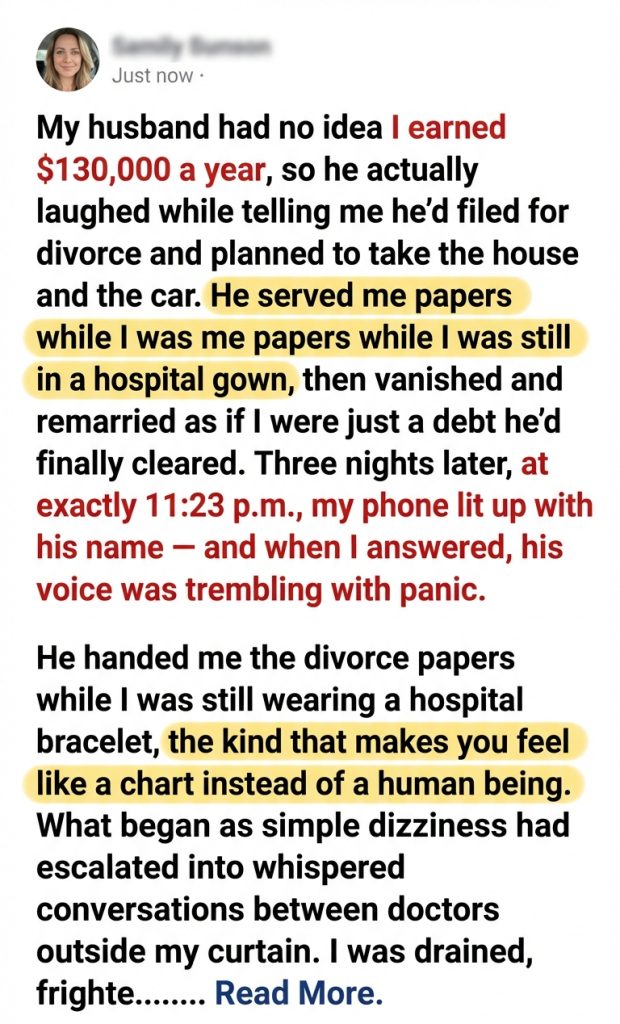
My husband had no idea I earned $130,000 a year, so he actually laughed while telling me he’d filed for divorce and planned to take the house and the car. He served me papers while I was still in a hospital gown, then vanished and remarried as if I were just a debt he’d finally cleared. Three nights later, at exactly 11:23 p.m., my phone lit up with his name — and when I answered, his voice was trembling with panic.
He handed me the divorce papers while I was still wearing a hospital bracelet, the kind that makes you feel like a chart instead of a human being. What began as simple dizziness had escalated into whispered conversations between doctors outside my curtain. I was drained, frightened, barely steady.
He walked in smiling — no flowers, no worry, just that smug satisfaction like he’d outplayed me.
“I filed,” he said loudly. “I’m taking the house and the car, lol.”
He laughed like it was a joke, then dropped a manila envelope on my lap. Everything was already signed on his end, highlighted where I was supposed to comply — like I was just paperwork waiting to be processed.
I read the words as my heart pounded. House. Car. Accounts. He’d marked them off like a shopping list. The shocking part wasn’t that he wanted it all — it was how convinced he was that I couldn’t stop him.
Because he didn’t know I made $130,000 a year.
For years, he treated my career like a side hobby. He preferred the quiet version of me — dependable, bill-paying, non-threatening. I never corrected him about my income. I didn’t need to. I kept my earnings separate, built savings quietly, and watched him spend as if consequences were optional.
He leaned in, voice soft. “You can’t afford to fight this. Just sign.”
I didn’t cry. I didn’t argue. I simply asked, “You’re leaving me here?”
“You’ll be fine,” he shrugged. “Hospitals fix people.”
Then he walked out.
By the time I was released, he’d already moved out. Within weeks, I heard he’d remarried — quickly, extravagantly — like he needed a stage to prove he’d replaced me. People expected me to be crushed.
I wasn’t.
I felt clear.
Three days after his wedding, at 11:23 p.m., his name flashed across my screen. I hesitated — then answered.
There was no laughter this time.
Only fear.
“Please,” he said, voice breaking. “Tell me what you did.”
Behind him, a woman was crying like her world had just collapsed.
I sat up straighter in bed, my apartment dark except for the lamp on the nightstand and the blue glow of my laptop still open to a spreadsheet. Rain tapped softly against the window. For one surreal second, I thought I was still in the hospital and the call was part of a fever dream.
Then his wife sobbed again in the background, raw and panicked, and I knew this was real.
“Marcus,” I said, keeping my voice flat. “It’s 11:23.”
“I know what time it is!” he snapped, then caught himself. “Please. Please, just tell me what you did.”
I stared at the phone, at his name on my screen, remembering the same mouth laughing in my hospital room while I wore a paper-thin gown and an IV bruise. My fingers tightened around the phone, but my voice stayed calm.
“I didn’t do anything,” I said. “What happened?”
A pause. Breathing. Muffled whispering on his end. I could hear cabinet doors, footsteps, the sound of someone moving fast through a house trying to find control.
Then he spoke again, lower this time. “The accounts are frozen.”
I blinked once.
“Which accounts?”
“All of them,” he said, voice cracking with anger and fear. “Joint checking. The card. The line of credit. Even the house payment account. The transfer I made bounced. My card got declined at dinner. Then hers did too.” He lowered his voice further, as if shame had finally entered the room. “There’s a notice. Fraud review. Financial hold. My payroll deposit is gone. The mortgage site says the ownership details are under legal review.”
I leaned back against the headboard, suddenly understanding.
Not luck. Consequences.
“Did you read the divorce response my attorney sent?” I asked.
Silence.
That told me everything.
I had sent it that morning through certified service and email. Thick, polite, devastating. A formal response contesting his filing, requesting emergency temporary orders, and—most importantly—documenting unauthorized withdrawals, asset concealment, and financial misconduct tied to our joint obligations. My attorney, Dana, had moved faster than he expected because men like Marcus only planned for the version of women they thought they’d married.
He thought he married someone passive.
He married someone organized.
“Marcus,” I said quietly, “you tried to strip marital assets while I was in a hospital bed.”
“It was a joke—”
“No,” I cut in. “The ‘lol’ was a joke. The paperwork was real.”
Behind him, the woman—his new wife, apparently—said something sharp through tears. I couldn’t make out the words, but I heard my name.
He hissed away from the phone, then came back. “Look, whatever your lawyer did, undo it. Right now. You made your point.”
I laughed once, short and humorless. “I didn’t make a point. I protected myself.”
“That house is in my name too!”
“And the mortgage was being paid from an account I funded,” I replied. “Including the months you said your paycheck was ‘late.’”
He went quiet.
There it was again—that gap between what he assumed and what was true.
For years, Marcus had moved through our marriage like a man riding in a car he thought drove itself. Bills got paid. Insurance stayed active. Registration renewed. Groceries appeared. Tax forms were filed. The dishwasher soap refilled itself. He mistook my labor for background noise because he never had to hear the machinery.
Now the machinery had stopped.
“Tell me exactly what you told them,” he said. “The bank. The mortgage company. Whoever.”
“I told my attorney the truth,” I said. “She handled the rest.”
He swore under his breath. “This is retaliation.”
“No,” I said again, almost gently. “This is documentation.”
On the other end, the crying grew louder, then sharper, turning into an argument. A woman’s voice, furious now: “You said she was broke. You said she depended on you!”
I closed my eyes.
There it was.
Not the real reason he called, not entirely. Not panic over paperwork. Exposure.
He had remarried on a lie.
When Marcus came back on the line, his voice was thin with humiliation. “What did you tell her?”
“Nothing,” I said. “I’ve never spoken to her.”
“Then how does she know about your salary?”
I opened my eyes and stared at the ceiling. “Because numbers leave trails.”
Another silence.
And suddenly I could picture the scene on his side: a rushed wedding, expensive photos, a house tour, promises, a husband performing certainty while balancing a life on money he assumed he could keep. Then declined cards. Locked accounts. Legal notices. Bank statements. My income records buried in tax returns he’d never bothered to read closely because he had already decided who I was.
I heard him breathing harder. “Please.”
The word sounded wrong in his mouth.
“What do you want me to do?” I asked.
“Call your lawyer. Tell her to release the holds. Tell her this was a misunderstanding.”
I almost admired the audacity.
“You served me divorce papers in a hospital gown,” I said. “You tried to bully me into signing while I was under medical care. You moved money before the filing was even fully processed. You left me there. Then you remarried before our financial issues were settled.”
His voice rose. “I had a right to move on!”
“You had a right to file for divorce,” I said. “You did not have a right to raid shared assets and assume I wouldn’t notice.”
That shut him up for a second.
Then he tried a different tone. Softer. Familiar. The one he used when he wanted to sound reasonable after being cruel.
“Look, we both know you’re smart. You always were. Let’s not drag this out. We can work something out. You keep your stuff, I keep mine, and we move on.”
I smiled at the darkness of my room.
“Marcus,” I said, “I already am moving on.”
I hung up.
For a long moment, I sat there in the quiet, listening to the rain and my own heartbeat. My hands were shaking, but not from fear. Adrenaline, maybe. Or the delayed crash of hearing the same man who once laughed at my vulnerability suddenly begging for help.
My phone rang again immediately.
I let it ring.
Then a text.
Please answer.
Another.
She’s threatening to leave.
I stared at that one for a full ten seconds before setting the phone face down.
Not my emergency.
The next morning, I woke to three missed calls from Marcus, one voicemail, and a message from Dana sent at 6:12 a.m.:
Call me before 9. We need to discuss his attorney’s response. Also—proud of you for not engaging last night.
I smiled despite myself and called her while making coffee.
Dana Pierce had the kind of voice that could cut steel without ever rising above conversational volume. Mid-forties, immaculate suits, terrifyingly organized. My cousin Jenna had referred me to her years ago “just in case,” after Marcus “borrowed” money from a joint savings account and insisted he’d replace it after a fantasy football payout that never happened.
I hired Dana for one meeting, then kept her card in my wallet for four years.
Turns out “just in case” is sometimes the most expensive wisdom you never regret paying for.
When she answered, papers rustled on her end. “Good. You’re up.”
“Barely.”
“I’ve been up since five because your husband’s attorney sent me a six-page email pretending theft is a communication issue.”
I poured coffee and sat at my kitchen table—the same table Marcus once mocked as “too practical” because I’d chosen durability over aesthetics. It was scuffed at one corner and perfect.
“Can he get the holds lifted?” I asked.
“Not quickly,” Dana said. “Not without explaining the transfers, the timing, and why he represented certain assets as exclusively his before discovery. He also has a problem.”
“What problem?”
“He remarried while still financially entangled in a pending divorce dispute and appears to have used disputed funds for wedding expenses.”
I exhaled slowly. “That’s… bad?”
“For him?” Dana replied. “It’s excellent.”
I laughed into my coffee for the first time in weeks.
Then the laugh faded and I looked down at my hospital bracelet sitting beside the sugar bowl. I’d cut it off after getting home and couldn’t quite bring myself to throw it away. My name. Date of birth. A barcode. Evidence that there had been a night when I was vulnerable enough for him to think I’d fold.
“Dana,” I said quietly, “I need to make sure this doesn’t become just a money fight.”
Her tone changed, softening without losing precision. “Tell me what you want.”
I stared out the window at the wet parking lot, at a woman in scrubs hustling to her car under an umbrella, at a delivery driver double-parked with hazards blinking.
“I want the truth on paper,” I said. “I want every account traced. I want the house handled legally. I want him nowhere near my medical records or my paycheck. And I want this done in a way that makes it impossible for him to paint me as hysterical.”
Dana was quiet for a beat.
Then she said, “That’s not revenge. That’s strategy. I can do strategy.”
We built the plan over the next hour.
Temporary orders. Asset tracing. Exclusive use requests. Documentation of service timing while I was hospitalized. A sworn statement from the nurse who witnessed him delivering divorce papers and making comments about “taking everything.” Dana had already subpoenaed banking records. I hadn’t even known she could move that fast.
“I’ve seen this type before,” she said. “Men who mistake financial ignorance for femininity. They get very loud when paperwork starts answering back.”
After we hung up, I sat in silence for a while and let the truth settle.
Marcus had always underestimated me because I allowed it when it was safer than correcting him.
That part was on him.
But staying quiet that long? Partly on me.
The thought stung, but it also felt like a door opening.
I wasn’t in the hospital anymore. I didn’t have to survive on his version of me.
By lunchtime, the calls started.
First my mother.
“Sweetheart, is everything okay? Marcus called me in a panic.”
Of course he had.
I pinched the bridge of my nose. “Why is he calling you?”
“He said you froze his money!”
“I protected marital assets.”
She went silent, which was her version of disapproval when she didn’t yet know who was winning. “Well… he sounded very upset.”
I looked at the bracelet on the table. “I was upset in the hospital too. Did he mention that part?”
A pause. Then, carefully: “He said you two were having a difficult conversation.”
I almost laughed.
“That’s one way to describe being served divorce papers while hooked up to an IV.”
Her intake of breath crackled over the line. “He did what?”
I closed my eyes. “Exactly.”
By evening, the story had moved through our friend circle in distorted fragments. Some people sent sympathy. Some sent curiosity disguised as concern. One mutual acquaintance texted, I heard you’re trying to ruin him?? I ignored it.
Jenna came over with takeout and zero patience for nonsense.
She kicked off her shoes at the door, took one look at my face, and said, “Okay. Start with the hospital gown part because if that’s true, I may need an alibi.”
I laughed so hard I nearly cried.
Jenna and I sat cross-legged on my living room floor eating noodles out of containers while I told her everything—the envelope, the laugh, the “lol,” the remarriage, the late-night panic call, the crying new wife in the background.
When I finished, Jenna set down her fork slowly and stared at me. “He really thought you were broke.”
“He thought I was dependent.”
“Worse,” she said. “He thought you were harmless.”
That word hit harder than I expected.
Harmless.
I’d spent years performing calm, competence, and patience while Marcus spent, deflected, and postured. I called it keeping the peace. Maybe some of it was. But a lot of it was fear—fear that if I made my full self visible, he’d resent me even more than he already did.
Jenna nudged my knee. “Hey. Don’t do that.”
“Do what?”
“That thing where you blame yourself for somebody else’s character flaw.”
I looked down. “I should’ve left earlier.”
“Probably,” she said. “But you didn’t. And now he served the wrong woman at the right time.”
I snorted. “That sounds like a movie trailer.”
She lifted her soda. “Coming this fall.”
By the end of the week, Marcus had called eleven times. I answered none of them.
His attorney called Dana repeatedly, first aggressive, then conciliatory, then “open to reasonable temporary arrangements.” Dana translated this for me as: He’s running out of options and his new marriage is on fire.
The court moved faster than I expected once the timeline became clear. My medical discharge papers, the date-stamped service, and the transfer records painted a picture even a bored judge could read.
At the temporary orders hearing, Marcus walked in looking like someone had borrowed his face and returned it wrinkled. Expensive suit, forced composure, eyes ringed with sleeplessness. He glanced at me once, then away when he realized I wasn’t looking broken.
I wore a navy blazer, simple earrings, and the expression Dana called my “audit face.”
When Marcus’s attorney suggested I had “overreacted to routine financial restructuring during a marital transition,” Dana stood and, with devastating calm, introduced the hospital records, the timing of service, the transfer attempts, and copies of text messages Marcus sent bragging to a friend that he’d “finally cut dead weight before she could cry-poor.”
The courtroom went very quiet.
Marcus looked at his attorney like he’d never seen him before.
I didn’t look at Marcus at all.
That was the moment I realized something important: closure is not always a speech. Sometimes it’s a spreadsheet and a judge with reading glasses.
The judge issued temporary protections, restricted major asset movement, and granted me exclusive access to my salary accounts pending full discovery. The house would remain under court-monitored status until final division. The car too. Marcus’s face tightened visibly at that.
Outside the courthouse, he tried to approach me.
“Can we talk?”
Dana stepped between us before I had to answer. “Through counsel.”
He looked over her shoulder at me, desperation leaking through anger. “You’re blowing up both our lives.”
I met his eyes for the first time that day.
“No,” I said. “You did that in my hospital room.”
Then I walked away.
The calls stopped after that.
At least from him.
Two weeks later, the new wife called me.
I almost didn’t answer because I didn’t recognize the number, but something in me—curiosity, intuition, maybe simple fatigue—made me swipe.
“Hello?”
A woman inhaled shakily. “Is this… Ava?”
“Yes.”
“This is Brielle.”
I leaned against my kitchen counter, suddenly very still. “Okay.”
There was a long pause, then a voice trying very hard not to break. “I’m not calling to fight you.”
I waited.
“I didn’t know,” she said. “About the money. About the house. About the divorce not being settled financially. He told me you didn’t work much, that you were emotionally unstable, that you were dragging things out to punish him.” Her breath hitched. “I found documents in his office. Tax returns. Your salary. Credit card statements. He used my savings for part of the wedding because his cards were getting declined and he said it was a fraud alert.”
I closed my eyes.
Not because I pitied Marcus.
Because I recognized the shape of what he’d done to her. Different stage, same act.
“I’m sorry,” I said quietly.
She let out one broken laugh. “That’s more kindness than he deserves from either of us.”
We spoke for twenty minutes.
Not as allies, not exactly. But as two women comparing notes after the magician dropped his props. She asked if I’d told the bank anything about her. I told her no. She asked if the late-night call was because of me. I told her yes, indirectly, because legal consequences had started landing. She went silent for a while, then said the line that stayed with me longest:
“He wasn’t panicking because he lost money. He was panicking because he lost control of the story.”
When we hung up, I stood in my kitchen for a long time with the phone in my hand.
That was it.
That was the heart of all of it.
Marcus could handle less money. He could spin a setback. He could remarry quickly, smile for photos, and pretend momentum was happiness. But he could not tolerate a narrative in which I was competent, prepared, and impossible to bulldoze.
The rest of the divorce took months, as divorces do.
There were disclosures, depositions, petty arguments over furniture he never noticed until lawyers assigned value to it. He tried charm again once during mediation. Tried indignation the next session. Tried victimhood after that. Every version looked tired.
I stayed boring.
Boring won.
Dana called it “the power of regulated energy.” Jenna called it “weaponized adulthood.” Either way, it worked.
In the end, the settlement wasn’t dramatic, just fair—and fairness felt more satisfying than revenge. I kept my salary accounts, my savings, and my retirement untouched. The house was sold, proceeds divided after documented reimbursement adjustments. The car issue resolved exactly as Dana predicted: math, not emotion. He walked away with less than he’d imagined, more than he deserved, and no ability to claim he’d been blindsided except by facts.
The day the final papers were signed, I came home, took off my shoes, and sat on the floor of my new apartment surrounded by half-open boxes.
No husband. No shouting. No legal folders on the table.
Just quiet.
Real quiet.
Not the tense quiet of waiting for someone else’s mood.
The kind that lets you hear your own thoughts returning.
I found the hospital bracelet in a drawer where I’d tucked it months before and held it in my palm. White plastic. Black barcode. My name printed in all caps like the system needed to flatten me to process me.
I thought about that room. The curtain. The whispered doctors. Marcus smiling with that manila envelope. The way he assumed I was too sick, too scared, too small to respond.
Then I thought about 11:23 p.m., his voice shaking through the speaker, asking what I had done.
I hadn’t screamed. I hadn’t threatened. I hadn’t chased him.
I had documented. Planned. Called the right people. Told the truth in the right order.
For years, Marcus mistook my silence for weakness because he only respected noise.
He never learned the difference between quiet and powerless.
I did.
I dropped the bracelet into the trash, stood up, and opened the windows.
Cold air rushed in, clean and sharp.
My phone buzzed on the counter with a calendar reminder I’d set weeks earlier: Direct deposit review / savings transfer / celebrate something.
I laughed, grabbed my keys, and headed out for the best dinner I could afford—which, as it turned out, was a very good one.
Not because I made $130,000 a year.
But because for the first time in a long time, every dollar, every decision, and every version of my life belonged to me.