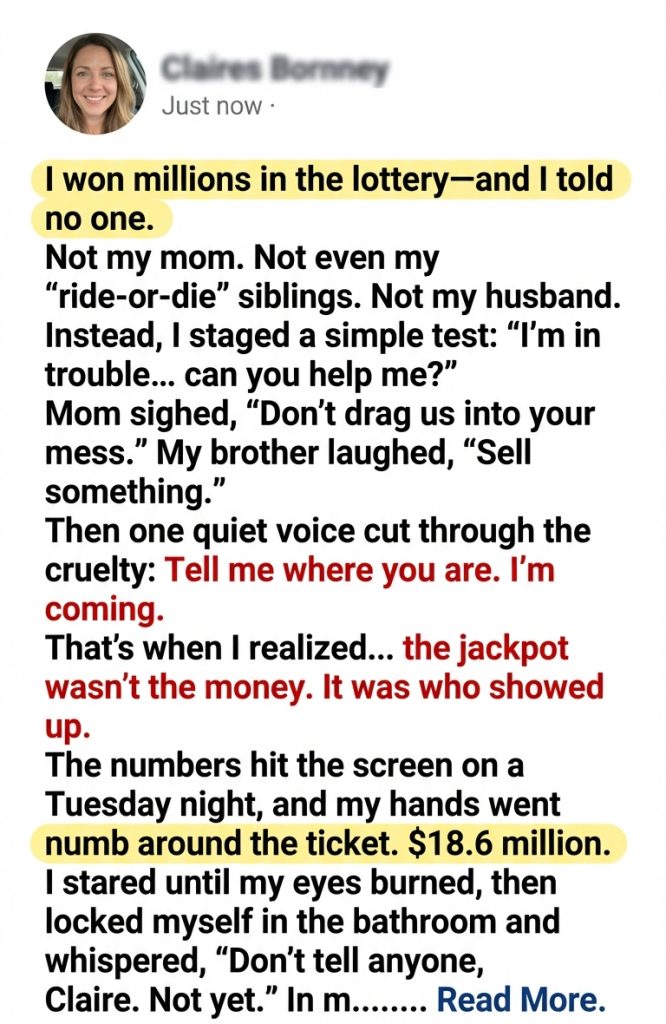
I won millions in the lottery—and I told no one. Not my mom. Not even my “ride-or-die” siblings. Not my husband. Instead, I staged a simple test: “I’m in trouble… can you help me?” Mom sighed, “Don’t drag us into your mess.” My brother laughed, “Sell something.” Then one quiet voice cut through the cruelty: “Tell me where you are. I’m coming.” That’s when I realized… the jackpot wasn’t the money. It was who showed up.
The numbers hit the screen on a Tuesday night, and my hands went numb around the ticket. $18.6 million. I stared until my eyes burned, then locked myself in the bathroom and whispered, “Don’t tell anyone, Claire. Not yet.” In my family, money didn’t just change people—it revealed them.
I’d spent my whole life being the reliable one. The one who loaned gas money, covered late rent, paid for my mom’s prescriptions “just this once.” My husband, Ryan, loved calling me “practical,” which was his polite way of saying easy to lean on. My older brother, Derek, called me “soft.” My sister, Megan, only texted when she needed something.
So I decided on a test. Not cruel. Just clear.
The next morning, I sent a group text: Emergency. I’m short on a payment. I need help—today.
Within minutes, my mom, Linda, called. I put on my best shaky voice. “Mom, I’m really scared. I can’t cover it.”
There was a pause on the line, but not the kind I wanted. Not concern. Not fear for me. It was the irritated kind, the kind that sounded like cabinet doors closing and a cigarette being lit in someone’s mind.
“Claire,” she said finally, drawing my name out like I’d interrupted something important, “you are always too dramatic in the mornings.”
My grip tightened on the phone. I stood in the kitchen, sunlight pouring across the counter where the winning ticket sat hidden inside an old recipe tin labeled HOLIDAY COOKIES. My coffee had gone cold.
“I’m not being dramatic,” I said, letting my voice tremble just enough. “I really need help. Today.”
“With what?” she asked sharply. “How much?”
That question landed harder than it should have—not Are you okay? Not What happened? Just a number.
“I… I can’t say over the phone,” I whispered. “It’s a payment. If I miss it, it’ll get worse.”
She exhaled hard enough for me to hear it through the speaker. “Don’t drag us into your mess. I warned you about trying to keep up with things you can’t afford.”
The words were so exact to the text in my memory that it almost made me laugh, if laughing hadn’t felt like cracking in half. I stared at the window over the sink, at the bird feeder Ryan kept forgetting to refill.
“Mom—”
“I don’t have it,” she cut in. “And even if I did, I can’t keep rescuing grown children from consequences. Call your husband.”
The line went dead.
I kept the phone at my ear for a moment after the call ended, listening to nothing.
Then my screen lit up again.
Derek calling.
I answered and barely got out, “Hey,” before he barked a laugh.
“What’d you do now?”
I closed my eyes. “I just need some help. A loan. I can pay you back.”
“With what?” he said. “Your positive attitude?” He laughed again, louder this time, and I heard a sports broadcast in the background. “Sell something.”
Something in me went still.
There it was. Not even surprise. Not even fake sympathy. Just that old family role handed back to me like a stained apron: You’re the one who handles it. Figure it out.
“Right,” I said quietly. “Thanks.”
“Don’t get weird about it,” he muttered, already distracted. “Everybody’s struggling.”
He hung up.
I stood there with my heart pounding too fast, though no one had actually shouted. Cruelty in my family rarely wore raised voices. It came in sighs. In smirks. In advice shaped like blame.
Megan didn’t call. She sent exactly what I expected:
Oof. I’m broke too. Have you tried one of those payday apps?
Then, thirty seconds later:
Actually can u spot me $120 till Friday?
I stared at the message so long the screen dimmed.
From the hallway, I heard Ryan moving around upstairs—drawer shut, closet door, the thud of one shoe, then another. We’d been married eight years. If anyone was supposed to know how exhausted I was from being useful to everyone, it was him.
I hadn’t planned to include him in the test. I told myself I was protecting the marriage, that keeping the lottery secret for one day was smart. Responsible. But now the house felt too small with the secret inside it, and his footsteps sounded like a question.
He came down in a navy shirt and tie, still buttoning one cuff. “You okay? You look pale.”
I turned toward the sink, pretending to rinse my mug. “I’m fine.”
He walked closer. “Claire.”
There was a softness in the way he said my name that nearly broke my plan right there. But I remembered all the little moments I’d swallowed. The times he volunteered me before asking. The times “we” helped someone and the money always came from my account because he was “between bonuses.” The time he called me from the golf course because Derek needed rent and Ryan knew I’d cave faster if he asked while sounding stressed.
I set the mug down carefully. “I might need help with a payment today.”
He went still. “What payment?”
I forced myself to meet his eyes. “I can’t explain everything yet. I just need to know… if I asked you to help me no questions asked, would you?”
His face changed by degrees. Concern first. Then calculation. Then annoyance.
“Claire, that’s not how marriage works,” he said. “You don’t spring money emergencies on me and ask for blind trust.”
I almost laughed at the phrase blind trust. “I’m not springing anything. I’m asking.”
He rubbed his jaw. “How much?”
“Enough that I can’t cover it alone.”
He looked toward the front window, toward his car, toward the clock. “I’m already stretched this month.”
“With what?” I asked before I could stop myself.
He frowned. “What’s that supposed to mean?”
“It means every time I need something, there’s a reason I should wait.”
His expression hardened. “That’s unfair.”
“Is it?”
He grabbed his keys off the entry table. “I have a meeting. We can talk tonight when you’re ready to be specific.”
The front door closed behind him with a sharp, ordinary click.
And just like that, the test I’d called “not cruel” began to feel like surgery without anesthesia. Clean, necessary, and impossible to mistake.
I stood alone in my kitchen, one hand on the counter, breathing through a wave of nausea. In the recipe tin, hidden beneath index cards for cinnamon rolls and pot roast, sat the ticket worth $18.6 million.
Enough money to buy a new house. Enough to pay every debt I had ever quietly covered for other people. Enough to leave. Enough to stay. Enough to become a story people fight over at funerals.
I wanted to cry. I wanted to laugh. I wanted to call someone who loved me without needing anything.
Instead, I sat at the table and made a list.
It wasn’t dramatic. It was survival.
At the top, I wrote:
Who asks if I’m okay?
Who asks how much?
Who asks what they can do?
Who actually comes?
By noon, no one had passed.
Mom texted:
If this is about credit cards, I can’t help you. I told you to be careful.
Derek sent a meme of a guy selling a kidney.
Megan sent:
Seriously on that $120??
Ryan sent one message at 12:14 p.m.:
We’ll discuss tonight. Don’t make any decisions before I get home.
That one made me stare.
Not I’m sorry you’re scared.
Not Hang in there.
Not What do you need from me right now?
Just a management memo.
I should have been used to it. I was, in a way. But knowing I could solve every financial problem in my life before dinner made their responses feel even uglier, because suddenly I could see the pattern without panic blurring it. I had never been “the reliable one” because they respected me. I had been reliable because I was easier to spend than they were.
Around one o’clock, another message came in.
Not in the family group.
From my cousin Naomi.
We weren’t especially close, which is to say we were the kind of close that happens in big families when one person is quiet and the other is busy and life keeps happening in different zip codes. She lived forty minutes away, worked nights as a hospice nurse, and had a habit of sending me random photos of sunrise skies with no caption.
Her text was short:
Saw the group text. What happened?
I stared at it, surprised. I hadn’t even remembered Naomi was still in that group thread. She almost never spoke in it. Mostly she reacted with a heart or a prayer hands emoji and disappeared.
I typed back:
I’m in a bad spot. Need help today.
Three dots appeared immediately.
Money? Car? Medical?
My throat tightened. Categories. Solutions. Not judgment.
I wrote:
A payment. I’m scared.
She called at once.
When I answered, her voice was low and calm, with hospital-noise silence behind it. “Claire?”
I sat straighter in my chair. “Yeah.”
“Are you safe?”
I closed my eyes. My first honest answer all day came out before I could stop it. “I don’t know.”
She didn’t rush to fill the silence. “Okay,” she said softly. “Tell me where you are. I’m coming.”
I felt the air leave my lungs.
That line. That exact line. No sigh. No lecture. No transaction. Just movement.
I almost told her everything right then—the ticket, the test, the shame of needing to prove what I already suspected. Instead I pressed my fist to my mouth and gave her my address.
“I’ll be there in thirty,” she said. “Do you need me to bring cash?”
The question shattered me in a completely different way. Not because of the money. Because she was willing.
“No,” I said, voice cracking. “Just… come.”
“I’m on my way.”
After we hung up, I sat at my kitchen table and cried so hard I had to put my head down on my folded arms. Not the dramatic, movie-beautiful kind. The ugly kind that shakes your shoulders and leaves your face hot and swollen. Grief, mostly. Relief, too. And beneath both, a fierce, clear thing I hadn’t felt in years.
Truth.
When Naomi arrived, she didn’t knock lightly or wait in her car texting “Here.” She came straight up the walk with her hair half pinned, scrubs under a zip-up hoodie, and a canvas tote slung over her shoulder like she was heading into a shift.
The moment I opened the door, she looked at my face, stepped inside, and wrapped me in a hug.
No questions first. No performance. Just arms.
I held on longer than I meant to.
When we pulled apart, she scanned the room in one quick nurse glance—the untouched coffee, my phone on the table, my shaking hands. “Okay,” she said gently. “Start anywhere.”
I laughed wetly. “I don’t even know where ‘anywhere’ is.”
“Then start with the emergency text. Was it real?”
I looked at her and made a choice.
“Yes,” I said. “Just not the emergency everyone thinks.”
I went to the kitchen, lifted the recipe tin from the top shelf, and brought it to the table. Naomi watched without interrupting as I opened it, moved the recipe cards, and slid the ticket across to her.
She looked down.
Then she looked up.
Then back down.
For a long moment, neither of us spoke.
Finally, Naomi exhaled once through her nose and said, “Well. That’s one kind of emergency.”
I let out a startled laugh, half sob. “I knew you’d say something like that.”
She sat down slowly. “Claire… is this real real?”
“I checked twelve times. Then I drove to a different gas station and scanned it again because I thought I was hallucinating.”
Her hand came over mine. “Okay. Breathe.”
I did. Barely.
Then the whole story came out in a rush—the bathroom lock, the whisper to myself, the test, Mom’s sigh, Derek’s laugh, Megan asking for $120, Ryan telling me not to make decisions before he got home.
Naomi listened the way good people listen: with her whole face. No interruptions except the right ones. “He said that?” “You’re kidding.” “Claire…”
When I finished, she sat back and looked at me for a long moment. “You know what’s hitting you hardest?”
“That they failed?”
She shook her head. “No. That part you already knew. You just kept hoping you were wrong.”
The words landed with painful precision.
I stared at the ticket between us. “What do I do now?”
Naomi’s expression turned practical. “First, sign the back if you haven’t.” She pointed at it. “Then put it somewhere safer than a cookie tin. Second, do not tell a single person else until you talk to a lawyer and a financial advisor—ones you choose, not Ryan, not your brother’s ‘friend,’ not your mom’s church guy. Third…” She squeezed my hand. “Decide whether you want your life to change, or just your bank account.”
I gave a shaky laugh. “That sounds like a line from a movie.”
“It’s a line from watching families implode over less than this.”
She reached into her tote and pulled out a small notebook and a granola bar. “Also, eat. You make bad choices when your blood sugar crashes.”
I laughed again—really laughed this time—and took the bar.
We spent the next two hours at my kitchen table making a plan. Not a fantasy plan. A real one. Naomi wrote names of attorneys she trusted through hospice families. I made a new email address on my laptop. We talked through whether to stay at the house tonight or get a hotel. She asked questions no one else had asked all day:
“Do you feel emotionally safe with Ryan if he finds out before you’re ready?”
“Has he ever controlled your spending?”
“Do you have copies of your personal documents?”
“If everyone gets angry, where do you go?”
Each question peeled back another layer of the life I had normalized.
By late afternoon, my phone was buzzing nonstop. Mom again. Megan. A message from Derek in the group chat:
So are we helping or are we just doing vague drama all day?
Then Ryan:
Home at 6. We need to talk.
Naomi looked at me across the table. “Do you want me here?”
I looked around my own kitchen—at the family calendar I maintained, the bills in tidy stacks, the fruit bowl I refilled every Sunday, the space I had turned into a life by sheer effort. For the first time in years, I asked myself what I wanted before what everyone else expected.
“Yes,” I said. “Please stay.”
Ryan came home right at six, loosened tie, controlled face, briefcase in hand. He stopped short when he saw Naomi at the table.
“Oh,” he said. “Didn’t know we had company.”
Naomi stood, polite but solid. “Hey, Ryan.”
He nodded, eyes already on me. “Can we talk privately?”
I looked at Naomi, then back at him. “No. Not tonight.”
His jaw flexed. “Claire, whatever this is—”
“It’s me asking for help this morning,” I said, calm in a way I didn’t feel. “And seeing what happened.”
He set his briefcase down slowly. “I said we’d talk.”
“You said not to make decisions before you got home.”
He frowned. “Because I didn’t know what was going on.”
“Exactly.” I stood up. My knees trembled, but my voice didn’t. “And you still didn’t ask if I was okay.”
Silence spread across the kitchen.
Ryan looked from me to Naomi and back, suddenly aware that an audience made his usual tone look harsher. “I’m asking now.”
“No,” I said. “You’re managing now.”
His face changed. “What is this? Some kind of setup?”
The truth was sitting ten feet away in a recipe tin, and for the first time all day, I felt no urge to reveal it. Not as a weapon. Not as proof. He was telling me what I needed to know without the money ever entering the room.
“This is me paying attention,” I said.
He laughed once, incredulous. “To what?”
“To who shows up.”
The words hung there.
Naomi didn’t move. Didn’t rescue me. Didn’t speak for me. Just stayed.
Ryan looked genuinely angry now, which in our marriage had often been enough to make me backpedal. “If this is about money, Claire, you know I can’t just pull cash out of nowhere.”
“I didn’t ask for cash out of nowhere,” I said. “I asked if you’d help me because I was scared.”
He threw up a hand. “You were vague. I’m not a mind reader.”
“No,” I said quietly. “You’re my husband.”
Something flickered in his expression—guilt, maybe, or the realization that the conversation was slipping beyond the script he knew. But then he crossed his arms.
“So what now? You punish everybody because they didn’t answer your fake emergency correctly?”
The word fake hit hard, because he wasn’t entirely wrong. I had staged the test. But the pain it exposed was real enough to choke on.
I took a breath. “Now I stop pretending this family dynamic is normal.”
He stared at me. “Family dynamic? What are you even talking about?”
“I’m talking about my mother treating fear like inconvenience. Derek mocking me. Megan asking me for money while I’m saying I’m in trouble. You treating my distress like a scheduling conflict.” My voice finally shook, but I let it. “And me spending years making excuses for all of it.”
No one spoke.
Then Naomi, gently and without looking at Ryan, asked, “Claire, do you want to tell him?”
I looked at the recipe tin.
Ryan followed my eyes. “Tell me what?”
My heart pounded so hard I felt it in my throat. This was the point where the movie version would have me slam the ticket down and watch everyone scramble. But real life felt quieter than revenge. Heavier. More important.
I walked to the shelf, took down the tin, and set it on the table. Ryan gave a baffled half-laugh.
“What is this?”
I opened it, lifted the cards, and placed the ticket in front of him.
He stared.
Then picked it up.
Then stared harder.
“What is this?” he repeated, but now his voice was thin.
“It’s a winning lottery ticket,” I said. “$18.6 million.”
The kitchen went so silent I could hear the refrigerator motor kick on.
Ryan looked at me like he’d forgotten who I was. “You’re joking.”
“I’m not.”
His face flooded with a dozen emotions at once—shock, disbelief, excitement, greed, panic. I watched them all arrive like weather fronts.
“When?” he asked.
“Tuesday night.”
“And you didn’t tell me?”
“No.”
“Why?”
I held his gaze. “Because I needed to know what love sounded like before money made everyone fluent.”
He recoiled as if I’d slapped him.
Naomi stood up slowly, collecting her tote. “I’m going to give you two a minute,” she said, then paused beside me. “Call me if you need me. I mean it.”
I touched her arm. “Thank you.”
She squeezed my shoulder and left through the front door, quiet as she’d come.
Ryan sat down heavily, still holding the ticket. “Claire… this changes everything.”
I almost smiled. “That’s exactly what I was afraid of.”
For the next hour, he talked in loops. First apology. Then defense. Then plans. So many plans. Investments. A lake house. Paying off his business partner. Helping “family strategically.” A trust. A vacation. A better neighborhood because “we can’t stay here once people find out.”
I listened. Really listened.
In all those words, he said “we” a hundred times and “you” almost never.
When I finally spoke, it was to say something I had never once said in our marriage without softening it afterward.
“I’m not claiming this ticket yet.”
He blinked. “What?”
“Not until I have legal advice. Independent legal advice.”
His mouth tightened. “You don’t trust me.”
I let the silence answer for me.
By the time he went upstairs, angry and stunned and insisting we’d “revisit this with cooler heads,” the sky outside had gone dark. My phone still buzzed on and off with family messages I no longer felt obligated to answer.
I sat alone at the kitchen table where Naomi and I had made the first honest plan of my adult life and opened a fresh page in her notebook.
At the top I wrote:
What the money is for.
Underneath, slowly, I wrote:
-
Safety
-
Time
-
Choice
-
Therapy
-
A home that feels peaceful
-
Helping people who help without scorekeeping
-
Never being cornered again
Then, after a long minute, I added one more line:
-
Naomi
The next weeks were a blur of signatures, secure meetings, whispers, passwords, and professionals who spoke in acronyms. I learned more about tax law, estate structures, and privacy strategies than I had ever wanted to know. I also learned how quickly stories leak through families.
I never announced the win. Somehow, they found out anyway.
A clerk who knew a cousin. A cousin who told Megan. Megan who called my mother. Derek who showed up at my door with a grin too wide to trust and a bottle of expensive bourbon he absolutely had not bought for himself.
Mom cried when she called, said she was “just worried sick,” said she “didn’t mean it like that,” said family should “handle blessings together.”
Ryan became attentive in a way that felt like customer service. Flowers. Dinners. Sudden interest in my opinions. He apologized again, this time with tears. Maybe some of it was real. Maybe fear can look like change for a while. I didn’t have the energy to sort sincerity from strategy overnight.
So I stopped rushing.
That was the first real gift the money gave me: time to think before forgiving.
I moved part of the funds into structures my lawyer recommended. I opened an account in Naomi’s name—not a flashy amount, not life-wrecking money, just enough to erase her student loans and create a cushion she’d never ask for. When I told her, she sat on my couch and cried so quietly it made my chest ache.
“I didn’t show up for this,” she whispered.
“I know,” I said. “That’s why.”
As for the rest, I made rules. Written ones. No emergency loans without paperwork. No “just this once.” No guilt-transfers disguised as family duty. No decisions made under pressure. No conversations about money without a witness or a cooling-off period.
People hated the rules.
That told me they were good rules.
Months later, after lawyers and counselors and long honest nights, Ryan and I separated. Not because of the lottery exactly. Because the lottery turned on a stadium light in a room I had spent years pretending was dim. Once I saw everything clearly, I couldn’t unsee it.
Mom still calls, but less often. Derek jokes carefully now, which is somehow sadder than his old cruelty. Megan sends friendly messages with too many exclamation points and no requests—yet.
Naomi comes over on Sundays. We drink coffee on my porch, and she tells me hospice stories about stubborn grandfathers and impossible grace. Sometimes we talk about the night of the test. Sometimes we don’t have to.
People hear “lottery winner” and imagine champagne, sports cars, diamond bracelets, and a sudden life of glittering ease. Some of that exists, sure. I won’t pretend comfort isn’t sweet after years of counting every grocery item twice.
But the true miracle wasn’t the amount on the screen.
It was the moment the world split open and, before anyone knew there was money, I got to see exactly who reached for me—and who reached for themselves.
That Tuesday night, in a locked bathroom, I whispered, “Don’t tell anyone, Claire. Not yet.”
I’m glad I listened.
Because the jackpot did more than change my bank account.
It introduced me to the people I can trust… and finally, to myself.