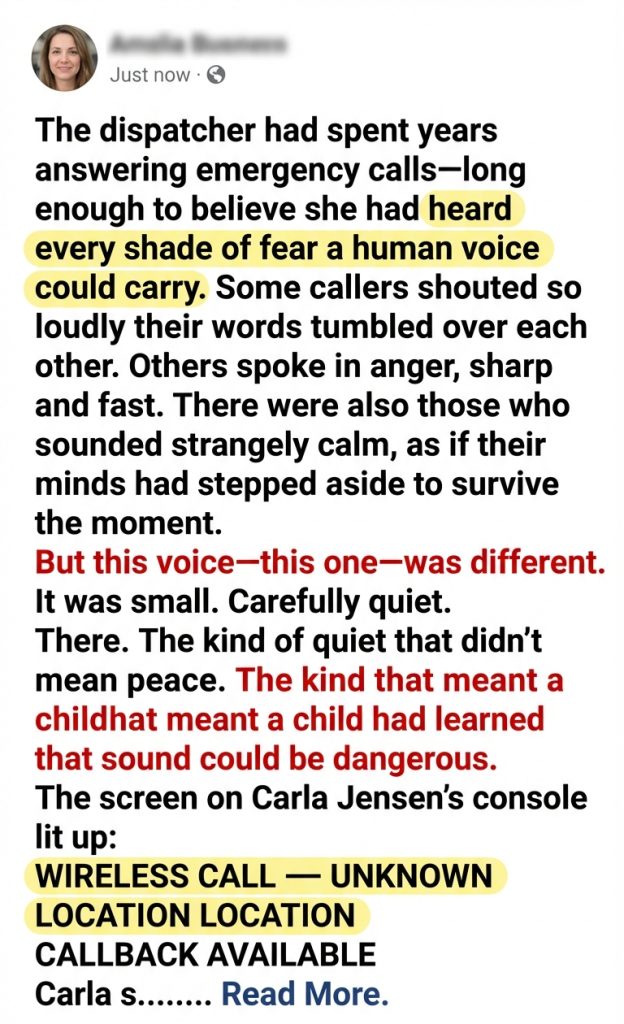
The dispatcher had spent years answering emergency calls—long enough to believe she had heard every shade of fear a human voice could carry.
Some callers shouted so loudly their words tumbled over each other. Others spoke in anger, sharp and fast. There were also those who sounded strangely calm, as if their minds had stepped aside to survive the moment.
But this voice—this one—was different.
It was small. Carefully quiet. The kind of quiet that didn’t mean peace. The kind that meant a child had learned that sound could be dangerous.
The screen on Carla Jensen’s console lit up:
WIRELESS CALL — UNKNOWN LOCATION
CALLBACK AVAILABLE
Carla straightened in her chair, the headset pressing into the soft spot behind her ear. The night shift in the county dispatch center was usually a slow crawl: the occasional drunk driver, a domestic argument that ended with slammed doors, an elderly man who had fallen and insisted he was “fine” while gasping through pain.
Carla clicked the line open.
“911, what’s your emergency?”
A pause.
Then, a whisper so thin it barely made it through the speaker.
“Hi… I’m sorry.”
Carla’s hand froze over the keyboard. “You don’t have to apologize. Can you tell me your name?”
Another pause. Breathing. As if the caller were pressing the phone close to her mouth and trying not to let it touch her lips.
“Lily.”
“How old are you, Lily?”
“Seven.”
Carla’s stomach tightened, but her voice stayed steady. “Okay, Lily. You’re doing great. Where are you right now?”
“I’m in my house,” Lily whispered.
“Can you tell me your address?”
Silence.
Then, in the same careful whisper: “I don’t know it. Mom says it’s not for kids.”
Carla forced herself to breathe slowly, to keep the rhythm of calm that callers needed to borrow.
“That’s okay,” she said gently. “Can you look around for mail? Or maybe a piece of paper with numbers on it?”
“I can’t,” Lily whispered. “If I move, he might cry.”
Carla’s fingers curled around her pen. “Who might cry, honey?”
“My baby,” Lily said, and the words trembled as if they’d been holding up something heavy for a long time. “He’s… he’s getting lighter.”
Carla felt her scalp prickle. “What do you mean, he’s getting lighter?”
Lily sniffed once, quiet as a mouse. “When I hold him. He used to be heavy. Now he’s not. He’s… like my backpack when it’s empty.”
Carla’s throat tightened. She kept her tone smooth and warm.
“Is your baby breathing right now?”
“Yes,” Lily whispered. “But it’s… like when you sleep and you forget to breathe, and then you do it fast.”
Carla’s eyes moved to the screen’s location estimate—broad, uncertain, a cluster of cell tower pings that covered a few miles. Not enough.
“Okay,” Carla said. “I want you to keep holding him, just like you are. You’re doing exactly the right thing. Is there an adult in the house with you?”
“No.”
“Where is your mom?”
Lily hesitated. “She left.”
“When did she leave?”
Lily’s whisper grew smaller. “A long time.”
Carla’s fingers hovered over the dispatch button. “A long time like… hours? Or days?”
Lily’s breath hitched.
“Like… when the sun went away and came back and went away again,” she said.
Carla’s heart dropped.
Two nights.
Possibly more.
Carla pressed the dispatch key, her voice low but urgent to her partner across the room. “I need a unit rolling now. Possible child neglect, infant in distress. We don’t have an address.”
Her partner’s chair squeaked as he moved fast.
Carla returned her full attention to Lily. “Lily, I’m going to stay on the phone with you. I’m going to send someone to help you and your baby. Can you tell me what you see outside your window?”
“I can’t go to the window,” Lily whispered.
“That’s okay. Can you tell me what room you’re in?”
“The living room,” Lily said. “On the floor. The couch is… too big. The baby can roll.”
Carla swallowed. “Is there any food in the house?”
Lily hesitated. “I ate crackers yesterday. There was a can, but I didn’t know how.”
Carla squeezed her eyes shut for half a second, then opened them again, focusing on the task like it was a rope she had to keep hold of.
“Lily,” she said softly, “what’s your baby’s name?”
“Eli.”
“How old is Eli?”
“I don’t know,” Lily whispered. “He’s not big. Mom said he’s still new.”
Carla leaned closer to the console as if she could somehow shorten the distance between them by an inch. Around her, the dispatch center came alive in that strange, controlled way panic travels through professionals—no shouting, just fast hands, clipped voices, screens changing colors.
Her partner, Nate, was already on a secondary line with patrol, triangulation support, and fire-rescue. He held up two fingers, then pointed to the map. Two likely sectors from the tower data. Too many streets. Too many apartment complexes. Too many houses with lights off and curtains drawn.
Carla kept her voice gentle. “Lily, I need you to listen to me, okay? You are doing something very brave. I’m proud of you.”
There was a tiny sound on the line. Not a sob. More like a child trying not to make one.
“My mom says brave girls don’t cry,” Lily whispered.
Carla’s jaw tightened. “Brave girls can cry. Brave girls can ask for help, too. You did exactly right by calling me.”
Another breath. A little steadier this time.
“Can you tell me if any lights are on in the house?” Carla asked.
“The kitchen one,” Lily said. “It buzzes.”
“Good. Do you hear anything outside? Cars? Trains? Dogs?”
Lily went silent long enough that Carla was about to repeat the question.
Then: “Sometimes dogs. And a bell. Not a school bell. A… ding-ding.” She attempted the sound softly.
Nate immediately scribbled a note and mouthed, crossing signal? ice cream truck? church?
Carla nodded slightly and kept going. “That helps. A ding-ding bell. Okay. Lily, is your front door close to where you are?”
“No. Hallway.”
“Can you see it?”
“No.”
“Do you know if it’s locked?”
A longer pause. Then, guilty and scared: “I put the chair there.”
Carla blinked. “You put a chair by the door?”
“Mom says don’t open for anyone. But I was scared. So I pushed the chair and the shoes and the mop.”
The image punched straight through Carla’s professional composure for a second: a seven-year-old barricading a door while holding a baby.
“You were trying to keep Eli safe,” Carla said. “That was smart.”
Nate slid a sticky note across her console: Ask landmarks inside. Brands. Mail. TV. Anything.
“Lily, can you look around where you are and tell me anything with words on it?” Carla asked. “A box, a bag, a bottle?”
Fabric rustled. Carla heard Lily’s breathing change as she shifted, and then a tiny panicked sound from the infant—a weak, airy complaint.
“It’s okay,” Carla said quickly. “You can stop if Eli needs you.”
“I got it,” Lily whispered, the words suddenly older than seven. “I got him.”
A beat passed. Carla heard the soft pat-pat of a child’s hand.
Then Lily said, “There’s diapers. Blue box. It says… Moon… something. Moon sleep? No. Moon… hush.”
Carla typed it anyway. Brand might help, but likely not enough.
“What else?”
“The TV is black. It has stickers because it’s cracked. One sticker is a strawberry.” Lily breathed in. “And there’s mail on the table but I can’t read the tiny words good.”
Carla seized it. “Can you tell me any big words? Maybe the name? Even one word?”
A shuffle. A strained exhale.
“Don’t drop him, don’t drop him,” Lily whispered—to herself, not Carla.
Then: “I see… Green… Oaks? I think. Green Oaks.”
Nate was already searching apartment complexes, mobile home parks, and streets with that name. There were six in the county. He swore under his breath, then looked up sharply as another dispatcher at the far pod raised a hand and called out, “Rail crossing bells near Green Oaks Estates, west district.”
Nate pointed to the map and circled a zone. Smaller now. Still too big, but human-sized.
Carla kept the line steady. “Lily, you’re helping so much. Can you hear me okay?”
“Yes.”
“Good. I need you to look at Eli’s face for me. Is he awake?”
“No.”
“Are his eyes closed?”
“Yes.”
“Is his skin warm?”
Lily hesitated. “His hands are cold.”
Carla’s pulse thudded in her neck. “Okay. Are there any blankets close to you?”
“My pink one.”
“I want you to wrap Eli in the pink blanket, but keep his face where you can see it. Can you do that for me?”
“I can try.”
“You don’t have to rush.”
Carla listened to the rustle, the shaky breaths, the tiny sounds of effort. Somewhere in the background, a patrol unit radioed they were en route to Green Oaks Estates, building numbers starting at the north end. Another unit would enter from the south. Fire and EMS staged behind them.
Lily came back, whispering harder now with concentration. “He’s wrapped.”
“You did perfect,” Carla said, and meant it. “Now put one finger on his chest if you can. Tell me if it goes up and down.”
Silence.
Carla could hear Lily breathing, counting in her own way.
“Up… down… long wait… up.”
Carla typed every word.
“Okay,” she said. “You stay with him. I’m right here. You are not alone.”
That sentence changed something. Carla heard it in the little crack of breath on the other end.
“Can you… can you keep talking?” Lily asked.
Carla swallowed the thickness in her throat. “Absolutely. I can keep talking.”
So she did.
She told Lily that the people coming to help wore uniforms and might knock loudly. She told her not to be scared if they sounded big. She described the red and blue lights, the radios on shoulders, the way paramedics carried bags with medicine and blankets and little clips to help babies breathe. She made her voice a bridge and asked tiny questions in between.
What color were Lily’s socks? One pink, one purple.
What was Eli’s favorite thing? “He likes when I hum.”
Could Lily hum for him now? Lily did—softly, off-key, heartbreakingly careful. A lullaby with no words, just a seven-year-old trying to keep a baby tethered to the world.
Nate muted his microphone for a second and turned away, rubbing a hand over his face.
The first patrol unit radioed in: “At Green Oaks Estates. Multiple buildings. Starting sweep.”
Carla tapped her pen against the desk, then forced herself to stop. “Lily, do you know if you live in a house or apartments?”
“Apartments,” Lily whispered. “Stairs outside. They’re loud.”
“Do people walk by your door a lot?”
“Sometimes. The lady downstairs yells at TV.”
Nate snapped his fingers and scribbled BUILDINGS W/ EXTERIOR STAIRS + lower unit complaints.
Another radio burst: “Unit 14 checking Building C. No answer. Moving.”
Carla spoke before the silence could eat Lily alive. “You are doing an amazing job, Lily.”
“My phone is warm,” Lily said suddenly.
“Is it a cell phone?”
“It’s Mom’s old one. It only does games. But I hit the numbers and then you came.”
Carla closed her eyes for half a blink, stunned at the small miracle of an inactive phone still reaching emergency service.
“You did exactly right,” she whispered.
Then Lily’s voice changed.
Small. Frantic.
“He did the weird breathing again.”
Carla went cold and sharp all at once. “Okay, Lily, listen carefully. Put the phone on speaker if you know how.”
“I don’t know.”
“That’s okay. Tuck it by your shoulder. I need both your hands if you can. Is Eli on his back?”
“No, on me.”
“I want you to lay him flat on the floor on the blanket. Gently. Can you do that?”
A rustle. A tiny whimper from Lily that she swallowed.
“He’s down.”
“Good. Good. Look at his chest. Is it moving?”
A long pause.
“No.”
The dispatch center seemed to tilt.
Carla’s voice became pure instruction. “Okay, Lily. You’re going to help him breathe. I’ll tell you exactly what to do.”
Across the room, Nate was already signaling EMS supervisor, mouthing infant CPR coaching in progress.
“Put one hand on Eli’s forehead,” Carla said, slow and clear. “Use two fingers of your other hand and lift his chin a little. Just a little. Can you do that?”
“Yes.”
“Now put your ear near his mouth. Do you feel any air?”
“No.”
Carla heard her own heartbeat in the headset. “Okay, Lily. I need you to give him two tiny breaths. Cover his nose and mouth with your mouth if you can. Gentle puffs. Like blowing bubbles, not blowing candles. Ready?”
A pause. Then a trembling: “I’m scared.”
“I know,” Carla said. “I’m right here. You can do scared things. Ready? One little breath.”
A breath sound into the phone.
“Good. One more.”
Another breath.
“Now look at his chest.”
Silence.
Then, a noise—thin, wet, miraculous. A cry. Weak, but there.
Lily gasped so hard Carla thought she might faint. “He did it! He did it!”
Carla nearly sagged over the console. “Yes. Yes, baby, he did. You helped him. You helped him breathe.”
At that exact moment a patrol voice cracked over the radio, urgent: “Possible match—female child visible through window, second-floor unit, Building F. Making contact now.”
Carla sat up so fast her chair wheels squealed. “Lily,” she said, fighting to keep her voice level, “do you hear any knocking?”
For a second there was nothing.
Then thunder on wood. A man’s voice, muffled but loud. “Sheriff’s office! 911 sent us! Lily, if you can hear me, we’re here to help!”
Lily made a sound Carla would remember for the rest of her life—not a cry, not a laugh, but the instant a child realizes she can stop being the grown-up.
“They came,” she whispered, and then sobbed once, sharply, like her body had finally been granted permission.
“Okay,” Carla said, tears blurring her own screen now. “Listen to me. You need to leave the phone and move the chair if you can. Can you do that?”
“The chair is big.”
“That’s okay. Try the shoes first. Then the mop. Then push the chair just enough.”
The knocking came again, firmer, urgent. “Lily! We’re at the door!”
Carla heard scraping, dragging, Lily’s strained little breaths. Somewhere in the background, Eli began to cry again—louder this time, angry and alive.
“Good sign,” Carla whispered, mostly to herself.
A clatter. A grunt.
Then the sound of a deadbolt turning.
The door flew open and the world rushed in all at once: boots, radios, voices layered over each other.
“We got her—two children—infant critical but breathing!”
“Medic up here now!”
“You’re okay, sweetheart, we got you.”
Lily’s voice, farther from the phone now and breaking apart with relief: “Please don’t be mad. I called because he was getting lighter.”
Carla pressed her lips together so hard it hurt.
A deputy’s voice came clear into the phone. “No one’s mad, honey. You saved your brother.”
The line filled with motion—paramedics calling for oxygen, one asking infant age, another asking how long unattended. Lily crying in earnest now. Eli crying harder, the sound ugly and beautiful.
Carla stayed on until a paramedic picked up the phone and said, “Dispatch, this is Medic 6. We’re on scene. You can disconnect. And… tell your caller she did good.”
Carla managed, “Received,” though her voice came out ragged.
The line clicked dead.
For a moment she sat absolutely still, one hand still curled around the pen, the other pressed against her headset as if Lily might come back if she held it there.
The dispatch center moved on around her because it always had to. Another screen flashed. Another phone rang. A crash on Route 12. A welfare check. A neighbor complaint. The machinery of emergency never stopped to honor one saved life.
But Nate set a paper cup of water beside her keyboard and didn’t say anything.
Carla nodded once in thanks and stared at the call notes on her screen. Seven-year-old caller. Infant respiratory distress. No address. CPR instructions given. Children located. Scene secured.
The words looked clinical. Flat. They carried none of the weight of Lily’s whisper, or that tiny exhausted hum, or the sentence that would stay with Carla for years: He’s getting lighter.
Near dawn, after the shift ended and the sky outside the dispatch center windows turned the color of old silver, Carla sat in her car without starting it. Her hands trembled now that she no longer needed them steady. She thought of all the voices she had carried home over the years and tried not to carry into her own life. The screaming ones. The numb ones. The ones that ended badly.
This one she knew would not leave.
Not because it was the worst.
Because it was the quietest.
Two days later, Carla came in for another shift and found a note tucked beneath her keyboard in Nate’s crooked handwriting.
Eli stable. Severe dehydration, malnutrition. Expected to recover. Lily okay. Asked if “911 lady” heard him cry.
Carla stared at the note until the letters softened.
Then she laughed once through tears and wiped her face with the heel of her hand before anyone could comment.
That night, when her screen lit up and another frightened voice entered her headset, she answered the same way she always did.
“911, what’s your emergency?”
But something in her voice had changed—something gentler, steadier, as if one seven-year-old had reminded her what the work truly was.
Not radios. Not codes. Not maps.
A human voice in the dark, saying: Stay with me.
And another voice answering: I’m here.