Some storms don’t arrive with thunder. They arrive with a swollen ankle, a grocery bag cutting into your hand, and the quiet humiliation of walking home while someone else holds your keys. Lauren didn’t wake up that morning thinking her life would shift. She woke up thinking about diapers, formula, and making it through another day in a house where she was constantly reminded she was “lucky” to be allowed inside. But the thing about control is this: it depends on silence. And the thing about fathers is this: some of them can smell silence like smoke.
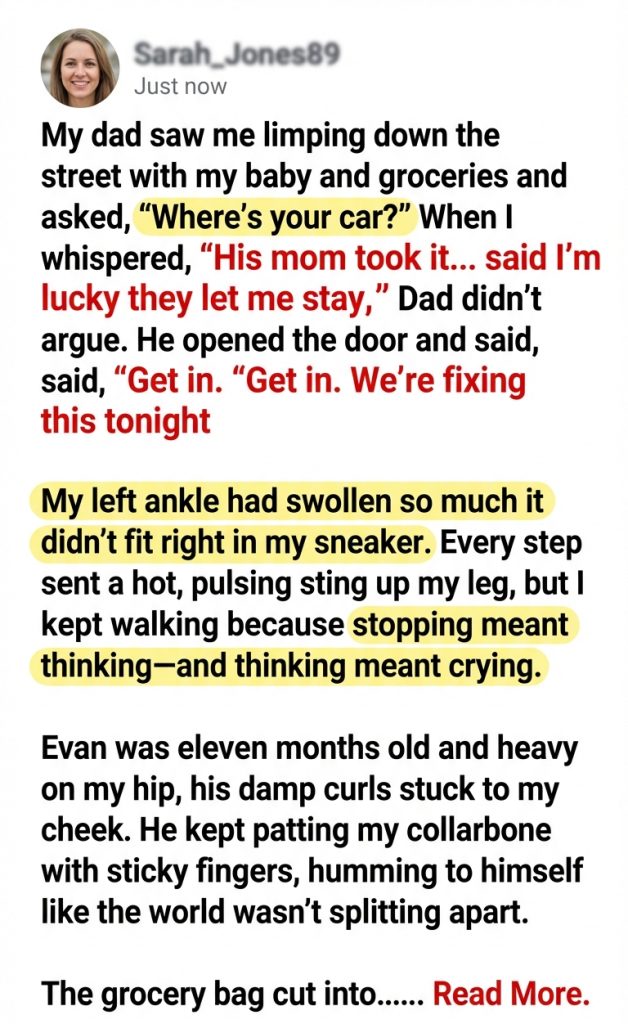
My dad saw me limping down the street with my baby and groceries and asked, “Where’s your car?” When I whispered, “His mom took it… said I’m lucky they let me stay,” Dad didn’t argue. He opened the door and said, “Get in. We’re fixing this tonight.
My left ankle had swollen so much it didn’t fit right in my sneaker. Every step sent a hot, pulsing sting up my leg, but I kept walking because stopping meant thinking—and thinking meant crying. The pain wasn’t just physical. It was the kind of pain that arrives when your dignity gets chipped away in small daily pieces—when you start measuring your worth by whether you’re allowed to sit on the “good” couch, whether you’re allowed to use the “family” dishes, whether you’re allowed to ask a simple question without someone acting like you’re demanding the moon.
Evan was eleven months old and heavy on my hip, his damp curls stuck to my cheek. He kept patting my collarbone with sticky fingers, humming to himself like the world wasn’t splitting apart. Babies have a way of living in the present that can break your heart. He didn’t know his mother was trying not to cry. He didn’t know that every time Patricia smiled too wide and said, “We’re just helping you,” it felt like a leash being tightened. He was content because he was fed and warm and close to me—and the innocence of that trust made my chest ache.
The grocery bag cut into my other hand. A gallon of milk bumped my knee with each limp. I was half a mile from the apartment, and the late-afternoon heat in Phoenix pressed down like a hand. The air smelled like hot asphalt and dust, and the sun didn’t feel like light—it felt like pressure. My ankle throbbed in time with my heartbeat, and I could taste the metallic edge of frustration in my mouth.
I was focusing on one thing: make it home before Evan starts screaming. That was always the goal. Make it through dinner. Make it through bath time. Make it through the night without Derek’s mother finding a new way to remind me that I was a guest in what was supposed to be my life.
A car rolled alongside me, slow. I flinched automatically. Then I heard my name—sharp, stunned.
“Lauren?”
I turned. My father’s face was behind the windshield, eyes wide in the way they got when he saw something he couldn’t accept. It was the look he’d had once when I broke my wrist falling out of a tree as a kid—anger at the pain, not at me. The kind of alarm that comes from love that doesn’t negotiate.
“Dad,” I said, and my voice came out smaller than I meant it to.
He pulled over fast, hazards blinking, and jumped out before the engine even fully died. He was still in his work shirt—electric company logo on the chest, sunburn on his forearms. The kind of man who always looked like he was in the middle of fixing something. My dad had spent his life solving problems you could see: downed power lines, broken outlets, flickering lights. But he was the same kind of man when the problem was invisible too. He just needed to know where to put his hands.
His eyes went straight to my ankle. Then to Evan. Then to the grocery bag like it was evidence. Like it proved something he didn’t want to believe but couldn’t deny.
“Why are you walking?” he asked. “Where’s your car?”
My stomach tightened. I’d practiced answers for friends, for coworkers, for strangers who asked. I hadn’t practiced one for my father. Strangers got polished lies. My father got the truth—or at least the version I could admit out loud without shaking.
I tried to shrug like it didn’t matter. It did. Everything did.
I swallowed. “His mom took it,” I said, shifting Evan higher. “Said I’m lucky they let me stay.”
For a second, Dad didn’t move. He just stared at me like my words were a language he couldn’t believe existed. Then his jaw set, hard. It was the same jaw I’d seen when someone cut him off in traffic and nearly hit my mom. Not explosive. Controlled. Dangerous in its steadiness.
“Who,” he said slowly, “is ‘his mom’?”
“Derek’s mom,” I answered. “Patricia.”
The name landed in the air like a curse. Dad’s nostrils flared. He looked past me, toward the apartment complex down the road like he could see through walls. I felt a flash of fear—not of my father, but of what his presence would trigger. Patricia hated being challenged. Derek hated conflict. And I was the one who always paid for it afterward.
“You mean the car you pay for?” he asked, voice too calm.
I looked down. My fingers clenched around the bag handles until the plastic stretched. “It’s in Derek’s name,” I admitted. “She said since I’m ‘living under their roof’ she can decide who uses it.”
Dad blinked once, sharp. “You’re living under their roof?”
Heat crawled up my neck. “After Derek got laid off, we couldn’t keep our place. His parents said we could stay until we got back on our feet.” I could hear how that sounded—like generosity. Like family stepping in. But generosity doesn’t take your keys. Generosity doesn’t make you ask permission to use the washing machine. Generosity doesn’t comment on how much your baby eats.
“And in exchange,” Dad said, voice flattening, “they take your transportation.”
I didn’t answer. Evan squirmed, tired. My ankle throbbed like it had a heartbeat. Somewhere deep inside me, shame stirred—the shame Patricia had planted carefully, the kind that grows when you’ve been told enough times that needing help is the same thing as being a burden.
Dad reached out and took the grocery bag from my hand as if it weighed nothing. Then he opened the passenger door.
“Get in the car,” he said.
“Dad—” I started, because panic was already rising. Panic about what Derek would say. About what Patricia would say. About the way they made everything feel like it was my fault for needing anything.
Dad cut me off without raising his voice. “Lauren. Get in the car. We’re fixing this tonight.”
Something in his tone—steady, final—made my throat burn. I hesitated anyway, because fear is a habit. Fear becomes muscle memory. It tells you to keep the peace even when peace is just another word for surrender.
Dad stepped closer and lowered his voice so only I could hear. “Sweetheart, you are limping down the street with my grandbaby on your hip because someone wants you to feel trapped.”
My eyes stung. “I don’t want a fight.”
Dad’s expression didn’t soften, but it warmed. “Then they shouldn’t have started one.”
He took Evan gently from my arms for half a second so I could climb in without twisting my ankle. Evan blinked at him and then, traitorously, smiled. That little smile—like my father was safe by instinct—hit me so hard I had to look away.
Dad buckled Evan into the back seat with the careful focus of a man who’d decided the next hour mattered more than anyone’s feelings. Then he got behind the wheel, hands at ten and two, like he was about to drive into a storm on purpose.
I watched the road ahead, my heart beating too fast.
Because I knew exactly where we were going.
And I knew Patricia would say I was “ungrateful.”
But for the first time in a long time, I didn’t feel alone……
The apartment complex appeared at the end of the road like a tired promise. Beige stucco walls baked by the sun. A few struggling palm trees. Rust stains under the balconies. The kind of place that could be temporary if temporary didn’t stretch into months, then into seasons, then into a quiet acceptance that this was just your life now. Dad parked and cut the engine. The sudden silence in the car felt loud.
“You stay close,” he said, not as a suggestion, but as a plan.
My ankle screamed when I put weight on it. Dad noticed and didn’t comment—he just shifted so he could support me without making me feel weak. He carried the grocery bag in one hand and Evan’s diaper bag in the other like it was nothing. I carried Evan because I needed that. I needed to be his mother, not a passenger in my own life.
As we approached the door, I could already hear the television inside—Patricia’s afternoon news blaring, the anchors’ voices sharp and certain. That sound always made my stomach tighten because it meant Patricia was in her chair, her kingdom, her eyes on everything. She liked to be present. She liked to be able to say, “I saw what you did.” She liked the power of witnessing.
Dad knocked once.
Not timid.
Not polite.
Just firm.
The door opened quickly, and Patricia’s face appeared, smiling—until she saw my father. Then the smile shifted, tightening at the edges as if it had been glued on and was starting to peel.
“Oh,” she said, too bright. “Lauren. You’re back early.”
Her eyes flicked to my ankle. Then to Evan. Then to my father’s work shirt. It took her half a second to recognize the type of man standing in front of her: not a boy she could intimidate, not a son she could guilt, but a father whose love had claws.
“Patricia,” my dad said calmly. “We need to talk.”
Patricia’s mouth tightened. “About what?”
Dad didn’t step inside yet. He stayed in the doorway like he was controlling the border. “About the car,” he said. “And about how my daughter is being treated in this house.”
Patricia let out a laugh that wasn’t real. “Treated? Oh, please. We’ve been helping Lauren. You know how hard it’s been for Derek.”
My dad nodded once, almost like he agreed, and that scared me more than anger would have. “Helping doesn’t mean controlling,” he said. “Helping doesn’t mean taking keys from a mother carrying a baby in the Phoenix heat.”
Patricia’s eyes flashed. “Keys?” she repeated, offended. “That car belongs to Derek. And Derek’s family has the right to decide—”
“No,” Dad said, still calm. “Not when Lauren pays for the insurance. Not when she buys the groceries. Not when she’s the one getting Evan to appointments.”
Patricia opened her mouth, then closed it. A small crack appeared in her certainty. Just a hairline fracture. But my father saw it and pressed gently, the way a skilled worker tests a weak point before removing it.
“You want to make rules?” Dad continued. “Fine. But you don’t make them by trapping someone. That’s not family. That’s captivity.”
Patricia’s face went rigid. “How dare you—”
“Where is Derek?” my dad asked.
Patricia’s chin lifted. “At his brother’s. Looking for work.”
Dad nodded. “Then we’ll talk to him too.” He leaned slightly forward, his voice low and firm. “But right now, I want the keys. Tonight.”
Patricia stared as if he’d demanded the moon. Then her eyes narrowed the way they did when she was deciding whether a fight would benefit her.
“I don’t have to give you anything,” she snapped. “This is my home.”
Dad didn’t flinch. “And Lauren doesn’t have to stay in it,” he replied.
The words hit me like a gust of air. Because I realized something: my father wasn’t here to win an argument. He was here to open a door I’d forgotten existed.
Patricia scoffed. “Where will she go? Back to your place? With a baby? You can’t afford—”
My dad’s expression didn’t change. “Try me,” he said simply.
For the first time, I saw it in Patricia’s eyes—real uncertainty. Because bullies thrive on one thing: the belief that you have nowhere else to go.
Dad turned slightly and looked at me. His voice softened just enough. “Lauren,” he said, “do you want to stay here?”
My throat tightened. My instincts screamed to say yes. To keep the peace. To avoid the fallout. To pretend I could endure it a little longer until Derek found work and everything “went back to normal.”
But normal had already become something ugly.
I looked down at Evan’s face. He was watching Patricia with wide baby eyes, then looking back at me, sensing tension but not understanding it. And I thought about the day he would understand. The day he would learn how to treat women by watching how his grandmother treated his mother.
I swallowed hard. “No,” I whispered.
The word felt like stepping off a cliff.
Dad nodded once, like he’d been waiting for me to remember my own voice. He turned back to Patricia.
“You heard her,” he said. “We’re leaving.”
Patricia’s face hardened quickly—anger replacing uncertainty. “You’re being dramatic,” she hissed. “Lauren is emotional. She doesn’t know what she’s saying.”
My dad’s eyes narrowed. “She knows exactly what she’s saying,” he replied. “And you know exactly what you’ve been doing.”
Patricia’s lips parted, ready to attack again, when a voice came from inside the apartment—tired, irritated.
“What’s going on?”
Derek appeared in the hallway, hair messy, wearing an old T-shirt like he’d been sleeping all day. His eyes landed on me, then my father, then my ankle, then Evan.
“Lauren?” he said, confused. “Why is your dad here?”
I felt my chest tighten. Derek had always had a way of acting like problems appeared out of nowhere, as if my pain was just weather he couldn’t control.
Dad spoke before I could. “She’s walking home with a swollen ankle and a baby,” he said. “Because your mother took her car.”
Derek blinked. “Mom?” he said, turning. “Is that true?”
Patricia lifted her chin. “I was teaching responsibility,” she said smoothly. “Lauren needs to learn gratitude. She’s living here for free—”
“That’s not true,” I interrupted, my voice shaking but louder than it had been in months. “I buy groceries. I pay for Evan’s things. I pay for your phone half the time. And you know it.”
Derek’s mouth opened slightly, like he hadn’t expected me to speak.
Dad stepped forward, still calm, still steady. “You have a choice,” he told Derek. “You can be a husband and a father. Or you can let your mother run your family.”
Derek’s face tightened. “It’s not like that—”
“It is exactly like that,” Dad said.
Silence fell.
Evan made a small babbling sound, reaching for my father’s shirt like he was trying to hold onto the one person in the room who felt stable.
Derek’s eyes darted between us. Then, finally, he said something that told me everything I needed to know.
“Lauren, can we not do this right now?” he pleaded. “You’re making it worse.”
Worse.
Not wrong.
Not unfair.
Just… inconvenient.
Something inside me went cold, the way it goes when a truth finally stops hurting because it becomes certain.
Dad nodded slowly, as if he’d heard enough. “Okay,” he said. “Then we won’t.”
He turned to me. “Go get what you need,” he said. “Ten minutes. I’ll carry it.”
Patricia stepped forward sharply. “You can’t just take—”
Dad looked at her. “Watch me,” he said.
I limped past her into the apartment, my heart pounding. Every step felt like rebellion. I grabbed Evan’s things—diapers, bottles, his small blanket. I went to the bedroom Derek and I had been using and opened the closet. My clothes were squeezed into a corner like I was temporary.
I realized I had been living like I didn’t deserve space.
In ten minutes, I had everything that mattered. Not much. But enough.
When I came out, Derek was standing in the hallway, his eyes wet now, finally realizing I was serious. “Lauren,” he whispered. “Don’t—please. We’ll talk.”
I looked at him, and my voice came out steady.
“We’ve been talking,” I said. “You just haven’t been listening.”
Dad took the bag from my hand. He didn’t look triumphant. He looked protective. Like he was doing what he should’ve done the moment he saw me limping.
As we walked out, Patricia’s voice followed us, sharp and furious. “Fine! Go! But don’t come crawling back when you realize you can’t survive without us!”
Dad paused at the doorway. He turned and looked at her, his expression calm as stone.
“She’s been surviving without you,” he said. “She’s been surviving despite you.”
Then he walked me to the car.
And for the first time in a long time, my breath didn’t feel trapped inside my chest.
On the drive to my dad’s house, the sunset spilled orange across the windshield. Evan fell asleep in his car seat, his mouth slightly open, trusting the world again just because I wasn’t shaking.
I stared out at the road, feeling something strange and unfamiliar settling in my ribs.
Not fear.
Not shame.
Relief.
Dad glanced at me at a red light. “You did the hardest part,” he said quietly.
“What’s that?” I asked, voice small.
Dad’s hand tightened on the steering wheel. “You stopped believing you deserved it,” he said.
I swallowed hard, tears threatening. “I didn’t want to be a burden.”
Dad’s voice was gentle but firm. “Sweetheart,” he said, “you are not a burden. You’re my daughter.”
I stared at the road, blinking through tears, because I realized something powerful.
Patricia thought taking the car made me powerless.
But she had accidentally handed me the one thing she could never control again:
My father’s refusal to let me be trapped.
And that night, as we pulled into my dad’s driveway and the porch light clicked on like a welcome-home signal, I understood the strongest ending wasn’t revenge, or screaming, or a dramatic showdown.
It was this simple, life-saving truth:
I wasn’t alone anymore.
And I never had to limp through my life in silence again.