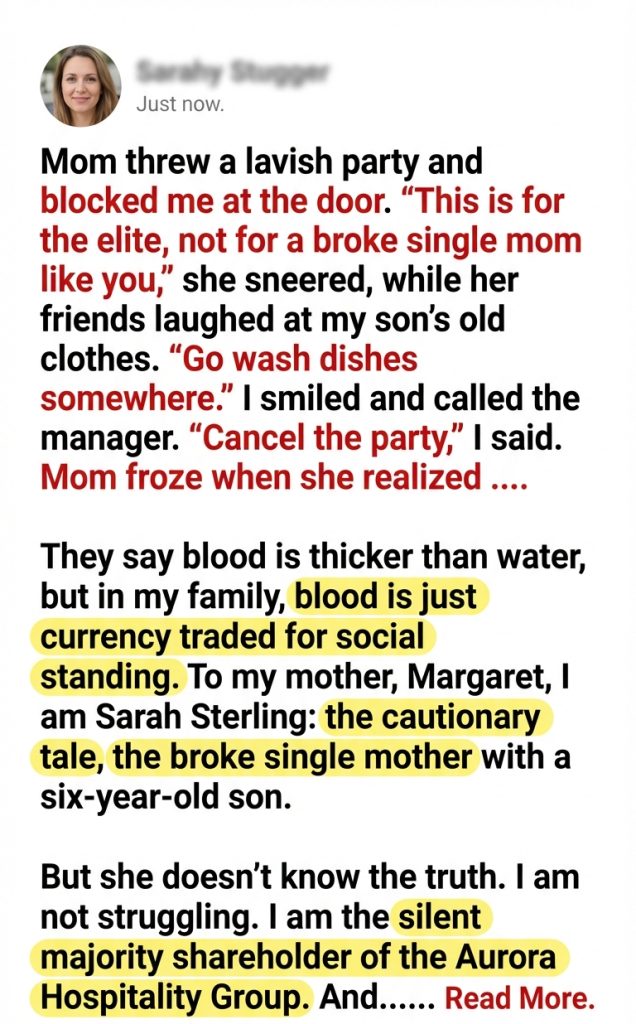
Mom threw a lavish party and blocked me at the door. “This is for the elite, not for a broke single mom like you,” she sneered, while her friends laughed at my son’s old clothes. “Go wash dishes somewhere.” I smiled and called the manager. “Cancel the party,” I said. Mom froze when she realized ….
They say blood is thicker than water, but in my family, blood is just currency traded for social standing. To my mother, Margaret, I am Sarah Sterling: the cautionary tale, the broke single mother with a six-year-old son.
But she doesn’t know the truth. I am not struggling. I am the silent majority shareholder of the Aurora Hospitality Group. And tonight, at the Grand Obsidian Hotel, I gave her one last chance to prove she had a heart.
She threw that chance away the moment my son, Leo, reached for a snack because he was hungry.
“Mother, he’s a child!” I cried out as she slapped the scallop from Leo’s hand, watching it splatter onto the pristine white carpet.
“He’s a thief!” Margaret announced, her voice turning her cruelty into a performance for the elite. “This food is for people who contribute to society, Sarah! Not for a penniless single mother and her undisciplined brat.”
A ripple of nervous, mocking laughter filled the room. Women dripping in diamonds covered their mouths, pointing at my son’s worn-out sneakers.
“If you want to eat,” Margaret sneered, her voice projecting to the back of the ballroom, “go wash dishes in the kitchen. Maybe the staff will give you scraps if you work hard enough.”
The humiliation was absolute. She was stripping me bare for the amusement of her social circle. I looked at Leo, trembling.
That was it. The test was over.
I sent Leo to the lobby and stood up. The slouch vanished. The “struggling daughter” facade evaporated. I looked at Margaret, not with fear, but with the cold, dead eyes of an executioner.
“So hard to get good help, isn’t it?” Margaret laughed to her friends, thinking she had won.
She didn’t see me pull out the sleek, matte-black phone from my pocket—a prototype months ahead of the market. I pressed a single button, staring directly into her soul as I spoke four words that cut through the laughter like a blade.
“Execute Protocol Omega. Now.”
The effect was instantaneous. The warm, golden chandeliers flickered and died, replaced by a harsh, blinding white light. The music cut out. And the smile on my mother’s face froze…
For two heartbeats, the ballroom didn’t understand what had happened.
People still held champagne flutes halfway to their lips. A woman in a pearl choker had her laugh stuck in her throat like a swallowed pin. The string quartet stopped mid-note, bows hovering in the air as if the musicians had been unplugged.
Then the emergency lights snapped on—white, clinical, unforgiving—bleaching the room of all its glamour. Every smudge, every wrinkle, every desperate edge of “elite perfection” showed under that light.
Margaret blinked rapidly, her smile tight and confused, like a face trying to remember a script.
“What is this?” she demanded, too loud, too sharp. “Why did the lights—”
A calm voice came over the speakers, replacing the soft jazz that had been floating through the room.
“Attention, guests of the Grand Obsidian Hotel. This event is now suspended. Please remain where you are. Staff will assist you shortly.”
A collective gasp rippled through the crowd.
Margaret’s head snapped toward the nearest waiter. “Fix it,” she hissed. “Fix it now.”
The waiter—young, trembling—looked toward the side doors instead of her.
Because a line of security guards had just entered the ballroom.
Not the usual hotel guards in soft blazers.
These wore earpieces and dark suits that didn’t wrinkle. Their posture screamed one word:
Authority.
Behind them walked the hotel’s general manager, Mr. Carlisle—tall, silver-haired, immaculate. His expression was pale, not from fear, but from sudden, sharp respect.
His eyes were on me.
He stopped several feet away and inclined his head like I was a storm he’d been warned about in training.
“Ms. Sterling,” he said, voice steady.
Margaret spun around.
“Ms. Sterling?” she repeated, as if hearing my name spoken with respect was an insult.
I didn’t smile.
I didn’t gloat.
I simply held Margaret’s gaze.
And in that sterile white light, for the first time in my life, my mother looked… small.
Not physically. Margaret was a woman who knew how to take up space. Her hair was styled perfectly, her dress was expensive, her jewelry heavy enough to bruise.
But her power had always depended on one thing:
An audience willing to believe her.
And now her audience was confused.
Nervous.
Listening.
Mr. Carlisle cleared his throat. “For the comfort and safety of our guests,” he said, “we will be concluding this event immediately.”
Margaret’s eyes widened in fury. “You can’t do that!” she snapped. “Do you know how much I paid for—”
Mr. Carlisle’s gaze didn’t flinch. “Yes,” he said quietly. “I do.”
He held up a tablet and tapped once. A list of numbers appeared—reservation codes, charges, event approvals.
Margaret straightened, certain she could win this by sheer entitlement.
“I am the client,” she said coldly. “This party is mine.”
Mr. Carlisle’s expression tightened. “No,” he said. “This party was approved under the assumption of compliance with our guest conduct policy.”
Margaret scoffed. “Guest conduct policy?” she repeated. “This is a private event!”
Mr. Carlisle’s voice remained calm. “Our conduct policy applies to every guest inside our walls.”
Then he added, carefully:
“And it applies especially when the majority owner is present.”
The air left the room.
You could feel it.
A kind of invisible collapse.
Margaret’s face twitched. “Majority—” she began, then laughed once, high and sharp. “Don’t be ridiculous. My daughter is a broke single mother. She can’t even afford—”
I lifted my hand slightly.
Two security guards moved.
Not toward Margaret.
Toward the doors.
They closed them quietly.
Not dramatic.
Just… final.
I stepped forward one pace.
Every heel click echoed like punctuation.
“Mom,” I said softly, and the entire ballroom leaned in because softness can be scarier than shouting. “You should know something about me.”
Margaret’s lips tightened. “I know plenty.”
“No,” I said. “You know the version of me you created to entertain your friends.”
I turned slightly, gesturing toward the room. Toward the diamonds. The designer bags. The women who had laughed at my son’s shoes like cruelty was a sport.
“You told them I’m broke,” I continued. “You told them my son is a brat. You told them we deserve scraps.”
I looked at Margaret again. “That was your choice.”
Margaret’s throat bobbed. She glanced around, trying to catch someone’s eye—someone to help her. But her friends were suddenly fascinated by their drinks, their phones, the floor.
Nobody wanted to be collateral damage.
Mr. Carlisle spoke again. “Ms. Sterling,” he asked carefully, “do you confirm the cancellation order?”
I nodded once. “Yes.”
Margaret’s voice rose. “You can’t just cancel—this is Christmas week! People flew in! The décor—”
I cut her off, calm. “I can. And I did.”
Then I added, not louder, but sharper:
“Because you slapped food out of my child’s hand.”
That sentence changed the room.
Not because it was dramatic.
Because every parent in that ballroom—every person with a conscience—felt it land.
A child’s hand.
A slap.
Hunger.
Cruelty dressed in pearls.
Margaret’s jaw trembled. “He—he was grabbing—”
“He was hungry,” I said simply. “And you wanted an audience.”
Margaret’s eyes flashed with rage. “You always do this,” she hissed. “You always come to ruin me. You’ve been a disappointment since the day you—”
“Stop,” I said, and my voice wasn’t loud, but it stopped her anyway.
Because it wasn’t the voice of a daughter pleading.
It was the voice of someone who didn’t need her.
Margaret stared at me, and in her eyes I saw the same thing I’d seen my whole life:
Not love.
Not remorse.
Ownership.
Like she believed she could still yank my life back into the shape that served her.
I lifted my phone again. “Protocol Omega wasn’t about lights,” I said quietly. “It was about truth.”
Mr. Carlisle tapped his tablet again, and the large screen at the side of the ballroom—used for event slides and speeches—flickered on.
A hush fell as the first image appeared.
It was a corporate document.
Aurora Hospitality Group.
Share distribution.
A name highlighted in bold:
Sarah Sterling — 51%
A murmur surged through the room.
Margaret staggered back a step.
“No,” she whispered, and it sounded like prayer.
The screen advanced to another page—board approvals, legal filings, signatures.
Mr. Carlisle’s voice was clear. “This is Ms. Sterling’s property,” he said. “And she has exercised her authority to cancel this event.”
Margaret’s face drained of color. “But… but I—”
“You booked this hotel because you thought it was safe,” I said softly. “Because you thought I’d never dare show up where your friends could see me.”
I let my gaze sweep the room again. “You thought I’d stay small.”
A woman near the front whispered, “She owns Aurora?”
Another murmured, “That includes three resort chains…”
A third voice, quieter: “My God.”
Margaret’s friends finally looked at her—not with admiration, but with calculation. Like they were figuring out if she was still useful.
Margaret’s lips parted. “Sarah,” she whispered, voice shaking now. “Why didn’t you tell me?”
That question almost made me laugh.
Because she didn’t mean, Why didn’t you share your success?
She meant, Why didn’t you give me the chance to treat you differently once it benefited me?
I stared at her for a long moment.
Then I answered honestly.
“Because I wanted to see if you had love in you that wasn’t transactional,” I said.
Her eyes filled with something like panic. “Of course I love you.”
I tilted my head slightly. “You just called my son a brat.”
Margaret’s face tightened. “I was… upset.”
I nodded once. “That’s the truth of you.”
Mr. Carlisle stepped forward. “Ms. Sterling, the refund—”
“No refund,” I said.
The room stirred again.
Margaret’s head snapped up. “What?”
I looked at her. “You can keep the bill.”
Her eyes widened, hopeful for a split second—until I finished.
“But the party is canceled,” I said. “And the next step is this: every guest here will be escorted out.”
A chorus of protests rose instantly.
“But we’re in the middle of—”
“My purse—”
“I haven’t even—”
“This is outrageous—”
Mr. Carlisle raised a hand. “Please,” he said smoothly. “Our staff will assist you. Thank you for your cooperation.”
Security moved with silent efficiency.
The “elite” started scrambling like startled birds.
Margaret looked around wildly as her audience dissolved.
And that was when she truly panicked.
Because my mother didn’t fear losing money.
She feared losing status.
She lurched toward me, grabbing my arm hard enough to hurt.
“Sarah,” she hissed, desperation cracking her voice. “You can’t do this to me.”
I looked down at her hand on my arm.
Then I looked at her face.
And I said the sentence I had waited years to say:
“You did this to yourself.”
Margaret’s eyes flashed. “I raised you—”
“No,” I said calmly. “You performed motherhood when it made you look good.”
She flinched like I’d slapped her.
I gently removed her hand from my arm. Not angry. Not dramatic.
Just final.
Then I turned and walked toward the lobby.
Because my son was waiting.
Leo was sitting on a couch near the grand Christmas tree, swinging his legs slowly, clutching a napkin that still had crumbs on it. His cheeks were pink, his eyes worried.
When he saw me, he hopped down.
“Mom?” he asked softly. “Are we in trouble?”
I knelt in front of him and cupped his face.
“No,” I whispered. “We’re free.”
His brows knitted. “But Grandma was mad.”
I swallowed. The word “Grandma” felt too gentle for Margaret.
“I know,” I said softly. “And I’m sorry you had to see that.”
Leo looked down at his shoes, scuffed and worn. “She said my clothes are old.”
My heart clenched.
I lifted his chin gently. “Listen to me,” I said, making sure he heard every word. “Your clothes don’t decide your value. Your heart does.”
His eyes filled. “Was I bad for taking food?”
“No,” I said firmly. “You were hungry. And hungry kids deserve kindness.”
I hugged him tightly.
Then I stood, took his hand, and walked out.
Behind us, the ballroom emptied completely.
Margaret was left standing under harsh lights with no music, no applause, no audience.
Just truth.
Outside, the night air was cold and clean.
Leo squeezed my hand. “Where are we going?” he asked.
I looked down at him, and for the first time that night, I smiled—not sharp, not devastating.
Warm.
“Somewhere we’re welcome,” I said.
“And Mom?” he asked, voice small.
“Yes, baby?”
He hesitated. “Are we still broke?”
I laughed softly, and tears finally came—not from humiliation this time, but from relief.
“No,” I whispered. “We never were.”
Then I corrected myself, gently.
“We were never less.”
And that was the real ending.
Not chandeliers flickering. Not Protocol Omega. Not the dramatic shut down.
The real ending was my son learning—at six years old—what I learned too late:
That the richest people aren’t the ones in diamonds.
They’re the ones who can walk away from cruelty without begging for love.