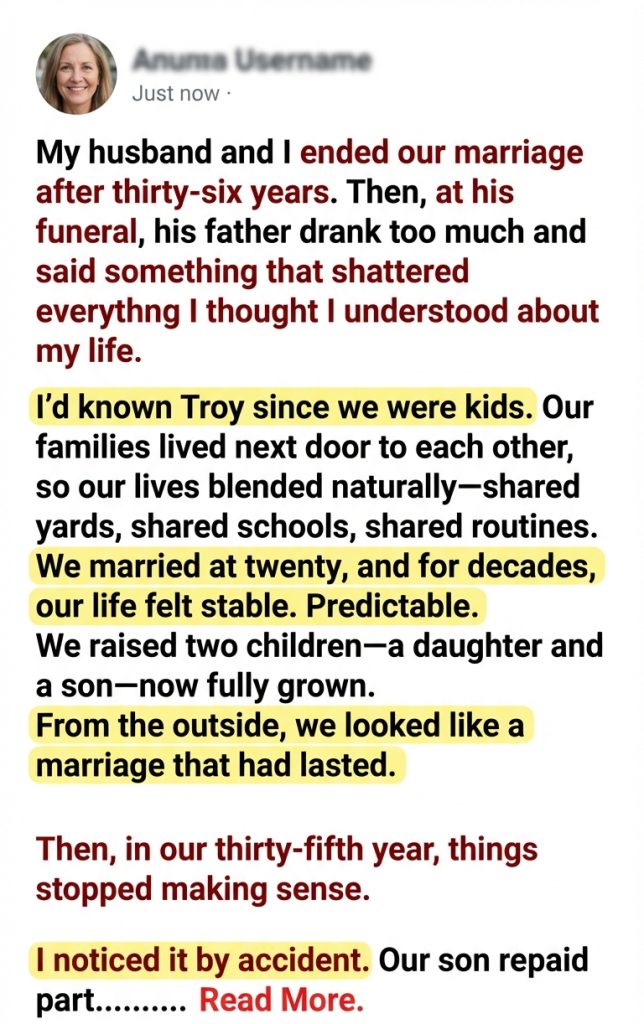
…… of a loan, and I logged in to transfer the money into savings. The balance was off. Thousands were missing. Then more. It felt like the account was slowly being drained without a sound.
When I asked Troy, his explanations kept changing.
“Bills.”
“House costs.”
“I shifted some money around—it’ll come back.”
It never did.
A week later, I opened his desk drawer looking for batteries—and found hotel receipts tucked beneath paperwork instead. The same hotel. The same city. The same room. Again and again.
My stomach sank.
I called the hotel, pretending to be his assistant, and asked to reserve the room he usually used. The concierge didn’t hesitate.
“He’s a regular,” he said. “That room is basically his.”
When Troy came home, I placed the receipts on the table and asked him to explain. He didn’t deny them. But he wouldn’t tell me the truth either. Instead, he looked at me as if I were the problem.
That’s when I understood I couldn’t keep living inside a lie I wasn’t allowed to question.
After thirty-six years, we divorced.
Two years later, Troy passed away unexpectedly.
At his funeral, his eighty-one-year-old father approached me. He was unsteady, reeking of whiskey, grief carved deep into his face. He leaned in close and whispered—his words slurred, but unmistakably sharp:
“You don’t even know what he did for you, do you?”…
I felt my breath catch like something had hooked the inside of my ribs.
His father—Frank—wasn’t a man of mystery. He was blunt, proud, and usually careful about what he said in public. Even tipsy, he’d always been the type to keep family matters close to his chest.
So when he said that—right there in the funeral home, under the soft lighting and the hum of polite condolences—it didn’t sound like drunken nonsense.
It sounded like a key.
I stared at him. “What are you talking about?”
Frank’s eyes were glossy and bloodshot. He swayed slightly, one hand gripping the back of a chair like it was an anchor. “You walked away,” he muttered. “You walked away and never even knew.”
My throat tightened. “Frank. If you know something, say it plainly.”
He laughed, rough and bitter. “Plainly?” he echoed. “Plainly is what got him killed on the inside.”
Before I could respond, my daughter, Elise, touched my arm gently. “Mom,” she whispered, “leave Grandpa Frank alone. He’s been drinking all day.”
I almost listened.
I almost let it go because funerals make everything feel inappropriate—questions, truth, anger.
But I’d already let things go for thirty-six years. I’d already swallowed confusion and doubt until it became my daily bread.
So I leaned in closer and lowered my voice. “Frank,” I said, steady, “tell me.”
He stared at me for a long moment, then his face shifted—something like guilt crossing into anger, like he was choosing between loyalty to his dead son and some long-delayed need to speak.
“He wasn’t with some woman,” Frank whispered. “Not the way you thought.”
My stomach lurched. “Then what was it?”
Frank’s mouth twisted. He glanced around, as if afraid of being overheard. Then he leaned close enough that I could smell the whiskey on his breath.
“That money,” he slurred. “Those hotel rooms. That wasn’t for him.”
My pulse hammered. “For who?”
Frank’s eyes narrowed, and his voice dropped into something almost sober.
“For you,” he said.
I felt the room tilt.
I pulled back, staring at him like he’d lost his mind. “For me? That doesn’t make any sense.”
Frank’s gaze sharpened. “Because you didn’t know,” he whispered again, almost furious now. “You never knew what you were carrying.”
My mouth went dry. “What I was carrying?”
Frank made a small, frustrated sound. “He didn’t want you to know,” he said. “He thought he was protecting you. Protecting the kids.”
My heart was pounding so hard it hurt.
“Frank,” I said carefully, “protecting me from what?”
Frank’s eyes flicked toward my son, Aaron, who was standing across the room speaking with relatives. Aaron looked tired and hollow, dressed in a black suit that didn’t quite fit right, like grief had altered his shape.
Frank’s voice trembled. “Ask your son,” he said.
My stomach dropped again. “Why would Aaron know?”
Frank laughed once, bitter. “Because Aaron has known longer than you.”
A cold wave rolled through me. “No,” I whispered. “No, he wouldn’t—”
But my mind was already racing back through the last few years—little moments that had felt off and then faded because I was exhausted.
Aaron offering to drive his father to “appointments” even when Troy didn’t seem sick.
Aaron asking me, strangely, if I was “okay” after I confronted Troy about the bank account.
Elise looking like she wanted to say something during our divorce, then swallowing it.
Pieces shifting into a shape I didn’t want.
I turned to Frank. “What did Troy do?” I demanded. “Tell me.”
Frank’s face tightened. He shook his head, as if the act of saying it was too heavy. “He did what a man does when he’s trying to keep his family safe,” he murmured. “He took the blame.”
“The blame for what?” I asked, my voice cracking.
Frank’s eyes filled. “For your illness,” he whispered.
I froze.
“My… illness?”
I felt a ridiculous urge to laugh, because I wasn’t sick. I wasn’t dying. I was standing right there, alive, breathing, divorced, confused.
Frank grabbed my wrist suddenly, tight enough to make my skin sting. “Do you remember,” he said, voice urgent, “eight years ago, when you started having those episodes?”
My throat tightened.
I did remember.
The dizzy spells that came out of nowhere. The fatigue so deep I thought I was aging overnight. The tremors in my hands that made me drop things. The nights I woke up with my heart racing for no reason, sweating through my sheets.
The doctors ran tests. They shrugged. They called it “stress,” “hormones,” “getting older.”
Troy had acted worried at first. Then impatient. Then distant.
“We’ll figure it out,” he said, until he stopped saying it at all.
Frank’s grip loosened. “He found out what it was,” he whispered. “And he couldn’t tell you.”
My mouth opened, but no words came.
Frank swayed, blinking hard. “He paid for it,” he said. “He paid to keep it quiet. He paid to keep you alive.”
I stared at him, trembling. “Frank… what are you saying?”
Frank’s lips quivered. “I’m saying Troy wasn’t cheating,” he whispered. “He was meeting with the people who could fix what the doctors missed.”
My heart pounded painfully.
Then Frank’s voice dropped lower, full of shame.
“And the reason you got sick,” he said, “was because someone tried to hurt you.”
The funeral home suddenly felt too bright, too crowded, too unreal.
“Someone tried to hurt me?” I whispered.
Frank nodded slowly, eyes glassy. “You remember that old water heater issue? The time you said the water tasted funny for weeks?”
My throat went tight. I remembered complaining. Troy had told me I was imagining it.
“You remember those headaches you’d get after coffee?” Frank continued.
My stomach turned.
“No,” I whispered. “No. Frank, stop.”
Frank’s voice shook. “It was poisoning,” he said.
The word hit me like a slap.
Poisoning.
My legs went weak. I grabbed the edge of a chair.
Frank blinked, tears spilling now. “Troy found out,” he said. “And he went to that hotel because he had to meet with someone quietly. He didn’t want it traced back to the house. He didn’t want you panicking. He didn’t want anyone targeting the kids.”
My mouth was dry. “Who?” I managed. “Who would poison me?”
Frank’s gaze flicked again toward Aaron. Then it flicked toward Elise.
And suddenly I understood why he’d said, Ask your son.
My blood turned cold.
“No,” I whispered. “Not my children.”
Frank shook his head quickly. “Not the kids,” he said. “Not directly.”
Then he swallowed hard and said the name that made my vision blur:
“Your sister.”
My sister.
Hannah.
I hadn’t spoken to Hannah in years. We’d never been close, but we were family—holiday visits, awkward hugs, polite small talk. She was always jealous of my “perfect” life, always making little comments about how lucky I was, how Troy was steady, how our house was nice.
I’d always dismissed it as bitterness.
Now my skin crawled with a horror so deep it felt ancient.
“Why?” I whispered, barely audible.
Frank exhaled shakily. “Money,” he said. “Your mother’s will. Hannah thought you’d get the larger share. She thought Troy would cave and give her something. When you didn’t… she got ugly.”
I stared at him, shaking my head like denial could undo it. “That’s insane.”
Frank’s eyes were full of grief and fury. “It is insane,” he said. “And Troy tried to handle it without destroying the family. He thought if he could get proof, stop it quietly, and get you treatment, you’d never have to carry the fear.”
My breath came in short bursts. “Treatment?” I whispered. “For what?”
Frank’s voice broke. “For the damage,” he said. “The specialists said it could be reversed if caught early. Troy paid for private testing. Private doctors. He paid for a safe place to meet them because he didn’t want any of it showing up on insurance paperwork.”
I stared at him, stunned. “So the missing money—”
“Went to doctors and investigators,” Frank said. “And the hotel?” He swallowed. “That’s where the investigator met Troy. Same room, same place—quiet, off the radar.”
My body felt like it was shaking apart.
I thought of the receipts. The room “basically his.” The way the concierge spoke like it was normal.
It had never been normal.
It had been a hiding place.
A place where my husband tried to save me without letting me know I needed saving.
And then I thought of the night I confronted Troy. The receipts on the table. The way he looked at me like I was the problem.
Maybe he had.
Not because I was wrong—because I was too close to the truth.
Maybe he couldn’t tell me because the truth would have set a bomb off in our family.
Or maybe he didn’t tell me because he still wanted control over how I felt.
Either way, the result was the same:
I divorced him believing he’d betrayed me.
And he died with me believing it.
My knees buckled. I sat down hard.
Frank wiped his face with the back of his hand like an embarrassed child. “He never blamed you,” he whispered. “Not once. He just… he couldn’t forgive you for leaving before he could finish.”
“Finish what?” I whispered.
Frank’s voice cracked. “He was going to tell you,” he said. “After he got the confession.”
My stomach dropped. “Confession?”
Frank nodded. “Hannah wrote it down,” he said, words thick. “She admitted it. She signed it. Troy had it.”
My heart raced. “Where is it?”
Frank blinked, as if he hadn’t expected me to move from shock into action. Then he pointed weakly. “In his safe,” he whispered. “In the garage. The small metal one.”
My hands trembled as I stood.
Across the room, Aaron noticed me and started walking over, concern on his face. “Mom?” he asked. “What’s wrong?”
I stared at him. I wanted to ask him a thousand questions at once.
But the funeral home wasn’t the place. Not with relatives watching, not with grief thick in the air.
“I’m fine,” I lied, because lying had become muscle memory. Then I added, “I need to go.”
Elise hurried to my side. “Mom, are you okay?”
I looked at my daughter’s face—so much like mine—and felt something sharp twist in my chest.
“I need you both,” I said quietly. “Now. At the house.”
They exchanged a confused look, but they followed me because my voice had changed.
On the drive, my hands gripped the steering wheel so tightly my knuckles hurt.
Neither of them spoke at first.
Then Aaron cleared his throat. “Grandpa Frank said something to you,” he said cautiously. “What did he say?”
I kept my eyes on the road. “He said I don’t know what your father did for me.”
Aaron went quiet.
Too quiet.
Elise looked at him. “Aaron?”
Aaron swallowed. “Mom…” he began.
My heart pounded. “You knew,” I said, voice shaking. “He said you knew.”
Aaron’s shoulders sagged like he’d been waiting for this moment for years. “I didn’t know everything,” he whispered. “Not at first.”
I pulled into the driveway and parked hard.
We went into the garage, and I found the small metal safe in the corner where Troy kept tools.
The keypad required a code.
My hands trembled. I looked at Aaron. “Do you know it?”
Aaron hesitated, then nodded.
He typed it in like he’d done it before.
The safe clicked open.
Inside were folders—neatly labeled. Medical records. Lab results. Bank statements. And then, in a manila envelope, a single sheet of paper.
A confession.
Signed.
Hannah’s handwriting.
I pulled it out and read the first line, and the room blurred instantly.
Because it was real.
It admitted everything—how she’d added something to my coffee during visits, how she’d tampered with water filters, how she’d wanted me weak, how she’d believed Troy would pay her “to keep the peace,” how she’d hated me for “having everything.”
My hands shook so hard the paper rattled.
Elise covered her mouth, crying.
Aaron stared at the floor, face wet.
And in that moment, all the years rewrote themselves again.
The “stress” diagnosis.
The fatigue.
Troy’s impatience.
The money disappearing.
The hotel receipts.
The divorce.
My God—the divorce.
I pressed the paper to my chest and made a sound that didn’t feel human.
Aaron’s voice broke. “Dad told me not to tell you,” he whispered. “He said it would destroy you. He said he’d handle it.”
My throat burned. “And did he?” I whispered.
Aaron nodded slowly. “He did,” he said. “He turned it over to the police. He made Hannah sign the confession with an attorney present. She was charged… but then it got complicated.”
“Complicated?” I repeated, dizzy.
Aaron swallowed. “She took a plea,” he said. “Probation. Monitoring. Dad didn’t want a public trial. He said it would ruin the family.”
I stared at him. “Ruin the family?” I whispered.
Elise sobbed. “Mom, I’m so sorry.”
I felt something harden inside me, like grief turning into clarity.
Troy had tried to keep things quiet.
He had tried to protect me from the truth.
He had tried to protect our children from scandal.
He had tried to control the story.
And in doing so, he had robbed me of the choice to respond, to heal honestly, to know what my own life had survived.
He had saved me—yes.
But he had also lied to me.
And both things could be true.
I sank onto a stool, the confession in my hands, and for the first time since the divorce, I finally understood Troy’s face that night at the table.
He wasn’t guilty of cheating.
He was guilty of secrecy.
He’d been staring at me like I was the problem because my questions threatened to pull the whole hidden structure down.
And I—tired, confused, scared—had walked away, because I refused to stay inside a lie.
But the lie wasn’t what I thought.
Two hours later, I sat at my kitchen table surrounded by evidence that my life had been in danger and I hadn’t even known.
Aaron sat across from me, ashamed. Elise sat beside me, holding my hand.
And I thought about Troy.
Troy, who drained the account to pay for private doctors and investigations.
Troy, who rented hotel rooms not for romance, but for secrecy.
Troy, who let me hate him so I would leave, because maybe he believed leaving him was safer than staying near whatever darkness had targeted me.
Or maybe he believed I’d never forgive him if I knew the truth.
And he was right.
Because I didn’t know what forgiveness even meant anymore.
That night, after the children went to bed in their old rooms, I sat alone with Troy’s obituary folded beside me and the confession in my hands.
I pictured him in those hotel rooms, meeting investigators, hearing medical updates, carrying the weight alone.
I pictured him coming home and watching me look at him with suspicion, unable to tell me why.
I pictured him dying two years after we divorced, still holding this secret like a stone in his pocket.
And I realized something that hurt almost as much as the betrayal:
Our marriage didn’t end because we stopped loving each other.
It ended because we stopped trusting each other enough to face the truth together.
The next morning, I did what Troy had avoided.
I called Hannah.
I hadn’t spoken to her in years.
When she answered, her voice was cautious. “Hello?”
I didn’t scream. I didn’t curse.
I simply said, “I read your confession.”
Silence.
Then a small, shaky breath on the other end. “I… I was sick,” she whispered.
I laughed softly, coldly. “Yes,” I said. “And you tried to make me sick too.”
She started crying immediately, but it didn’t move me.
Because the kind of harm she’d done doesn’t get softened by tears.
“I wanted you to know,” she sobbed. “I wanted to apologize—”
“You apologized to Troy,” I said. “In writing. Because you were caught. You never apologized to me.”
More sobbing.
I stared out my kitchen window at the quiet street where Troy and I once built a life.
“Here’s what you’re going to do,” I said calmly. “You’re going to leave my children alone. You’re going to stay away from my family. And you’re going to live with the truth that Troy saved me—because you tried to destroy me.”
Her crying turned into pleading, but I didn’t listen.
I hung up.
Then I went to Troy’s grave.
I brought the confession.
I sat on the grass, feeling the weight of everything I’d never said, everything he’d never let me know.
“I’m sorry,” I whispered. “I’m sorry I believed the wrong lie.”
The wind moved through the trees, soft and constant.
I pressed the confession flat against the earth like I was returning it to the only person who had carried it long enough.
“I don’t know if I could have stayed,” I said quietly. “I don’t know if I could have handled the truth. But you didn’t give me the chance. And that hurt, Troy.”
I swallowed hard.
“Still,” I whispered, tears coming now, “thank you for saving my life.”
I stayed there a long time.
And when I finally stood to leave, I realized the strongest ending wasn’t neat.
It wasn’t revenge.
It wasn’t a dramatic confrontation that fixed everything.
It was something quieter.
It was learning to live with two truths at once:
That Troy betrayed my trust.
And that Troy protected me in ways I never understood.
He died with me thinking he’d taken from me.
But the truth was, he was giving—desperately, secretly, imperfectly—trying to keep my life intact.
Frank was right.
I didn’t know what he did for me.
Now I did.
And the knowledge shattered me.
But it also rebuilt something I thought was gone forever:
My ability to see my life clearly.
Not as a perfect marriage that fell apart.
Not as a simple story of cheating and lies.
But as a complicated, human story—where love and fear can live in the same house, and where secrets can both save you and destroy you.
And where sometimes, the truth arrives too late… but still changes everything.