………. trying to convince yourself something still matters.
The restaurant was small and warm, the kind of place couples go when they want to feel romantic without making a show of it. I’d picked it because it had soft lighting and a corner table where you could hear each other talk. I’d picked it because I still had that embarrassing hope—after all the disappointments—that maybe this year would be different.
I arrived early, like I always did. I asked for our usual table. I smiled at the hostess like she wasn’t watching my story repeat itself in real time.
I put my purse on the chair across from me.
And I waited.
At first, I waited with optimism. I checked my phone, thinking maybe he’d text any second: Running late. Traffic. Be there soon. The normal excuses people give when they still respect you enough to pretend.
Ten minutes passed. Then twenty. Then forty.
The waiter came over twice, each time trying to read my face.
“Would you like to order something while you wait?” he asked.
I ordered water. Then I ordered another water. Then I ordered a small appetizer I didn’t really want, just to look like I belonged there.
All the while, my candles sat on the table—three little flames melting slowly down like time itself was getting tired of me.
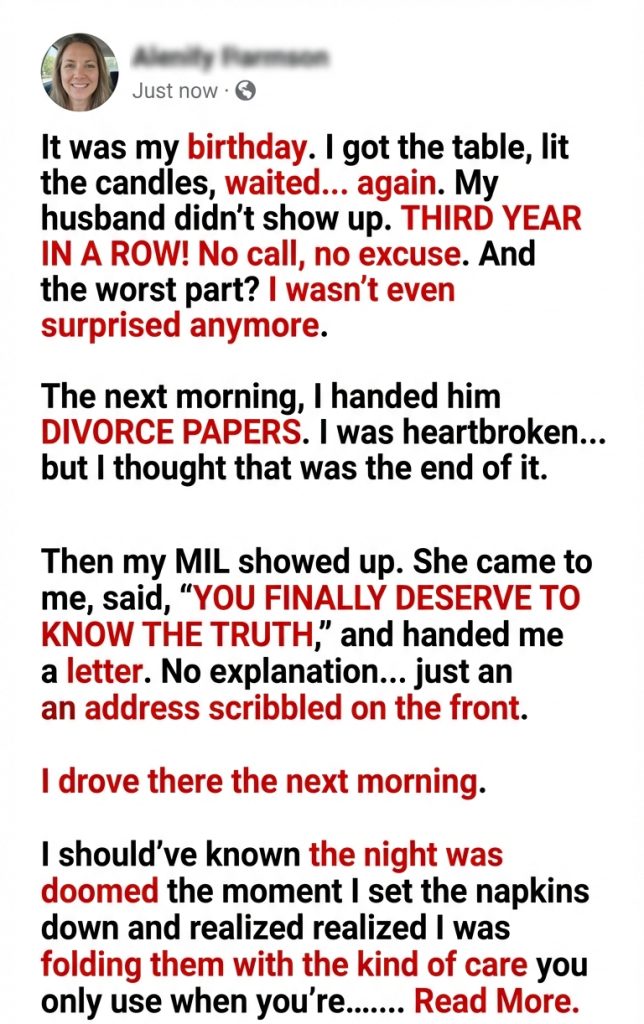
It was my birthday. I got the table, lit the candles, waited… again. My husband didn’t show up. THIRD YEAR IN A ROW! No call, no excuse. And the worst part? I wasn’t even surprised anymore.
That was the moment that broke me—not the absence, but the lack of shock.
Surprise is hope.
And I had none left.
I paid for the appetizer I didn’t touch, left a tip that was too generous because I was embarrassed, and carried my birthday cake back to my car like it was a punishment.
When I got home, the house was dark. Quiet.
His shoes weren’t by the door.
For a second, I stood in the entryway and pictured all the birthdays I’d tried to salvage with laughter, all the anniversaries I’d “understood” away, all the holidays where I was the only one who planned and wrapped and smiled.
I set the cake down on the counter.
Then I opened the fridge, took out a fork, and ate a bite standing up.
Not because it tasted good. Because it was mine. Because I deserved something sweet even if no one else cared.
I slept in the guest room.
I didn’t cry loudly. I didn’t throw things. I didn’t call friends in the middle of the night and demand validation.
I did something scarier.
I went quiet.
The next morning, I woke up with a clear mind and a heavy chest—the kind of clarity that doesn’t come from peace, but from exhaustion.
He came home around 8 a.m., smelling like cold air and something faintly metallic—like a parking garage or a train station. He walked in as if nothing had happened.
As if I hadn’t waited with candles burning down for him.
He glanced at the counter. “Oh,” he said casually. “You went without me?”
That was what he said.
Not: I’m sorry.
Not: What happened?
Not even: Happy birthday.
Just: “You went without me?”
My hands started to shake. I didn’t trust my voice, so I didn’t answer right away.
He yawned. “Work was crazy,” he said, as if that explained three years.
I stared at him. “Work,” I repeated quietly.
He waved a hand. “Yeah. Something came up. I was going to call.”
“You didn’t,” I said.
He looked annoyed—actually annoyed, like I was inconveniencing him with my feelings. “Okay. I didn’t. Can we not do this first thing in the morning?”
Something in me hardened.
I walked to the kitchen drawer where I’d hidden the papers weeks earlier—because somewhere deep inside, I’d been preparing for this moment before my brain admitted it.
I pulled them out, placed them on the table, and slid them toward him.
The next morning, I handed him DIVORCE PAPERS. I was heartbroken… but I thought that was the end of it.
His face changed as he stared at the documents.
For a moment, I thought I saw fear.
Then he scoffed. “You’re serious?”
I didn’t flinch. “I’m done.”
He laughed once, sharp. “Done? Over dinner?”
I looked at him steadily. “Over three years of being last.”
His jaw tightened. “You’re being dramatic.”
There it was again—that word people use when they don’t want accountability.
He pushed the papers back like they burned. “I’m not signing anything.”
“I’m not asking permission,” I said.
He stood up so fast his chair scraped the floor. “You can’t just blow up our marriage because you feel—”
“Because I feel unloved?” I cut in, my voice finally rising. “Because I feel invisible? Because I feel like I’m married to an absence?”
He stared at me, breathing hard.
Then he did what he always did when confronted with reality.
He left.
Not stormed out—just grabbed his keys and walked out like he was going for milk. Like I was a problem he could postpone.
I sat down and pressed my hand to my chest because my heart felt like it was bruising itself from the inside.
That’s when the doorbell rang.
I expected maybe a neighbor. A delivery. Anyone but her.
My mother-in-law stood on my porch, dressed neatly, hair perfect, eyes too sharp to be kind.
For years, she had been distant but polite—never warm, never cruel. She was the kind of woman who attended holidays and judged silently, saving her real opinions for later.
Seeing her there made my stomach tighten.
“What are you doing here?” I asked.
She didn’t answer right away. She stepped inside as if she owned the air in my house.
Then she looked at me with something I’d never seen on her face before.
Regret.
Then my MIL showed up. She came to me, said, “YOU FINALLY DESERVE TO KNOW THE TRUTH,” and handed me a letter. No explanation… just an address scribbled on the front.
I stared at the envelope.
My name was written on it, but not in her handwriting.
In his.
My husband’s handwriting.
My throat went dry. “What is this?”
My mother-in-law’s lips tightened like she was holding back years of words. “It’s time,” she said simply.
“Time for what?”
“For you to stop thinking you’re crazy,” she said, voice low. “For you to stop thinking you’re not enough. For you to stop blaming yourself for a man’s shame.”
I stared at her, stunned. “Why are you doing this?”
Her eyes flicked away. “Because I’m not proud of my son,” she said quietly. “And because… you were the only person who tried to love him like he was worth saving.”
That sentence hit me harder than I expected.
I looked at the address scribbled on the front of the envelope. It was across town. An unfamiliar street.
I held the letter like it might explode.
“What’s there?” I whispered.
My mother-in-law exhaled slowly. “The reason,” she said. “And the lie.”
Then she turned toward the door.
“Wait,” I said, panic rising. “I don’t understand.”
She paused with her hand on the knob. “You will,” she said softly. “But once you go there… you can’t unsee it.”
Then she left.
I stood in my living room staring at the envelope for a long time, feeling like my life had tilted.
When you’ve been dismissed for years, you start to doubt your own instincts. You start to wonder if you really are too sensitive, too needy, too dramatic.
But my mother-in-law had just confirmed something I never had proof of:
There was a truth.
And it had been kept from me on purpose.
I drove there the next morning.
The address led me to an older part of town, where the streets were quiet and the houses were close together, as if they were leaning in to share secrets.
I parked in front of a small brick building with faded numbers on the door.
It didn’t look like a home.
It looked like an office that had been converted into something else.
A counseling center, maybe. Or a clinic.
My hands trembled as I got out of the car.
I walked up the steps and stared at the sign in the window.
WILLOWRIDGE FAMILY SUPPORT SERVICES
Underneath, smaller letters:
Grief Counseling • Addiction Recovery • Trauma Support • Domestic Violence Advocacy
My stomach dropped.
I stood frozen, the envelope in my hand suddenly feeling heavier than paper.
Why would my husband be connected to a place like this?
I pushed the door open.
A bell chimed softly.
The front desk area smelled like coffee and lavender cleaner. Calm, intentional.
A woman behind the counter looked up and smiled. “Hi there. Can I help you?”
My voice came out thin. “I… I’m looking for someone.”
“Name?”
I swallowed and said my husband’s name.
Her smile faded slightly—not into suspicion, but into recognition.
“Yes,” she said softly. “I thought you might come.”
My heart slammed. “You knew?”
She nodded. “We were told you might show up. He left a letter.”
I held up the envelope. “This?”
She shook her head. “That’s the address. There’s another letter here. For you.”
My hands went numb.
She reached under the desk and pulled out a second envelope, thicker, sealed.
My name was written on it again. Same handwriting.
She placed it on the counter and added gently, “Before you read it… are you safe? Do you have support today?”
Safe?
The question was so unexpected it made my throat tighten.
“Yes,” I whispered. “I think so.”
She nodded slowly. “Okay. There’s a room you can use. Private.”
I followed her down a hallway lined with soft posters about healing and boundaries and starting over.
She opened a small room with a couch and a box of tissues on the table, like they expected tears as a guest.
I sat down, staring at the envelope in my hands.
Then I opened it.
Inside was a letter and a photocopy of a certificate.
At the top of the certificate were words that made my vision blur:
DEATH CERTIFICATE — BABY BOY [HIS LAST NAME]
My breath caught violently.
Below it, dates.
A baby born… and died… years before I ever met my husband.
My hands flew to my mouth.
I turned to the letter, trembling so hard the paper shook.
My husband had written:
If you’re reading this, you finally stopped waiting for me. And you were right to.
My tears spilled instantly.
He wrote:
I didn’t miss your birthday because you weren’t important. I missed it because that date is the day my first child died.
I stared at the words, unable to process them.
I never told you because I didn’t want you to look at me differently. I didn’t want you to pity me. I didn’t want you to realize that the man you married has been broken since before you knew him.
My chest ached like it was trying to crack open.
He explained that before he met me, he’d been with someone else, young and reckless and unprepared. They’d had a baby too early, too fragile. Complications. A hospital room. A tiny heartbeat that stopped.
And he never healed.
He never talked about it. Not with friends. Not with family. Not even with his mother—until recently.
Instead, he built a life around avoidance.
He learned to disappear when feelings got too big. He learned to go numb on important days. He learned to run from intimacy by letting it rot quietly.
He wrote:
Every year, when your birthday came, it collided with that day in my head. And I hated myself for resenting your joy. So I ran.
I closed my eyes, sobbing silently.
Then came the part that made my stomach twist with anger again:
I should have told you the truth the first year. I should have asked for help. But I was ashamed. And shame makes cowards of men who look fine on the outside.
I wiped my face and kept reading.
He wrote that his mother had finally confronted him after the third missed birthday.
That she’d called him selfish.
That she’d said, “If you keep punishing her for your pain, you’ll end up alone like you deserve.”
He wrote:
She’s right. You didn’t deserve this. You deserved a husband who shows up.
My hands shook harder. I looked at the tissue box and laughed through tears because of course they knew.
He wrote that he had been coming to Willowridge for months—grief counseling. Trauma support. Trying to become someone who could stay in a room when it hurt.
Then he wrote the sentence that made my heart drop:
But you handed me divorce papers, and I realized I might have waited too long.
I stared at that line, breathless.
He wasn’t denying it. He wasn’t angry.
He was admitting he’d earned it.
The letter ended with an address inside the same building—a support group room number—and a time.
Tonight. 7 p.m.
If you want to hear the whole truth, I’ll be there. If you don’t, I’ll understand.
I sat there for a long time, shaking.
Because grief is real. Trauma is real. Losing a child is unimaginable.
But so is being married to someone who makes you invisible and calls it “private pain.”
I left the building in a fog.
In the car, I stared at my reflection in the rearview mirror and whispered, “So that’s the truth.”
The truth didn’t excuse him.
It explained him.
And now I had to decide what to do with it.
That evening, I went back.
Not because I knew I would forgive him.
Because I needed closure that didn’t involve another empty chair.
At 7 p.m., I walked into the group room.
He was there.
My husband sat in a circle of chairs, hands clasped, eyes red like he’d been crying for hours. He looked smaller than I’d ever seen him—less like a man who could ignore me and more like a man who had been ignoring himself.
When he saw me, his breath hitched. He stood slowly.
“I didn’t think you’d come,” he whispered.
I didn’t sit. I didn’t hug him. I didn’t soften my face.
“I didn’t come to comfort you,” I said quietly. “I came to understand what I lived through.”
He nodded, tears slipping down his cheeks. “You’re right.”
For the next hour, I heard the whole story—messy details, ugly truths, things his mother didn’t even know until recently. How he’d been angry at happiness because it reminded him of loss. How he’d punished me without intending to. How he’d convinced himself he was protecting me by staying silent.
And when he finished, he looked at me and said, voice shaking:
“I’m sorry. I’m sorry I stole your birthdays. I’m sorry I made you beg for a normal marriage. I’m sorry I made you feel like you weren’t worth showing up for.”
My throat burned. “Why didn’t you tell me?” I whispered. “Why did I have to find out like this?”
He flinched. “Because I was weak,” he said. “Because I thought if you knew, you’d leave.”
“And you were right,” I said, my voice breaking. “I might.”
Silence filled the room.
Then I took a breath and said the most honest thing I could:
“I’m not your therapist. I’m not your grief container. I’m your wife. And if you want a marriage, you have to show up—even when it hurts.”
He nodded, desperate. “I will.”
I studied him carefully.
Then I said, “The divorce papers still stand.”
His face crumpled.
“I’m not threatening you,” I continued. “I’m protecting myself. If you want to earn another chance, you do it with actions. Not excuses.”
He nodded, swallowing hard. “Okay.”
That night, I went home alone.
I slept in my bed for the first time in weeks, but I didn’t feel comforted. I felt awake.
Over the next month, he did what he’d never done before:
He showed up.
Not with flowers and apologies and grand gestures.
With consistency.
He went to counseling. He stopped disappearing. He told the truth, even when it made him look bad. He listened without defensiveness when I said, “That hurt.”
And I did something new too.
I stopped begging.
I watched.
I measured.
I gave myself permission to leave if the pattern returned.
Because love without reliability is just waiting with candles burning down.
On my next birthday, I didn’t plan a dinner.
I didn’t book a table and hope.
I made one quiet plan: I would not spend my birthday feeling unwanted.
He asked me what I wanted to do.
I said, “I want you to be honest if the day is hard for you.”
He nodded, eyes wet. “It is hard,” he admitted. “But I want to be here.”
So we stayed home. We cooked together. We lit one candle—not as a test, but as a symbol.
He didn’t run.
And when midnight came, he held my hand and whispered, “Happy birthday. I’m here.”
It didn’t erase the three years.
It didn’t fix everything.
But it did something powerful.
It proved that the truth—when finally spoken—can be the start of healing.
And that sometimes, the “end of it” isn’t divorce.
Sometimes it’s the end of silence.
Sometimes it’s the beginning of a marriage that finally has two people in it.
Not one person waiting at a table.
And one person vanishing into the dark.