My sister scheduled her wedding on my graduation day. She got the attention she wanted when no one showed up.
I was the first person in my family to go to college. Not just college, but medical school. Eight years of absolute hell—working three jobs while studying, living on ramen, and four hours of sleep, missing every family vacation because I had exams or hospital rotations. My parents always said they were proud, but they never really understood why I put myself through it when I could have just gotten married like my sister Rachel did at 19.
Rachel dropped out of community college after one semester to marry her boyfriend Todd, who sold insurance. She spent the next seven years having three kids and complaining about how hard her life was while I was pulling 36-hour shifts at the hospital.
When I finally matched into my residency program, I called my family with my graduation date circled in red on my calendar. May 15th. I’d already bought my parents their plane tickets as a surprise. My mom cried on the phone saying she couldn’t wait to see me walk across that stage.
Two weeks later, Rachel called me screaming with excitement about her news. She and Todd were renewing their vows for their eighth anniversary and having the big wedding they never got to have. The date? May 15th.
I told her that was my graduation day and she said I’d had plenty of graduations before, so missing one wouldn’t kill me. When I reminded her this was medical school, not some random ceremony, she said I was being selfish trying to make her change her date when she’d already put down deposits. She actually said my graduation was just a boring ceremony, but her wedding was a once-in-a-lifetime event. I asked her what about her first wedding and she hung up on me.
Rachel immediately called our parents crying about how I was trying to ruin her special day. She told them I demanded she change everything just so people would pay attention to me. She said I’d always been jealous of her beautiful family and was trying to sabotage her happiness.
My mom called me, disappointed, saying Rachel already paid for the venue and it would be such a waste of money to change it. My dad said I could just get my diploma mailed to me. They chose her wedding…….
I wish I could say I screamed. I wish I could say I told them exactly what kind of parents choose balloons and centerpieces over the daughter who spent nearly a decade clawing her way through med school.
But I didn’t.
I sat on the edge of my apartment bed in scrubs that still smelled faintly like antiseptic and cafeteria coffee, and I just went quiet.
That was the moment something in me changed.
Not shattered. Not dramatically snapped.
It just… settled.
Like a final answer.
I realized I had spent most of my life trying to earn a kind of love my family only handed out when it was easy for them. When it was convenient. When it didn’t require them to miss anything fun.
Rachel gave them grandkids, holiday photos, drama, matching outfits, and constant need. I gave them milestones that took years of invisible work—exams, rotations, overnight shifts, debt, exhaustion.
Her life looked like a celebration.
Mine looked like sacrifice.
And people who don’t understand sacrifice often mistake it for selfishness.
I hung up the phone and stared at the plane ticket confirmations I had bought for my parents. Nonrefundable. A surprise I’d saved for by skipping actual groceries for two weeks and surviving on instant noodles and peanut butter.
I laughed once, dry and ugly.
Then I cried. Not because they picked her. Some part of me had always known they would.
I cried because for one stupid second when my mom said she “couldn’t wait to see me walk,” I believed her.
The next morning, I was back at the hospital before sunrise. I had a surgery rotation and no room to fall apart. A resident handed me a chart and barked, “You okay?”
“Yep,” I lied.
That became my skill. I could place an IV in a shaking patient, talk a terrified family through bad news, stay calm during emergencies—but I could never quite figure out how to say, “My family doesn’t show up for me and it still hurts.”
A few days later, my best friend Priya found me crying in a supply closet.
I know that sounds dramatic, but if you work in a hospital, you know the supply closet is where medical people go when they’re trying not to ruin mascara or have a breakdown in front of patients.
She closed the door behind her, leaned against a shelf of gloves, and said, “Who died?”
I wiped my face and gave a watery laugh. “Apparently my family’s last bit of common sense.”
She waited.
So I told her everything. Rachel’s vow renewal. The date. My parents. The “mail your diploma” comment.
Priya’s face went from concern to stunned silence to rage in about fifteen seconds.
“They said what?” she asked.
“My dad said I could get my diploma mailed.”
She stared at me like I’d told her someone set my car on fire.
“You know what?” she said finally. “Good. Let them go to the wedding.”
I blinked. “What?”
She pointed at me. “Listen carefully. You are graduating from medical school. Medical school. Do you understand how insane that is? Do you know how many people start this path and don’t finish? You are not skipping that because your sister has Main Character Syndrome.”
I laughed through tears. “Main Character Syndrome?”
“Advanced stage,” Priya said. “Terminal attention-seeking.”
I laughed harder than I had in days, and she softened.
“Look,” she said, sitting beside me on an upside-down supply bin. “I know it hurts. It should hurt. But don’t let them make you small on your biggest day.”
I nodded, wiping my face.
Then she said the sentence that changed the rest of the story:
“If your family won’t show up, we will.”
I thought she meant her. Maybe one or two friends.
I had no idea what she meant by we.
Graduation week came fast, the way all major life events do after years of waiting.
The campus was buzzing—families arriving, students taking photos, people hugging and crying and pretending they hadn’t all been stress-eating and trauma-bonding for years.
My classmates kept asking, “Your family flying in?” and I got good at smiling while answering.
“Something came up.”
That phrase does so much heavy lifting in adult life.
Something came up.
Translation: someone let me down.
Translation: I don’t want to explain this pain in a hallway.
The night before graduation, I sat alone in my apartment, pressing my gown and trying not to think about Rachel in some white dress posing under string lights while my parents dabbed happy tears and told her she looked beautiful.
My phone buzzed with a text from my mom.
Send pictures tomorrow! We’ll be busy most of the day but we’ll try to FaceTime later.
I stared at the message for a long time.
No apology. No “we wish we could be there.” No acknowledgment that they were choosing not to come.
Just logistics.
I typed three different replies and deleted all of them.
In the end, I sent: Okay.
Then I turned my phone face down and went to bed feeling hollow.
The next morning, I woke up before my alarm and just lay there staring at the ceiling.
For years, I’d imagined this day differently.
I pictured my parents in the crowd, my mom crying, my dad pretending not to cry, Rachel maybe even being proud for once. I imagined a dinner afterward where nobody talked about themselves for one hour.
Instead, I put on my graduation gown alone and pinned my hood with hands that wouldn’t stop shaking.
When I got to campus, the first surprise was Priya.
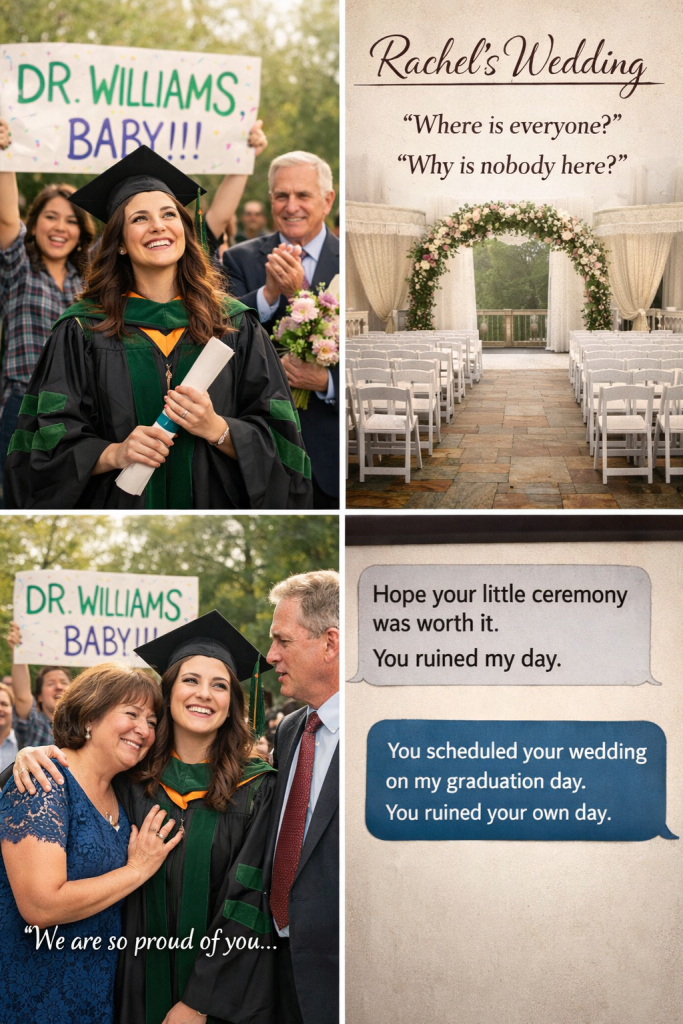
She was standing by the entrance holding a giant homemade sign with glitter letters that read:
DR. [MY LAST NAME], BABY!!!
I laughed so hard I snorted.
Then I saw the second surprise.
Behind her were six more classmates and two nurses from our rotation, all cheering like maniacs. One of the attendings I admired—Dr. Rosen, who scared everyone and complimented no one—was standing there with coffee in one hand and a bouquet in the other.
I stopped walking.
“What… what is this?” I asked, voice cracking.
Priya grinned. “Family seating replacement program.”
I looked at her, then at all of them, and started crying immediately.
“Don’t you dare ruin your makeup,” one of the nurses said, pulling me into a hug. “We worked too hard on this.”
Dr. Rosen handed me the bouquet awkwardly, like emotions were not his preferred specialty. “You earned this,” he said. “Now go graduate.”
That ceremony felt different than I’d imagined.
Not smaller. Different.
When they called my name and I walked across the stage, I heard screaming—real screaming, the kind families do when they’re proud and unashamed to show it.
I looked toward the crowd and saw my people on their feet, signs waving, Priya crying harder than I was, Dr. Rosen actually clapping.
And in that moment, I understood something I wish I’d learned earlier:
Sometimes the family who celebrates you isn’t the family who raised you. It’s the family who witnessed what it cost.
After the ceremony, while everyone was taking pictures with parents and grandparents, I stood with my group under a tree near the medical building and took what became my favorite photo of my life.
Not because I looked perfect. I didn’t. My eyes were red. My hood was slightly crooked. Priya had lipstick on her teeth and didn’t care.
But because I looked happy in a way I hadn’t expected to feel that day.
Then my phone exploded.
First, texts from cousins.
Wait… where are Aunt Linda and Uncle Mark?
Are your parents not at graduation?
Rachel’s venue is empty.
What is going on?
I frowned.
Priya peered at my screen. “Uh… why are they saying your sister’s wedding is empty?”
Before I could answer, my phone rang.
Rachel.
I stared at it, then answered.
She was hysterical.
“Where is everyone?” she screamed the second I picked up. “Why is nobody here?”
I blinked. “What?”
“I sent invitations! I posted reminders! Todd’s family came but half of them left because there was no one from our side and this is humiliating!”
In the background, I could hear chaos—kids crying, someone arguing, music playing to an almost empty room.
I stepped away from my friends. “Rachel, I don’t know what you want me to say.”
She let out a choking sound. “Mom and Dad aren’t even here yet!”
Now I froze.
“What do you mean?”
“They said they were stopping by your thing first because it was ‘on the way’ and they’d just stay for a few minutes, but they’re not answering!”
My heart skipped.
I turned slowly and scanned the crowd.
At first I saw nothing but caps and gowns and proud families.
Then, near the back of the lawn, I saw them.
My parents.
My mother still in a dress too fancy for a graduation ceremony. My father in a suit, holding a crumpled program and looking stunned. They were standing side by side, searching the crowd like people who weren’t sure if they were welcome.
My breath caught.
Priya followed my gaze. “Is that them?”
I nodded slowly.
Rachel was still yelling in my ear. “Hello? Are you listening? Tell them to answer me!”
I stared at my parents—really stared.
My mother looked like she’d been crying. My father looked ashamed.
I finally answered Rachel, quietly.
“I can’t tell them anything. They’re here.”
Silence.
Then Rachel hissed, “What?”
I swallowed. “They came to my graduation.”
The line went dead.
I stood there holding my phone, stunned.
My parents began walking toward me slowly, like they were approaching a wounded animal.
My first instinct was anger. My second was relief. My third was a grief so old it felt like childhood.
When they reached me, my mom burst into tears.
“I’m sorry,” she said before I could speak. “I’m so, so sorry.”
My father cleared his throat and looked at the ground. “I was wrong,” he said quietly. “We were wrong.”
I didn’t know what to do with that. For years, I’d imagined this confrontation, and in every version I was eloquent and fierce and unforgettable.
In real life, I just stood there in my gown, bouquet in hand, blinking too fast.
My mom grabbed my hand. “We went to Rachel’s venue first this morning to help set up,” she said, words tumbling out. “And all she cared about was whether the photographer could make the room look full. She kept saying people could ‘just skip your boring ceremony and come to the reception.’”
My father nodded grimly. “Then she told your mother to call you and tell you not to post graduation pictures until after her vows because she didn’t want attention split online.”
Priya muttered, “Wow,” under her breath.
My mom cried harder. “That’s when it hit me. What we were doing. What we’ve been doing for years.”
My father finally looked me in the eyes. “We always expected you to understand,” he said. “To be the mature one. The easy one. And we used that to justify failing you.”
That sentence hit harder than I expected.
Because it was true. Painfully true.
I looked at them—my parents, older than I realized, flawed in the plainest human way—and felt anger and love fighting in my chest.
“You told me to mail my diploma,” I said quietly.
My mother covered her mouth, sobbing. My father closed his eyes. “I know.”
I nodded once, because I needed them to sit inside that sentence.
Then my mom squeezed my hand and whispered, “Can we still see you walk?”
I swallowed hard. “I already did.”
Her face crumpled.
For one mean second, part of me felt satisfied. Rachel got the empty room. My parents missed the stage walk. Everyone lost something.
But then I looked at the people around me—my chosen family, still hovering protectively, pretending not to listen while listening to every word—and I made a choice.
“There’s a hooding photo area and a reception,” I said. “You can come with me. If you’re here for me.”
My father nodded immediately. “We are.”
My mom whispered, “We are.”
So they stayed.
Not because they deserved instant forgiveness. They didn’t.
But because I deserved to be celebrated, and I was done shrinking the day to punish people.
We took photos—awkward at first, then softer. My mom kept touching my sleeve like she couldn’t believe it was real. My father asked questions about residency, actual questions, and listened to the answers.
At one point he looked at Priya and the others and said, “Thank you for showing up for her.”
Priya, still holding the glitter sign, smiled and said, “She earned a crowd.”
Later that evening, I got one final text from Rachel.
Hope your little ceremony was worth it. You ruined my day.
I stared at it while sitting in a restaurant surrounded by classmates, my parents, and people laughing over bad champagne and fries.
I typed back exactly one sentence.
You scheduled your wedding on my graduation day. You ruined your own day.
Then I muted her.
That wasn’t the end of the family drama, of course. There were months of fallout. Rachel told everyone I turned our parents against her. She posted passive-aggressive quotes online about betrayal. She claimed people skipped her wedding because “nobody supports mothers.”
But something had changed, and not just for me.
My parents started noticing things they’d ignored for years. The manipulation. The tears on command. The way Rachel created emergencies whenever someone else had a milestone.
And for the first time in my life, they stopped asking me to “be the bigger person” just to keep the peace.
They started asking what I needed.
That question healed something in me.
Not all at once. Not magically.
But enough.
I started residency two weeks later, exhausted and terrified and proud. The hours were brutal. The learning curve was vicious. I still ate bad food and slept too little.
But on the wall of my apartment, I framed that graduation photo—the one with me, my chosen people, my parents, and my crooked hood.
Not because it was perfect.
Because it was honest.
It reminded me that being overlooked doesn’t make your achievement smaller. It just reveals who can’t stand to watch you shine.
My sister wanted attention, and for once, she got exactly what she chased: a spotlight with no audience.
And me?
I got something better.
I got the stage. I got the degree. I got the life I fought for.
And in the end, the people who mattered finally showed up.