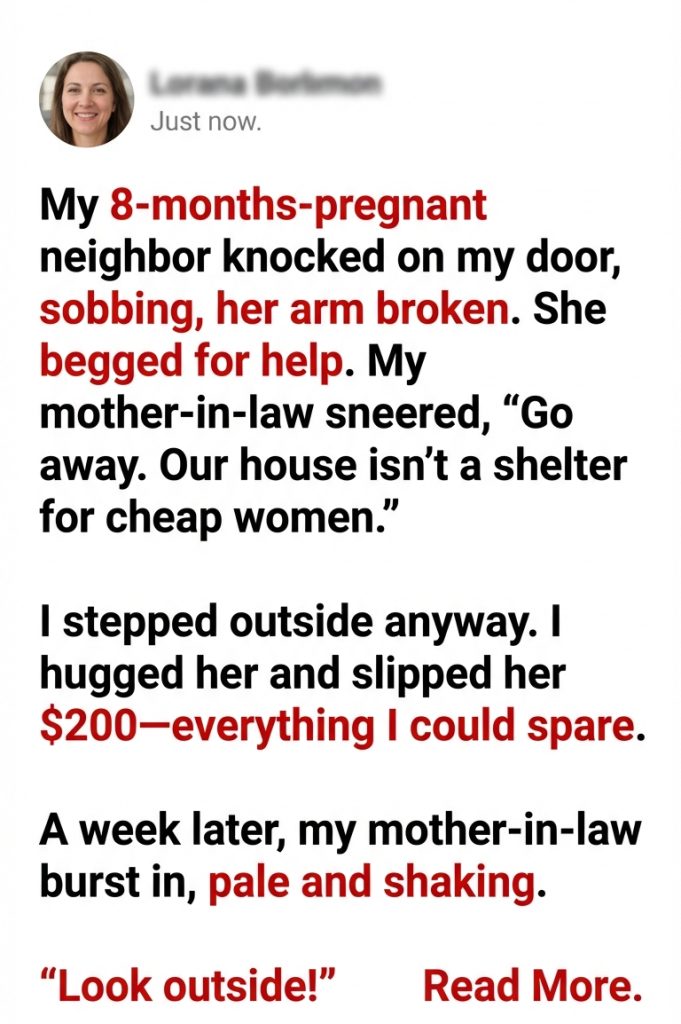
My 8-months-pregnant neighbor knocked on my door, sobbing, her arm broken. She begged for help. My mother-in-law sneered, “Go away. Our house isn’t a shelter for cheap women.”
I stepped outside anyway. I hugged her and slipped her $200—everything I could spare.
A week later, my mother-in-law burst in, pale and shaking.
“Look outside!”
For a second, I didn’t move. Not because I didn’t believe her—but because my whole body recognized that tone. The tone that only comes when someone is finally afraid of consequences.
My mother-in-law, Marlene, didn’t do fear. She did control. She did judgment. She did that tight-lipped smile that says, I’m right and you’re wrong, even when the room is full of evidence.
But now her face had lost its color. Her eyes looked too wide, like she’d seen something that didn’t fit inside her world.
“Look outside!” she repeated, louder this time, as if volume could force me to obey.
I set the dish towel down slowly, wiped my hands, and walked to the front window.
And there it was.
A line of cars—nice cars—parked neatly along our curb. Not the usual neighborhood mix of dusty sedans and work trucks. These were polished. Black and silver. The kind that look like they belong in front of a courthouse or a hotel with revolving doors.
Two men in dark suits stood near the sidewalk, speaking quietly into earpieces. A woman in a cream coat held a clipboard, scanning the house like she was checking an address.
And across the street, under the bare branches of a winter tree, stood my neighbor—Lina.
Her belly was huge now, the round weight of her baby pulling her forward slightly. Her broken arm was in a sling. Her hair was brushed, her face cleaner, but the bruising on her cheekbone was still faintly visible, like a shadow that hadn’t fully lifted.
She wasn’t sobbing today.
She was standing tall.
Next to her were two uniformed officers, calm and watchful, and a couple I didn’t recognize—an older man with silver hair and a woman with kind eyes. The man’s hand rested lightly on Lina’s shoulder, protective and steady.
Marlene made a strangled sound behind me. “What is this?” she hissed.
I turned to look at her.
Her hands were shaking so hard she had to press them against her cardigan to hide it. Her mouth opened and closed like she wanted to speak but couldn’t find the right insult fast enough.
“Did you… did you invite them?” she snapped at me.
“I don’t even know who they are,” I said honestly, my pulse thumping.
Marlene’s eyes narrowed, then flicked to the door as a knock sounded—firm, official.
My husband, Evan, came in from the hallway, confused. “What’s going on?”
Marlene spun toward him as if he were a weapon she could use. “Your wife has brought trouble to this house,” she said, voice rising.
Evan looked at me. “What happened?”
Another knock, stronger.
I exhaled and walked to the door, my heart pounding harder with each step. I opened it.
The woman with the clipboard smiled politely. “Good afternoon. Are you Mrs. Carter?”
“Yes,” I said, cautious.
She angled the clipboard. “My name is Ms. Ramirez. I’m here on behalf of the county victim services unit—and,” she paused, glancing toward the cars, “a private foundation that supports emergency relocation and protection for domestic violence survivors.”
My stomach dropped.
Behind her, one of the suited men stepped forward slightly, scanning the doorway with quiet alertness.
Ms. Ramirez continued gently, “We’re here because Lina requested to speak with you.”
Lina.
My eyes flicked past Ms. Ramirez to where Lina stood across the street. When she saw me, she lifted her chin and gave me a small, trembling smile.
Not a triumphant one.
A grateful one.
“May we come in for just a moment?” Ms. Ramirez asked.
Marlene appeared at my shoulder like a storm cloud. “Absolutely not,” she snapped. “This is a private home!”
Ms. Ramirez didn’t flinch. She kept her tone even. “Ma’am, we won’t take much time.”
“I said no,” Marlene barked, stepping forward. “We are not running a shelter. We don’t let—”
“Mom,” Evan cut in, startled by his own voice. “What are you doing?”
Marlene whirled on him. “Protecting our family!”
Evan looked from her to me, then to Ms. Ramirez, clearly trying to assemble the puzzle.
I swallowed. “You can come in,” I said quietly.
Marlene’s head snapped toward me. “How dare you—”
“I said they can come in,” I repeated, firmer this time.
There was a moment where Marlene’s mouth opened to unleash something sharp—something she’d regret later but would say anyway because regret had never stopped her.
Then Ms. Ramirez stepped inside with professional calm, and the two suited men remained outside like they were guarding something important.
Evan stood off to the side, tense. Marlene hovered like a furious shadow.
Ms. Ramirez set her clipboard down and said, “I’ll be direct. Lina is safe now. She has been placed under a protection plan. Her abuser has been arrested and charged.”
My breath caught.
Marlene scoffed like she didn’t believe it. “Charged? For what? For a domestic spat?”
Ms. Ramirez’s eyes cooled. “For aggravated assault, unlawful imprisonment, and domestic violence, among other charges.”
Evan’s face shifted—shock, then anger. “He did this to her?”
I nodded slowly, remembering Lina’s broken arm, the way she’d flinched at sudden sounds, the desperate way she’d begged.
Marlene crossed her arms, still trying to stay above it. “Well, that’s sad, but it’s not our problem.”
Ms. Ramirez looked at Marlene steadily. “Actually, in part, it is.”
Marlene blinked. “Excuse me?”
Ms. Ramirez opened her folder. “Lina has been documenting her situation for months. She has records. Messages. Photos. Medical reports. And,” she glanced at me, “she has a statement regarding the night she came to this home seeking help.”
Marlene’s face tightened. “What statement?”
My stomach turned as I realized what was happening. Lina hadn’t just come to me for money.
She’d come for a witness.
For proof that she tried to get help. That she was desperate. That she was not “fine.” That she was turned away.
And my mother-in-law had chosen that moment to show exactly who she was.
Ms. Ramirez continued, “Lina has asked us to deliver two things to you. One is a formal thank-you letter. The other is a notice.”
“A notice?” Evan repeated.
Ms. Ramirez nodded. “Regarding an ongoing investigation into your household’s potential role in denying emergency assistance to a vulnerable person.”
Marlene barked a laugh that sounded hollow. “Investigation? Are you kidding me? She knocked on my door! I told her to go away! That’s not a crime!”
Ms. Ramirez’s voice remained calm. “Denying assistance isn’t a crime. But intimidation, harassment, and discriminatory language can be relevant in civil proceedings—particularly if it contributes to continued endangerment.”
Marlene’s lips thinned. “So now I’m being punished for having standards.”
Evan stepped closer, voice sharp. “Mom, what did you say to her?”
Marlene’s eyes flicked away. “Nothing. I told her to leave.”
I felt my jaw tighten. I could still hear it—the way Marlene had spat the words like Lina was dirt on her shoe.
“Our house isn’t a shelter for cheap women.”
I looked at Evan. “She called her ‘cheap,’” I said quietly. “While she was crying, pregnant, and had a broken arm.”
Evan’s face hardened. He turned back to Marlene. “Did you?”
Marlene lifted her chin. “I said what needed to be said. You can’t invite every sob story into your home.”
“She wasn’t a sob story,” I said, my voice shaking with anger now. “She was bleeding. She was terrified.”
Ms. Ramirez lifted a hand slightly. “I want to clarify,” she said. “We’re not here to prosecute anyone in this home. The investigation notice is standard when there’s documented interaction with neighbors and witnesses. Most likely, it will lead to nothing more than statements.”
Marlene exhaled like she’d won.
Then Ms. Ramirez added, “However, Lina also requested that we tell you something else.”
My heart thudded. “What?”
Ms. Ramirez smiled softly, and for the first time her professionalism showed warmth. “Lina’s family found her. Because of you.”
Marlene blinked. “What?”
I stared. “Because of me?”
Ms. Ramirez nodded. “Lina’s father—Mr. Alvarez—has been searching for her for years. Lina had been isolated and cut off. She wasn’t allowed to contact family. The night she came here, she used your phone.”
I inhaled sharply.
I remembered it now—after I hugged Lina on the porch, I’d asked if she had anyone to call. She’d said, “No.” Then she’d hesitated, eyes wide with fear, and whispered, “Maybe… my dad, but I don’t know the number.”
I’d handed her my phone anyway. I’d told her to try any email she remembered, any social media account, anything.
She’d typed with her good hand, trembling, and sent a short message to someone with a name I didn’t recognize.
Dad. It’s me. I’m alive. Please help.
Then she’d wiped her face and handed me the phone back like she was ashamed she’d taken up space in my life for even two minutes.
Ms. Ramirez continued, “That message reached her father within hours. He immediately contacted authorities and filed an emergency welfare report. When Lina’s abuser realized she’d reached out, he panicked. That’s when the situation escalated. But that report—the one prompted by your phone—created the paper trail that allowed law enforcement to locate her quickly once she was taken to the hospital.”
My knees felt weak.
Evan’s hand found my arm. “You did that?” he whispered.
I shook my head slowly, tears rising. “I… I just let her use my phone.”
Ms. Ramirez’s eyes softened. “Sometimes that’s enough. You treated her like a human being when she was being treated like property.”
Across the street, Lina lifted her hand slightly in a small wave, her eyes shiny.
My throat burned.
Marlene, however, looked like she’d swallowed a stone. “So what is all this outside?” she demanded, voice strained. “The cars? The suits?”
Ms. Ramirez glanced out the window. “Mr. Alvarez is a prominent donor to the foundation I mentioned. He insisted on coming in person to thank you. The security is… his.”
Marlene’s face went even paler.
Prominent donor. Security. Foundation.
Her brain was catching up to what her mouth had already ruined.
All week, Marlene had strutted around the house like her opinion was law. Like she could label people—cheap, trashy, unworthy—and the world would rearrange itself to match her judgment.
But now the world had arrived at our curb, and it didn’t look like her rules mattered.
Evan swallowed. “Her father is… that man?”
Ms. Ramirez nodded. “Yes. And he requested to speak with you briefly, if you’re willing.”
My stomach tightened with nerves.
I looked out again. Lina’s father—Mr. Alvarez—was watching our window, patient, respectful. Not angry. Not demanding.
Just present.
It hit me then that Lina’s life had been split into “before” and “after,” and somehow, my porch had been the hinge.
I nodded. “Okay,” I whispered. “I’ll speak with him.”
Marlene stepped forward quickly. “Absolutely not,” she hissed. “You are not bringing those people into my son’s home!”
Evan turned on her, voice low and dangerous. “Mom. Stop.”
Marlene froze, shocked that he’d spoken to her like that.
Evan looked at me. “If you want to talk to him, talk to him,” he said. Then he looked back at Marlene. “This isn’t about you.”
That was the first time I’d ever heard him say it so clearly.
And Marlene—who had built her whole identity on being the center—looked like the floor had shifted under her feet.
We stepped outside.
The cold air hit my face, sharp and clean. Lina stood across the street and took a small step forward. Her eyes met mine, full of something that looked like relief and gratitude tangled together.
Mr. Alvarez approached slowly, hands visible, respectful the way powerful people often are when they know they don’t need to prove it.
He stopped a few feet away and said, “You are the woman who helped my daughter.”
My voice trembled. “I did what anyone should do.”
He shook his head gently. “No. Not everyone does.” His eyes flicked briefly toward the house behind me, where Marlene’s silhouette was stiff in the window. “I’ve learned that the hard way.”
He reached into his coat pocket and pulled out an envelope.
My stomach clenched, assuming it was money.
But he held it out carefully and said, “This is a letter Lina wrote for you. She wanted you to have her words, not mine.”
I took it with shaking hands.
Then he added, “And this is for your household.”
He handed me a second envelope—thicker.
“This contains information about the foundation’s services,” he said calmly. “We provide support for families who take in victims temporarily—food vouchers, security upgrades, counseling, legal guidance. I’m not assuming you want or need it. But I want you to know help exists for helpers, too.”
I blinked, stunned.
Because he wasn’t offering a reward.
He was offering support.
He wasn’t acting like I owed him anything.
He was acting like kindness should be protected—not punished.
Lina stepped closer then, careful with her sling. Her face crumpled as she tried to speak. “Thank you,” she whispered. “I thought… I thought no one would care.”
I swallowed hard. “I cared,” I said. “I still do.”
Her eyes filled. “That $200,” she said, voice shaking. “I tried to give it back but I didn’t know how. It paid for the ride to the clinic when I couldn’t… when he—” She stopped, swallowing a sob. “It kept me moving. It kept me alive.”
Tears slid down my face before I could stop them. “You don’t owe me anything,” I whispered.
Mr. Alvarez’s voice softened. “Actually,” he said, “there is one thing.”
I stiffened, heart racing.
He looked past me toward the window again. “Tell the woman in there something for me.”
Marlene’s silhouette shifted.
I swallowed. “What?”
Mr. Alvarez’s eyes remained calm—no shouting, no threats—just a quiet kind of power.
“Tell her,” he said, “that my daughter is not cheap.”
The words landed like a gavel.
He continued, voice steady. “Tell her my daughter is a survivor. And tell her that if she ever speaks to another woman in pain that way, she will be remembered for it.”
I nodded slowly, my throat tight. “I will.”
We spoke for a few more minutes—about nothing dramatic, just practical things: Lina’s safety plan, the baby, the court process. Mr. Alvarez thanked Evan as well for letting me do what I did.
Then they returned to their cars. The officers stayed nearby, watching, protective.
When I walked back inside, Marlene was waiting in the living room like a judge.
She didn’t even let me take my shoes off.
“Well?” she snapped. “Did you enjoy your little performance?”
Evan stepped between us. “Stop,” he said again, firmer.
Marlene’s eyes flashed. “I’m trying to protect this family!”
Evan’s voice went quiet. “No,” he said. “You’re trying to control it.”
Marlene’s mouth opened.
Evan didn’t let her speak.
“You insulted a pregnant woman with a broken arm,” he said. “In our home. And you called her cheap. That’s not protection. That’s cruelty.”
Marlene’s face tightened. “She was looking for money.”
“She was looking for help,” I said, voice steady now. “And I helped her.”
Marlene scoffed. “And now look. Police. Strangers. Trouble.”
I took a breath. “No,” I said. “That’s what justice looks like when someone finally gets found.”
Marlene looked like she was going to explode, but something in her eyes flickered—fear. Because she’d seen the cars. The security. The foundation. The reality that Lina wasn’t powerless anymore.
She suddenly tried a different approach—sweetness.
“Well, maybe I was harsh,” she said, forcing a smile. “But you know I meant—”
“No,” Evan cut in, and his voice was final. “You meant what you said.”
Silence filled the room.
Then Evan said the words I didn’t know I needed to hear:
“Mom, you’re not staying here anymore.”
Marlene froze. “What?”
Evan didn’t blink. “Pack your things,” he said. “You can stay with Aunt Carol. Or at your apartment. But you can’t stay here.”
Marlene’s face twisted. “You’re choosing her over me?”
Evan’s eyes softened slightly, but his voice stayed firm. “I’m choosing decency,” he said. “I’m choosing the kind of home I want us to have.”
Marlene looked at me as if she expected me to beg Evan to stop.
I didn’t.
Because for the first time, I understood something clearly:
If you allow cruelty to live in your house, it will eventually turn on you.
Marlene stormed off to the guest room, muttering under her breath about ungrateful children and foolish wives.
Evan exhaled slowly, rubbing his face. “I’m sorry,” he said quietly. “I should’ve stopped her earlier.”
I swallowed. “Thank you for stopping her now,” I whispered.
That night, I opened Lina’s letter.
It was short and shaky, written like someone who still didn’t fully believe she was safe.
She wrote that she’d knocked on three doors that night.
Two had ignored her.
One had opened.
She wrote: “When your mother-in-law called me cheap, I believed her for a second. Then you hugged me. And I remembered I’m a person.”
I pressed the letter to my chest and cried—quietly, the way you cry when you realize your small kindness mattered more than you knew.
A week later, Lina had her baby—a healthy little boy. Mr. Alvarez sent a thank-you card to our address. No money. No gifts. Just words.
And Marlene?
She didn’t speak to me for months.
But the strange thing was, the silence didn’t feel like punishment anymore.
It felt like peace.
Because now, when I looked at my front door, I didn’t see a boundary that kept “cheap women” out.
I saw a door that could open when someone was desperate.
And I knew, with complete certainty, that I would open it again.
Every time.
Because the truth is: a home isn’t made respectable by who you turn away.
It’s made honorable by who you choose to protect.