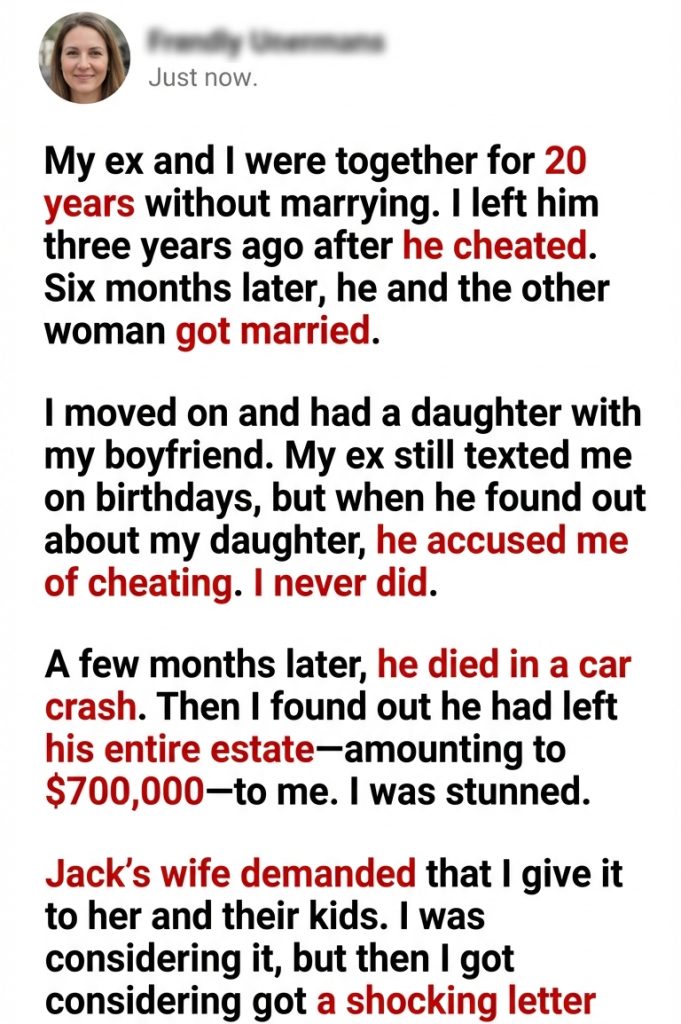
My ex and I were together for 20 years without marrying. I left him three years ago after he cheated. Six months later, he and the other woman got married.
I moved on and had a daughter with my boyfriend. My ex still texted me on birthdays, but when he found out about my daughter, he accused me of cheating. I never did.
A few months later, he died in a car crash. Then I found out he had left his entire estate—amounting to $700,000—to me. I was stunned.
Jack’s wife demanded that I give it to her and their kids. I was considering it, but then I got a shocking letter from him in which he…
Some stories don’t end when the relationship ends. Some relationships, especially the ones that stretch across decades, leave invisible threads behind—threads that tug at you years later, when you least expect it.
When I left Jack, I told myself I was done with him. Done with the lies, the apologies that sounded rehearsed, the small humiliations that pile up until you can’t even recognize yourself in the mirror anymore.
But twenty years doesn’t just disappear because you walk out the door.
We met in our early twenties—young enough to believe love was all you needed, old enough to feel proud we were “different.” We didn’t need rings, we said. We didn’t need paperwork to prove anything. We had each other, and we had time.
Except time is funny. It doesn’t just pass—it builds habits.
For twenty years, Jack and I built a life of habits. Morning coffee. Shared bills. Lazy Sundays. Inside jokes that made no sense to anyone else. Friends who stopped asking when we’d “make it official.” Family members who raised eyebrows at holidays.
We weren’t unhappy for most of it. Or at least, we weren’t unhappy in ways that looked obvious from the outside.
Then the cheating happened.
It wasn’t a one-time mistake. It wasn’t a drunken accident. It was a double life that lasted long enough for him to get comfortable with betrayal.
When I found out, I didn’t scream. I didn’t throw his things on the lawn. I didn’t create a scene.
I just felt… hollow.
And that hollowness did something powerful. It made me realize how much of myself I’d slowly folded down to keep the peace.
So I left.
Not because I didn’t love him anymore, but because I finally loved myself enough to stop negotiating with disrespect.
My ex and I were together for 20 years without marrying. I left him three years ago after he cheated. Six months later, he and the other woman got married.
That part still makes people blink when I tell them. They look at me like I’m leaving out a twist—like there must be more context.
But no. That was the context.
For twenty years, I was “not the marrying type” with him.
Six months after I left, he was in a tux.
I remember the day I found out. A mutual friend texted me a screenshot of an announcement. Jack smiling beside her—the other woman—both of them holding champagne flutes like they’d achieved something noble.
I stared at it for a long time.
It wasn’t jealousy that hit me.
It was the sting of being shown—loudly—that I had been the convenient option.
The placeholder.
The “good enough” until someone else came along.
I blocked the friend who sent it, not because she meant harm, but because I couldn’t bear being a spectator to their celebration.
Then I did what you do after heartbreak: you rebuild.
Slowly, awkwardly, day by day.
I moved into a smaller place. I bought furniture that was mine. I learned how quiet a home can be when nobody else’s habits live in it.
I met my boyfriend later than I expected, and I was cautious. I was the kind of cautious that comes from being burned so thoroughly that you flinch at warmth.
But he was patient. He didn’t push. He didn’t love-bomb. He just… showed up.
And eventually, life did what it always does when you stop staring at the wreckage behind you.
It moved forward.
I moved on and had a daughter with my boyfriend. My ex still texted me on birthdays, but when he found out about my daughter, he accused me of cheating. I never did.
When I got pregnant, I didn’t tell Jack. It wasn’t his business.
But news travels, especially in circles where people have known you for two decades. Someone told him. Maybe out of gossip, maybe out of carelessness.
Either way, my phone lit up one evening with a message from a number I hadn’t saved but still recognized by heart.
Jack: So you were cheating on me. That’s why you left.
My stomach tightened with that old familiar mixture of anger and disbelief.
I wrote back one sentence.
Me: I left because you cheated. Don’t rewrite history.
He didn’t respond for a day. Then he sent something that made my chest burn.
Jack: Twenty years and you replace me like that?
Replace.
As if I had traded him in like a car.
As if he hadn’t married his affair partner six months after I walked out.
As if betrayal didn’t count if he was the one doing it.
I didn’t answer. I didn’t owe him a debate.
But his birthday texts continued—short, confusing little pings that felt like emotional litter.
Happy birthday.
Hope you’re well.
Thinking of you today.
No apology. No accountability. Just the steady insistence that he still had access to me.
When my daughter was born, my world changed in a way I can barely put into words.
The first time I held her, tiny and warm and squinting at the light, I felt something shift in me permanently. Like my heart had been living in a guarded room and someone opened all the windows.
I promised her, in that hospital bed, that she would never have to question whether she was loved.
Which meant I had to be careful about what kind of chaos I allowed around us.
Jack’s messages stopped for a while after that accusation. I assumed he’d finally moved on, or maybe his wife had put her foot down, or maybe he’d gotten bored.
Then, out of nowhere, I got the call.
A few months later, he died in a car crash.
When I heard the words, my first reaction wasn’t grief.
It was shock.
Because no matter how angry you are at someone, death feels impossible at first. Like the universe has made a mistake.
I sat on my couch staring at the wall while my daughter napped in her bassinet. My boyfriend held my hand, asking if I was okay, and I couldn’t answer because I didn’t know what “okay” meant in that moment.
Jack and I had twenty years of memories. Some of them were beautiful. Some of them were painful. All of them were now… frozen.
I didn’t go to the funeral. I told myself it was because I didn’t want drama, because his wife would glare, because it wasn’t my place.
But the truth was simpler:
I couldn’t stand the idea of mourning someone who never properly mourned what he did to me.
Then came the second shock.
Then I found out he had left his entire estate—amounting to $700,000—to me. I was stunned.
I found out through a lawyer’s call. A formal voice. An appointment request. The words “beneficiary” and “estate” thrown into the air like they were normal.
I thought it had to be a mistake.
I told the lawyer, “You have the wrong person.”
He didn’t.
He confirmed my name, my address, even my birth date.
Then he said it again, slower, as if he expected me to faint.
Jack’s entire estate—about seven hundred thousand dollars—was left to me.
Not to his wife.
Not to his children.
To me.
My hands went cold.
I hung up the phone and just sat there, listening to my daughter’s soft breathing from the next room, feeling like I’d been shoved into a story I didn’t agree to.
My boyfriend came in and found me staring. “What happened?”
I told him, and his face tightened with the same confusion I felt.
“Why would he do that?” he asked.
I didn’t know.
And not knowing felt dangerous.
Because money like that doesn’t arrive without consequences.
Two days later, those consequences showed up in my phone.
Jack’s wife demanded that I give it to her and their kids.
She didn’t start politely. She started like a person who believed the world owed her.
Her first text was a wall of rage.
You have some nerve. That money belongs to his FAMILY. If you have any decency, you’ll sign it over immediately.
I stared at the message, heart pounding.
I’d never met her properly, but I knew enough about her to imagine the tone: sharp, entitled, certain she was right.
Then came another text.
Jack told me you were selfish. I didn’t believe him, but here we are.
Selfish.
The word was almost funny, coming from the woman who married a man who cheated with her.
She started calling. Leaving voicemails. Crying in some, threatening in others.
She told me their kids deserved it.
She told me she was his wife, legally, which meant she was “the rightful owner.”
She told me she could take me to court.
And every time my phone buzzed, I felt my chest tighten.
Because a part of me—the part trained by twenty years with Jack—still wanted to smooth things over.
Still wanted to fix discomfort.
Still wanted to be the “reasonable” one.
I was considering it, but then I got a shocking letter from him in which he…
The letter arrived in the mail, not through the lawyer.
A plain envelope. No return address. Just my name, in handwriting I recognized instantly.
Jack’s handwriting.
My first thought was impossible: He wrote this before he died.
My second thought was worse: He planned this.
My fingers trembled as I opened it.
Inside was a single page, folded neatly.
And the first line made my throat tighten.
If you’re reading this, I’m gone, and you’re probably wondering why I did what I did.
I sat down hard at my kitchen table.
My daughter babbled from her play mat, completely unaware that my past had just slid into my present like a knife.
Jack’s letter wasn’t long, but it was heavy.
He wrote about regret. Not the dramatic kind. The quiet kind that grows when you’ve ruined something and still have to live with yourself afterward.
He admitted the affair wasn’t “an accident.”
He admitted he married her out of guilt and momentum, not love.
He admitted he’d been angry when he found out about my baby—not because I cheated, but because I moved on without him.
I accused you of cheating because I needed you to be the villain, he wrote. If you weren’t, then I was.
My hands shook.
He wrote about money next—how he’d always controlled it, how he’d always used it as leverage, how he’d promised his wife things he couldn’t really give without selling pieces of himself.
Then came the line that turned my stomach:
I found out she was draining my accounts.
I blinked, rereading it.
He claimed he’d discovered she’d been taking money quietly—opening credit lines, moving funds, spending beyond what they had—then blaming him when bills came due.
He didn’t say she was the only reason their finances were bad. He wasn’t suddenly a saint.
But he wrote that he realized something in the last year of his life:
She didn’t love me. She loved what she could get. And I trained her to think that was the point.
He wrote that his wife had threatened to “take everything” if he ever left.
He wrote that he’d stayed because he didn’t want to look like the villain again.
Then he wrote something that made my eyes burn:
You were the only person who ever loved me when I had nothing to offer but myself.
I stared at that sentence.
Because it was true, in a painful way.
Back in our twenties, we’d had nothing. We built from scratch. We shared dreams. We ate cheap meals and laughed anyway. I loved him before he became comfortable, before he became careless with people’s hearts.
And he knew it.
He wrote that he left the estate to me because it was the only way he could do one honest thing at the end.
But then he added something that changed everything:
I didn’t leave it to punish her. I left it to protect you.
I frowned, confused.
Then I read the next lines.
Jack explained that he suspected his wife would come after me either way—because she blamed me for everything, because she needed an enemy, because she couldn’t accept that he had a life before her.
He said leaving me the money would force everything into the open—lawyers, paperwork, court if needed. No more quiet manipulation.
And then he wrote the part that made my blood run cold:
If she threatens you, give this letter to the attorney. I already filed the second document.
Second document?
My breath caught.
I turned the page over, but there was nothing else.
I grabbed my phone and called the lawyer immediately.
My voice shook. “Jack wrote me a letter. He said there’s a second document.”
The lawyer went quiet for a beat. Then he said, carefully, “Yes. There is.”
He explained that Jack had set up the estate in a way that included conditions—legal protections. A trust structure. Clauses that could limit what the wife could access, depending on her actions.
He didn’t tell me every detail over the phone, but the message was clear:
Jack hadn’t just tossed me money.
He’d built a wall.
And his wife had been running into it since the moment she texted me.
When I met with the lawyer, I learned the rest.
Jack had left a separate fund specifically for the children—untouchable by his wife unless it was used for education and verified expenses. He’d also left her certain assets, but not the bulk cash.
And there was one clause that made my stomach flip:
If his wife harassed me or tried to defraud the estate process, she would lose her portion and it would be redirected into the kids’ trust.
That’s why Jack wrote “protect you.”
Because he knew she’d come after me.
And he knew her own behavior would decide her outcome.
When I left the lawyer’s office, my phone buzzed again.
Another message from Jack’s wife.
I’m giving you 24 hours before I make your life miserable.
I stared at it, then at my daughter’s tiny fingers curled around a toy, then at the letter in my bag.
I felt something settle in my spine—something like steel.
For twenty years, I had been the one who softened edges. The one who gave chances. The one who carried emotional messes that weren’t mine.
Not anymore.
I forwarded the message to the attorney.
Then I wrote one reply to Jack’s wife—just one.
All communication goes through the estate attorney now. If you contact me again, your kids lose your portion.
Silence followed.
For two days.
Then she called from a different number.
I didn’t answer.
I sent that number to the attorney too.
After that, it stopped.
Not because she suddenly became reasonable.
Because she finally understood she couldn’t bully her way into winning.
Weeks passed. The estate process moved forward. Papers were signed. Accounts transferred. The kids’ trust was set up properly.
And in the middle of all of it, I kept thinking about the strangest part:
Jack, the man who betrayed me, had done one protecting thing at the end.
Not because he deserved forgiveness.
But because he finally saw what he’d done—and tried, too late, to balance the scale.
I didn’t know how to feel about that.
So I focused on what I did know.
I knew I had a daughter whose future mattered more than my confusion.
I knew money could be used for healing, not drama.
I used part of it to buy a modest home—safe, stable, mine. I used part to build a college fund for my daughter. I donated some quietly to a local program that helps women leave relationships after infidelity and financial abuse—because I understood how leaving can cost you everything.
And I kept Jack’s letter in a folder, not as a love note, not as a trophy, but as a warning to myself:
Even people you love can betray you.
And even people who betray you can regret it.
But regret doesn’t rewrite history.
It just explains it.
One afternoon, months later, I received a final envelope from the attorney. It contained the last accounting statement and a brief note: The estate is closed.
I held it for a long moment before putting it away.
My boyfriend asked, “Do you feel… resolved?”
I looked at my daughter on the floor, laughing at something simple, safe in a life I built without Jack.
And I answered honestly.
“I feel free,” I said.
Because the real ending wasn’t the money.
The real ending was this:
Jack tried to come back into my life through guilt and accusation, even after I’d moved on.
But in the end, his last move didn’t control me.
It released me.
And his widow’s demand didn’t break me.
It reminded me that I no longer belong to their mess—because I stopped choosing it the moment I walked away.