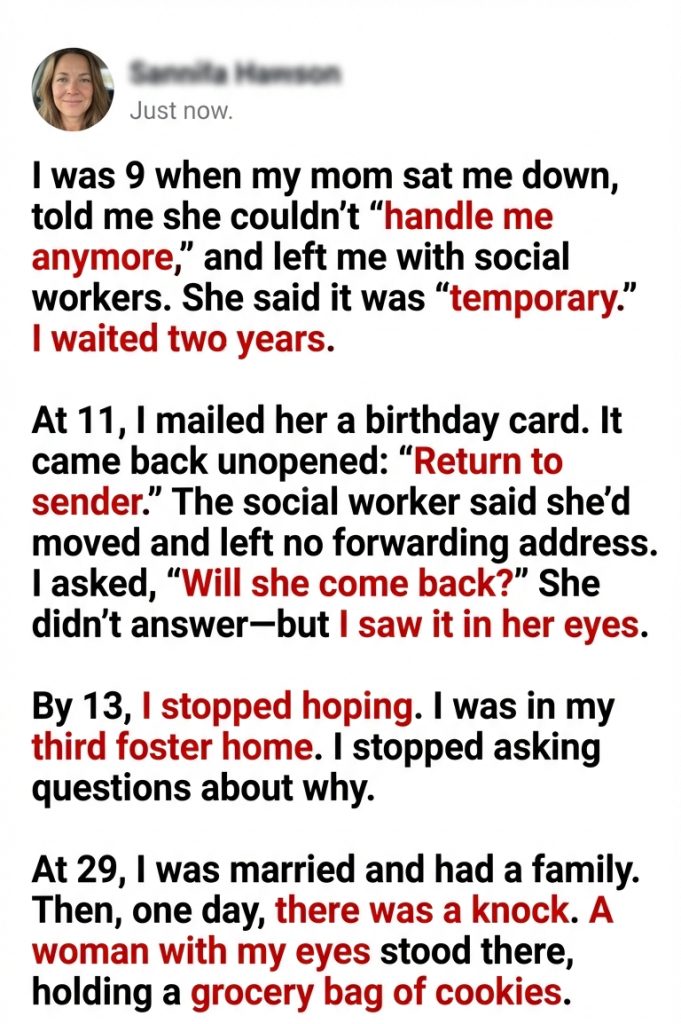
I was 9 when my mom sat me down, told me she couldn’t “handle me anymore,” and left me with social workers. She said it was “temporary.” I waited two years.
At 11, I mailed her a birthday card. It came back unopened: “Return to sender.” The social worker said she’d moved and left no forwarding address. I asked, “Will she come back?” She didn’t answer—but I saw it in her eyes.
By 13, I stopped hoping. I was in my third foster home. I stopped asking questions about why.
At 29, I was married and had a family. Then, one day, there was a knock. A woman with my eyes stood there, holding a grocery bag of cookies.
“Hi,” she said. “You have to]
I used to think the worst part of being abandoned was the leaving.
It isn’t.
The worst part is the waiting—watching the door like it’s a living thing, listening for footsteps that never come, measuring your worth by the silence of someone who was supposed to love you first.
When my mom handed me off to social workers, she tried to make it sound gentle. Like she was taking me to a summer camp. Like it was a favor to both of us.
She told me she was tired. She told me I was “a lot.” She told me she just needed time to “get things together.”
And then she bent down, kissed my forehead, and walked away without looking back.
I remember gripping the strap of my little backpack so hard my fingers hurt. I remember the smell of disinfectant in the social services office. I remember a woman in a cardigan offering me crackers and saying, “It’s going to be okay,” with the kind of voice adults use when they want a child to stop crying because it makes them uncomfortable.
I didn’t cry at first. I just stared at the door.
I thought my mom would come back. Any minute now.
Because that’s what “temporary” means when you’re nine. It means later today. It means after lunch. It means after she cools off.
It doesn’t mean forever.
For the first few weeks, I kept my shoes by the bed. I went to sleep dressed in a T-shirt and jeans because I wanted to be ready when she arrived.
Every car door outside made my heart kick.
Every time the phone rang, I held my breath.
Every adult I met became a possible messenger—someone who might say, “Your mom is here.”
But instead, the days stacked up like bricks.
Two years of birthdays without her voice. Two years of holidays where other people tried to “make it special” while I watched other kids get picked up by parents who looked tired but still came.
And during those two years, I learned something that children learn too early in systems like that:
If you keep hoping, you keep bleeding.
At 11, I mailed her a birthday card. I remember choosing it carefully from a rack at the grocery store. It had flowers on the front and glitter that got stuck to my fingers. Inside, I wrote her name in the neatest letters I could manage, because part of me believed if the card looked perfect, she might come back.
I didn’t have money for a gift, so I drew one instead: a cake, a heart, the two of us holding hands.
I wrote: I miss you. Please write back. I’m being good.
When it came back unopened, the words “Return to sender” burned into my brain like a stamp on my skin.
I stared at it so long my eyes dried out.
The social worker didn’t need to explain much. The envelope did the talking.
Still, I asked anyway—because hope makes you stupid and brave at the same time.
“Will she come back?”
The social worker didn’t answer. But I saw it in her eyes.
That look wasn’t cruelty. It wasn’t even impatience.
It was pity.
And pity is worse, because it’s the adult version of the truth you don’t want to hear.
By 13, I stopped hoping. I was in my third foster home. I stopped asking questions about why.
That’s when the survival mode kicked in.
I learned how to pack a trash bag fast. I learned not to get attached to a bedroom because it might not be mine next month. I learned how to smile politely when new foster parents said, “We’re excited to have you,” because I’d learned those words didn’t always mean what they sounded like.
Some homes were kind. Some were cold. Some were dangerous in quiet ways—rules that changed daily, affection that came with conditions, punishments that came with silence.
But all of them had one thing in common:
None of them were my mother.
And somewhere between thirteen and fourteen, my heart did something that saved me.
It shut a door.
Not completely. Not forever. But enough to stop the constant ache.
I told myself she must have had a reason.
I told myself she was sick.
I told myself she was broken.
And then, slowly, I stopped telling myself anything at all.
Because numbness is easier than explanation.
Years passed in a blur of school changes, temporary addresses, caseworkers who came and went, and the steady, exhausting task of becoming your own parent.
I got through high school by sheer stubbornness. I didn’t go to dances because watching other kids take photos with their moms in the hallway made my chest tight. I didn’t invite friends over because I never knew who would be living with me next.
When graduation came, I sat in my cap and gown and scanned the bleachers anyway.
Even though I told myself not to.
Even though I told myself I didn’t care.
There was no familiar face looking back.
No one waving.
No one crying.
I walked across the stage, took the diploma from a stranger, and clapped for myself inside my head because nobody else was going to.
After that, I built a life the way you build a shelter in the rain—with urgency.
I worked. I saved. I stayed out of trouble. I learned how to cook, how to budget, how to fix little things around an apartment.
I married someone gentle—someone who didn’t ask me to explain everything at once. Someone who understood that love sometimes looks like patience.
By 29, I was married and had a family.
A real family.
Not perfect, but real.
We had Saturday pancakes, bedtime stories, sticky fingerprints on the fridge, and the kind of chaos that felt warm instead of threatening. We took photos. We made traditions.
I became the kind of parent I always wished would show up.
And I thought, finally, I was safe.
Then one day, there was a knock.
It was a normal afternoon. The kids were loud in the living room. My spouse was in the kitchen. I was half-listening to everything the way parents do, moving through the house like a multitasking machine.
The knock was ordinary.
But my body didn’t treat it that way.
My stomach dropped before my brain caught up, like some old alarm that never fully shut off.
I opened the door—and the world tilted.
A woman with my eyes stood there, holding a grocery bag of cookies.
Her hair was streaked with gray. Her face had lines. But those eyes—the shape, the color—were undeniable.
“Hi,” she said. “You have to]
She didn’t finish because she realized she was already too late.
Too late for “temporary.” Too late for apologies that would’ve mattered when I was eleven and staring at an unopened envelope. Too late for explanations that could undo years of foster homes and quiet birthdays and the slow death of hope.
She stood on my porch like she belonged there.
Like she hadn’t left.
Like time was something she could step over.
My hands were on the doorknob so tight my knuckles hurt.
My spouse came up behind me. “Who is it?” they asked.
I couldn’t answer.
My mom’s eyes flicked past me into the house—toward the sound of children laughing—and something like hunger moved across her face.
Not hunger for cookies.
Hunger for a place in my life.
“Hi,” she repeated, softer. “I brought cookies.”
I stared at the bag like it was a bribe.
My voice came out low and flat. “Why are you here?”
Her mouth opened, closed, then opened again. She tried to smile. “I just… I need to talk to you.”
I didn’t move aside.
She shifted her weight, as if she expected me to.
“Can I come in?” she asked, already leaning forward slightly.
I felt my chest tighten the way it used to when I was nine, watching a door.
Except now I wasn’t waiting.
Now I was guarding.
“No,” I said.
The word surprised both of us.
Her eyes widened. “No?”
I swallowed. “You don’t get to walk back into my life like this. Not with… cookies.”
Her face pinched with something like offense—like I was being unreasonable.
“I’m your mother,” she said, as if that title was a key.
It hit me like a slap.
I let out a breath that sounded like a laugh, but it wasn’t. “You were,” I said. “Then you left.”
Her eyes flickered. “I told you it was temporary.”
My jaw clenched. “And I waited two years.”
The air between us thickened.
My spouse touched my shoulder gently, a silent question: Do you want me to step in?
I shook my head without looking back.
My mom’s voice got thinner. “I didn’t have a choice.”
That sentence was the one I’d imagined a thousand times. The one people always use to excuse the unforgivable.
My heart pounded. “You didn’t have a choice but to abandon your child?”
She looked away. “You don’t understand what I was going through.”
I nodded slowly, feeling something sharp settle into place. “I don’t,” I admitted. “Because you never told me. You just disappeared.”
Her eyes filled with tears. “I was sick. I was depressed. I was—”
I held up a hand. “Stop.”
She flinched like my hand was a wall.
“I’m not nine anymore,” I said. “And I’m not here to make you feel better about what you did.”
Her tears fell anyway, dramatic and fast. “I missed you,” she whispered.
A part of me wanted to believe her. That old part that had mailed a glitter birthday card and thought love was something you could earn by being good.
But another part of me—the part I’d built brick by brick in foster homes and lonely years—knew better.
Missing someone isn’t the same as showing up.
“I had a family,” I said quietly. “I had foster parents. I had caseworkers. I had strangers deciding where I slept. Do you know what it’s like to be passed around like a file?”
She shook her head, crying harder.
“Of course you don’t,” I said. “Because you weren’t there.”
My mom took a shaky step forward. “Please. Just let me explain.”
I looked at the grocery bag of cookies. The cheap plastic. The ordinary sweetness.
It was insulting how small her offering was compared to what she’d stolen.
“You returned to sender my birthday card,” I said, voice steady now. “Did you know that?”
Her face went blank. “What?”
“It came back unopened,” I said. “Return to sender. Like I was nothing.”
Her mouth trembled. “I didn’t— I moved. I wasn’t—”
I stared at her. “So you couldn’t be found. That’s what that means.”
She shook her head frantically. “No, no, I was running. I was scared. I thought I was protecting you.”
I felt something inside me go cold.
“Protecting me?” I repeated.
“Yes,” she insisted. “There were people—dangerous people. I didn’t want them to find you.”
My spouse’s hand tightened on my shoulder. I felt it—the shared instinct of two adults in a safe home: Is this true? Is this manipulation?
I didn’t know.
And I hated that I didn’t know.
Because abandonment doesn’t just leave you alone. It leaves you unable to trust your own judgment.
I took a breath. “If that’s true,” I said slowly, “then why now?”
Her eyes darted away again. And that was the answer.
There was always a reason for “now.”
She swallowed. “I… I need help.”
There it was. The real sentence hiding behind cookies.
Help.
Not love. Not remorse. Not reunion.
Need.
My stomach twisted.
“What kind of help?” I asked, even though my body already knew.
Her voice came out small. “I’m in trouble. I don’t have anyone. I heard you were doing well. I thought… maybe you could—”
She didn’t finish, because she didn’t want to say the word.
Money.
My pulse roared in my ears.
For a moment, I saw the entire pattern like a map: she left, she vanished, she cut ties, she returned when she needed something.
And suddenly, the cookies weren’t sweet anymore.
They were bait.
I stared at her, feeling something unexpected: not hate, not even anger—clarity.
I stepped out onto the porch and closed the door behind me gently so my kids wouldn’t hear.
My mom looked relieved, like the closed door meant I was choosing her.
But I wasn’t.
I was choosing them.
“I’m going to say this once,” I said quietly. “You can talk. You can explain. But you are not coming into my home. And you are not touching my children.”
Her face crumpled. “They’re my grandchildren.”
“No,” I said. “They’re my children. And I won’t let you confuse them the way you confused me.”
She sobbed, clutching the cookie bag like it was proof of effort. “You’re being cruel.”
I felt my jaw tighten. “Cruel is leaving a child with strangers and calling it temporary.”
She flinched.
I looked at her closely, trying to find the mother I’d once worshiped. Trying to find the woman I’d hoped would burst through a door one day and say, “I’m here. I’m sorry. I never stopped loving you.”
But all I saw was someone who wanted forgiveness without earning it.
I breathed out slowly. “Tell me what you want.”
She wiped her face. “I need a place to stay.”
The words landed heavy.
I stared at the porch railing. “No.”
Her eyes widened with disbelief. “No? You’d let me be homeless?”
I met her gaze. “You let me be motherless.”
She opened her mouth, but no words came.
I continued, quieter. “I don’t say that to punish you. I say it because you don’t get to demand from the child you abandoned.”
She shook her head violently. “I didn’t abandon you. I left you with social workers. It was safer.”
My voice stayed calm. “And I waited two years.”
Her shoulders shook. “Please. I’ll do anything.”
I believed her.
But not the way she meant.
She would do anything to survive.
That didn’t mean she would do anything to heal what she broke.
I looked back at my front door—the door behind which my kids were laughing, safe and loved. The door I never had as a child.
“I can give you information,” I said. “Shelters. Resources. Services. I can even help you contact someone who can help you. But I’m not letting you into my life like nothing happened.”
Her face twisted. “So that’s it? You’re going to punish me forever?”
I felt a strange sadness then, because even now, she was making herself the victim.
I shook my head. “This isn’t punishment,” I said. “This is boundaries. This is me finally being the adult you weren’t.”
She stared at me, shaking, then suddenly her expression changed—hardening. The tears stopped.
“I gave birth to you,” she said flatly. “You owe me.”
My stomach dropped, not from surprise, but from confirmation.
There it was.
Not love.
Debt.
I nodded slowly. “No,” I said again. “I don’t owe you for surviving what you caused.”
Her grip tightened around the cookie bag. “You’ll regret this.”
I looked at her—really looked—and felt the last thread of childlike hope snap.
“I regretted it at eleven,” I said quietly. “When my card came back unopened.”
She stared at me for a long moment, then turned and walked down my steps.
No goodbye.
No apology.
Just the sound of her shoes on concrete and the rustle of plastic, fading away.
I stood on my porch until she reached the sidewalk.
Then I went back inside.
My kids looked up at me, smiling. “Who was that?” one of them asked.
I hesitated for a second, then answered with the truth that healed something in me:
“Just someone from my past,” I said. “It’s okay. I’m here.”
That night, after everyone was asleep, I sat in the dark living room and let myself feel it—everything. The grief of a mother who never really existed. The anger of being treated like an option. The ache of a child who waited two years.
But for the first time, the ache didn’t own me.
Because I realized something important:
The door she never walked back through is the door I built for my kids.
And I will never leave it.
Some people think redemption is letting someone back in.
Sometimes redemption is finally closing the door—and choosing the family you created over the pain you inherited.