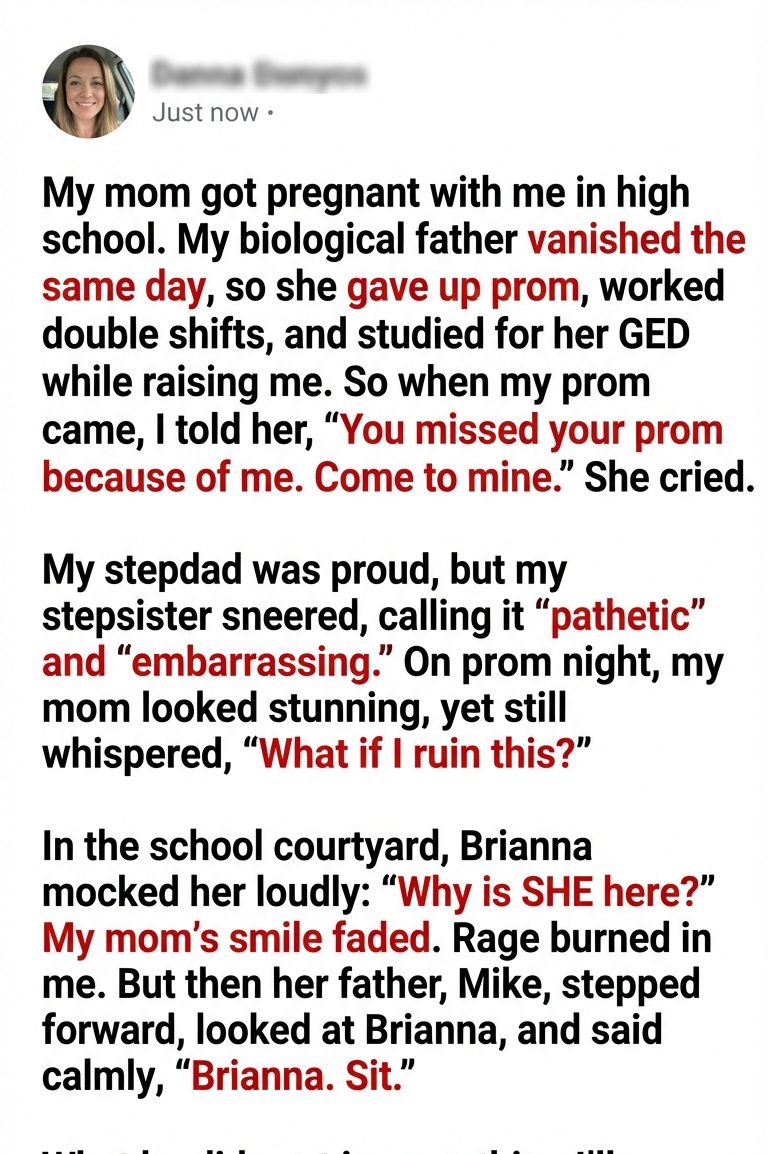
My mom got pregnant with me in high school. My biological father vanished the same day, so she gave up prom, worked double shifts, and studied for her GED while raising me. So when my prom came, I told her, “You missed your prom because of me. Come to mine.” She cried.
My stepdad was proud, but my stepsister sneered, calling it “pathetic” and “embarrassing.” On prom night, my mom looked stunning, yet still whispered, “What if I ruin this?”
In the school courtyard, Brianna mocked her loudly: “Why is SHE here?” My mom’s smile faded. Rage burned in me. But then her father, Mike, stepped forward, looked at Brianna, and said calmly, “Brianna. Sit.”
What he did next is something I’ll remember forever
If I could go back and protect my mother from every cruel word ever thrown at her, I would. But life doesn’t work like that. Life gives you moments—small ones, bright ones—where you can decide what kind of person you’ll be. And that night, in the glow of string lights and the hum of music I’d been waiting for all year, I made a promise to myself:
No one was going to humiliate my mother again.
Not while I was standing there.
People think prom is about the dress, the photos, the limo, the slow dance. But for me, prom had always been about one thing—my mom.
I grew up hearing little fragments of her story, not because she sat me down and made speeches, but because truth leaks out in ordinary moments. Like when she was balancing the checkbook at the kitchen table late at night, rubbing her forehead, and she’d say, half-joking, “I used to dream of wearing a big prom dress. Now I dream of paying the electric bill on time.”
Or when we’d pass a high school on graduation day and she’d get quiet, staring at the teens in their gowns, and I’d feel something heavy in the air that I couldn’t name yet.
By the time I was old enough to understand, I had the full picture.
My biological father didn’t just leave. He disappeared with the kind of speed that tells you he never planned to stay. One day she was a teenager with a date circled on a calendar. The next day she was a teenager with a future growing inside her and nobody beside her.
She didn’t romanticize it. She never called herself a hero. She just did what needed to be done—two jobs, late-night studying, GED prep books with cracked spines, and a tired smile that kept showing up for me no matter how hard the day had been.
When prom season rolled around my junior year, I watched my classmates obsess over dresses and tuxes, over limos and corsages, over who would ask who. The hallway chatter was a constant buzz.
But every time prom came up, I saw my mom’s face in my head—not the mom I knew now, older and wiser, but the version of her I’d imagined: a teenage girl in a borrowed dress, watching other girls take photos while she held a secret in her stomach and fear in her throat.
So when my prom came, I asked her.
At first, she laughed like I’d told a joke. “Oh, honey, no. That’s your night.”
“That’s the point,” I said. “It’s our night.”
She tried to refuse, because she always tried to refuse anything that felt like it was “for her.” She kept saying, “People will stare,” and “You’ll regret it,” and “It’s not appropriate.”
But then I said the truth—the sentence that had been sitting in my chest for years.
“You missed your prom because of me. Come to mine.”
And she cried.
Not a pretty tear. Real crying. The kind that comes from being seen.
We made it official. I told my stepdad first, expecting him to be confused, maybe even annoyed. But he surprised me—his face softened and he said, “That’s… actually beautiful.”
He’d married my mother when I was ten. He wasn’t perfect, but he was steady. He’d shown up. He’d treated me like I belonged at his table. And for the most part, I respected him for it.
But then came Brianna—his daughter.
Brianna was my stepsister in the technical sense, but she never let me forget that in her world, I was an accessory. A “plus-one” her dad had acquired along with my mom.
She was two years older than me, tall and pretty in a way she knew how to weaponize. She had a sharp laugh and sharper opinions. If kindness entered a room, Brianna usually left.
When she found out my mom was coming to prom, she didn’t even try to hide her disgust.
“That is so pathetic,” she said, loud enough for the kitchen to hear. “It’s embarrassing. Prom is for teenagers. Not for… moms.”
My stepdad told her to stop, but it was the lazy kind of stop—more annoyed than firm. Brianna rolled her eyes and smirked, like she knew she’d already planted the seed.
My mom pretended it didn’t matter. That was her habit—swallow the insult, keep the peace, move on.
But I saw the way her shoulders tightened. I saw the way she got quiet after that, folding laundry with too much force.
Prom night arrived faster than I expected.
I remember the afternoon sunlight slicing through the curtains while my mom got ready in her room. She’d told me not to worry about her, that she could do her own hair and makeup. But when I peeked in, I almost stopped breathing.
She looked stunning.
Not “stunning for a mom.” Not “stunning for someone who’s tired.”
Stunning.
Her dress was simple but elegant—deep blue with a soft shimmer that caught the light when she moved. Her hair was curled and pinned back so her face was open, glowing. She wore earrings I’d never seen before—small and sparkling, like she’d kept them hidden for a day she didn’t think she deserved.
But the best part was her expression. For a moment, she looked like the girl she used to be—the one with dreams she hadn’t buried yet.
Then her eyes met mine, and the fear returned like a shadow.
“What if I ruin this?” she whispered.
I stepped closer and took her hands. They were trembling.
“You can’t ruin anything,” I said. “You’re the reason I’m here.”
She swallowed hard. “People will talk.”
“Let them,” I said. “They don’t know what you survived.”
My stepdad walked in, took one look at her, and his face lit up. “Wow,” he said quietly, like he meant it. “You look incredible.”
My mom smiled, shy and uncertain. “You think?”
“I know,” he said.
For a second, I believed we were safe.
I believed the night would be what it was supposed to be: music, photos, laughter, a small victory for the girl my mom never got to be.
Then we arrived at the school courtyard.
The courtyard was full of fairy lights and parents hovering near the edges, trying not to look too emotional. Students in tuxes and dresses swarmed like a colorful tide, phones up, flashlights on, everyone performing joy for social media.
And then Brianna saw us.
Her mouth curled immediately, and she didn’t even bother to lower her voice.
“Why is SHE here?”
The word “she” came out like poison. Like my mother was something inappropriate that had wandered in by mistake.
My mom’s smile faded.
I watched it happen in real time—the way her face fell, the way the light in her eyes dimmed, the way she instinctively tried to make herself smaller. It was like she’d been yanked back in time, back to the moment she’d realized she wouldn’t get a prom because life had other plans.
Rage burned in me.
I took a step forward, ready to unleash every bitter thought I’d ever had about Brianna.
But then her father, Mike, stepped forward.
I’d met Mike only a handful of times—Brianna’s grandfather, my stepdad’s father. He was a quiet man with silver hair and heavy eyebrows, the kind of man who didn’t talk much but somehow commanded attention anyway. He’d always been polite to me. Reserved. Watching.
I hadn’t known he was coming.
He stood beside us now, calm as stone. He didn’t shout. He didn’t snap. He simply looked at Brianna with a stare that could freeze steam.
“Brianna,” he said calmly. “Sit.”
The courtyard noise seemed to lower around him, like the universe was turning down the volume to hear what happened next.
Brianna blinked, surprised. “Grandpa—”
“Sit,” Mike repeated. Still calm. Still steady. No argument in his tone.
For a second, Brianna looked around like she expected backup. Like she expected her dad to save her from being corrected in public. But my stepdad was standing there, silent, face tense, not stepping in.
Brianna’s cheeks flushed. Her lips parted, ready to protest.
Mike didn’t let her.
He turned slightly, reached into his jacket pocket, and pulled out a small folded piece of paper.
Then he did something I never expected—something that made my throat tighten and my eyes burn.
He raised his voice just enough for the nearby families and students to hear.
“Everybody,” he said, “I need your attention for a moment.”
A few heads turned. Then more. The DJ kept music low in the background, but people were noticing. Brianna looked like she wanted the ground to swallow her.
Mike held up the paper.
“I’m not here to embarrass anyone,” he said, eyes still on Brianna. “I’m here because I’m tired of watching people confuse cruelty with confidence.”
Brianna’s face went pale.
Mike looked toward my mom.
“And I’m tired,” he continued, “of watching good women treated like they don’t belong.”
My mom’s eyes widened. She looked at him like she couldn’t believe she was being defended. Like she’d spent so many years defending everyone else that she didn’t know what it felt like to receive it.
Mike unfolded the paper.
“My granddaughter,” he said, “likes to talk about what’s ‘pathetic’ and what’s ‘embarrassing.’ So I’m going to read something she wrote when she was thirteen.”
Brianna’s head snapped up. “What?! Grandpa, no—!”
Mike held up one hand. “Sit.”
Brianna froze.
Mike read aloud.
It was a school assignment—one of those “write about someone you admire” essays. His voice was steady, each word crisp.
“At thirteen,” he said, “Brianna wrote this about her stepmother.”
My heart stopped.
Brianna looked like she’d been slapped.
My stepdad’s eyes widened.
My mom’s hand flew to her mouth.
Mike read:
“Mrs. Carter makes the best macaroni. She laughs even when she’s tired. She helps people without telling anyone. She makes my dad nicer. I think she’s brave because she had a kid young and still finished school. She didn’t give up.”
The courtyard went silent.
I heard a few quiet “oh my God” whispers.
Brianna’s face was flaming now, eyes glossy with humiliation and anger.
Mike kept reading, calmly.
“She lets people think she’s weak because she doesn’t fight back. But I think that’s stronger. I think she loves like a person who has suffered.”
My mom’s shoulders started to shake.
I glanced at her face and saw tears—real ones, spilling fast. But this time they weren’t from shame.
They were from being seen.
Mike folded the paper and looked at Brianna.
“You wrote that,” he said. “You knew who she was. You knew what she carried. And somewhere along the line, you decided being cruel would make you powerful.”
Brianna tried to speak, but her voice cracked. “I was thirteen. It doesn’t—”
“It does matter,” Mike said, still calm. “Because it was honest.”
He stepped closer to her, lowering his voice so it was meant for her but still audible to the circle of people watching.
“You don’t get to rewrite her story to make yourself feel superior,” he said. “Not in front of me.”
Then he turned to my stepdad.
“And you,” he said, voice still quiet but sharper now, “you don’t get to stand there and let your daughter poison your house.”
My stepdad flinched. His face reddened.
Mike’s gaze moved back to my mom.
He softened slightly. “You belong here,” he said. “Not because someone invited you, but because you earned every right to stand proud in any room you enter.”
My mom’s lips trembled. “Mike, I—”
He shook his head gently. “No. Tonight, you don’t apologize. Tonight, you dance.”
Brianna’s eyes filled with tears, but they weren’t sympathetic tears. They were angry, trapped tears—the kind that come when someone strips away your mask in front of people you wanted to impress.
She stood abruptly. “This is unfair,” she hissed.
Mike didn’t move. “Sit,” he said again, calm as ever.
And this time, Brianna did.
Not because she suddenly agreed.
Because she finally understood: her power wasn’t real in front of someone who refused to be manipulated.
A few parents nearby started clapping. It began awkwardly, like they weren’t sure it was appropriate, but it grew—soft at first, then stronger. Students joined. Teachers too.
My mom stood there in her blue dress, cheeks wet, eyes wide, and the sound of applause wrapped around her like a warm coat she’d never owned.
I felt my throat burn.
I looked at Brianna, sitting stiffly, face red, and I didn’t feel triumph. I felt something else.
Pity.
Because imagine having a woman like my mom in your life—and choosing to mock her instead of honoring her.
My stepdad walked over to my mom slowly, as if he didn’t know what to do with his hands. “I’m sorry,” he said quietly. “I should’ve stopped it sooner.”
My mom nodded, wiping her face. “Thank you,” she whispered, voice thin.
Mike stepped back, as if he’d done what he came to do and didn’t need credit.
Then he looked at me.
He didn’t say much—just nodded once, like he was passing me a baton.
And I understood: this wasn’t only about Brianna. It was about the whole family. About what we allow. About what we normalize. About who we protect.
The prom itself went on. Music swelled again. People returned to their photos and their small dramas. But something had shifted.
My mom’s posture changed. It was subtle, but I saw it. Her shoulders loosened. Her chin lifted. She started to smile again—this time not as a defense, but as joy.
When the slow songs started, I held out my hand.
“May I have this dance?” I asked, half-joking, half-serious.
My mom laughed through tears. “You’re silly.”
“Come on,” I said. “You missed your prom because of me. So I’m giving you the best parts.”
She placed her hand in mine.
And right there, under courtyard lights with teenagers spinning around us, I danced with my mother.
It wasn’t cool. It wasn’t trendy. It wasn’t something Brianna could post to look popular.
It was something better.
It was a girl and her mom reclaiming a night that should’ve belonged to her all along.
People watched. Some smiled. Some filmed. Some wiped their eyes.
I didn’t care.
Because in that moment, I could see the teenage version of my mom—the one who never got her prom—finally getting to be celebrated without having to earn it with suffering.
Halfway through the song, my mom leaned in and whispered, “I’m scared.”
“Of what?” I whispered back.
“That I’ll wake up and it’ll be gone,” she said.
I squeezed her hand. “It’s not gone,” I said. “It’s happening. You’re here.”
Across the courtyard, Brianna sat with her friends, pretending not to watch. But she did watch. I saw her eyes flick toward us again and again.
Sometimes shame is the beginning of change.
Sometimes it’s just shame.
I didn’t know which it would be for her.
But I knew what it was for my mom.
It was freedom.
When the song ended, the applause came again—not loud, not staged—just enough to make my mom laugh, embarrassed and glowing.
Mike stood off to the side, hands in his pockets, looking like he was trying to pretend he hadn’t just changed the whole night. When my mom caught his eye, she mouthed, “Thank you.”
He nodded once, and that was all.
Later, when we got home, my mom sat at the kitchen table and kicked off her heels with a dramatic sigh.
“Ow,” she laughed. “How did I ever think I could do this in high school?”
I laughed too. “You were stronger then.”
She looked at me, eyes soft. “I’m stronger now,” she said.
And she was.
Because strength isn’t just surviving a hard life.
Strength is showing up anyway—despite the whispers, despite the stares, despite the fear of being judged.
That night, before she went to bed, she paused in the hallway and looked back at me.
“I almost didn’t come,” she admitted quietly. “When Brianna said what she said… I wanted to disappear.”
I stepped closer. “But you didn’t.”
She smiled. “No,” she said. “I didn’t.”
And I realized the real thing I’d remember forever wasn’t just Mike’s words, or Brianna’s humiliation, or even the applause.
It was my mom, standing in a room that once would’ve rejected her, choosing not to shrink.
Choosing to stay.
Because she wasn’t pathetic.
She wasn’t embarrassing.
She was the reason I got to be there at all.