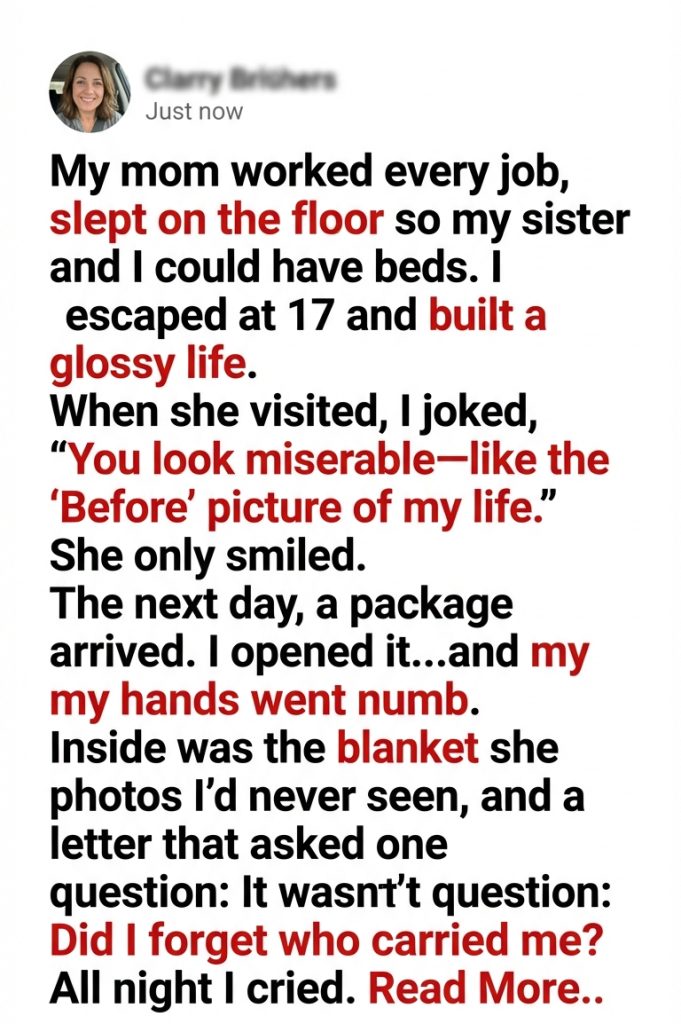
My mom raised me and my sister alone. She worked every job she could get and slept on the floor so we could have beds. I left home at 17 and built a glossy life.
When she visited me, I joked, “You look miserable, like the ‘Before’ picture of my life.” She just smiled.
The next day, a package arrived. I opened it and went numb. Inside, Mom….
That last word—Mom—hung in the air like a bell that wouldn’t stop ringing. Because in that moment, before I even knew what else was in the box, my body reacted like it already understood: whatever I’d done, whatever I’d said, the cost was about to arrive.
I used to believe success was something you wore. Like a jacket. Like a watch. Like a skyline view from a high-rise apartment where the floors never creaked and nobody’s neighbor played music too loud because everyone had enough money to be polite.
I believed if I could polish myself enough, I’d never have to feel where I came from again.
And my mother—my exhausted, stubborn, endlessly giving mother—was part of where I came from.
That’s what I hate admitting. Not that she was poor. Not that she struggled.
That I treated her like proof of something I wanted to erase.
Growing up, our life was a patchwork of survival tricks.
My mom had a way of making hunger feel like an adventure. She’d say, “Breakfast for dinner!” like it was a celebration instead of a budget. She’d cut sandwiches diagonally so they looked fancy. She’d let us pick one item from the dollar store like it was a gift shop.
But there were nights when the performance slipped.
I remember waking up thirsty and stepping carefully out of bed, only to see my mom lying on the floor between my bed and my sister’s, wrapped in a thin blanket. She looked smaller down there, curled up like she didn’t want to take up space.
When I was little, I thought it was love—her sleeping close to us in case we had nightmares.
When I got older, I realized it was sacrifice.
We had two beds.
She had the floor.
She worked cleaning houses in the morning, cashiering in the afternoon, and sometimes folding laundry at a motel at night. Some weeks she stitched together so many jobs that time lost meaning. She smelled like lemon cleaner and warm cotton and tiredness.
When she came home, she’d kick off her shoes and rub her feet like they belonged to someone else. Then she’d look at us, smile, and say, “You two ate?”
We learned early that her happiness depended on our okay.
I left home at 17 with a cheap duffel bag, a scholarship application, and a vow: I will never live like this again.
That vow turned into obsession.
I studied like my life depended on it—because it did. I took every internship, every overtime shift, every chance to look “professional.” I learned how to talk to people who’d never counted coins for gas. I learned to laugh at jokes I didn’t understand. I learned to hide my accent. I learned to never admit I’d been the kid with the free lunch card.
When I got my first real job, I bought things I didn’t need just because I could: a couch that cost more than our entire childhood living room, a coffee machine with buttons I never used, shoes that stayed clean because I barely walked anywhere.
And when my mother called, I answered less and less.
Not because I didn’t love her.
Because I didn’t want her to see how far I’d run.
And because, deep down, I didn’t want anyone in my new life to look at her and then look at me and connect the dots.
That’s the shame I carried.
That’s the ugliness I fed.
So when she told me she wanted to visit, I panicked. I told myself it was fine. I told myself I’d treat her to dinner, show her my apartment, buy her something nice. I told myself I’d be kind.
But kindness isn’t just what you do.
It’s how you see someone.
My mother arrived on a Tuesday afternoon with a small suitcase and a plastic bag full of snacks “for later.” She wore the same faded cardigan she always wore, the one that had been washed a thousand times until the fabric felt like paper.
I hugged her at the door. She smelled like the soap she’d always used—cheap, floral, comforting.
Then she stepped inside my apartment and looked around quietly.
My place was what I’d always imagined success looked like: bright, minimal, clean lines, a view that made people say “wow” without thinking. The kind of place that didn’t feel lived in because I was always working.
My mom walked slowly, taking it in, touching nothing.
“You did good,” she said softly.
I felt a sharp pride in my chest. Like I’d finally won.
I asked if she wanted coffee. She said tea was fine. Then she offered to wash the cup when she was done. Automatically. Like her hands needed to be useful to justify her presence.
That night, I took her to a restaurant with cloth napkins and fancy words on the menu. She stared at the prices like they might bite her, then ordered the cheapest thing.
I told her to get whatever she wanted. She smiled and said, “This is fine.”
Back at my apartment, she sat on my couch like she was afraid of sinking into it too much. She asked about my job, my life, my plans.
And then she said something that should’ve softened me.
“I’m proud of you,” she said. “You were always meant for more.”
And instead of letting that moment be holy, I made it about me.
The next morning, she stood in my bathroom, combing her hair in the mirror. The harsh lighting showed every line time and struggle had written on her face. She’d gotten older. Smaller. Her shoulders were slightly hunched from years of carrying everything.
I walked past the doorway, half awake, and I saw her reflection beside mine: me in a crisp shirt, her in her worn cardigan.
And the thought flashed through my mind like a cruel joke:
She looks like the “Before.” I look like the “After.”
I should’ve swallowed it. I should’ve kept it inside where shame belongs.
But I said it.
When she visited me, I joked, “You look miserable, like the ‘Before’ picture of my life.” She just smiled.
She didn’t gasp. She didn’t get angry. She didn’t even look surprised.
She smiled like she was used to swallowing pain.
“That’s funny,” she said gently, even though her eyes went shiny for half a second before she blinked it away.
My stomach tightened. I felt something like regret, but I crushed it under the same pride I’d been living on.
That day, I left for work like nothing happened.
When I came home, she had cleaned my kitchen.
Of course she had.
The counters were wiped, the sink empty, the trash taken out. A small bowl of cut fruit sat on the table like she was trying to be helpful in a house that didn’t need help.
I should’ve thanked her.
I should’ve apologized.
Instead, I ate the fruit and asked if she wanted to watch a movie.
She said she was tired and went to bed early.
I lay awake in my own room feeling oddly irritated. Like her quietness was an accusation.
The next morning, she hugged me goodbye and said she had to get back. She said she didn’t want to “bother” me.
I told her she wasn’t a bother.
But my words were weak because I hadn’t earned them.
After she left, I felt relief—then immediately hated myself for it.
And then came the box.
The next day, a package arrived. I opened it and went numb. Inside, Mom….
The package was heavy enough that the delivery guy had knocked twice and waited, like he didn’t trust it to sit unattended in the hallway. The label was neat. My name spelled correctly. My mom’s return address in the corner.
I carried it inside and set it on my coffee table.
For a few seconds, I just stared at it.
Then I cut the tape.
The first thing I saw was a thin, worn blanket, folded carefully. It looked like a blanket you’d keep in a car trunk for emergencies.
But my fingers recognized the fabric before my brain did.
I lifted it, slowly.
And the smell hit me like a punch.
That specific scent of old laundry soap and time.
It was the blanket she used to sleep on.
The one I’d seen on the floor between our beds, night after night.
Under the blanket was a photo.
Not framed. Not pretty.
A snapshot, creased at the corners.
It showed our childhood bedroom. Two small beds pushed against the wall. And on the floor between them, my mother—young, exhausted, curled up on that exact blanket.
Her face was turned toward the beds like she was guarding us.
On the back of the photo, in her handwriting, it said:
“The ‘Before’ picture you forgot.”
My throat closed. I couldn’t breathe.
There were more photos.
My mother washing dishes in a stranger’s house, her hands raw.
My mother at a bus stop before dawn, holding a cheap thermos.
My mother asleep sitting upright in a chair at a laundromat, head tilted back, mouth slightly open—so tired she’d fallen asleep waiting for our clothes to dry.
And then, near the bottom of the box, an envelope.
Plain.
My name on it.
Inside was a letter.
I unfolded it with shaking hands.
Her handwriting was careful, like she’d written it slowly, with breaks.
She wrote:
“I smiled because I didn’t want to ruin your life with guilt. But you should know something, baby. I didn’t look miserable because I was your ‘Before.’ I looked tired because I carried you.”
Tears blurred the page immediately.
“I slept on the floor so you could sleep in a bed and dream bigger than me,” she wrote. “I worked every job I could get so you could walk into rooms I was never allowed in.”
I pressed my palm against my mouth, trying to hold the sound in.
“I visited you because I wanted to see you safe,” she continued. “Not because I needed anything. I didn’t come to be admired. I came to love you.”
Then came the line that shattered me:
“But I’m sending you this because love without truth becomes a habit of silence, and silence can turn your heart hard.”
I sobbed then. Ugly, shaking sobs that made my chest hurt. The kind of crying adults do when the person who loved them most is no longer there to soften the blow.
I kept reading.
She wrote that she didn’t blame me for wanting more. She didn’t blame me for leaving at 17. She said she was proud I escaped the cycle.
But she asked me—gently, devastatingly—not to escape her.
“Success is not supposed to make you ashamed,” she wrote. “It’s supposed to make you free.”
At the end, she wrote:
“If you ever feel tempted to laugh at where you came from, hold this blanket. Remember what it cost.”
I dropped the letter into my lap and stared at the blanket, the photos, the proof.
My glossy apartment suddenly felt sterile. Cold. Like a museum built to display a version of myself that wasn’t real.
Because the real version of me—the one my mother had raised—would never have said what I said.
Unless something inside me had broken along the way.
And I knew exactly what it was.
It was the fear of being poor again.
It was the shame of being seen.
It was the lie that I had built myself alone.
I looked around my apartment and saw the truth everywhere: every clean surface, every quiet luxury, every polished corner.
All of it had been paid for with a woman’s floor-sleeping, job-juggling, self-erasing love.
And I’d turned around and mocked her for wearing the evidence.
I grabbed the blanket and held it to my chest like a child. I didn’t care how ridiculous it looked. I didn’t care how expensive my couch was.
I cared that my mother was gone.
And the last joke I’d made was cruel.
I called my sister immediately.
When she answered, I couldn’t speak at first.
“Are you okay?” she asked, alarmed.
I choked out, “Mom sent me something.”
There was a pause. “Me too,” my sister whispered.
My stomach dropped. “What did she send you?”
“A letter,” she said. “And… pictures.”
We cried on the phone together, two grown people reduced to the children we used to be, remembering the same blanket, the same floor, the same sacrifices we’d stopped seeing because we’d gotten used to surviving them.
Later that week, we met.
We spread the photos out on my coffee table. The “Before” pictures. The real ones.
And we did something we should’ve done years ago.
We told each other stories.
The nights we didn’t know she skipped dinner.
The days she pretended she wasn’t sick.
The way she always said she was fine, even when she clearly wasn’t.
We talked about the day I left at 17. My sister admitted she’d resented me for leaving her behind.
I admitted I’d been afraid if I stayed, I’d never escape.
We realized our mother had carried not just our bodies, but our emotions—absorbing everything so we could grow without breaking.
And then my sister said something that changed everything.
“Mom didn’t send that box to punish you,” she said softly. “She sent it because she knew you’d listen to the truth when it looked like a ‘before and after.’ That’s how you see the world now.”
I stared at the blanket.
My mother had known me.
Even the parts I was ashamed of.
She’d chosen a language I couldn’t ignore.
That night, after my sister left, I made a decision.
I took the blanket and placed it at the foot of my bed, folded neatly.
Not as decoration.
As a reminder.
Then I did something I hadn’t done in years.
I went through my contacts and called people back. Old family friends. Neighbors from home. People I’d ignored because they reminded me of where I came from.
I apologized for disappearing.
I didn’t make excuses.
I told them I’d been wrong.
And then I went to my mother’s grave.
I brought the letter.
I sat on the grass like a kid and read it out loud, my voice shaking, because I needed to say the words into the world, not just into my head.
“I’m sorry,” I whispered into the quiet. “I’m sorry I made you feel like you were my ‘Before.’ You were my everything.”
The wind moved through the trees softly, like breath.
I pressed my hand to the earth and stayed there for a long time.
You don’t get to fix everything when someone is gone. That’s one of the cruelest parts. The apology has nowhere to land except inside you.
So you make it land in your actions.
In the months that followed, I changed the way I spoke about my past. I stopped calling my childhood “humble” like it was a polite euphemism. I called it what it was: hard.
And I stopped pretending I had built myself alone.
Whenever someone praised me, I learned to say, “My mom made this possible.”
Not as a sad story.
As a truth.
I also started volunteering in a community program that helps single parents find job training and childcare support. At first it felt performative, like I was trying to buy forgiveness.
But slowly, it became something else.
It became gratitude turned into action.
One afternoon, a woman came in holding a toddler on her hip and a stack of forms in her other hand. She looked exhausted. Her hair was messy. Her eyes were tired in a way I recognized in my bones.
For a second, I saw my mother.
And I realized the difference between “Before” and “After” isn’t money.
It’s whether you still have your heart.
That night, I went home and stared at the blanket again, and I understood the real ending my mother had written without saying it directly:
She didn’t want me to feel guilty forever.
She wanted me to become the kind of person who would never laugh at sacrifice again.
Because sacrifice is not misery.
It is love with bruises.
And the truth is, my mother didn’t look like the “Before” picture of my life.
She looked like the foundation.
The reason anything stood at all.
So if you’re reading this and you’ve ever made a joke at someone’s expense because you wanted to feel above your past—stop.
Call them.
Hug them.
Thank them.
Because one day, a package might arrive, and all the words you thought you had time to say will be trapped in your throat forever.
And you’ll realize too late that the “Before” picture was the only reason you ever got an “After.”