I didn’t realize how heavy grief could be until it stopped being dramatic and started being practical.
Everyone talks about losing a parent like it’s only tears and memories. Nobody really warns you about the paperwork, the looks people give you at the funeral, or the way your own family can start speaking in sentences that feel like locks turning.
The day we buried my mom, the sky was bright in a way that felt cruel. People hugged me, told me she was in a better place, and offered casseroles they barely knew how to make. I thanked them because that’s what you do when you’re numb: you perform politeness while something inside you collapses quietly.
At home—what I still thought of as home then—my stepdad moved through the rooms with a strange kind of calm. He didn’t cry much. He didn’t raise his voice. He just looked… settled, like the house had already rearranged itself around him.
I tried to tell myself it was grief, that everyone handles pain differently.
But then the will reading happened.
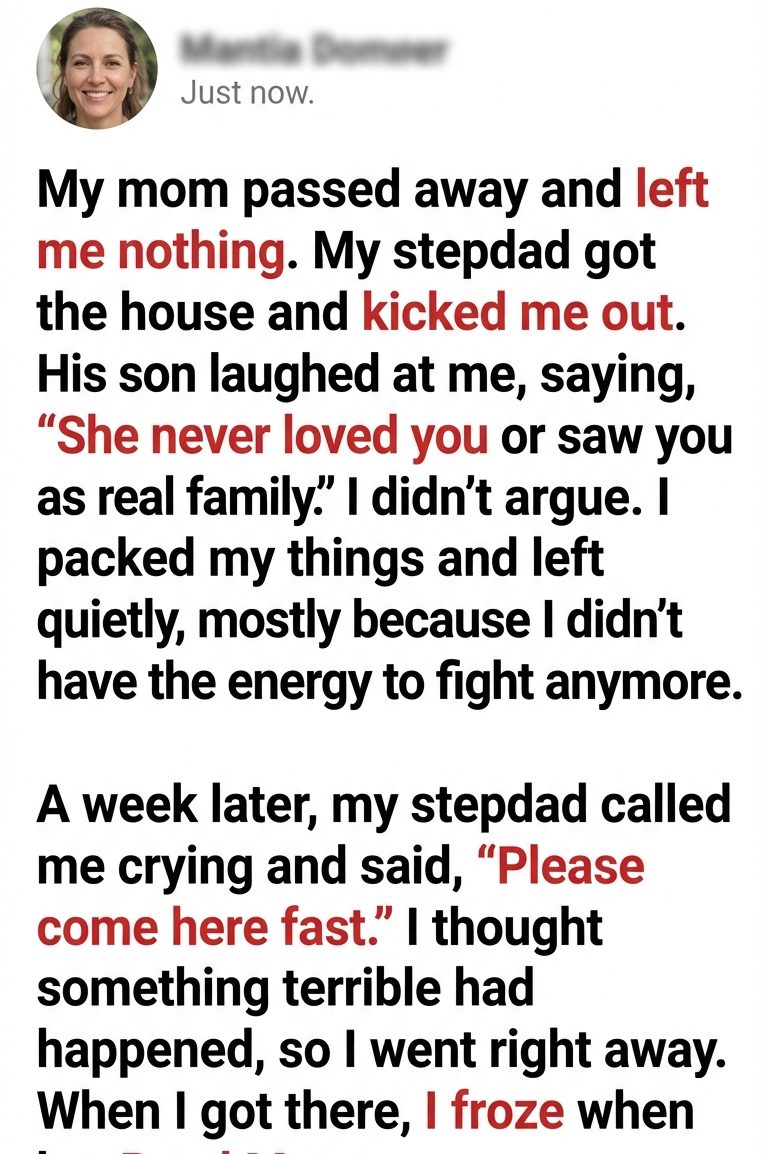
My mom passed away and left me nothing. My stepdad got the house and kicked me out. His son laughed at me, saying, “She never loved you or saw you as real family.” I didn’t argue. I packed my things and left quietly, mostly because I didn’t have the energy to fight anymore.
The words “left me nothing” didn’t just mean money. They meant I was being told I was nothing. Like my place in her life had been a misunderstanding. Like all those years of birthdays and school pickups and family photos had been… optional.
When my stepdad told me I needed to be out by the weekend, he said it with the tone you’d use to remind someone of trash day. Not angry. Not emotional. Matter-of-fact.
“You’re grown,” he said. “You’ll figure it out.”
I stared at him, waiting for the part where he softened. Waiting for the part where he said, “Of course you can stay—this is your home too.” But he didn’t. He just walked away and turned on the TV.
His son—my stepbrother, technically—didn’t even try to hide his satisfaction. He leaned in the doorway with his arms crossed, like he was watching a show that had finally gotten good.
“She never loved you or saw you as real family,” he said, laughing like it was the punchline to a joke.
I remember looking at the floor after that, because I didn’t trust my face. I didn’t trust what it might reveal—anger, humiliation, heartbreak, all of it tangled together. Grief had already eaten most of my strength. I didn’t have enough left to wrestle with cruelty too.
So I did what people do when they’ve been cornered by life one too many times.
I packed.
I folded my clothes with hands that shook. I taped up boxes from the garage. I wrapped my childhood photo albums in towels because I didn’t even have bubble wrap. Every object I touched felt like it carried a memory my mom wasn’t here to defend anymore.
I kept thinking: If she really didn’t leave me anything… did she ever mean to?
It’s a terrible thought, the kind that makes you question your entire life. And that’s what my stepdad and his son were counting on—me doubting myself so deeply that I’d walk away without making noise.
By the time I loaded my car, it was late afternoon. The house looked the same from the outside: pale paint, familiar porch steps, the wind chime my mom had hung by the door.
But it wasn’t mine anymore.
My stepdad stood on the porch as I shut the trunk. He didn’t offer to help. He didn’t say goodbye. He simply nodded once, as if this was the natural order of things.
His son waved with two fingers, a mock salute.
I drove away with my jaw clenched so tight my teeth hurt.
For the first few days, I slept on a friend’s couch. I told myself it was temporary. I applied for extra shifts at work. I looked for a cheap room to rent. I tried to keep moving because if I stopped, I’d have to feel everything all at once—and I was terrified that if I let the grief in fully, it would drown me.
Then, a week later, my phone rang.
A week later, my stepdad called me crying and said, “Please come here fast.” I thought something terrible had happened, so I went right away. When I got there, I froze when he…
His voice was not the same voice that had told me to be out by the weekend. It wasn’t cold. It wasn’t firm. It was broken—high, raw, shaking.
He didn’t even say my name at first. He just sobbed into the line like he couldn’t breathe.
“Please,” he choked out. “Please come here fast.”
My heart dropped straight through my body. For a second, I imagined the worst. A fire. A stroke. A break-in. Something that had snapped his life into panic.
“What happened?” I demanded, already grabbing my keys. “Is it the house? Are you hurt?”
“Just—just come,” he cried. “I… I need you.”
I didn’t think. I drove.
The whole way there, my thoughts spun like tires on ice. Part of me was angry—how dare he call me after what he did? Another part was afraid—what if my mom’s things were destroyed? What if something happened to the only place that still held her presence?
When I pulled up, the driveway was crowded.
There were cars I didn’t recognize. A service van. Two neighbors standing on the lawn, talking in low voices. The front door was open.
My hands went numb on the steering wheel.
I got out and walked quickly, my breath turning shallow. I pushed past the neighbors without acknowledging them and stepped inside.
The house smelled strange—like dust stirred up, mixed with something metallic and sharp. The living room was a mess: cushions tossed aside, drawers pulled open, papers scattered across the coffee table.
And in the middle of it all was my stepdad.
He was sitting on the floor.
Not on the couch where he used to sit like he owned the place—on the floor, back against the wall, his face red and wet, his hands trembling so badly he couldn’t hold the thing he was clutching.
He looked up when he saw me, and something in his expression made my stomach flip.
It wasn’t fear.
It was guilt.
“Thank God,” he whispered, voice cracking. “You came.”
I stared at him. “What happened?”
He tried to speak, but the words tangled up in his throat. Then he lifted the object in his hands.
It was a small black lockbox.
I recognized it instantly because my mom kept it hidden in the back of her closet, behind winter coats, on the top shelf where you needed a chair to reach. When I was younger, she’d told me it held “important papers” and that I should never mess with it.
I hadn’t seen it in years.
My stepdad held it like it was radioactive.
“I didn’t know,” he said, sobbing again. “I swear I didn’t know.”
My heart pounded. “Know what?”
He pointed with a shaking finger toward the hallway—toward my mom’s old bedroom.
“In there,” he whispered. “Just—just go in there.”
My feet moved before my mind did. I walked down the hallway that used to feel safe. Now every step felt like trespassing.
Her bedroom door was half open.
I pushed it wider.
And I froze.
The closet was empty.
Not “cleaned out” empty. Not “reorganized” empty.
Ripped-open empty.
The back panel—something I never knew existed—had been pulled away, exposing a narrow space between studs. The carpet beneath the closet had been peeled back too, and the floorboard looked pried up.
Someone had been digging.
On the bed were stacks of documents, envelopes, and—most shocking—a thick folder labeled with my name.
My name.
In my mom’s handwriting.
For a moment, I couldn’t breathe. My vision narrowed until all I could see was that folder.
I stepped closer, hands hovering, afraid that if I touched it, it would disappear.
Behind me, my stepdad’s voice carried down the hall, ragged and desperate.
“I found it this morning,” he said. “And then—then I realized what I did.”
I turned slowly and looked at him. “You found what?”
He swallowed hard. “Your mother… she didn’t leave you nothing.”
My pulse roared in my ears.
He dragged a hand down his face like he was trying to wipe away the last week. “She left you… everything that mattered.”
I stared at him, not trusting him, not trusting my own hope.
He pointed at the lockbox. “The key was taped under the shelf. I… I was cleaning out her things. I shouldn’t have. I—I thought it was all mine. I thought—” He broke down again. “I thought she wanted me to have it.”
I took a step toward him. “Why are there people outside?”
He flinched. “Because when I opened it… there was a letter. And instructions. And I—” He choked on the next words. “And I realized I’d committed fraud.”
The word hit like a slap.
“Fraud?” I repeated.
He nodded, tears spilling again. “Your mother changed the will. Months ago. She updated everything. The house… the accounts… the insurance… it wasn’t supposed to go to me.”
My knees weakened. I grabbed the doorframe.
He whispered, “It was supposed to go to you.”
The room tilted.
All week I had been walking around with a hole in my chest, believing my mother had erased me. Believing she had chosen them.
And now this man—who had kicked me out—was telling me the truth was the opposite.
I forced myself to speak. “Then why didn’t it?”
He squeezed his eyes shut. “Because I… I filed the old paperwork. I told the lawyer it was the most recent version. I told myself it didn’t matter because she was gone and I was here and—” His voice broke. “And then I saw her letter. And it mattered.”
My heart thundered. I walked back into the bedroom and picked up the folder with my name, fingers trembling.
Inside were copies of documents—deeds, beneficiary forms, and a sealed letter addressed to me.
The envelope had one line written across the front:
For my child. When you need to know the truth.
I sat on the edge of the bed because my legs couldn’t hold me.
I stared at that envelope for a long time.
Then I opened it.
The paper inside was thick, the handwriting careful.
And with every line I read, something inside me both shattered and healed.
My mom wrote that she loved me. That she saw me. That she had worried about what would happen after she was gone. That she had watched my stepdad become “controlling with money” and had seen his son “grow comfortable with cruelty.”
She wrote that she’d stayed quiet for too long because she was sick and tired and didn’t have the strength for war, but she had made plans anyway—quiet plans, legal plans, plans that would protect me when she couldn’t stand in front of me anymore.
She wrote:
“You may feel abandoned. But you are not. If you are reading this, then the worst happened, and I’m not there to correct the story myself. So I’m correcting it here.”
My throat closed. Tears blurred the page.
In the letter, she explained the updated will. She even named the attorney and included a copy of the newer documents—signed, dated, witnessed.
She also explained the lockbox.
There was a second letter inside it, meant to be read by my stepdad if he ever opened it.
And that letter was the reason he was crying.
I looked at him from the doorway. He couldn’t meet my eyes.
“What did she say to you?” I asked quietly.
He sobbed harder. “She said… she said if I ever tried to take what wasn’t mine, I’d ruin myself.”
I swallowed. “And you did.”
He nodded, shaking. “I did.”
I glanced toward the window and finally understood why there were people outside.
Not just neighbors.
A uniformed officer stood near the driveway, talking to the manager of the service van. And the service van had the name of a locksmith company on the side.
My stepdad had called them because he couldn’t open the lockbox at first.
And once he did, he realized what he’d done wasn’t just cruel—it might be criminal.
“I called you because…” he started, voice hoarse. “Because you’re the only one who can fix it. Because it’s your house. Your mother’s house. And I—” He shook his head violently. “I don’t deserve it.”
I looked down at the folder in my hands. At my mom’s handwriting. At her careful planning.
All that time, she’d been sick and still thinking of me.
My stepbrother appeared in the hallway then, drawn by the sound of voices. His face was pale when he saw the papers on the bed. He tried to mask it with a sneer, but his eyes betrayed him—fear.
“What’s going on?” he demanded.
My stepdad snapped at him in a way I’d never heard. “Shut up.”
The stepbrother recoiled. “Dad—”
“I said shut up,” my stepdad repeated, voice cracking. “You said she never loved them. You said they weren’t family. You were wrong.”
My stepbrother’s eyes darted to me, then to the documents. “This is—this is some trick.”
I didn’t answer him. I didn’t need to.
The truth was in ink and signatures.
He stepped forward, voice rising. “That house is ours! She was married to Dad. She—”
My stepdad stood up unsteadily, wiping his face. “No,” he said, and the word came out like a confession. “It’s not.”
He looked at me, eyes red. “It’s yours.”
My stepbrother stared, jaw slack. “You’re kidding.”
My stepdad shook his head. “I filed the wrong paperwork. I thought—” He swallowed. “I thought I could get away with it.”
My stepbrother’s face twisted. “So fix it. Don’t be stupid.”
My stepdad turned toward him, and for the first time, he looked like a man seeing his own reflection in his son’s face—and hating what he saw.
“I’m not fixing it for you,” he said. “I’m fixing it because your mother—because she—” He couldn’t finish.
I held the folder tighter. My hands were still trembling, but now it wasn’t just grief. It was power returning.
I looked at my stepdad. “What do you want me to do?”
He sank back down like his bones couldn’t support him. “I want you to take what’s yours,” he whispered. “And… and I want you to forgive me.”
The word “forgive” hung in the air like smoke.
I didn’t answer right away.
Because forgiveness isn’t a switch you flip when someone finally regrets being caught. It’s a process. It’s a choice. And sometimes it’s not the choice you can make immediately.
I walked into the bedroom and gathered the documents carefully, like they were fragile pieces of my mother herself. I slid them back into the folder. I placed the lockbox beside it.
Then I turned and faced them both—my stepdad and his son.
“I’m not here to comfort you,” I said softly. “I’m here to honor my mother.”
My stepdad nodded, tears falling again.
My stepbrother scoffed, but his voice was weaker now. “This is unbelievable.”
I met his gaze. “What’s unbelievable,” I said, “is how easy it was for you to laugh at someone who’d just lost their mom.”
He opened his mouth, but no words came.
I stepped into the hallway and saw the officer again through the front window.
I turned back to my stepdad. “Did you call the police?”
He nodded. “I… I didn’t know what else to do. The lawyer—he said it could be serious.”
I took a breath. “Good.”
He blinked at me like he expected me to protect him.
But I had spent my whole life protecting other people’s comfort. I wasn’t doing that anymore.
I walked into the living room, past the scattered papers and the overturned cushions, and opened the front door wider.
The cold air hit my face like a reset.
I stepped onto the porch and said, clearly, “Hello. I’m the person the property belongs to. I’m ready to speak.”
Behind me, my stepdad made a sound—half sob, half surrender.
And in that moment, I finally understood what my mother had done.
She hadn’t left me nothing.
She had left me the truth—packaged in a way that would surface at the exact moment someone tried to bury it.
Because she knew: some people only cry when the consequences arrive.
And she made sure they would.