The first time I realized how little I’d been seeing my wife, it wasn’t during an argument or a dramatic moment. It was in a quiet hallway, late at night, when I passed the laundry room and saw her sitting on the floor with a basket of clean clothes, staring at nothing like she’d forgotten how to move. Not crying. Not sleeping. Just paused—like a song that had stopped mid-note and never started again.
I told myself she was tired. Of course she was tired. We had two kids, a mortgage, and a life that ran on schedules and spill-proof cups. She stayed home, I worked, and we did what couples do when the days blur together: we survived on routine and called it normal.
But there was a difference between being tired and being invisible. I just didn’t understand that yet. Or worse—I understood it and still benefited from it.
It started with a simple announcement while she was wiping down the kitchen counters after dinner, her hair tied up in a loose knot, her sleeves pushed to her elbows.
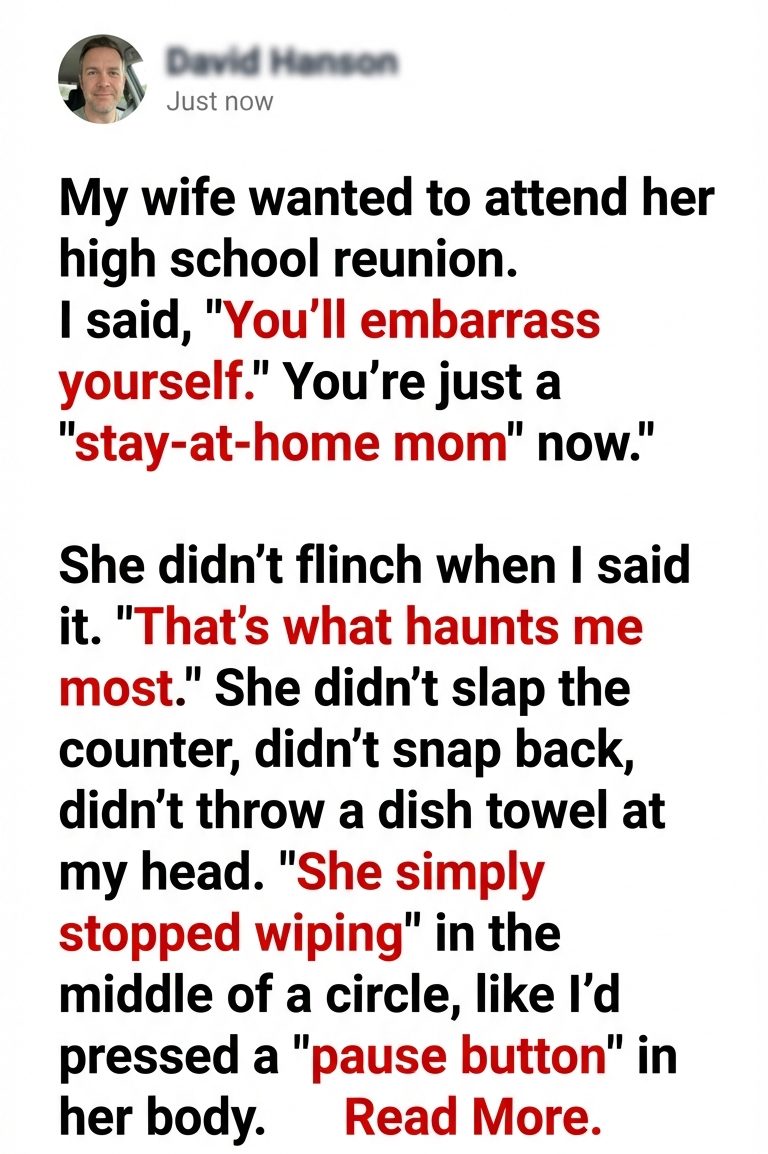
My wife wanted to attend her high school reunion.
I said, “You’ll embarrass yourself. You’re just a stay-at-home mom now.’
She didn’t flinch when I said it. That’s what haunts me most. She didn’t slap the counter, didn’t snap back, didn’t throw a dish towel at my head. She simply stopped wiping in the middle of a circle, like I’d pressed a pause button in her body.
Her eyes stayed on the countertop for a second too long. Then she rinsed the sponge, wrung it out carefully, and set it back in its little holder with a precision that felt like she was trying to keep herself from falling apart in front of me.
She didn’t go.
She didn’t speak to me for days.
At first, I acted offended. I told myself she was being dramatic. I told myself I’d only said what was true, and truth hurts, doesn’t it? I leaned on that excuse like it was a cane: I’m tired, I’m stressed, I didn’t mean it like that, she knows I love her, she’s overreacting.
But the house changed in those days. It wasn’t louder or quieter. It was sharper.
The kids still asked for snacks, still argued over toys, still climbed onto her lap like she was the safest place in the world. She still packed lunches, still signed permission slips, still reminded me we were almost out of toothpaste.
But she stopped offering me herself in the small ways she used to.
No “How was your day?” when I walked in. No absentminded touch to my arm as she passed. No calling me into the kitchen to taste something she was proud of. No soft laughter when I tried to be funny. She moved around me like you move around furniture—careful, practiced, emotionless.
I kept waiting for her to “get over it.” That’s what I told myself. Give it time.
On the fourth night, I tried to apologize, but it came out wrong—half apology, half defense.
“I didn’t mean you’d embarrass yourself,” I said, standing in the doorway of our bedroom while she folded towels. “I just… I don’t know. Those reunions can be weird.”
She didn’t look up. “Mm.”
“That’s it?” I asked. “You’re going to ignore me forever?”
Still nothing.
My pride rose up fast, as it always did. Instead of taking the silence as a sign of how deeply I’d hurt her, I took it as a challenge—like she was punishing me on purpose. I went to bed angry, and when I woke up, she was already up with the kids, moving through the morning like a ghost.
Two weeks later, a heavy box arrived addressed to her. I opened it and went numb. Inside was…
A framed photograph, the glass wrapped in bubble plastic. Beneath it, layers of tissue paper and packing foam. I pulled the frame out first, and my stomach tightened because I recognized the face immediately: my wife, eighteen years old, wearing a cap and gown, smiling so brightly it looked like the sun had decided to live inside her.
The plaque beneath the picture read:
DISTINGUISHED ALUMNA HONOREE
KEYNOTE SPEAKER — CLASS REUNION
I stared at it until my vision blurred. Keynote speaker? Honoree? My wife?
There were more things in the box. A thick envelope with the school logo. A folded program. A letter with careful, formal wording.
I opened the letter with hands that didn’t feel like mine.
It was from the reunion committee. They had been searching for her. They were “thrilled” she had been located. They were “honored” to announce she’d been selected as their “Distinguished Alumna,” the person they wanted to spotlight for her accomplishments and “inspiration to the graduating classes that followed.”
I read that line again and again—accomplishments. Inspiration.
I felt cold all at once.
Under the letter was a second envelope, handwritten. The handwriting was loopy and familiar, like someone who used to pass notes in class.
It said: “Please give this to her if you’re her husband. If you’re not, then please just make sure she gets it.”
I stared at that for a long moment, then opened it.
Inside was a short note from an old friend—someone named Tessa.
It said:
“Tell her we never forgot her. We voted for her unanimously. We’ve told her story for years: the girl who did everything right, who got into the program, who could’ve gone anywhere. We thought she’d be the one to change the world. We know life happened. We just wanted to remind her that she mattered to us before she belonged to everyone else.”
My throat tightened so hard I couldn’t swallow.
I sat at the kitchen table with the box in front of me like a confession. The house was quiet; the kids were at school, and my wife had taken a rare afternoon out, saying she needed to “run errands.”
I pictured her walking through a store aisle, expression calm, while inside she carried the weight of what I’d said. “You’re just a stay-at-home mom now.” As if “now” erased everything she had been. As if motherhood was a downgrade. As if her life had shrunk instead of transformed.
My phone buzzed with a work email, and the sound made me flinch. I couldn’t focus on anything except the items in the box.
I lifted the program next. It was glossy, professionally printed, with the reunion schedule and a list of events. And there it was, in bold near the end:
7:30 PM — Keynote Address: [Her Name]
My pulse pounded. I’d said she would embarrass herself.
But the truth was: she had been invited to stand in front of a room full of people and be honored.
Which meant the embarrassment wasn’t hers.
It was mine.
I reached deeper into the box and found something else—an old newspaper clipping sealed in plastic, yellowed with age. The headline read:
LOCAL TEEN WINS STATEWIDE SCHOLARSHIP — FULL RIDE
It had a photo of her holding a trophy, hair pulled back, eyes fierce with determination. Beneath the headline was a short article describing her achievements: academic awards, volunteer work, science fairs, a scholarship offer.
I didn’t know about any of this.
How could I not know?
I tried to trace my memory backward. When we met in college, she’d been quiet about her past, always brushing off compliments. I remembered her saying she used to like school, used to “be a nerd,” used to dream about medical research, engineering, something ambitious and bright.
At the time, I’d found it charming, even funny—like it was a cute hobby she’d outgrown. I’d never asked for details. I’d never insisted she tell me the parts she’d hidden.
And now I wondered if she hid them because people like me had trained her to believe they didn’t matter.
I stared at the table until the lines of the wood grain looked like rivers.
Then I heard the garage door.
Her keys. The click of the lock. The soft thud of her purse dropping onto the entryway bench.
I stood up too fast, the chair scraping. My heart felt like it was trying to climb out of my throat.
She walked into the kitchen and stopped when she saw the box open.
Everything in her posture changed. Her shoulders stiffened. Her mouth became a flat line.
For a few seconds, neither of us spoke.
Then she said, very quietly, “You opened it.”
It wasn’t a question. It was an accusation, but not angry—more like tired.
“I did,” I admitted.
She stepped closer, eyes flicking to the plaque, the photo, the letter. Her face didn’t show surprise. That’s what made it worse. She already knew what was in there. She already knew what I’d find. She already knew how I’d react.
“I shouldn’t have,” I said. “I’m sorry.”
Her gaze stayed on the framed photo. “That’s the first time you’ve said sorry without adding a ‘but.’”
I swallowed. “I didn’t know.”
“No,” she said, still calm. “You didn’t want to know.”
The words landed clean and sharp.
I looked down at my hands. They were shaking.
“They wanted you to speak,” I said, as if saying it aloud might make it more real. “They wanted to honor you.”
She gave a small laugh that had no joy in it. “They wanted to honor the girl I used to be.”
“And what about the woman you are?” I asked before I could stop myself.
She finally looked at me then. Her eyes were not tearful. They were steady.
“The woman I am,” she said, “has cleaned vomit out of car seats at 2 a.m., stayed awake through fevers, taught two tiny humans how to read, held our life together while you built your career. The woman I am has done more work than that girl ever did.”
I felt my face burn.
“I didn’t mean—” I started.
“Yes,” she interrupted softly. “You did.”
Silence filled the kitchen, thick as smoke.
She reached for the letter from her friend and held it in her hands like something fragile. “Tessa sent this. I didn’t tell you about it because I already knew what you’d say.”
My chest tightened. “You thought I’d say something like… what I said.”
She nodded once. “Not exactly those words. But the meaning would be the same.”
I couldn’t argue. The proof was sitting right there.
“I was scared,” I admitted. The truth came out ugly and honest. “When you said reunion, all I could picture was you realizing you didn’t have… the kind of thing people brag about. And I didn’t want you to get hurt.”
She stared at me. “So you hurt me first?”
My mouth opened, but nothing came out.
Because yes.
Because I’d rather control the narrative than risk watching her shine and feeling small next to it.
Because I’d gotten used to being the one with the title, the one with the paycheck, the one society claps for.
And I’d let that poison my respect for the person who made my life possible.
“I didn’t go,” she said, voice still level, “because I believed you. For a second, I believed you were right. I looked in the mirror and saw what you saw: a woman with a minivan, a messy bun, and no ‘impressive’ answer to that question people ask at reunions—What do you do?”
My throat tightened. “You are impressive.”
She didn’t react. “That’s not what you said.”
I forced myself to hold her gaze. “I was wrong.”
She nodded, slowly. “I know.”
“And I’m sorry,” I said. “I’m sorry I said it. I’m sorry I thought it. I’m sorry I ever made you feel like your life got smaller because you chose our family.”
Her eyes flicked away for the first time—just a tiny crack in her composure.
She set the letter down. “Do you know why the box is heavy?” she asked.
I shook my head.
“Because it’s not just paper and plaques,” she said. “It’s everything I put away when we had kids. Not because I regret them. Not because I resent them. But because there are only so many hours in a day, and someone had to be the steady one.”
I thought about all the times I’d come home to a clean house and dinner on the table and assumed it was simply… there. Like magic. Like she didn’t have a body that got tired, a mind that got lonely, a soul that needed recognition.
“I wish I could go back,” I said.
“You can’t,” she replied.
“I know,” I said. “But I can do better now.”
She watched me carefully, like she’d heard promises before and learned not to trust them.
“What does ‘better’ look like to you?” she asked.
I stared at the plaque again. Keynote speaker. Honoree. A room full of people waiting to clap for her.
“I think,” I said slowly, “it looks like me shutting up and listening for once.”
She didn’t smile, but her shoulders lowered a fraction.
“And it looks like me being honest,” I added. “I was afraid you’d go and remember you were capable of more than this life… and you’d realize you didn’t need me.”
That finally did it. Something shifted in her expression—not anger, not triumph—just a deep sadness.
“You think motherhood is ‘this life,’” she said quietly, “as if it’s a cage.”
I flinched. “I didn’t mean—”
“But you did,” she said again, softer this time. “And that’s the problem.”
I took a breath that hurt. “Then help me understand. Tell me what you want.”
She looked at the program, then the photo. “I want to stop shrinking,” she said. “Even inside my own house.”
I nodded. “Okay.”
“And I want you to stop treating my sacrifices like they’re… nothing,” she continued. “Like they’re not worth respect.”
My throat tightened. “You have it. You do.”
She held my eyes. “Then prove it.”
The next morning, I took the day off work. I packed lunches. I found the permission slips. I took the kids to school. I did the grocery shopping without calling her three times. I cleaned the kitchen. I made dinner, badly, and didn’t expect applause for doing what she’d done for years.
When she came downstairs that evening and saw the table set, she paused like she couldn’t trust it.
“I’m not doing this for points,” I said. “I’m doing it because I finally understand that you’ve been carrying more than I ever acknowledged.”
She nodded slowly, and I saw exhaustion in her face that I’d ignored for too long.
That weekend, I asked her to tell me about high school. Really tell me.
She talked about late nights studying, about teachers who believed in her, about a scholarship she turned down because her mother got sick and she needed to be close to home. She talked about dreams that didn’t die—they just got postponed. She talked about how, even now, she sometimes imagined walking into a room and being seen as more than “someone’s wife” or “someone’s mom.”
I listened until my chest felt like it might crack open.
“I didn’t miss my reunion,” she said at the end, surprising me. “Not really.”
“Why not?” I asked.
“Because it wasn’t about them,” she said. “It was about me remembering I had value before anyone handed me a title.”
I nodded. “And you still do.”
She studied me. “Say it like you believe it.”
I swallowed. “You have value. You have always had value. And I was cruel because I forgot that, and because I got comfortable taking you for granted.”
Her eyes shimmered then—just briefly. She blinked it away fast.
A month later, her school held another event—an alumni fundraiser, smaller than the reunion, but still meaningful. The committee invited her again, not as a replacement, not as an afterthought, but as the person they wanted.
She almost said no out of habit.
I watched her hesitate, saw the old reflex to shrink.
And this time I said, “Go. I’ve got this.”
She didn’t trust it at first. So I made a plan. I arranged childcare. I cooked. I scheduled my work around it. I did not act like I was “helping” her. I acted like I was being a partner.
The night she left, she stood by the door in a dress she hadn’t worn in years. Not flashy. Just… her. Like she was reclaiming space.
She looked at me for a long moment before she turned the knob.
“If you ever say something like that again,” she said softly, “I won’t just stop speaking to you.”
“I know,” I whispered. “And you won’t have to. I’ll be gone before you need to.”
She studied my face like she was searching for the lie. Then she nodded once and left.
When she came home later that night, she wasn’t glowing in a movie-magic way. She was tired. Her feet hurt. Her hair was slightly frizzy from the rain.
But she looked… taller. Not physically—something deeper. Like the version of her that had been forced to fold itself smaller had finally stretched out again.
“They clapped,” she said, almost surprised.
“Of course they did,” I replied.
She walked past me, then stopped, turned back, and said quietly, “I clapped for myself too.”
And in that moment, I realized the real ending wasn’t about whether she forgave me quickly or whether I did enough chores to earn my way back into her warmth.
The ending was this: she stopped needing my permission to be proud of herself.
I wish I could say I changed in one dramatic epiphany, that I became a perfect husband overnight. I didn’t. I still catch myself slipping into old patterns—assuming, rushing, dismissing.
But now I notice. Now I correct myself. Now I ask what she needs instead of deciding what she deserves.
And the plaque from that box? It’s on our bookshelf in the living room, right at eye level. Not because the world needs to know she was honored, but because our children need to grow up seeing something I forgot:
That a woman doesn’t become “just” anything.
Not a wife. Not a mother. Not even a “stay-at-home mom.”
She becomes the center of a life—strong enough to hold everyone else up.
And if you ever make her feel small, you don’t deserve to stand beside her when she remembers how big she truly is.