The manager arrived with the kind of smile that usually means someone is about to apologize for an overcooked steak. My mother sat perfectly straight, napkin folded like a tiny white flag in her lap, not because she was surrendering—but because she’d never once let panic wrinkle her manners.
“Excuse me,” she said softly, as if she were asking for an extra lemon wedge instead of confronting a small betrayal. “Could I have a quick word?”
The manager leaned in. My mother didn’t raise her voice. She didn’t point. She didn’t even glance toward the door where my in-laws had disappeared in a flurry of excuses and perfume. She simply slid the leather bill folder back across the table like it was a chess piece.
“I believe our party stepped out,” she said. “They told me they’d be right back.”
The manager’s smile tightened. He’d heard this music before.
My mother added, “I’m happy to settle my portion. But I won’t be paying for food I didn’t order.”
The manager glanced down at the receipt. The total looked like it belonged to a wedding, not a birthday dinner: lobster tails, filet mignon, two bottles of imported wine, sides ordered twice because someone couldn’t decide between truffle fries and asparagus, plus a dessert tray that had apparently toured the table like a celebrity. My mother’s own order—one salmon, one glass of house white—looked like a polite footnote.
“I understand,” the manager said carefully. “But they were seated together. It’s one check.”
My mother smiled in a way I can only describe as… kind. Which made it more dangerous.
“Then please do me a favor,” she said. “Could you pull up the reservation details? It should be under Eleanor Hart.”
The manager’s eyebrows lifted. “Yes, ma’am. One moment.”
He returned with a tablet. My mother watched him scroll, calm as a lake.
“There it is,” he said. “Eleanor Hart. Four guests plus one. Notes say… ‘Preferred table by the window. Returning patrons.’”
“And the number?” my mother asked.
He hesitated, then read it out. “It’s tied to a membership number. A rewards profile. And a phone number ending in… 4182.”
My mother nodded once, as if she’d just confirmed the weather.
“That’s my daughter’s number,” she said.
The manager looked at her now with sharper attention. “Your daughter made the reservation?”
“My daughter-in-law,” my mother corrected gently. “I’m here in her place.”
The manager’s shoulders shifted—he was trying to find the right box to place this situation in.
My mother leaned forward. “Could you also check the payment methods saved to that profile?”
He tapped again, eyes moving quickly. “Two cards on file,” he said, voice dropping. “One is a corporate card. The other is personal.”
My mother’s smile didn’t change, but something in her eyes did—something that told me later this was the moment she knew the board was fully set.
“Thank you,” she said. “Now, I don’t want to cause trouble. But I also don’t want to be taken advantage of.”
The manager exhaled. “Of course.”
My mother tilted her head slightly, as if she were asking for a recommendation. “If someone leaves without paying, what do you call that?”
The manager’s face went still. “That would be… dine and dash.”
“And that is…?” my mother prompted.
“A crime,” he said, quietly.
My mother nodded once more. “I thought so. Then I’d like to do two things. First, I’ll pay for my meal. Second, I’d like to report that the rest of the party left without paying—unless they return within five minutes.”
The manager blinked. “Ma’am, are you sure?”
My mother lifted her glass of water and took a sip. “I’m certain.”
He looked around, likely weighing the odds of my in-laws popping back in with fake surprise. But the entrance stayed empty. The hostess stand was quiet. Outside, the parking lot lights reflected off car roofs like cold coins.
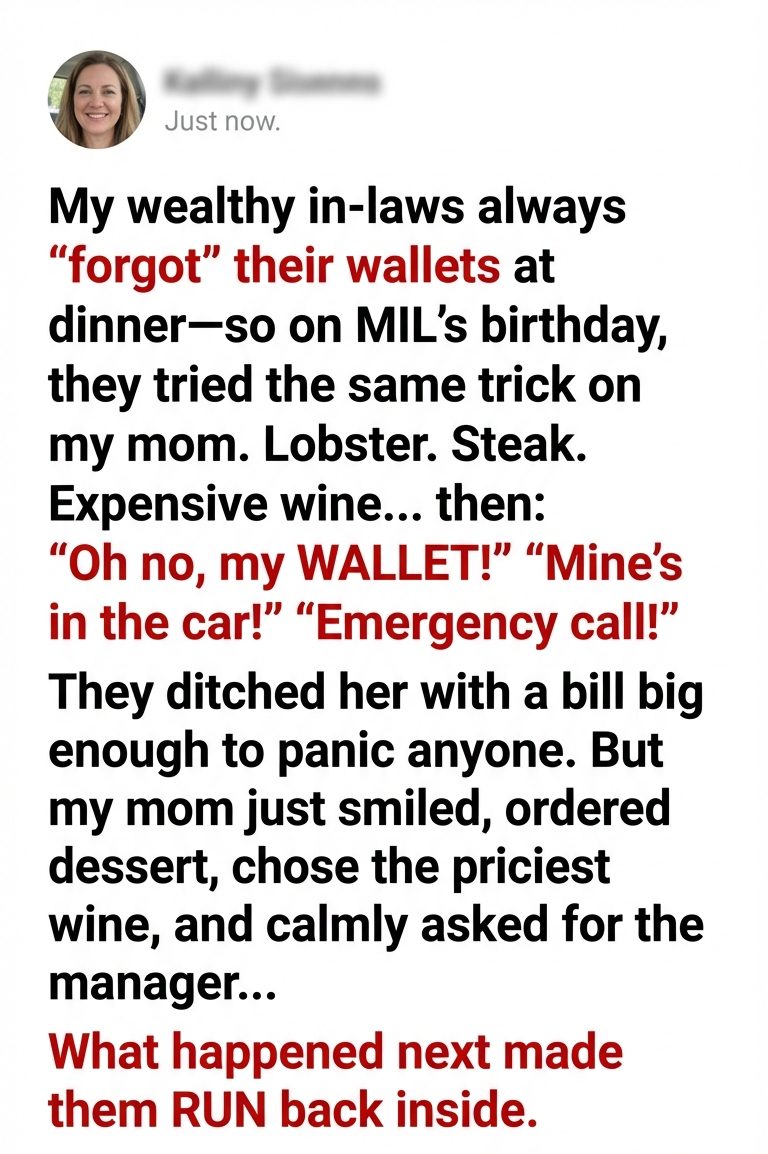
The manager walked away, and my mother did exactly what the screenshot ended on: she ordered dessert and the most expensive wine.
Not because she was celebrating.
Because she was baiting them.
She chose a deep red bottle with a name I couldn’t pronounce, the kind of wine that comes with a ceremony. The server returned with it, and my mother let him pour it slowly, as if time itself belonged to her. Then she took one small bite of crème brûlée, cracked the sugar top with her spoon, and waited.
Meanwhile, my phone was asleep in my pocket, but the time difference meant I was probably mid-afternoon overseas. When I finally checked later, I would see a message from her sent during those minutes:
Don’t worry, sweetheart. I’ve got this.
And then:
Do you know their car plate number?
I didn’t respond fast enough. I was in a museum with my husband, laughing at something dumb and harmless, unaware my mother was quietly turning my in-laws’ favorite trick into a lesson they’d never forget.
Five minutes passed.
Ten.
The manager came back with a different face—the one people wear when they’ve switched from customer service to consequence.
“Ma’am,” he said, “they haven’t returned.”
My mother dabbed her lips. “Then I’d like my check separated.”
He nodded. “Yes, ma’am. We can do that. But the rest—”
“The rest is theirs,” my mother said. “And I believe you have their information.”
The manager glanced at the tablet again, then at her. “We do.”
“Then please,” my mother said, “do what you need to do.”
The manager’s jaw worked. “We’ll contact them first.”
“That’s fair,” my mother said, smiling warmly, like she was granting him a favor.
He stepped away and made a call. My mother watched the window, swirling the expensive wine she had no intention of paying for unless she had to. Outside, headlights moved across the lot. A couple walked in, holding hands. A waiter carried a tray. Life continued. My mother didn’t rush it.
Two minutes later, she heard it.
A phone ringing somewhere outside.
Then another.
Then the faint, rising pitch of outrage that always follows people who think consequences are for everyone else.
The doors swung open so hard they almost slapped the hostess stand.
My mother-in-law stormed in first, cheeks flushed, eyes sharp, her necklace catching the light like a weapon. My father-in-law followed, trying to look calm while his face betrayed him. My sister-in-law trailed behind, pretending she hadn’t been the one to announce an “emergency call” like it was an Olympic sport.
“There you are!” my MIL snapped, as if my mother had wandered off, not the other way around. “We were worried!”
My mother didn’t stand. She didn’t apologize. She simply lifted her eyes and looked at them the way a teacher looks at a student who has been caught cheating with the answers written on their palm.
“I’m right here,” she said gently. “You left so quickly.”
MIL’s expression flickered. “We didn’t leave. We just—there was—”
“An emergency call,” my mother said, and her tone was so polite it almost sounded sympathetic. “And a wallet crisis. And a car situation.”
My FIL cleared his throat. “Look, Eleanor—”
“My name is Margaret,” my mother corrected, still smiling. “But go on.”
My SIL tried to laugh. “This is all a misunderstanding. We were coming right back. We just needed a minute.”
The manager appeared at the edge of the table like a shadow given permission to speak.
“Good evening,” he said, voice professional, eyes not smiling. “I’m glad you returned.”
My MIL’s head snapped toward him. “Yes, of course we returned. We’re loyal customers. We always—”
The manager held up the bill folder. “The check is still open. And we did attempt to contact you because your party left the premises without settling payment.”
My MIL’s mouth opened, then closed. “We didn’t leave the premises,” she said quickly. “We were… in the car.”
“In the car,” the manager repeated, as if tasting the excuse for quality. “For seventeen minutes.”
My mother’s eyebrows lifted slightly. “Seventeen? Oh dear. I thought it was ten.”
My FIL stepped forward, lowering his voice like this was a private conversation. “Margaret, why would you do this? We invited you.”
“You invited me,” my mother corrected. “Because your son and I were not here. And you assumed I would be… what? Too embarrassed to speak up?”
My MIL snapped, “We were going to pay. We always pay.”
My mother’s smile didn’t waver. “Then you’ll have no trouble paying now.”
My SIL crossed her arms. “This is so dramatic. It’s just a check.”
My mother finally looked directly at her. “It’s not just a check,” she said quietly. “It’s a habit.”
There was a pause in the air, the kind that makes a whole restaurant feel like it’s listening. My mother reached into her purse and pulled out a small envelope.
My MIL’s eyes narrowed. “What is that?”
“A birthday gift,” my mother said.
My MIL blinked, thrown off. “Well… finally.”
My mother slid the envelope across the table.
My MIL snatched it, opening it with fast fingers.
Inside was a card. Elegant. Plain. The kind of card you’d expect from someone who respects occasions.
My MIL read it.
Her face changed.
“What is this?” she hissed, voice low.
My mother’s tone stayed calm. “Read it out loud,” she said pleasantly. “Since you like an audience.”
My MIL’s hand trembled slightly. She didn’t want to read it. Because the card didn’t contain a sweet message.
It contained a copy of the restaurant’s policy about unpaid bills and the consequences of leaving without paying—printed neatly, like a quiet warning. And beneath it, in my mother’s handwriting, one line:
If you can afford lobster, you can afford honesty.
My MIL’s eyes lifted, furious. “How dare you—”
My mother nodded toward the manager. “He was kind enough to explain how this works.”
My FIL tried another approach—charm. “Margaret, come on. We’re family.”
My mother’s smile softened, but her voice sharpened just enough. “Family doesn’t set traps for each other.”
My SIL rolled her eyes. “Nobody set a trap. We just—”
“You all left,” my mother said, and for the first time her voice rose—not into a shout, but into a clear, undeniable truth. “You ordered the most expensive items on the menu. You joked. You clinked glasses. And then you performed your little routine as if it were cute.”
My MIL’s cheeks went red. “We were going to pay!”
My mother leaned back. “Then why didn’t you?”
Silence.
That’s the thing about asking a simple question. It leaves no room for decoration.
The manager cleared his throat. “Would you like to settle the bill now?”
My FIL reached into his pocket slowly. My MIL glared at him, like his wallet had betrayed her.
He pulled out a card.
My mother watched it, then looked at the manager. “Before you run it,” she said, “could you please do me one more favor?”
The manager paused. “Yes, ma’am?”
“Separate it,” my mother said. “Itemize by seat.”
My MIL snapped, “That’s ridiculous!”
My mother’s voice stayed sweet. “Is it? You all chose your meals. You all chose your wine. Why should one person carry what everyone else consumed?”
My SIL opened her mouth, ready to argue, but the manager was already nodding, because this made his job easier and their shame heavier.
“Of course,” he said. “We can do that.”
When the new checks arrived, the color drained from my in-laws’ faces one by one.
My MIL’s portion was the largest. She had ordered lobster, steak, and a second glass of the expensive wine “just to taste it.” My FIL had ordered a filet and added sides like he was building a mansion out of potatoes. My SIL had ordered the dessert sampler “for the table,” and somehow it had landed on her tab, exactly where it belonged.
Then there was my mother’s check: salmon and a modest glass of wine.
My MIL stared at her total like it was a personal attack. “This can’t be right.”
My mother leaned in with polite concern. “Did you forget your wallet again?”
My FIL’s jaw tightened. He swiped his card quickly, not meeting anyone’s eyes.
My SIL muttered something about “unbelievable” while tapping her phone to pay, the same phone that had been used for her “emergency call.”
My MIL tried to hold out. “I’m not paying this. This is humiliating.”
My mother nodded. “Then we can let the manager do what he said he would do when someone leaves without paying.”
My MIL froze. Because she understood what “dine and dash” meant when it wasn’t a joke she could giggle through.
With shaking hands, she paid.
And then, because my mother is my mother, she did the final thing that made it unforgettable.
She turned to the manager and said, “Thank you for your patience. I’m sorry you were put in that position.”
Then she reached into her purse again and handed him the envelope she’d prepared for him—not the one for my MIL. A separate one.
Inside was a generous tip. And a small note.
Thank you for protecting people who are too polite to protect themselves.
The manager’s expression softened, genuine this time. “Thank you, ma’am,” he said.
My MIL saw the tip and nearly choked. “You tipped him?”
My mother smiled. “Of course. He did his job.”
My SIL scoffed. “So you’re some kind of hero now?”
My mother looked at her with calm pity. “No,” she said. “I’m just a woman who refuses to be used.”
My FIL grabbed his coat. “We’re leaving.”
My mother nodded. “You do that.”
My MIL leaned closer, voice poisoned. “My son is going to hear about this.”
My mother’s smile warmed. “Please tell him. And while you’re at it, tell him I’ll be happy to explain why your ‘forgetful wallet’ routine ends today.”
They stormed out again, but this time they didn’t glide away like winners. They left like people who had been forced to see themselves in bright light.
Later that night—when my husband and I finally got back to our hotel and checked our phones—I saw my mother’s messages in order.
First: Do you know their car plate number?
Then: Never mind. The manager had their profile.
Then: I paid for my salmon. They paid for their pride.
And finally: Sleep well, sweetheart. Some lessons are expensive for a reason.
I called her immediately.
She answered on the second ring, voice light. “Hi, honey.”
“Mom,” I said, half laughing, half stunned. “What did you do?”
“I ate dessert,” she said, like that was the headline. “And I had a sip of very good wine. Not enough to pay for it, though.”
I covered my mouth, trying not to wake my husband. “You reported them?”
“I gave them a chance,” she corrected. “They chose embarrassment over honesty.”
I took a breath. “Are you okay?”
She paused, and her voice softened. “Yes. And more importantly… now they’ll think twice before they try it again. Not just with me. With anyone.”
The next day, my husband called his parents. I didn’t even need to listen to know how it went. I could hear his tone from across the room—quiet, controlled, the way it gets when he’s disappointed and done being gentle.
When he hung up, he looked at me and said, “They’re furious.”
I nodded. “Good.”
He sat beside me. “They said your mom ‘made a scene.’”
I laughed once, sharp and humorless. “No. She didn’t make a scene. She stopped one.”
He looked down, then back up. “They also said… they’ve been doing that for years. With friends. With coworkers. Even with their church group.”
My stomach turned. “And nobody called them on it.”
He shook his head. “Everyone just… paid. To keep the peace.”
I leaned back, staring at the ceiling. “So your mom’s birthday dinner wasn’t a one-time thing. It was a pattern.”
His face tightened. “Yeah.”
I turned to him. “Then my mom didn’t embarrass them. They embarrassed themselves.”
He reached for my hand. “I told them if they ever pull anything like that again—especially with you or your mom—we’re done.”
A week later, we returned home. My in-laws invited us to dinner as if nothing happened, but this time there was a new detail: my MIL announced loudly at the start of the meal, “We’re doing separate checks.”
She said it like she’d invented the concept.
My mother, sitting beside me, sipped her water and smiled into her glass.
And when the server came back with the checks, my MIL patted her purse dramatically and said, “Don’t worry. I have my wallet.”
My mother leaned over and whispered to me, sweet as sugar, “Look at that. Miracles do happen.”
Then she opened the dessert menu anyway—because some women don’t just survive disrespect.
They teach it never to come back.