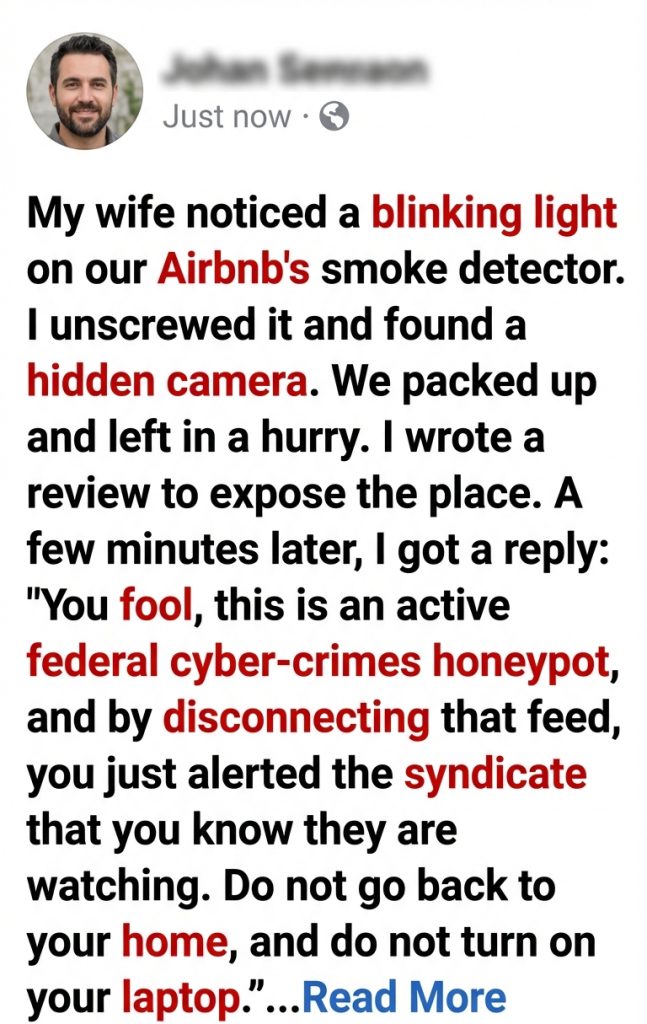
My wife noticed a blinking light on our Airbnb’s smoke detector. I unscrewed it and found a hidden camera. We packed up and left in a hurry. I wrote a review to expose the place. A few minutes later, I got a reply: “You fool, this is an active federal cyber-crimes honeypot, and by disconnecting that feed, you just alerted the syndicate that you know they are watching. Do not go back to your home, and do not turn on your laptop.”
The silence inside the car became absolute, heavy, and suffocating, broken only by the rhythmic, frantic thud of the windshield wipers pushing away the torrential rain. The harsh yellow glow of the streetlights flickered across the dashboard, illuminating the sheer, unadulterated panic etched into my wife’s face. Sarah gripped the steering wheel so tightly her knuckles were bone-white, her eyes darting between the slick, winding asphalt ahead and the rearview mirror. I just sat in the passenger seat, staring at the glowing screen of my phone, the host’s terrifying reply burning itself into my retinas. My thumb hovered over the screen, trembling uncontrollably. I had expected a frantic apology, a desperate lie, or maybe a string of defensive curses from a creepy property owner trying to save their rating. I had not expected to be thrust into the center of a criminal surveillance operation.
“What did they say?” Sarah’s voice was barely a whisper, frail and tight with a fear I had never heard from her before. She didn’t take her eyes off the road, but the car swerved slightly, the tires hissing against the wet pavement as she overcorrected.
“They… they said it’s a honeypot,” I stammered, reading the message again to make sure I wasn’t hallucinating the words. “They said it’s a cyber-crimes sting. And we just alerted whoever was watching us.”
Sarah slammed on the brakes. The car skidded slightly on the wet shoulder of the empty, tree-lined highway before shuddering to a violent halt. The sudden deceleration threw me forward against the seatbelt, knocking the breath out of my lungs. She turned to me, her eyes wide, the rain drumming a deafening rhythm against the roof of the sedan.
“What do you mean, whoever was watching us? It was the host’s camera! You left a review on their profile!”
“The reply didn’t come from a normal host,” I explained, my mind racing as a terrifying realization began to form in the back of my skull. “The profile picture is gone. The listing is already showing up as a dead link. Sarah, think about it. Think about the exact placement of that smoke detector.”
She blinked, her brow furrowing as she mentally retraced our steps through the sprawling, modern cabin we had just fled. “It was in the main living area. On the vaulted ceiling. Right above the large oak dining table.”
“Exactly,” I said, a cold, clammy sweat breaking out across the back of my neck. “It wasn’t in the bedroom. It wasn’t pointed at the bathroom door. They didn’t care about watching us sleep or shower. They cared about the dining table. They cared about the exact spot where I have been sitting for the last forty-eight hours.”
The realization hit me with the force of a freight train, knocking the wind out of me all over again. I hadn’t booked this secluded, high-end cabin just for a romantic weekend getaway. I had specifically sought out this remote property to escape the noise and distractions of the city. I needed absolute, uninterrupted isolation to finalize a massive, high-stakes professional project: the 2026 business plan for Hattha Bank. As a senior banking strategist, I was tasked with mapping out our comprehensive growth strategy for expanding Microfinance Institutions and Small to Medium Enterprise loans across Krong Siem Reap.
The encrypted files sitting on my laptop—which was currently zipped inside my leather satchel in the backseat—contained highly sensitive financial projections, unreleased client vulnerability assessments, regional economic forecasts, and proprietary lending algorithms. It was a literal roadmap to the region’s emerging economic infrastructure, worth an incomprehensible amount of money to the right corporate spy or cyber-syndicate. I thought I was just a stressed executive looking for a quiet weekend in the woods to hit a deadline. I didn’t realize I had willingly walked into a digital sniper’s crosshairs.
“My laptop,” I choked out, unbuckling my seatbelt with frantic, clumsy fingers. “Sarah, the Hattha Bank business plan. The Krong Siem Reap MFI data. I’ve been sitting under that camera for two days, typing in my admin credentials, accessing the bank’s secure intranet, reviewing the SME loan portfolios. The camera had a perfect bird’s-eye view of my screen and my keyboard.”
Sarah gasped, clapping a hand over her mouth. “They were logging your keystrokes visually. They were stealing the bank’s data.”
“And the feds—or whoever replied to this message—were letting them do it to trace the connection,” I finished, climbing over the center console and reaching frantically into the darkened backseat. I grabbed my leather satchel, hauling it into the front with me. My heart was hammering against my ribs like a trapped bird.
“Don’t turn it on!” Sarah shrieked as I reached for the zipper. “The message said not to turn it on!”
“I’m not going to,” I promised, my hands shaking as I pulled the cold, sleek aluminum machine from the bag. “But if they were visually monitoring me, they might have needed a physical bridge to bypass the bank’s two-factor authentication. Something on the local network. Or something physical.”
I flipped the laptop over in the dim light of the cabin. At first glance, everything looked perfectly normal. But then I ran my thumb along the side ports. There, plugged into the rearmost USB-C slot, was a tiny, matte-black dongle. It was no larger than a wireless mouse receiver, completely flush with the casing. I hadn’t put it there. I never use wireless accessories when working with secure banking data.
“They cloned my machine,” I whispered, holding the tiny device up so it caught the faint light from the dashboard. “Sometime while we were sleeping, someone came into the cabin and plugged a transmitter into my hardware. They didn’t just get my passwords. They got a direct tunnel into Hattha Bank’s internal network.”
The terrifying implications of what this meant for the Krong Siem Reap branches washed over me. If a syndicate had access to the MFI and SME loan databases, they could manipulate credit lines, authorize fraudulent transfers, and completely destabilize the local financial sector the bank had spent years building.
Suddenly, my phone vibrated violently in my hand, emitting a harsh, discordant alarm tone that I had never heard before. The caller ID was a string of zeroes. I stared at it for a second before answering, putting it on speakerphone.
“Hello?” I said, my voice cracking.
“Listen to me very carefully,” a deep, synthesized, metallic voice echoed through the car’s speakers. It didn’t sound human; it sounded like software masking a voice to strip away all identifiable cadence. “You compromised a thirty-month operation by unscrewing that device. The people who placed the keylogger on your machine now know they are blind. Which means they know their window to extract the remaining Hattha Bank data is closing. They will not let you walk away with the physical encryption keys on that laptop.”
“Who are you?” Sarah cried out, leaning toward the phone. “Are you the police?”
“Titles are irrelevant right now,” the voice replied coldly. “What is relevant is the dark gray SUV that just pulled off the highway and is currently idling a quarter-mile behind your position. Do you see it in your mirrors?”
I whipped my head around. Through the rain-streaked rear window, I could see two harsh, halogen headlights cutting through the darkness, sitting perfectly still on the shoulder of the road. They weren’t moving. They were watching us.
“Oh my god,” Sarah sobbed, her hands hovering over the gearshift.
“Do not drive home,” the voice commanded, perfectly calm. “Your residential address in the city is already compromised. Do you have the USB receiver?”
“Yes,” I said, clutching the tiny piece of plastic. “I just pulled it out of my laptop.”
“Roll down your window and throw it into the tree line. Now.”
I didn’t hesitate. I rolled down the passenger window, the freezing rain immediately whipping into my face, and hurled the tiny black dongle as hard as I could into the dense, dark woods beside the highway. I rolled the window back up, my chest heaving.
“Done,” I gasped into the phone.
“Good. Now, put the car in drive. When I say go, you are going to accelerate to eighty miles per hour. Three miles up this road is a bridge over the gorge. You are going to throw the laptop out the window and let it drop into the river.”
“I can’t do that!” I yelled. “This is a year’s worth of proprietary financial strategy! It’s the entire 2026 forecast for the region!”
“If they catch you, they will kill you to get that machine,” the voice stated, entirely devoid of emotion. “The data is already compromised. Your only priority right now is survival. Throw the machine in the river, take the next exit, and drive directly to the federal building downtown. Do not stop for red lights. Do not stop for anything. Go.”
The line went dead.
I looked at Sarah. She looked at me, her eyes filled with a terrifying, resolute clarity. She didn’t say a word. She just slammed the car into drive and floored the accelerator. The tires shrieked against the wet pavement as the sedan lurched forward, throwing us back into our seats.
I looked in the side mirror. The halogen headlights behind us instantly roared to life, accelerating rapidly to close the distance. They were chasing us.
“Faster, Sarah,” I urged, gripping the door handle as she took a sharp curve at sixty miles an hour, the car dangerously close to hydroplaning. The rain was coming down in sheets now, making visibility nearly impossible. The headlights behind us were aggressive, swerving back and forth, trying to blind us in the mirrors.
I grabbed my laptop, unzipping the leather case completely. I didn’t even bother trying to properly shut it down. The screen flickered to life, showing the login prompt with the Hattha Bank logo shining brightly in the dark cabin. It felt like holding a ticking time bomb.
“There’s the bridge!” Sarah shouted over the roar of the engine and the rain. Ahead of us, the concrete barriers of the gorge crossing loomed out of the darkness.
“Keep your foot down!” I yelled back. I rolled down my window again. The wind roared into the car, a deafening hurricane of noise and water. I held the heavy, expensive aluminum machine out the window, feeling the immense aerodynamic drag trying to rip it from my grip. I looked back one last time. The SUV was less than fifty feet from our bumper, accelerating hard.
As we crossed the center of the bridge, I let go.
The laptop vanished instantly into the black abyss below, plunging hundreds of feet into the raging river. I rolled the window up just as Sarah aggressively swerved into the exit lane, the tires screaming in protest. The SUV behind us didn’t follow. It slammed on its brakes on the bridge, the driver clearly realizing their prize was gone, effectively ending the pursuit.
We didn’t stop driving until we breached the city limits, pulling directly onto the heavily lit, secure plaza of the federal building just as the sun began to rise, casting a pale, gray light over the exhausted city. We sat in the car for a long time, the engine ticking as it cooled down, neither of us speaking.
I had survived the night, but as I looked out at the towering concrete pillars of the government building, a deep, unsettling paranoia settled into my bones. The physical laptop was gone, but the syndicate knew my name, they knew my bank, and they knew the 2026 plans for Krong Siem Reap. As the heavy glass doors of the federal building opened to let us in, I knew the nightmare wasn’t over. It was just moving from the woods, straight into the boardroom.