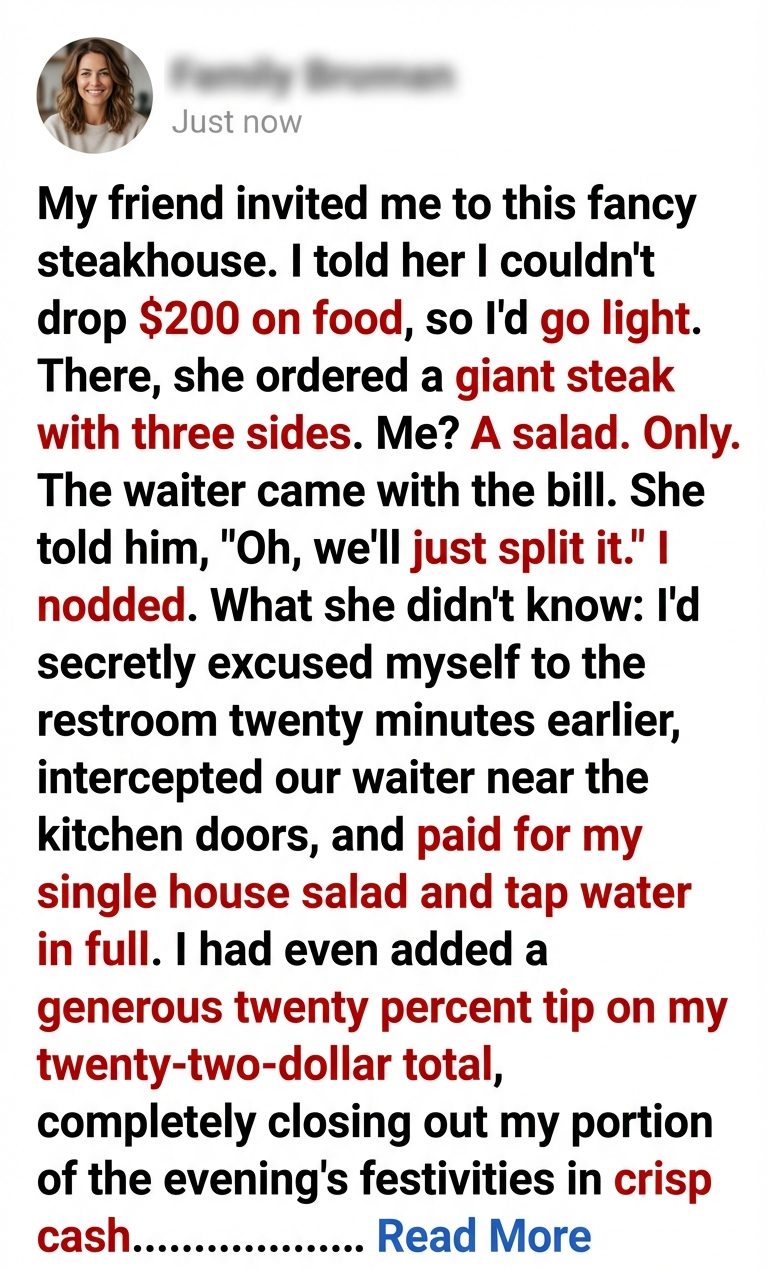
My friend invited me to this fancy steakhouse. I told her I couldn’t drop $200 on food, so I’d go light. There, she ordered a giant steak with three sides. Me? A salad. Only. The waiter came with the bill. She told him, “Oh, we’ll just split it.” I nodded. What she didn’t know: I’d secretly excused myself to the restroom twenty minutes earlier, intercepted our waiter near the kitchen doors, and paid for my single house salad and tap water in full. I had even added a generous twenty percent tip on my twenty-two-dollar total, completely closing out my portion of the evening’s festivities in crisp cash. The black, leather-bound checkbook currently resting on the pristine white tablecloth didn’t contain our combined total. It contained hers, and hers alone.
To fully appreciate the absolute poetry of this moment, we have to rewind. My friend—let’s call her Vanessa—has a well-documented, meticulously calculated history of financial amnesia when it comes to group dining. For years, I had watched her employ a specific kind of restaurant mathematics that somehow always heavily favored her own wallet. If a group of us went out for a casual Mexican dinner, she was invariably the one ordering three top-shelf margaritas, the premium tableside guacamole, and the steak fajitas, only to enthusiastically suggest we split the check evenly down the middle when the time came. For a long time, I went along with it. We all did. It was easier to absorb the extra twenty or thirty dollars than to be the one difficult person at the table pulling out a calculator, demanding itemized receipts, and completely killing the vibe of the evening.
But this dinner was entirely different. We were supposedly celebrating her recent corporate promotion, and she had chosen L’Entrecôte, a steakhouse so outrageously pretentious that they didn’t list the prices on the menu unless you specifically asked for the “reference copy,” and the waitstaff wore uniforms that cost more than my monthly rent. I had been completely honest and transparent with her from the moment she texted me the reservation details. I told her point-blank that my budget was incredibly tight this month, that I was aggressively saving for a necessary car repair, and that I would only be coming to keep her company and sticking to a cheap appetizer or a side salad. She had replied with a flurry of supportive emojis, assuring me it was completely fine, that she just wanted to celebrate with her best friend, and that there was absolutely no pressure on me whatsoever.
Yet, the moment we sat down in that dimly lit, mahogany-paneled dining room, the pressure was immediate and palpable. The air smelled rich, heavy with the scent of expensive cologne, dry-aged beef, and brown butter. Our waiter, a polished young man named Julian who spoke with the gentle cadence of a seasoned hospitality professional, handed us our menus. Vanessa immediately launched into a theatrical monologue about how much she deserved to treat herself after months of grueling overtime. I agreed enthusiastically. She really did deserve to treat herself. I just didn’t realize I was expected to act as the primary investor in her culinary treatment.
When Julian returned to take our order, I went first, wanting to establish my boundaries early. “I will just have the autumn harvest house salad, please. And tap water with a lemon wedge.”
Julian didn’t blink. He simply nodded gracefully. “An excellent choice, miss. And for you, madam?”
Vanessa closed her menu with a dramatic, heavy snap. “I am absolutely famished today. I think I will start with the jumbo lump crab cake appetizer. Then, I’ll do the thirty-two-ounce bone-in tomahawk ribeye, cooked medium rare. And for the table, let’s get the truffle macaroni and cheese, the creamed spinach, and the pan-seared wild mushrooms.” She glanced over at me with a bright, entirely innocent smile. “We can share all the sides. They’re family style anyway.”
“I’m actually okay,” I replied softly, keeping my tone light but firm. “Just the salad for me, thanks. I had a late lunch.”
The meal itself was a masterclass in awkward endurance and subtle psychological warfare. While I quietly chewed on mixed greens and a rather stingy portion of candied walnuts, Vanessa went to absolute war with a piece of meat the size of a hubcap. She moaned in theatrical appreciation over the truffle mac and cheese, deliberately pushing the heavy ceramic dish toward the center of the table so it sat directly between us. “You really have to try this,” she insisted, waving a silver fork dripping with melted gruyere cheese in my direction. “It is entirely to die for. Come on, live a little. One bite won’t kill your diet.”
“I’m full, honestly,” I lied, my stomach giving a quiet, hollow rumble of protest beneath the table. I watched her summon Julian to order a glass of vintage cabernet to pair with the steak, followed by a second, equally expensive glass when the steak was only half finished. Through it all, I maintained a perfectly polite smile, asking her questions about her new corner office, her new managerial title, and the upcoming projects she was leading. I played the role of the supportive, attentive friend flawlessly, all while a quiet, burning resolution solidified in my chest. I knew exactly how this movie ended. I had seen the ending too many times before. She was racking up a bill that rivaled a car payment, and she was going to spring the trap the moment the dessert plates were cleared.
So, when Vanessa happily announced she needed to “save room” for the restaurant’s famous molten chocolate lava cake, I recognized my narrow window of opportunity. I smiled, placed my linen napkin neatly on my chair, and told her I was going to run to the restroom before dessert arrived.
Instead of heading down the hallway to the elegantly tiled bathrooms, I took a sharp left toward the bustling wait station near the kitchen. I found Julian tapping rapidly at a point-of-sale terminal. I approached him, making sure to keep my voice low so it wouldn’t carry over the soft jazz playing in the background. “Excuse me, Julian? I need a massive favor.”
He looked up, instantly attentive and professional. “Of course, miss. Is everything alright with your meal?”
“The meal is lovely,” I assured him. “But I need to pay for my salad right now, completely separately. And I need you to put the rest of the entire meal—the crab cake, the massive steak, all three sides, the two glasses of wine, and whatever dessert she is currently ordering—on a single check for my friend. When you drop the final bill at the table, just let her do the talking, but that check inside the leather booklet needs to only reflect her items.”
Julian, bless his heart, was clearly a veteran of the fine dining industry. He had undoubtedly seen every possible iteration of bad first dates, awkward family dynamics, and cheap friends trying to pull a fast one. A knowing glimmer sparked in his dark eyes, and a very subtle, almost imperceptible smirk tugged at the corner of his mouth. He understood the assignment perfectly. “Consider it done,” he whispered, turning back to his screen and tapping a few buttons to split the electronic ticket. “Your autumn harvest salad and the tap water comes to twenty-two dollars exactly after tax.”
I pulled a crisp fifty-dollar bill from my wallet and handed it to him. “Keep the change. Seriously. You are about to earn every penny of it.”
“Thank you very much, miss,” he said, swiftly slipping the cash into his dark apron. “I’ll bring the final bill for the remaining items shortly after the dessert is finished and cleared.”
I returned to the table feeling physically lighter. I sat through the grand finale of Vanessa’s culinary marathon—the arrival of a decadent, powdered-sugar-dusted lava cake, which she ate while simultaneously complaining about how incredibly stuffed she was. And then, the moment of truth finally arrived. Julian glided over to our table, his face an impenetrable mask of utter professionalism, and placed the black leather booklet gently in the exact center of the table.
“No rush at all this evening, ladies,” he murmured politely before stepping away into the shadows of the dining room.
Vanessa didn’t even bother to open the booklet. She just placed her manicured hand flat over the leather cover, looked at me with that highly familiar, practiced expression of casual, breezy generosity, and delivered her signature line with flawless execution. “Oh, we’ll just split it.”
I nodded. I didn’t say a single word. I didn’t flinch. I just reached for my glass of tap water and took a very slow, deliberate sip, waiting for the inevitable.
Vanessa smiled, clearly pleased with my immediate and quiet compliance. She finally flipped open the booklet, reaching into her purse with her other hand to pull out her credit card. I watched her eyes drop to the bottom line of the receipt. I watched her gaze physically halt, freeze completely, and then scramble frantically back up the itemized list in disbelief.
The color drained from her face so rapidly I genuinely thought she might faint right there in the booth. The total staring back at her was somewhere in the neighborhood of two hundred and eighty dollars.
“Wait,” she stammered, her voice suddenly an octave higher than it had been a moment ago. She physically flipped the heavy paper over as if the real, lower total was somehow hiding on the back. “This… this is the whole thing. He didn’t split it.”
“Oh,” I said, setting my water glass down with a soft clink. “No, he didn’t. That’s just your half of the table.”
Vanessa blinked at me, her brain clearly short-circuiting as she tried to process the information. “What do you mean my half? This is the total for everything I ordered. The steak, the wine, the cake…”
“Right,” I agreed amiably, offering her a calm smile. “That’s your food.”
“But we’re splitting it!” she hissed, leaning across the table and glancing around nervously to make sure the neighboring diners weren’t listening to her sudden panic.
“Why would we split it, Vanessa?” I asked, keeping my voice incredibly calm, steady, and even. The contrast between my utter tranquility and her rapidly rising hysteria was stark. “I had a salad. It was twenty-two dollars. I already paid for it.”
“You… you already paid?” The sense of betrayal in her voice was highly theatrical, as if I had just looked her in the eye and confessed to a heinous, unforgivable crime. “When on earth did you do that?”
“When I went to the bathroom,” I replied simply, resting my hands in my lap. “I told you clearly before we even got here tonight that I couldn’t afford a big dinner. I stuck to my budget. That bill right there? That is your budget.”
“But we always split the check!” she argued, her fingers trembling slightly as she gestured aggressively at the leather booklet. “It’s just what friends do! It all evens out in the end!”
“It actually doesn’t,” I pointed out, leaning forward slightly to match her proximity. “It hasn’t evened out in four years, Vanessa. You consistently order feast after feast, premium cocktails, and extra appetizers, and I always end up subsidizing your expensive tastes. Tonight, you ordered a crab cake, a massive steak, three sides, two glasses of wine, and a dessert. I had a bowl of lettuce. Paying half of your two-hundred-and-eighty-dollar celebratory dinner isn’t ‘what friends do.’ It’s what a sugar daddy does. And I am fresh out of sugar.”
She stared at me, her mouth opening and closing soundlessly. She was completely out of her depth. The unwritten social contract she had relied on for years—the one where social politeness forced people into quiet, resentful submission—had just been abruptly ripped up right in front of her face.
“You’re embarrassing me,” she whispered fiercely, her eyes darting nervously toward Julian, who was currently polishing wine glasses at a nearby station, deeply engrossed in his work but undoubtedly aware of the localized drama unfolding.
“I haven’t raised my voice once,” I countered softly. “You’re the only one embarrassing yourself right now. You ordered the food, Vanessa. You ate the food. Now you have to pay for it. That’s how restaurants work.”
“I can’t put this all on my card,” she finally admitted, the defensive anger draining away, leaving behind only a pathetic, desperate vulnerability. “I… I just moved a bunch of money around for the deposit on my new apartment. My primary credit card is almost maxed out.”
And there it was. The ugly truth laid bare beneath the bravado. She had brought me here, under the guise of celebrating her success, fully intending to use my bank account as a financial cushion for her own irresponsibility. The realization instantly extinguished any lingering guilt I might have felt about leaving her with the bill.
“I’m really sorry to hear that,” I said, maintaining my boundaries like a fortress. “But that is not my problem to solve.”
Julian chose that precise, agonizing moment to reappear seamlessly at our table. “Is everything sorted here, ladies?” he asked, his tone polite, neutral, and wonderfully oblivious.
Vanessa looked up at him, then down at the terrifying bill, and then over at me. She was desperately searching my face for a lifeline, a rescue, a sudden change of heart. I offered her nothing but a pleasant, unyielding expression. Finally, entirely defeated, she reached deep into her designer purse, pulled out a different metallic credit card, and dropped it onto the leather folder with a heavy sigh.
“Take it,” she muttered to Julian without looking at him.
“Right away, miss,” he said, whisking the folder away with smooth, practiced efficiency.
The silence that descended upon our table in his absence was absolute and suffocating. The background jazz music suddenly seemed overwhelmingly loud. The clinking of fine silverware from other diners echoed around us like tiny, mocking bells. Vanessa flatly refused to look at me. She picked up her completely empty wine glass, stared at the dark red residue at the bottom, and put it back down with a sharp clatter.
When Julian returned with the final printed receipt, she signed it with furious, aggressive strokes of the pen, tearing the customer copy away. She grabbed her purse and stood up from the booth, not waiting for me.
“I’ll call an Uber,” she clipped out, her voice tight with suppressed rage and humiliation.
“You do that,” I said, standing up at my own leisurely pace and smoothing out my dress. “Congratulations on the promotion again.”
She didn’t answer. She just turned on her heel and marched rapidly out of the restaurant, her expensive heels clicking sharply against the polished hardwood floor.
I took a deep breath, letting the evening’s tension finally leave my shoulders. I caught Julian’s eye on my way out the door. He gave me a very subtle, respectful nod of solidarity. I smiled back warmly.
Stepping out into the cool evening air, I felt a profound sense of relief wash over me. The friendship was almost certainly over, or at the very least, irreparably altered. But as I walked down the street toward the subway station, my wallet intact and my dignity entirely secure, I realized I genuinely didn’t care. I had finally stopped paying the premium price for her companionship. And truthfully? That twenty-two-dollar bowl of lettuce was the most satisfying meal I had eaten in months.