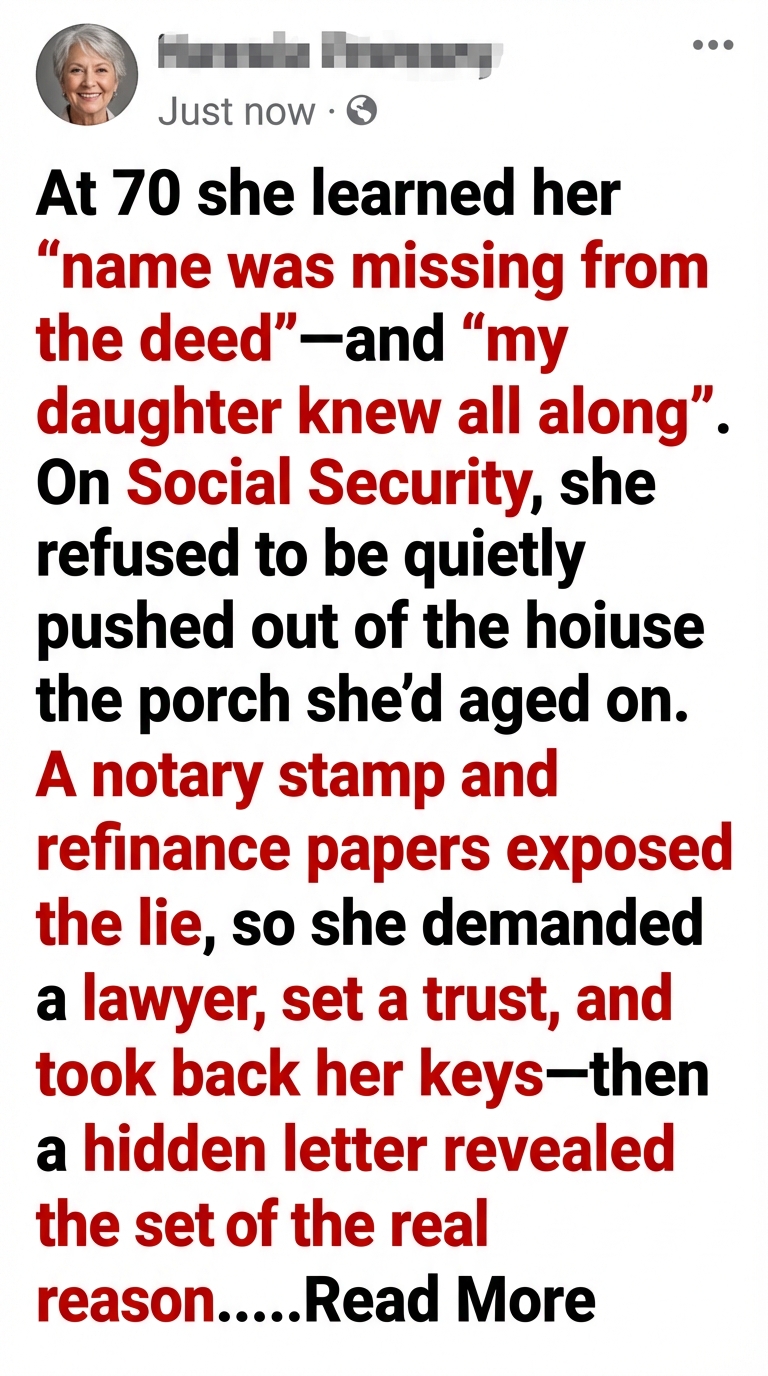
The clerk at the county recorder’s window didn’t look up when she said it. She just clicked her mouse, squinted at the screen, and slid the paper toward me like it was a receipt for something I didn’t want to buy. “Ma’am, your “name was missing from the deed”.”
I laughed once, small and embarrassed, because the alternative was to cry in a government office with fluorescent lights and a line of impatient strangers behind me. “That can’t be right,” I said. “I live there. I’ve lived there for decades.”
She finally met my eyes. “I’m sorry. The current deed lists one owner. Rachel Harlow.”
My daughter.
My hands went cold around the counter edge. “At “At 70”,” I whispered, like saying it out loud might make it sound less ridiculous, “how could my house belong to someone else?”
The clerk’s expression softened the way people’s faces do when they’re looking at an older woman whose world just tilted. “You can request copies of the recorded documents,” she said. “If there’s an error, you’ll need to consult an attorney.”
Attorney. Error. Consult.
Words that didn’t belong to my Tuesday morning errands.
Outside, the sky was the same pale blue it had been when I woke up. Cars moved, people walked, the world continued like nothing had happened. My phone buzzed in my purse, a cheerful vibration that made me flinch.
Rachel’s name glowed on the screen.
I didn’t answer.
I sat in my car for a long moment, hands on the steering wheel, trying to make sense of a sentence that didn’t fit inside my life: “name was missing from the deed”.
My house wasn’t fancy. It wasn’t one of those big homes with columns and gates. It was a simple ranch with a little porch and a magnolia tree out front that dropped blossoms like soft white handkerchiefs in spring. It was the house where my husband, Walt, had painted our daughter’s bedroom walls pink and then had to repaint them because she decided she hated pink. It was the house where I’d measured my son’s height against a doorframe until the pencil marks ran out of space. It was the house where I’d nursed my mother through her final months, where I’d held Walt’s hand when the cancer made him quieter than I’d ever seen him.
It was the house I’d paid for with overtime and careful grocery lists, with skipped vacations and patched shoes, with years of not buying anything new unless the old thing had fallen apart completely. It was the house that made my “Social Security” check feel like enough, because without rent, I could breathe.
And now—on paper—my daughter owned it alone.
Rachel had moved back in after her divorce, two years ago. She’d shown up with boxes and a smile that didn’t quite reach her eyes, looking tired in the particular way women look when they’ve been trying to hold everything together too long. I’d told her she could stay as long as she needed. I meant it. She was my child, even if she was grown.
The first few months were good. We fell into a rhythm. She cooked sometimes. I cooked sometimes. We watched old movies and laughed at scenes we’d both forgotten. She fixed things around the house that my hands weren’t strong enough to handle anymore. I liked having someone else in the rooms again. The silence after Walt died had been loud.
Then the mail started changing.
Thicker envelopes. More official-looking. Things addressed to Rachel that used to come in Walt’s name, or mine. Bank letters. Insurance letters. A refinancing flyer that made me squint because it had my address, but not my name.
One afternoon, I’d found a property tax notice on the kitchen table. Rachel’s name at the top. “That’s odd,” I’d said, tapping it. “Why is it in your name?”
Rachel had taken it quickly, too quickly, folding it like it was nothing. “They must have updated the mailing list,” she’d said. “Don’t worry, Mom. It’s just paperwork.”
I’d believed her. Why wouldn’t I? She was my daughter.
Still, a small pebble of unease had stayed in my stomach. Not because I suspected her, but because something about the way she’d grabbed that paper felt like hiding.
Then, last week, my homeowners insurance sent a renewal notice. It said “Policyholder: Rachel Harlow.” Beneath that, the word “Owner.”
I’d stared at it for a long time until my eyes blurred, then I’d called the insurance company. The woman on the line had been polite but firm. “We can only discuss the policy with the policyholder,” she’d said.
So I drove to the county office, thinking it was a mistake. Thinking it would be simple. Thinking I’d walk out with a corrected record and a laugh at my own worry.
Instead, I walked out with my knees weak and my chest tight, holding a copy request form like it was a diagnosis.
Back home, Rachel’s car was in the driveway. I sat in mine for another moment, watching the house like it might confess something if I stared hard enough. The magnolia tree moved gently in the breeze. The porch swing creaked once.
I went inside.
Rachel was in the kitchen, hair pulled back, phone pressed between shoulder and ear, talking too brightly.
“Yeah, I told her it’s fine,” she said into the phone. “She doesn’t need to know all the details. It’ll just stress her out.”
I froze in the doorway. My stomach turned.
Rachel turned and saw me. Her voice cut off mid-sentence. “I have to go,” she said quickly, hanging up.
Her smile appeared—familiar, practiced. “Hey, Mom! You went out early.”
I set my purse down slowly. “I went to the county recorder.”
Her smile held for half a second, then cracked.
“Why?” she asked, and her voice was too careful.
“Because the insurance has your name,” I said. “Because the property taxes have your name. Because I needed to know why.”
Rachel’s eyes flicked away. “I told you, it’s paperwork.”
“No,” I said, and surprised myself with how steady I sounded. “It’s more than paperwork. They told me my “name was missing from the deed”.”
Rachel’s face went pale so fast it looked like the color drained straight out of her.
“Mom,” she whispered, “it’s not—”
“Don’t,” I said softly. “Don’t tell me it’s nothing.”
Her lips trembled. “It was for your own good.”
That sentence made my hands shake. Not because it was cruel—because it was what people say right before they take something from you and call it love.
“For my good?” I echoed. “Rachel, what did you do?”
She swallowed hard. “I didn’t do anything to hurt you.”
“Then why didn’t you tell me?” I asked.
Rachel’s eyes shone, but not with guilt yet. With fear. “Because you wouldn’t have agreed.”
There it was. The first escalation. The first truth.
My voice got smaller, not weaker—more careful. “Agreed to what?”
She opened her mouth, then closed it. She looked down at the counter where my old recipe box sat, the one with Walt’s handwriting on some of the cards. She looked like she was trying to find the version of herself who still believed she could fix things without breaking anyone.
“Mom,” she said, “can we sit?”
We sat at the kitchen table, the same table where my kids had done homework, where Walt had read the Sunday paper, where I’d sorted pills into weekly boxes after his diagnosis. The table felt like it was holding its breath with us.
Rachel’s hands twisted together. “After the divorce,” she began, “I was drowning. And I didn’t want to bring that into your house.”
“It’s my house,” I said automatically, then felt the word catch in my throat. Was it?
Rachel flinched. “I know. I know it is. I just… I found out something.”
My heart hammered. “What?”
She hesitated. “Dad… Dad had a lien.”
The air left my lungs. “Walt? No. Walt paid everything.”
Rachel’s eyes filled. “He paid a lot. But at the end—when the treatments got expensive—he took out a second loan. He never told you. He didn’t want you to worry. He thought he’d have time to handle it.”
My chest tightened so hard it hurt. Walt. Secret. Debt. Those words didn’t belong together in my mind. Walt had been steady. Walt had been careful. Walt had been the man who balanced the checkbook twice because he didn’t trust himself to do it once.
“And then,” Rachel continued, voice breaking, “the loan got sold. And they started sending letters. And because the deed was still in Dad’s name and yours, it was messy. They threatened foreclosure if it wasn’t resolved.”
My ears rang. “Foreclosure?” The word sounded like a language from someone else’s life.
“I tried to handle it quietly,” she said quickly. “I thought if I could refinance, consolidate it, pay it off—then you’d never have to know. You’d stay safe. You’d stay in the house.”
I stared at her, mind spinning between grief and shock and anger so clean it almost felt cold.
“You refinanced my house without telling me?” I whispered.
Rachel wiped her cheek with the back of her hand. “I couldn’t refinance with your credit and your fixed income. Not easily. But with me on the deed—just me—they could approve it fast. I could pay it down. I could protect you.”
My hands trembled. “So you removed me.”
Rachel’s voice cracked. “I didn’t think of it like that. I thought of it like… temporary.”
Temporary. Like my safety was a tool. Like my ownership could be put on a shelf and picked back up later if it didn’t break.
I felt the second escalation hit: the paper truth.
“How?” I asked. “How did my name come off the deed?”
Rachel’s eyes dropped to the table. “There was a quitclaim form. You signed it.”
My stomach turned. “I never signed anything like that.”
Rachel’s mouth opened, then she whispered, “You did. When you were in the hospital.”
The room narrowed. “When?”
“When you had the fall,” she said, voice shaking. “When you hit your head and you were on pain meds. The notary came. I… I put the papers in front of you. You asked if it was insurance. I said yes. You signed.”
I felt like the floor dropped a few inches beneath my chair.
My fall. The dizzy day. The emergency room. The concussion. The fog where time didn’t line up right.
I remembered Rachel holding my hand. I remembered trusting her with my whole body because I couldn’t keep my eyes open. I remembered signing something, scribbling my name because she said it was important.
I had no memory of what.
My voice came out thin. “You told me it was insurance.”
Rachel started sobbing. “I’m sorry. I’m so sorry. I told myself I’d fix it before you noticed. I told myself you’d never have to carry Dad’s secret debt. I told myself it was love.”
I sat there, staring at my daughter, and felt something break in a slow, painful way.
Not just trust.
Time.
All the years I’d been a mother, thinking I was the one protecting her, and now realizing she’d been making decisions about my life like I was too old to have a say.
The third escalation came two days later, in the mail.
An envelope addressed to Rachel, but my address.
I didn’t open it. I didn’t want to be that person—snooping, invading. But my hands shook as I carried it into the kitchen and set it on the table.
Rachel saw it and went still.
“What is it?” I asked.
Rachel’s throat moved as she swallowed. “It’s probably nothing.”
“It’s never nothing,” I said.
She opened it with shaking fingers.
Inside was a notice about a scheduled appraisal.
A sale prep.
My heart slammed against my ribs. “Sale?”
Rachel’s eyes darted. “No. It’s… it’s for the loan. They have to appraise.”
But I saw the second page. The one that said “relisting.” The one that said “market analysis.” The one with a realtor’s name and a date.
Rachel’s face crumpled. “Mom, please—”
“Are you planning to sell my house?” I asked, and my voice cracked like it was made of glass.
Rachel’s tears spilled again. “I didn’t want to. But the payments—Mom, the payments are too high. I thought if we sold, you could move somewhere smaller. Somewhere easier. A senior community. You’d be safe.”
Safe. The word again, used like a leash.
I stood so fast my chair scraped loudly. “You don’t get to decide where I live.”
Rachel sobbed. “I was trying to save you!”
“No,” I said, shaking. “You were trying to fix something you hid from me by hiding something else. You were trying to save yourself from telling me the truth.”
Rachel flinched like I’d hit her.
Maybe I had.
With a truth she needed.
That night, I didn’t sleep. I sat in my bedroom, staring at the ceiling, listening to my house creak in the familiar way it always did, and wondered if I was about to lose the one stable thing I had left.
The lowest point came the next morning when I did the math.
“Social Security” wasn’t enough for rent anywhere decent. Not with prices the way they were. Not with my medication costs and the co-pays that still appeared like surprise attacks. Not with my pride.
If this house went, I didn’t just lose a building.
I lost independence.
I lost the ability to say, This is mine.
I looked at the family photos on my dresser—Walt holding Rachel as a baby, Walt smiling with cake frosting on his nose, Walt on the porch swing with his arm around me—and I felt grief rush up in a hot wave.
Walt’s secret debt. Rachel’s secret deed. My name missing. My life rearranged without permission.
I wiped my face and did something I’d avoided my whole life.
I asked for help outside the family.
I called an elder law attorney.
When I told her what happened, her voice stayed calm, but her words were sharp. “You may have a case for undue influence,” she said. “Possibly fraud if you were misled about what you signed. But even if you don’t want to sue your daughter, we can still protect you.”
Protect. A different kind of protect. One that didn’t require my silence.
She asked for documents. The deed. The quitclaim. The loan paperwork. The timeline.
Rachel tried to protest when I told her. “Mom, please. Don’t do this.”
“I’m doing it,” I said quietly. “Because you did something huge without me. And now I’m stepping back into my own life.”
We gathered everything. Rachel cried while she printed. I cried while I read.
The attorney explained options: placing the home in a “trust”, creating a life estate, rewriting the deed to ensure I had the legal right to live there no matter what happened. She explained consequences too—how loans and titles can become traps, how love can be used as leverage when money gets tight.
Rachel sat in my living room during that meeting looking like a child again, eyes wide, terrified.
When the attorney asked, “Did your mother understand what she was signing?” Rachel broke down.
“I told her it was insurance,” she admitted out loud, as if saying it to a stranger made it real in a new way.
The attorney’s face went still. “That is a serious admission,” she said gently.
Rachel sobbed. “I didn’t mean to steal. I meant to save.”
I stared at my daughter and felt two truths exist at once: she loved me, and she hurt me.
The climactic confrontation happened that weekend, not in court, but in my living room with the autumn light slanting through the blinds.
I asked Rachel to sit with me. No phones. No distractions. Just us, like when she was a teenager and I needed her to tell me the truth about where she’d been.
Rachel’s hands shook. “Are you going to call the police?”
“No,” I said. “Not today. But listen carefully.”
She looked up, eyes wet.
“You don’t get to ‘protect’ me by taking my choices,” I said, and my voice held steady. “You don’t get to rewrite my life because you think you know better. You don’t get to decide I’m too old to be informed. If you wanted to help, you should have told me the truth.”
Rachel swallowed hard. “I was scared.”
“I know,” I said. “But fear doesn’t give you permission.”
Rachel nodded, shoulders curling inward. “I’m sorry,” she whispered.
I held her gaze. “Say it again. Not for me. For you.”
She inhaled shakily. ““I’m sorry”,” she said louder, voice breaking. “I’m sorry I lied. I’m sorry I used your trust like a tool. I’m sorry I treated you like you were fragile instead of capable.”
Tears slid down my face, slow and hot. “Thank you,” I whispered. “Now we fix it properly.”
With the attorney’s help, we did. We restructured the deed to protect my right to live there. We established a “trust” that put the house in a safer legal container, shielding it from impulsive decisions and future pressures. We negotiated with the lender, adjusted payments, and mapped out a plan that didn’t involve tossing a seventy-year-old woman into the rental market like a piece of unwanted furniture.
The resolution wasn’t a miracle. We still had debt to pay. We still had hard conversations. Rachel had to accept that she couldn’t control outcomes by controlling me.
But something important changed.
I stopped feeling like a passenger in my own life.
Rachel stopped acting like the only adult in the room.
One evening, after the paperwork was signed and the attorney had left, Rachel stood in the doorway to my bedroom holding a small metal box.
“Mom,” she said quietly, “there’s one more thing.”
My stomach tightened. “What now?”
She held the box out. “Dad told me to give you this if… if things ever got complicated.”
My fingers trembled as I took it. “From Walt?”
Rachel nodded, eyes shining. “He asked me to keep it safe.”
The box was heavier than it looked. I opened it slowly.
Inside was a letter in Walt’s handwriting. The sight of it hit me like a wave—his slanted letters, his familiar loops, the way he always crossed his t’s too far to the right.
I unfolded it carefully, like it might crumble.
The first line made my breath catch.
Margaret, if you’re reading this, something went sideways.
My vision blurred. I kept reading.
He wrote about the loan. About the shame. About wanting to handle it alone. About loving me too much to scare me. And then, in the middle of the letter, the final punch-line twist sat like a spark in dry grass:
Rachel, if you ever have to put the house in your name to keep your mother safe, do it. But make sure she never loses her home. Never let her be pushed out. Promise me.
My throat closed. I pressed the letter to my chest and let out a sound that was half sob, half laugh.
Rachel had known.
Yes.
But she hadn’t been plotting to betray me for profit. She’d been following my husband’s last request—clumsily, fearfully, wrong in method but real in intent.
And Walt—my steady, careful Walt—had been the one who set this secret in motion, thinking he was protecting me.
I looked up at my daughter through tears. “You should have told me.”
Rachel nodded, crying too. “I know. I thought if I carried it alone, you’d stay happy.”
I wiped my face. “Happiness isn’t the same as peace.”
Rachel stepped closer, voice trembling. “Do you hate me?”
I stared at the letter again, then at my daughter. Love and anger and grief twisted together inside me, and I realized something surprising and steady:
Redemption doesn’t erase harm.
It acknowledges it, repairs it, and changes what comes next.
“I don’t hate you,” I said finally. “But you don’t get to do this again.”
Rachel nodded hard. “Never again.”
I folded Walt’s letter carefully and placed it back in the box. Then I took Rachel’s hand—still my child, still capable of hurting me, still capable of making it right.
Outside, the magnolia tree dropped a blossom onto the porch like a quiet blessing. Inside, my house creaked the way it always did, familiar and stubborn.
And this time, I heard it as a promise.