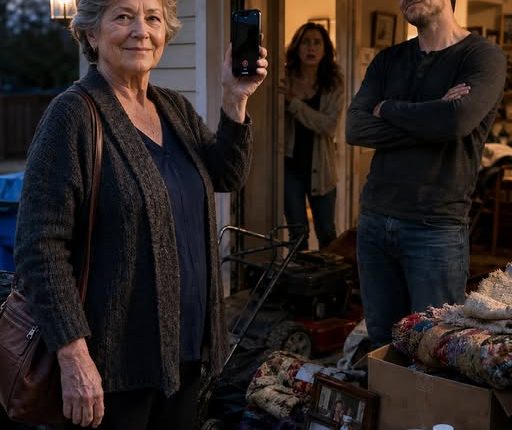
The bank’s number showed up on my phone like a warning light, bright against the quiet of my kitchen. I almost let it go to voicemail—because in retirement, most calls are either scams or reminders you’ve already heard twice. But something in me answered.
“Mrs. Harlow?” a calm voice asked. “This is First Valley Credit Union. I’m calling about a loan application where you’ve been listed as a co-signer. Are you… alone right now?”
The question tightened my grip on the phone.
“Yes,” I said. “Why?”
“Because we need to confirm you understand what “co-sign” means,” she said gently, “and we’re required to speak to you privately. Your son is not on this call.”
My heart did a slow, uncomfortable thump. My son, Evan, had asked me last night in my living room with hopeful eyes and that careful voice he used when he needed something big.
Mom, I just need you on this one.
He’d said it so softly it sounded like trust.
The woman continued, “Before we go further, I want to ask plainly: has anyone pressured you to do this?”
I stared at the turkey defrosting in my sink—because it was that time of year again, when families asked for more than they gave—and felt a strange chill.
“No,” I answered, but my voice didn’t sound sure.
“Thank you,” she said. “Now, do you understand that if the borrower misses payments, the lender can seek repayment from you? This loan could affect your credit, and it could affect your income and assets.”
My mind flashed to one word like a billboard on a highway.
“retirement”.
That nest egg I’d built slowly—through double shifts, careful grocery lists, saying no to vacations and yes to overtime. Through raising a kid alone after my husband passed, through taking every extra hour I could get without breaking my body. The money that meant I could replace my water heater when it died, could pay for medication when insurance played games, could sleep at night without fear.
“Mrs. Harlow?” the woman asked. “Are you still there?”
“I’m here,” I said, but my throat felt thick. “My son told me it was “just one signature”.”
There was a small pause on the other end, not dramatic, just heavy. Like she’d heard that phrase before.
“I understand,” she said. “But it is not ‘just’ anything. It’s a legal obligation. I’m going to review the terms with you, and then I’m going to ask you to confirm, in your own words, what you’re agreeing to.”
My stomach tightened. “Why did you call me first?”
“We call potential co-signers directly, separately, and privately,” she said. “It protects you. It also protects the borrower. Sometimes family means well. Sometimes family doesn’t.”
I sat down slowly at my kitchen table.
And in that moment, I realized something I didn’t want to admit even to myself:
My son had never had the bank call me like this before.
Evan wasn’t a bad kid. He was forty now, not a child—old enough to have a little gray in his beard, old enough to say “I’m fine” in a way that meant he wasn’t. He worked hard, but hard work didn’t always beat bad timing. The last few years had been rough. A layoff. A move. A rent increase that felt like a punishment. A car that always needed one more repair.
He called me often, and I loved that. But sometimes I could hear a strain behind his jokes. Sometimes his words moved too fast, like he was trying to outrun a thought.
Last night he’d sat on my couch, hands clasped, eyes bright with urgency.
“It’s an approval window,” he’d said. “If I miss it, they’ll raise the rate. I need the car for work, Mom. It’s not a big loan. It’s “just one signature”.”
I’d asked the questions I could think of. He’d answered quickly, too quickly.
And then he’d hugged me and whispered, “You’re the only one I can ask.”
That’s the line that always hooks a parent. Not because you’re weak. Because you remember every time your child ran to you for comfort, and your body still wants to be that safe place.
But the bank’s voice kept going, calm as a nurse.
“The loan amount requested is forty-eight thousand dollars,” she said.
My spine went straight. “Forty-eight?”
“Yes,” she said. “And the term is seventy-two months.”
My mouth went dry. “Evan told me it was… much smaller.”
“I can only speak to what’s in front of me,” she said. “There are also fees and optional add-ons included in the draft agreement. I can email you the full disclosure. Have you seen the documents?”
“No,” I admitted. “Not yet.”
“I recommend you do not agree to anything until you read them,” she said. “And Mrs. Harlow—one more question—did your son tell you he’d be present during this call?”
“He said the bank might reach out,” I said carefully.
“Understood,” she replied. “We’ll end here. I’m sending the disclosures now. Please call us back using the number on our website when you’re ready. That way you know you’re speaking to the actual lender.”
When I hung up, the kitchen felt too quiet. The only sound was the refrigerator humming and the water dripping from the faucet, steady as a clock.
I sat there staring at my hands.
Hands that had signed school permission slips, mortgage papers, medical forms. Hands that had held my husband’s when he was fading and held my son’s when he was small and scared.
Hands that could sign away my peace if I wasn’t careful.
I heard Evan’s voice in my head: just one signature.
Then I heard the bank’s voice: legal obligation.
My email pinged.
I opened the documents.
And the world narrowed to black print on white paper—cold, exact, impossible to argue with.
The payment amount. The due dates. The late fees. The clause that said the lender could pursue the co-signer after default. The line that made my stomach flip: “Co-signer acknowledges full responsibility…”
Full responsibility.
I scrolled and scrolled, feeling my chest tighten with each page.
Then I saw something that made my breath catch.
Purpose of loan: “Debt consolidation / personal.”
Not auto.
Not “purchase vehicle.”
Personal.
I stared at it like it might change if I blinked.
Evan had said car. He’d said work. He’d said necessity.
This said debt.
I picked up my phone and called him.
He answered on the second ring, too fast, like he’d been waiting.
“Hey, Mom,” he said brightly. “Did they call you?”
“Yes,” I said. “And they emailed me the documents.”
A pause that felt like a trap door opening.
“Okay,” he said. “Good. It’s all standard.”
“Evan,” I said slowly, “it says debt consolidation.”
Another pause. I heard a faint background noise—maybe a TV, maybe traffic.
“Yeah,” he said too casually. “It’s… it’s basically the same. It’s like… the way they categorize it.”
“It’s not the same,” I said. “And it’s not the amount you told me.”
“It’s because of the interest,” he rushed. “They roll stuff in. It looks worse on paper—”
“Evan,” I interrupted softly, “why did the bank call me first—“alone today”?”
He sighed. “Because they do that. It’s normal.”
“Then answer me clearly,” I said. “Is this loan for a car?”
Silence.
Not the kind where a phone drops. The kind where someone is choosing their words carefully.
Finally, he said, “It’s for… getting stable.”
My chest tightened. “What does that mean?”
“It means I’m behind,” he admitted, voice lower. “A couple cards. Some things. And if I don’t fix it, it’s going to get worse. The car is part of it, Mom. I can’t get to the job without it.”
I closed my eyes. Behind could mean anything. A late bill. A mountain.
“Why didn’t you tell me?” I asked.
“Because you worry,” he said. “Because I didn’t want you to look at me like I’m failing.”
I swallowed. “Evan. I’m not judging you. I’m trying to understand what you’re asking me to risk.”
His voice sharpened with desperation. “I’m asking you to help me.”
“I’m reading that helping you could cost me everything I have left,” I said quietly.
“It won’t,” he insisted. “I’ll pay it. I just need the approval.”
There it was again. The urgency. The pushing. The momentum.
A voice in my head—the older, wiser one—said: when someone needs you to move fast, ask why.
“Send me your full budget,” I said. “Income, expenses, debt totals. Everything.”
He exhaled hard. “Mom, come on.”
“No,” I said. “If you want me on the hook, I need the truth.”
Another tight pause.
“I’ll come over,” he said. “We’ll talk. Don’t make this bigger than it is.”
After we hung up, my hands shook. Not from anger. From fear. From love that felt like a rope pulling me toward a cliff edge.
I made tea I didn’t drink. I stared at the documents again. I thought about all the times I’d heard stories about parents losing homes because they tried to save their kids.
I promised myself I would not become one of those stories.
When Evan arrived, his smile came first. He held a pumpkin pie from the grocery store like it was a peace offering.
“Look,” he said, stepping in, “I brought dessert.”
I looked at him—my son, tall and tired, eyes a little too bright—and felt my heart split into two familiar pieces: compassion and caution.
“Sit,” I said.
He sat at my kitchen table where the documents lay printed out like a courtroom exhibit.
He glanced at the pages and gave a small laugh. “You printed everything.”
“I read better on paper,” I said. “Point to the part where you told me the truth.”
His smile faltered. “Mom.”
“Evan,” I said evenly, “why is the loan forty-eight thousand dollars?”
He rubbed his face. “Because the debt is more than I thought. Because I tried to juggle it. Because… things happened.”
“What things?” I asked.
He stared at the table. “Medical. When Jenna lost her job, we put groceries on cards. Then the rent jumped. Then the car died. It stacked.”
A flicker of relief ran through me—because that sounded like life, not lies.
But then he added, too quickly, “And some business stuff.”
I lifted my gaze. “Business stuff?”
He hesitated. “A friend. He had an opportunity. We put in a little money.”
“How much?” I asked.
His jaw tightened. “It was supposed to come back fast.”
That wasn’t an answer.
“How much?” I repeated.
He swallowed. “Ten.”
Ten could mean ten dollars or ten thousand. His face told me which.
“Ten thousand,” I said quietly.
He flinched. “It was supposed to double.”
My tea finally went cold in my hand.
“Evan,” I said, voice trembling despite my effort, “you’re asking me to gamble my “retirement” on a deal that already failed.”
“It didn’t fail,” he insisted. “It’s delayed.”
I leaned forward. “Who is this friend? What’s the business? Where is the contract?”
He stared at me, trapped.
“Mom—”
“Show me,” I said.
His eyes flashed with anger, quick and hurt. “Why are you interrogating me like I’m a criminal?”
“Because a bank just told me I could be responsible for forty-eight thousand dollars,” I said. “And because you called it “just one signature”.”
He pushed back from the table, chair scraping. “So you’re going to let me drown because you’re scared?”
That sentence landed hard.
Not because it was true.
Because it was the exact guilt a parent fears most.
I felt my throat close. I forced it open.
“I’m scared because I’m not twenty-five,” I said quietly. “I’m on a fixed income. I don’t have decades to recover if something goes wrong.”
Evan paced the kitchen like a caged animal. “I’m not asking for decades. I’m asking for help right now.”
“I’m trying to help,” I said. “But not by signing myself into danger.”
He spun toward me, eyes wet, voice breaking. “Then what? You just say no and go back to watching TV while I lose everything?”
The lowest point wasn’t his anger.
It was how quickly I wanted to give in.
How my hands almost reached for a pen just to stop his pain.
Because that’s what parents do: we would rather suffer ourselves than watch our children suffer.
But I saw the bank’s sentence in my mind again: full responsibility.
I saw the word: “retirement”.
I saw the truth in the documents. And I realized something that hurt in a clean, honest way:
If I co-signed, I wouldn’t be saving him.
I’d be teaching him that panic gets rewarded and consequences get outsourced.
I set my mug down carefully.
“Evan,” I said, “I love you. But the answer is “no”.”
He froze, like he’d been slapped.
“You can’t,” he whispered.
“I can,” I said. “And I have to.”
His face crumpled. “You’re choosing money over me.”
I felt tears sting my eyes. “I’m choosing stability over catastrophe. I’m choosing a kind of help that doesn’t ruin us both.”
He grabbed his jacket, shaking. “Forget it. I shouldn’t have asked.”
He walked out, slamming the door so hard a framed photo on the wall tilted crooked.
I sat there staring at that crooked frame, breathing shallowly, feeling the ache in my chest expand like a bruise.
Then I did the one thing I’d never done before.
I protected myself first.
I called the bank back using the official number, like the woman had instructed. I asked for the disclosures again. I asked about co-signer release. I asked why the loan was categorized as “debt consolidation.”
The bank representative’s voice stayed professional, but there was an edge of concern beneath it.
“Mrs. Harlow,” she said, “I’m glad you called. There’s something else you should know.”
My stomach dropped. “What?”
“There was an attempt to e-sign your co-signer acknowledgment from an IP address out of state,” she said. “We stopped it because we hadn’t completed the verbal confirmation with you.”
My mouth went dry. “Out of state?”
“Yes,” she said. “We flagged it as potential fraud. We’ve paused the application. We recommend you place a credit freeze and monitor your accounts.”
For a moment, my kitchen went blurry.
Because the twist wasn’t just that Evan had hidden debt.
The twist was that someone—maybe his “friend,” maybe a broker, maybe a desperate person in his orbit—had tried to move my name without me.
I thanked the bank and hung up with shaking hands.
Then I did it: I froze my credit, locked down my accounts, changed passwords, wrote everything down like I was building armor out of paper.
When I finished, I sat back and stared at the stack of documents again.
I wasn’t just saying no to a loan.
I was saying no to being used in the dark.
My phone buzzed near dusk.
Evan.
I almost didn’t answer. My heart couldn’t take another fight.
But I answered.
His voice sounded small. “Mom?”
“Yes,” I said.
A long pause. Then, quieter than I’d ever heard him, he said, “The bank called me.”
My chest tightened. “What did they say?”
“They said the application is paused,” he admitted. “They said someone tried to sign for you.”
Silence stretched between us, heavy and cold.
“I didn’t do that,” he said quickly, panic rising. “I swear I didn’t.”
“I believe you,” I said, and I meant it.
Because his fear sounded real.
“I think… I think my friend’s guy said he could ‘speed it up,’” Evan whispered. “He said it was just paperwork. I didn’t think—”
I closed my eyes. “Evan.”
“I messed up,” he said, voice cracking. “I’m so sorry.”
There it was—soft, raw, honest.
“I’m sorry”.
It didn’t erase the danger. It didn’t fix everything.
But it was the first real step out of the mess.
“Come over,” I said.
When he arrived, he looked different—less defensive, more frightened, like the reality finally caught him. He sat at the table and rubbed his hands together like he was cold.
“I thought I could fix it fast,” he admitted. “I thought if I just got ahead of it, no one would know how bad it got.”
I reached across the table and put my hand over his. “I don’t need you to be perfect,” I said. “I need you to be honest.”
He nodded, eyes wet. “I was embarrassed.”
“I know,” I said. “But embarrassment is cheaper than bankruptcy.”
He gave a small, broken laugh.
Then we did the work.
Not dramatic work. Real work.
We listed every debt. Every bill. Every payment. We called his creditors. We asked for hardship plans. We looked up a nonprofit credit counselor. We made a budget that didn’t rely on magic or miracles.
I offered help that didn’t put my life on the line: a limited monthly amount I could afford, paid directly to a specific bill, with full transparency. No blank checks. No rushed signatures. No secrets.
Evan didn’t like it at first. I could see it in his jaw—the pride, the frustration.
But then he exhaled like a man finally setting down a heavy lie.
“Okay,” he said. “Okay. I’ll do it.”
In the following weeks, he checked in. He showed me receipts. He stopped dodging questions. He went to counseling—financial and personal—because stress doesn’t live only in numbers.
And I kept my boundaries, even when my mother-heart wanted to melt.
One evening, after a long phone call with a creditor, Evan sat at my kitchen table again, looking exhausted.
“I used to think you saying no meant you didn’t believe in me,” he said quietly.
I stirred soup on the stove, the gentle sound grounding me.
“No,” I said. “Me saying no means I believe in you enough to let you grow up the hard way.”
He stared at his hands for a moment, then nodded. “That… that makes sense.”
He reached into his jacket and pulled out an envelope.
My stomach tightened automatically—because envelopes had started to mean danger lately.
But this one was plain, soft, handled carefully.
He slid it across the table to me.
“What is it?” I asked.
“Open it,” he said.
Inside was a single sheet of paper. Not a loan form. Not a contract.
A letter.
In his handwriting, messy and honest, it read: Mom, I won’t ask you to risk your “retirement” again. I’m going to fix what I broke. I’m going to earn back your trust.
Under the letter was a receipt: his first counseling payment, made on time.
And a second receipt: a small deposit into a new savings account labeled, in the memo line, “Emergency Fund.”
I stared at it until my vision blurred.
Evan swallowed. “It’s not much,” he said. “But it’s real.”
I pressed the paper to my chest and felt something loosen inside me—the old fear, the old guilt, the old habit of sacrificing without question.
“This is the first time,” I whispered, “I’ve felt like you’re not asking me to save you.”
He nodded, eyes shining. “Because you already did. You saved me from doing something worse.”
I looked at my son—tired, flawed, trying—and felt the true redemption land where it mattered:
Not in a signed loan.
In a changed pattern.
In honesty.
In boundaries that didn’t break love, but protected it.
Evan stood up, came around the table, and hugged me carefully, like he finally understood how fragile a parent can be.
Into my hair, he whispered again, ““I’m sorry”.”
I held him tighter.
And then I smiled, not the old fake smile that kept the peace, but a real one—the kind that comes when you realize the truth:
Sometimes the most loving thing you can do is refuse to disappear.