The first time Tom called it “Tradition”, he said it like a warm blanket. We were newly married, standing in my kitchen with a grocery list and a calendar covered in red circles. He kissed my cheek, smiled like a boy with good memories, and said, “We always do the holidays at the house. Everyone comes. Mom’s picky, Dad complains, but it’s family. It’s just what we do.”
He didn’t say who did the work.
He didn’t say who vanished.
By the ninth year, I could hear that word—“Tradition”—and feel my name fade.
That Thanksgiving morning, the oven light glowed like a little stage. The turkey sat on its tray, pale and huge, waiting for me to turn it into something everyone else would claim as “our” meal.
My hands moved automatically. Salt. Butter. Herbs. Tie the legs. Wash the cutting board. Wipe the counter. Start the gravy base. Fold the napkins. Check the guest towels. Replace the hand soap.
I was halfway through peeling potatoes when my phone buzzed.
A text from Karen, Tom’s sister.
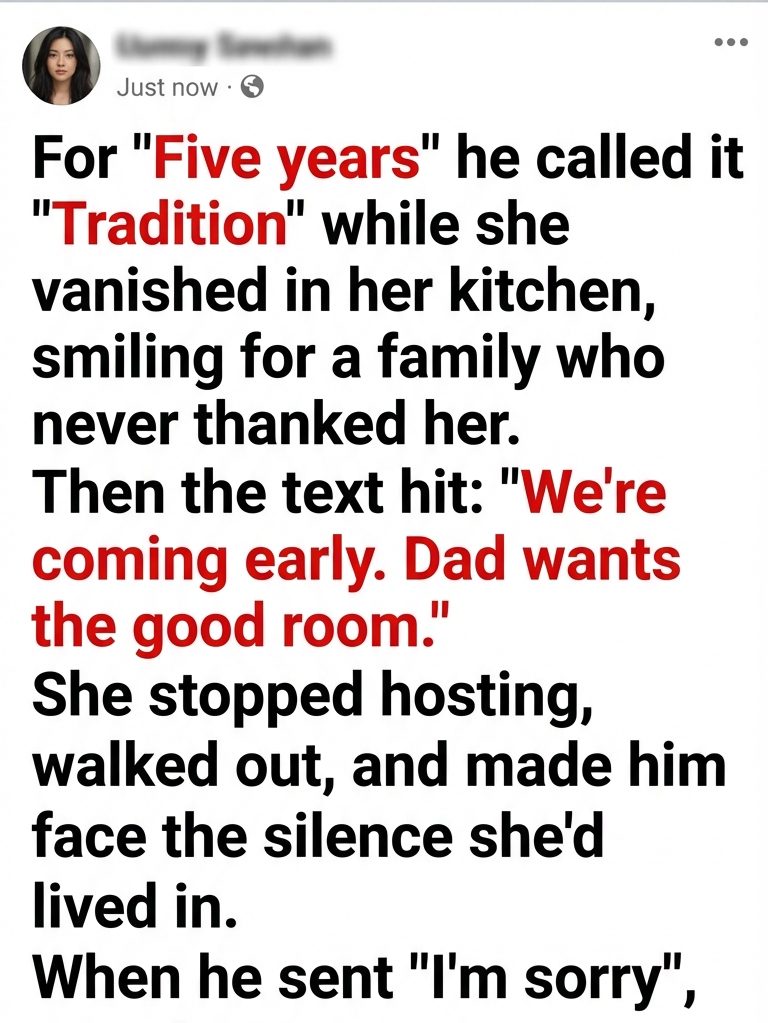
“We’re coming early. Dad wants the good room.”
I stared at the screen and felt the old reflex rise in me: the instinct to smooth, to fix, to make room. My fingers even hovered over the keyboard to type, Sure! Of course!
Then my eyes drifted to my reflection in the dark microwave door.
I looked like a woman working a shift.
And suddenly the word that had been ringing in my head for months finally found its shape.
Erasure.
I wasn’t just tired.
I was being erased in my own life, one “just help out” at a time, one “you’re better at this” at a time, one “don’t start something” at a time.
Tom called it “Tradition”.
I called it erasure.
And this year, I changed one thing.
I didn’t answer the text.
I set the phone down like it weighed too much, wiped my hands, and walked out of the kitchen.
Tom was in the living room, feet up, watching a pregame show, relaxed in that way men get when they’re certain someone else is holding the whole day together.
I stood in front of the TV until he looked up.
“What’s up?” he asked, like I was interrupting something that mattered more than me.
I breathed in slowly.
“I’m not hosting,” I said.
He blinked. “What?”
“I’m not hosting Thanksgiving,” I repeated, keeping my voice steady. “I’m not cooking. I’m not cleaning. I’m not running this house like a restaurant.”
Tom laughed once, short and confused. “Okay. Funny. But Karen’s coming early. Mom’ll freak out.”
“I know,” I said. “And I’m still not hosting.”
His smile faded. “Elaine… don’t do this today.”
That sentence—don’t do this today—was the first brick in the wall of my life. He’d used it on every hard conversation. Don’t do this today. Not now. After the holiday. After the weekend. After my dad’s birthday. After the busy season.
After my patience ran out.
I looked at him and realized something that hurt more than his family ever had.
Tom didn’t fear my exhaustion.
Tom feared their disappointment.
He sat up. “It’s “Tradition”. They expect it. They come here every year.”
“They expect it because we trained them to,” I said. “Because you trained me to disappear.”
Tom’s jaw tightened. “Nobody trained you.”
I nodded toward the kitchen doorway. “Then who’s been doing it for five years, Tom? Who’s been disappearing?”
For a second, he didn’t answer.
Then he said the line that always ended things.
“You’re overreacting.”
Something inside me went very quiet. Not numb. Not shut down.
Clear.
I didn’t argue. I didn’t plead. I didn’t try to be understood by someone determined not to understand me.
“I’m going to take a shower,” I said. “You can handle the rest.”
He stared like I’d spoken another language. “Elaine, stop. We need to talk.”
“We’ve talked,” I said. “For years.”
And I walked away.
That was the inciting incident. The smallest change with the biggest consequence: I stepped out of the role.
At noon, the first car pulled up.
I heard doors slam. I heard voices. I heard the familiar excitement of people arriving to be served.
The front door opened without knocking, because it never had to.
“Helloooo!” Karen called, already inside.
Denise came in behind her, carrying her usual casserole like proof she contributed. Frank shuffled toward the living room, looking for the recliner like it was his assigned seat. Tom’s brother Kyle dragged in a cooler.
They filled my house with their presence the way smoke fills a room.
Denise’s eyes swept over the entryway, the living room, the kitchen doorway.
“Elaine?” she called, sharp. “Where are you?”
Tom stood awkwardly near the hallway like a man caught between two storms. “She’s… uh… getting ready.”
Denise frowned. “Getting ready for what? Dinner isn’t ready?”
Karen laughed. “Maybe she’s trying a new hair thing.”
They all chuckled like I was a silly detail.
I walked into the living room fully dressed, hair still damp from my shower, no apron, no spoon in my hand. Just me.
Denise’s smile stiffened. “There you are. We’re early. Frank needs the good room. You know his back.”
I looked at Frank. He didn’t even look guilty.
“Hi, everyone,” I said calmly. “Before you settle in, I need to tell you something.”
Karen rolled her eyes like she could already predict the inconvenience. “What?”
“I’m not hosting,” I said.
Silence dropped like a plate.
Kyle barked a laugh. “What does that mean?”
“It means I’m not cooking,” I said. “I’m not cleaning. I’m not arranging rooms. I’m not serving.”
Denise’s face went tight. “Elaine, don’t be dramatic.”
Tom made a small sound like he wanted to stop me. “Elaine—”
I turned to him briefly. “No.”
That one word was my first escalation. It wasn’t a scream. It was a boundary.
Denise stepped closer, her voice lowering as if she was addressing a misbehaving employee. “This is a family holiday. You don’t get to opt out.”
I held her gaze. “I do.”
Karen’s mouth fell open. “You can’t just decide that today.”
“I decided it months ago,” I said. “Today is just the first day I’m saying it out loud.”
Frank’s brows knitted. “So what, we’re supposed to starve?”
I gestured toward the kitchen. “There’s a turkey in the fridge. Potatoes on the counter. You’re welcome to cook. Or order food. Or leave.”
The room erupted.
“That’s insane.”
“This is cruel.”
“You’re embarrassing Tom.”
“What did we do to deserve this?”
Tom’s brother Kyle pointed at me, voice rising. “This is why nobody likes coming here. You’re always making it about you.”
I felt my face heat, but I didn’t step back.
“This has always been about you,” I said. “I’m just the one who’s been paying for it.”
Denise turned to Tom, pleading and furious at once. “Tell her to stop.”
Tom swallowed, eyes flicking between his mother and me like he was choosing the least painful side.
He chose the one he always chose.
“Elaine,” he said softly, “can we not do this right now? Please. Just… for today.”
That was the second escalation. Not their anger.
His request for my silence.
My throat tightened. “For today,” I repeated. “You’ve said that for five years.”
Karen snapped, “Because it’s a holiday!”
“And I’ve missed every one of them,” I said, surprising even myself with how true it sounded. “I’ve been in the kitchen. Smiling. Disappearing.”
Denise scoffed. “No one asked you to do that.”
I looked straight at Tom.
He didn’t answer. He didn’t defend me. He didn’t deny it.
He just stood there like a man watching a fire he helped build.
Midpoint twist came when my phone buzzed again.
Another text from Karen, sent accidentally to the wrong person. The little typing bubble appeared, then the message:
“Tell Tom to calm her down or we’re taking the master anyway.”
It wasn’t a request. It wasn’t even about me.
It was a plan.
I held my phone up, showing Tom first.
His eyes widened, then flicked away.
I showed Denise.
Her face changed—just a fraction—then hardened back into authority. “That’s not what she meant.”
Karen’s cheeks went red. “I was joking.”
I stared at them. And in that moment, the truth settled into me like a stone.
They didn’t see me as family.
They saw me as a service.
And Tom had been the one translating my labor into their comfort.
The realization didn’t make me louder.
It made me steadier.
“Here’s the deal,” I said. “If you want to be here, you’ll treat this house like it belongs to me. You’ll ask. You’ll help. You’ll clean up after yourselves. You’ll stop choosing rooms like you’re checking into a resort.”
Kyle snorted. “Or what? You’ll throw us out?”
I nodded. “Yes.”
Frank stood up, slow and offended. “You’re disrespecting your elders.”
I didn’t blink. “You’ve disrespected me in my own home for years.”
That’s when the third escalation hit: Denise did what she always did when she didn’t get control.
She went for my soft spot.
“You know,” she said, voice turning syrupy, “if you had children, you’d understand what it means to do things for family.”
The room went so quiet I could hear the refrigerator hum.
My chest tightened like it used to when grief surprised me in a grocery aisle. I felt Tom’s gaze slam into the floor. I felt Karen shift uncomfortably. I felt the familiar urge to swallow the pain, smile, and keep serving so nobody had to feel awkward.
Erasure again.
Except this time, I didn’t let it happen.
I took a breath. “Don’t,” I said.
Denise’s eyes widened slightly. “Excuse me?”
“You don’t get to use that against me,” I said, voice trembling but firm. “Not in my house. Not ever again.”
Tom finally looked up, face pale.
And for a heartbeat, I thought, maybe he’ll step beside me now.
But he didn’t. He stayed where he always stayed—halfway between me and them, trying to keep everyone comfortable.
That was my lowest-point moment. Not Denise’s cruelty. Not Kyle’s mocking.
Tom’s silence.
Tom’s refusal to choose me.
He rubbed his face, frustrated. “Elaine, you’re blowing this up.”
I stared at him. “No,” I said quietly. “I’m finally seeing it.”
His eyes flashed. “Seeing what?”
“That you’ve been letting me disappear so you don’t have to deal with them,” I said. “You call it “Tradition” because that sounds nicer than what it is.”
Karen snapped, “Oh my God, you’re acting like we’re monsters.”
I nodded once. “You’re acting like I’m invisible.”
Denise stepped closer, voice low and sharp. “If you do this, you’ll ruin Thanksgiving.”
I looked at her and felt something loosen inside me, like a knot finally giving up.
“Then let it be ruined,” I said.
The climactic confrontation wasn’t a scream. It was a decision.
I walked into the kitchen, opened the fridge, and pulled out the turkey.
I set it on the counter.
Then I took the apron off its hook and laid it beside the turkey like I was setting down a uniform.
I turned back to the living room and spoke clearly.
“Tom,” I said. “If you want them here, you host. Not me. You cook. You clean. You manage the rooms. You keep your mother from insulting me. You keep your sister from treating me like a maid.”
Tom’s mouth opened, then closed.
Kyle laughed. “He can’t do all that.”
I looked at Kyle. “Then maybe it was never fair that I did.”
Denise’s voice rose. “This is absurd. Tom, tell her—”
Tom lifted a hand, finally, not toward me, but to stop his mother.
The room froze. Even Denise paused.
He swallowed. “Mom… stop.”
Denise stared at him like she couldn’t believe her own son had interrupted her.
Tom’s voice cracked. “Elaine’s right. She’s been doing everything. And I’ve been letting her.”
I blinked, surprised by the sudden honesty.
Karen scoffed. “Tom, don’t be ridiculous. She’s just being emotional.”
Tom turned to her, jaw tight. “No. She’s been clear for years. I just ignored it.”
Denise’s eyes flashed. “So you’re choosing her over us.”
Tom hesitated. That hesitation told me everything.
But then he said, quiet and awful and necessary: “I’m choosing my marriage.”
Denise recoiled like he’d slapped her. “After all I’ve done—”
Tom cut in, voice trembling. “You’ve done a lot. And so has Elaine. And you don’t talk to her like that anymore.”
The room erupted again—Denise furious, Frank grumbling, Kyle mocking—but something had shifted.
Not because they suddenly respected me.
Because Tom finally stopped making me the sacrifice that kept them comfortable.
Still, I didn’t trust the moment. I’d seen Tom apologize before, then slip back into old habits when the next holiday came.
So I did the final “one thing” that made it real.
I picked up my car keys.
Denise’s eyes narrowed. “Where are you going?”
I lifted my bag from the chair—packed the night before, just in case. “I’m going to a hotel,” I said. “I’m going to breathe.”
Tom’s face panicked. “Elaine, wait—”
I looked at him. “You said you’re hosting. Good. Host.”
I walked to the door. My hands shook, but my steps didn’t.
Behind me, Karen shouted something about selfishness. Denise hissed that I was dramatic. Frank muttered about “women these days.”
Tom followed me onto the porch.
His voice was raw. “I’m sorry.”
There it was: “I’m sorry”.
But this time, it didn’t sound like a bandage. It sounded like the beginning of work.
“I’m not asking for words,” I said. “I’m asking for change.”
He nodded fast. “I’ll do it. I’ll tell them. I’ll set the rules. I’ll… I’ll stop using “Tradition” as an excuse.”
I studied his face. I could see fear, yes—but also shame. Real shame.
“I’ll come back tomorrow,” I said. “We’ll talk. But today, I’m choosing myself.”
I drove away with my heart pounding like a drum, the house shrinking in my mirror. For the first time in years, I felt the weight of the holiday lift off my shoulders.
At the hotel, I sat on a bed with crisp white sheets and listened to silence. No footsteps above me. No voices in my hallway. No demands in my kitchen.
I took a full breath.
Then another.
The next morning, I woke up to a text from Tom.
“They left.”
Another text.
“I’m sorry.”
Another.
“I cooked. It was terrible. But I did it.”
I laughed once, startled, because the image of Tom trying to baste a turkey was almost absurd.
Then I started crying, because it meant something deeper: he had finally felt what I’d carried.
When I returned home that afternoon, the house smelled faintly of burnt gravy and stubborn effort.
Tom was at the kitchen table, eyes tired, hair messy.
He stood up slowly when he saw me, like he wasn’t sure if he deserved to move.
“I told my mother she can’t talk to you like that,” he said immediately. “I told Karen they don’t get to pick rooms. I told them if they can’t respect you, they don’t come.”
I set my purse down, watching him. “And when they got mad?”
He swallowed. “I let them be mad.”
That sentence felt like a miracle.
Tom exhaled. “Elaine, I didn’t understand what it cost you. I thought you were just… good at it.”
I nodded, voice quiet. “I was good at disappearing.”
He looked like he might break. “I don’t want that anymore.”
The resolution wasn’t perfect. Denise didn’t apologize. Karen didn’t suddenly become thoughtful. Frank didn’t learn manners.
But the house was quiet.
And Tom—Tom washed the dishes without being asked.
He didn’t make a show of it. He just did it like it was his job too.
That night, we sat at the table with leftovers from a takeout meal Tom had ordered after his turkey disaster. It wasn’t a perfect Thanksgiving.
It was the first honest one.
Tom reached across the table and took my hand. “Next year,” he said, “we do it differently. Or we don’t do it at all.”
I stared at him. “You mean it?”
He nodded. “Yes.”
I believed him—not because the day ended nicely, but because he finally let discomfort exist without making me pay for it.
Later, when I went to put my keys on the counter, I noticed something I hadn’t seen before.
A small stack of envelopes.
Three of them.
Tom had written on each in black marker:
DENISE
KAREN
KYLE
And beneath their names, one word:
BOUNDARIES
I looked at Tom.
He gave a tired, sheepish smile. “I figured you shouldn’t be the only one who writes things down.”
I felt my throat tighten, but this time it wasn’t grief.
It was relief.
Then came the final punch-line twist, small but sharp.
I reached into my purse and pulled out the last envelope I’d made weeks ago. The one I hadn’t used.
Tom blinked. “What’s that?”
I turned it over.
Elaine.
My name.
I opened it and pulled out a single card with one sentence in my own handwriting:
“This year, you finally come first.”
Tom’s eyes filled.
“I thought I was changing one thing,” I said softly. “But I changed everything.”
Because I didn’t just stop hosting.
I stopped disappearing.