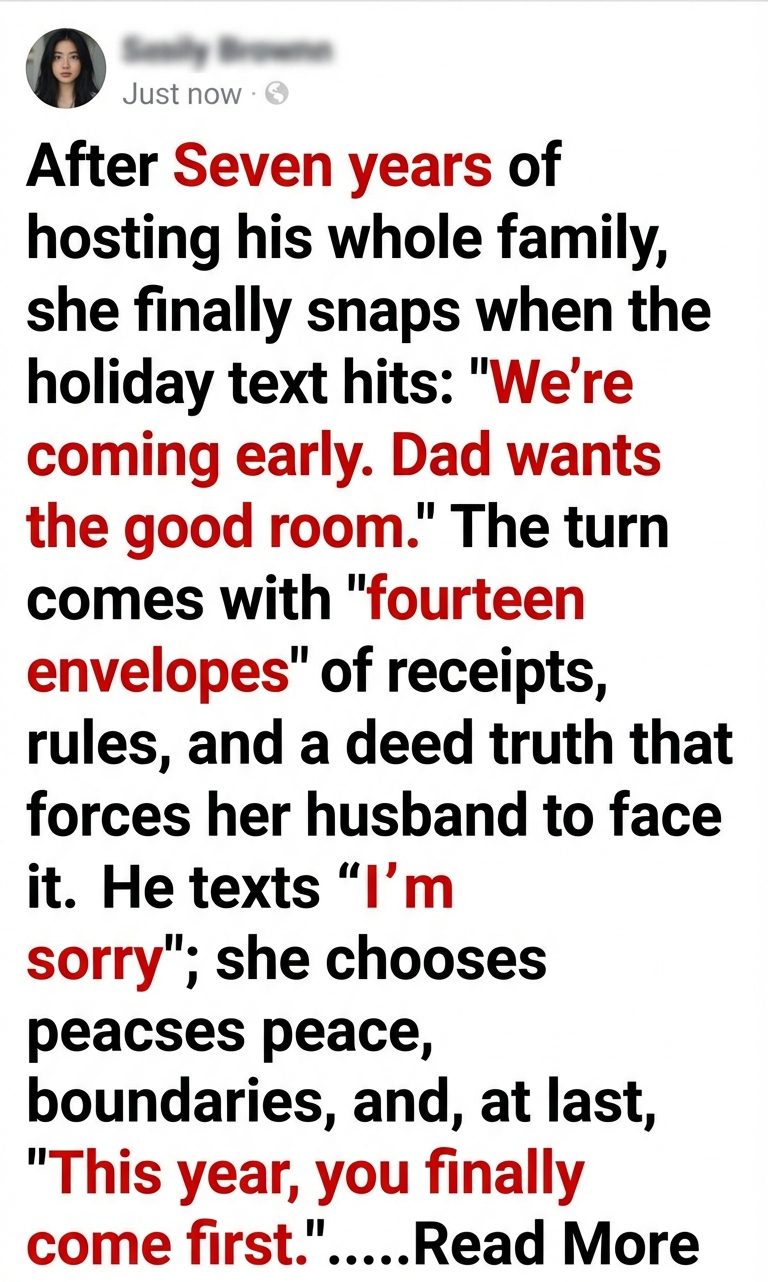
The turkey was still half-frozen in the sink when my sister-in-law texted: “We’re coming early. Dad wants the good room.”
No hello. No question. Just a command—like I was a hotel clerk who’d been on shift for seven straight years.
I stared at the message until my hands started to shake, then I looked at the row of fourteen envelopes on my kitchen counter and finally felt calm.
Seven years.
That’s how long I hosted his whole family for every holiday—Thanksgiving, Christmas Eve, Christmas Day, New Year’s brunch, even the random “family Sundays” that somehow became my responsibility. The first year, I thought it was sweet. I thought this was what marriage looked like: a warm house, a crowded table, laughter spilling into the hallway.
By year three, I understood the truth.
I wasn’t hosting a family.
I was running an unpaid resort.
They arrived with suitcases like they were checking into a villa. They argued over rooms. They criticized my food. They left wet towels on my couch and crumbs in my bed. They brought extra guests without warning—“Oh, we thought you’d want to meet Trevor’s girlfriend,” as if I’d begged for another mouth to feed and another opinion to endure.
And my husband, Mark, always wore the same expression when they walked in.
Relief.
Because once they were here, he could disappear into the background like a man slipping off a coat. He’d laugh with his brothers, take his father to watch sports, go on “quick store runs” that lasted two hours, and if anyone needed anything—
More ice. Another blanket. A different pillow. Coffee made “the right way.” A second dessert because “your pie crust is a little thick.”
It was me.
Always me.
And every time I tried to talk to him about it, Mark would soften his voice the way you talk to a child who’s upset about nothing.
“They’re my family,” he’d say.
“It’s only a few days,” he’d say.
“You’re just better at this,” he’d say.
Better at being used.
The holiday that broke me wasn’t the year his brother’s kids drew on my dining table with a permanent marker and their mother said, “Oh, it adds character.” It wasn’t the year his father announced at my table that I’d gained weight “in my face” and everyone laughed like it was a joke I should be grateful for.
It was last Christmas.
I’d cooked for two days straight. I’d wrapped gifts for people who weren’t mine. I’d scrubbed bathrooms until my knuckles burned. And on Christmas morning, when I finally sat down with my coffee, Mark’s mother, Denise, looked around my living room and sighed dramatically.
“You know,” she said, “for a woman with no children, you really should have more holiday spirit.”
No children.
As if it was a preference like choosing oat milk. As if she hadn’t watched me cry in the car after the third miscarriage. As if she hadn’t watched Mark go quiet and distant every time I brought up trying again.
I didn’t respond. I couldn’t. I just sat there, holding my mug like it was the only thing keeping me from falling apart.
Denise smiled and took another bite of cinnamon roll.
And Mark—Mark sat beside me and said nothing.
That night, after everyone went to bed, I walked into my laundry room and shut the door so I could cry without being heard. My reflection in the dark window looked older than it should. Tired in a way sleep couldn’t fix.
Something in me stopped begging.
I didn’t decide to “be strong.” I didn’t give myself a motivational speech.
I simply got… quiet.
And when I get quiet, I get organized.
January came. Then February. On the surface, I went back to normal—work, groceries, bills, polite texts, forced smiles. But underneath, I started recording everything. Every expense. Every request. Every rude comment. Every instance where Mark promised help and didn’t show up.
It wasn’t revenge at first.
It was clarity.
Because I needed to know if I was imagining it.
I wasn’t.
By August, I had a folder in my desk called HOLIDAYS that was thick enough to slam shut. Receipts. Notes. Photos. Screenshots. Bank statements. A spreadsheet of every time his family stayed, what they ate, what they broke, what they “forgot” to replace.
By October, I had a plan.
By the first week of November, I had fourteen envelopes.
I didn’t choose fourteen because it sounded dramatic.
I chose fourteen because that’s how many of them were coming this year.
Denise and Frank.
Mark’s two brothers and their wives.
The three adult cousins who “had nowhere else to go.”
Two teenage nephews.
A girlfriend.
A friend of a friend who “just needed a place for a couple nights.”
And Mark, of course—who counted as family when it suited him.
Fourteen.
Fourteen people who treated my home like an all-inclusive package.
This Thanksgiving, I decided to change the rules.
The first to arrive was Denise—always early, always loud, always carrying a casserole dish like it was proof she contributed to something besides criticism.
She walked in without waiting to be invited and started immediately.
“Oh, you moved the chairs. Interesting.”
“Did you gain a new wrinkle? Maybe try retinol.”
“I hope you didn’t buy cheap turkey again.”
She set her dish on the counter and made herself at home like she owned the air.
Mark followed behind her, carrying suitcases, eyes already sliding away from me.
“Hey,” he said, like he’d seen me yesterday and not like we were about to survive another invasion.
Then Frank barged in. Then the brothers. Then the cousins. Then the teenagers.
By noon, my house was full of voices that weren’t mine and smells I didn’t choose. My kitchen became a battlefield. People opened cabinets and sighed at what they found. Someone asked if I had “better snacks.” Someone’s kid put their shoes on my couch.
I watched it all like a scientist observing a familiar experiment.
And then Denise asked the question she always asked.
“So,” she said, glancing around like a queen inspecting her castle, “who’s sleeping where this year?”
Mark didn’t look at me. He looked at the floor, like a man trying to become wallpaper.
Denise pointed without hesitation. “Frank and I get the master. My back can’t handle those little rooms.”
That’s when my quick setup ended and my real story began.
I smiled.
“Actually,” I said, “nobody is choosing rooms this year.”
Denise blinked. “Excuse me?”
I walked to the kitchen counter and picked up the neat row of envelopes I’d lined up earlier. Each one was thick, sealed, and labeled with a name in black marker.
Fourteen names.
I held them like a deck of cards.
“I made something special,” I said. “A holiday tradition.”
Mark finally looked at me then, confusion creasing his forehead. “What is that?”
“A gift,” I said. “For each of you.”
Denise’s eyes narrowed, suspicious. “What kind of gift?”
“The kind you’ve earned,” I said softly, and handed her the first envelope.
One by one, I passed them out.
Frank took his with a grunt.
Mark’s brothers took theirs and smirked like they expected gift cards.
The cousins grabbed theirs fast.
The teens shook theirs like they were hoping for cash.
Mark hesitated when I held his envelope out.
His was the thickest.
When everyone had one, I leaned back against the counter and said, “Open them.”
They did.
At first, there was silence—paper sliding out, the soft crack of envelopes, the rustle of confusion.
Then came the first laugh.
“Oh my God,” Mark’s brother Kyle said, holding up a printed invoice. “What is this? A bill?”
Denise’s face changed—slowly, like sour milk turning.
She’d pulled out a packet labeled SEVEN YEARS OF HOLIDAY COSTS with highlighted totals at the bottom.
Frank’s envelope contained photos of his “accidental” wine spills on my rug, the broken lamp he swore “was like that already,” and a receipt for the replacement.
One cousin’s envelope had screenshots of her text messages: “We’re bringing two extra people, hope that’s fine!” followed by my polite response and then, directly beneath it, a list of costs: extra bedding, extra food, extra utilities, extra cleaning service.
The teenagers—those two smug boys who never said thank you—stared at their envelopes and went pale. Their packet wasn’t a bill.
It was a printed list titled: HOUSE RULES + CHORES, with times, tasks, and consequences.
One of them whispered, “Is this real?”
I nodded. “Very real.”
The girlfriend—barely twenty, chewing gum like she was bored by life—looked at her envelope and frowned. Inside was a copy of my home insurance policy, with a sticky note that read: If you break it, you replace it. No exceptions.
Denise’s voice rose first. “This is insulting.”
I didn’t flinch. “So is telling a woman with miscarriages that she has no holiday spirit.”
Her mouth opened, then closed.
Kyle waved his invoice. “You can’t charge family!”
I tilted my head. “You’ve charged me for seven years. Just not with money.”
The room started to boil.
Voices layered over each other—outrage, disbelief, mockery, attempts to laugh it off. Someone called me dramatic. Someone called me cheap. Someone said, “Mark, are you seeing this?”
Mark stood frozen with his envelope still unopened, like if he didn’t touch reality, it wouldn’t touch him back.
Denise slammed her packet on the counter. “This is your doing,” she snapped. “You’re poisoning him against us.”
I smiled, small and tired. “No. I just stopped drinking the poison you kept handing me.”
That was my first escalating scene: the reveal.
The second came right after.
Denise pointed at the paper like she wanted to stab it. “We are not paying you!”
“I didn’t say you had to,” I replied.
Kyle scoffed. “Then what is this? Some weird power move?”
“It’s information,” I said. “The kind you’ve avoided for years. Now you know exactly what your visits cost me. You can react however you want.”
Frank growled, “We can go stay somewhere else.”
“You can,” I agreed. “And if you choose to stay here, you’ll follow what’s in your envelope.”
Denise’s eyes flashed. “What’s in mine?”
I nodded toward her packet. “At the end.”
She flipped pages until she reached the last sheet.
Her face drained.
Because the last sheet wasn’t a bill.
It was a hotel booking confirmation.
Not for her.
For me.
A three-night stay at a spa resort starting tomorrow morning.
Under it, in my handwriting: I’m not hosting Thanksgiving dinner. You are. Or you can leave.
The room went dead quiet.
Mark finally tore open his envelope with shaky fingers.
And that’s when we hit the midpoint twist.
His packet wasn’t about food or chores or money.
It was about the house.
The first page was a copy of our mortgage statement—highlighted in yellow.
Next to it, a set of bank transfers.
Then a spreadsheet showing, in cold clean numbers, exactly how much of the mortgage had been paid by my salary and how much had been paid by his.
At the bottom, another sheet: my name—only my name—on a legal document he’d never shown his family.
A deed transfer form.
Unsigned.
Ready.
Mark’s lips moved, but no sound came out.
I spoke for him.
“I found the paperwork in your desk,” I said, keeping my voice even. “The one where you were planning to put your mother’s name on this house if anything happened to you.”
Denise sucked in a breath like she’d been slapped.
Mark’s brother’s wife whispered, “What?”
Mark finally found words. “That’s not—”
“Don’t,” I cut in. Not loud. Just sharp enough to slice. “Don’t lie. Not today.”
Mark’s face crumpled. “I never filed it.”
“You planned to,” I said. “You made the file. You made the draft. You made sure my name wouldn’t protect me.”
Denise’s eyes were glittering now—furious and hungry. “Mark,” she said softly, “tell her she’s mistaken.”
Mark didn’t.
And in that silence, my story pivoted from “overworked hostess” to something darker.
Because I hadn’t just been hosting.
I’d been financing my own replacement.
The third escalating scene hit like a storm.
Denise turned on me fully then. “So this is what this is,” she hissed. “A divorce threat. A tantrum. After all we’ve done for you.”
I laughed—not happily. Just once, bitter. “What you’ve done for me? You’ve done nothing for me. You’ve done things to me.”
Mark’s brothers started shouting. Frank called me ungrateful. The cousins muttered that I was crazy. The room turned ugly fast, like it always did when they weren’t getting what they wanted.
And Mark—
Mark took a step back.
Not toward me.
Away from me.
That was my lowest point.
It wasn’t their anger that hurt. I expected that.
It was my husband instinctively retreating—choosing the crowd, choosing the noise, choosing the comfort of not defending me.
I felt something cold settle behind my ribs.
Seven years of “only a few days” stacked into a lifetime.
Denise leaned close, voice low and venomous. “You think you’re clever? You think you can embarrass us and still be welcome in this family?”
I looked at her and realized something that should’ve been obvious long ago.
I didn’t want to be welcome.
I wanted to be free.
I reached for the final envelope—the one I hadn’t handed out yet. The one I’d kept tucked behind the others.
Denise’s eyes narrowed. “What’s that?”
“This,” I said, “is the last one.”
I held it up.
It wasn’t addressed to them.
It was addressed to Denise.
She already had one, but this was different—thicker, heavier, the paper inside rigid.
I slid it across the counter to her with two fingers.
“Open it,” I said.
Her hands trembled—not from fear, from rage. She ripped it open like she could tear the truth in half.
Inside was a folder.
The front page was a legal notice.
Denise’s eyes skimmed it.
Then widened.
Because it wasn’t about me paying them.
It was about them paying me.
A formal rental agreement—dated, printed, and signed.
Seven years of “family visits,” itemized as extended stays.
Seven years of utilities.
Seven years of damages.
Seven years of unpaid “shared” expenses.
And at the bottom, the line that made her breath hitch:
If you remain in the home past 6:00 p.m. tonight without agreeing to the terms, you are trespassing.
Kyle exploded. “You can’t do that!”
I nodded. “Actually, I can. The house is in my name.”
Mark flinched.
Denise’s head snapped toward him. “What?”
Mark’s voice was barely audible. “It’s… it’s complicated.”
“It’s not,” I said. “It’s just inconvenient for the people who assumed I’d always stay quiet.”
That was the climactic confrontation.
They all shouted at once—legal threats, emotional threats, personal insults. Denise called me cold. Frank called me selfish. Kyle called me a monster.
And Mark… Mark looked like a man watching the floor collapse beneath him.
“Please,” he said, and for the first time in years, he sounded afraid. “Can we talk privately?”
I stared at him. “We’ve had seven years of private talks.”
“I didn’t think you’d—”
“Finish?” I offered. “I didn’t think you’d ever have consequences.”
Denise leaned in again, voice shaking with fury. “You’re ruining Thanksgiving.”
I met her eyes.
“No,” I said. “You ruined seven years. I’m just ending the season.”
I turned, walked to the coat rack, and pulled my overnight bag from behind the hallway bench. Packed, zipped, ready—like I’d been waiting for permission I no longer needed.
I slung it over my shoulder and looked back at the room full of people who’d feasted on my silence.
“Dinner is in the fridge,” I said. “Uncooked. Turkey’s in the sink. Recipes are on the counter. If you want a holiday, build it yourselves.”
Then I looked at Mark.
“You can come with me,” I said. “Or you can stay with them. But either way, I’m done being the place you hide.”
His eyes filled.
He didn’t move.
So I did.
I walked out.
The air outside felt sharp and clean, like breathing for the first time after years in a crowded room. I loaded my bag into my car, hands steady, heart pounding.
As I drove away, my phone buzzed again—message after message lighting up the screen like fireworks.
Anger. Panic. Demands. Blame.
Then one text from Mark.
Just two words:
“I’m sorry.”
I didn’t answer.
At the resort, the woman at the front desk smiled and handed me a key card. “Welcome,” she said. “You must be exhausted.”
I almost laughed at how true it was.
I slept that night like my body finally believed it was safe.
The next morning, I sat alone with coffee that stayed hot because nobody needed anything from me. I watched the sun climb, slow and sure, and felt something shift inside my chest.
Not joy.
Not yet.
But peace.
Around noon, my phone rang.
It was Mark.
I let it ring twice before answering, because I wasn’t trained anymore to jump.
His voice was hoarse. “They left.”
“Good,” I said.
“They… they were furious,” he admitted. “Mom said she’ll never forgive you.”
I stared out at the pool where strangers lounged in quiet happiness. “That’s okay.”
There was a long pause, then he said, “I didn’t realize how bad it got.”
I almost corrected him.
He did realize. He just benefitted from pretending he didn’t.
Instead I asked, “Did you read your envelope all the way through?”
Another pause.
“…Yes,” he said.
“And?”
“I don’t want to lose you,” he whispered.
I took a slow breath.
“Mark,” I said, “I already lost myself. I’m deciding whether I want to find me again with you… or without you.”
He swallowed hard. “What do you want?”
I looked at the resort calendar on the desk beside me. My name was printed on it in clean letters like I belonged somewhere.
“I want the house quiet,” I said. “I want counseling. I want boundaries. And I want you to understand something.”
“What?”
I smiled, small and sharp, and gave him the final punch-line twist—the thing none of them expected.
“There were fourteen envelopes,” I said. “But only thirteen were for them.”
He went silent.
“And the fourteenth?” he asked carefully.
I picked up the last envelope from my purse—the one I’d never placed on the counter, the one addressed to me.
I opened it and let the paper slide out.
A single sheet. One sentence.
I read it out loud.
“This year, you finally come first.”
Then I hung up and went back to my coffee—hot, untouched, and entirely mine.