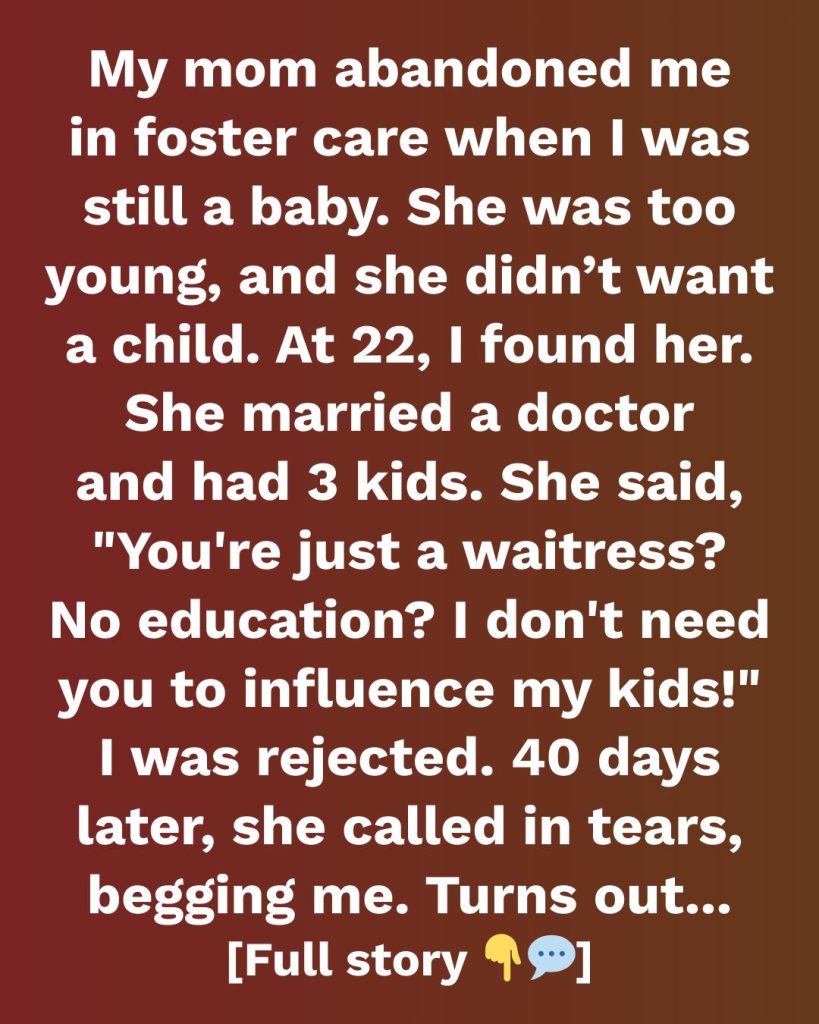
I don’t remember the day my mother abandoned me. I was still a baby—too young to form memories, too small to understand what was happening. All I know is what I was told later: she was young, overwhelmed, and didn’t want a child. So I was placed into foster care, handed over like an unfinished story, my life beginning with absence instead of arms.

Growing up, I learned how to adapt quickly. New houses, new faces, new rules. Some foster homes were kind, others merely tolerable, but none felt permanent. I learned not to get attached, not to ask for too much, and not to expect anyone to stay. By the time I was old enough to understand what abandonment really meant, it had already woven itself into who I was. I carried it quietly, like a bruise that never fully healed.
Still, I survived. I worked hard. I stayed out of trouble. I learned to rely on myself. Love, to me, felt conditional—something you earned, something that could disappear without warning.
When I was twenty-two, curiosity finally grew stronger than fear. For years, I had told myself I didn’t care. But deep down, there was always a question that never stopped whispering: Why? I didn’t want money or explanations or apologies. I just wanted to see her. To look at the woman who gave birth to me and know where I came from.
It took months of searching, paperwork, and late nights online, but eventually I found her address. On the bus ride there, my hands wouldn’t stop shaking. I rehearsed what I might say over and over again. Hello. I’m your daughter. I just wanted to meet you. I don’t want anything.
When she opened the door, she didn’t smile. She looked at me like I was a stranger who had made a mistake.
She looked polished and confident, wearing the ease of someone who had built a stable life. Over her shoulder, I saw framed photographs lining the wall—family portraits, school pictures, three children smiling brightly. A whole world existed behind that door. A world that had never included me.
She asked me what I did for a living.
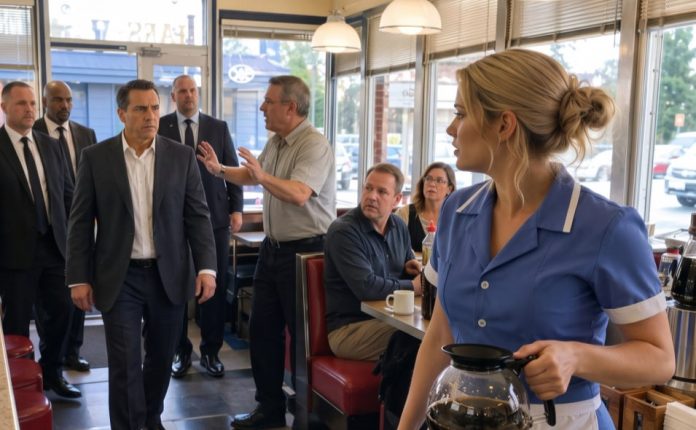
I told her the truth. I said I was a waitress. I said I didn’t have a college degree. I said I was working and managing on my own.
Her face changed immediately.
“You’re just a waitress?” she said, her voice sharp and dismissive. “No degree? I don’t want you anywhere near my kids.”
Then she shut the door in my face.

There was no yelling. No dramatic confrontation. Just the quiet, final sound of the lock clicking into place. I stood there for a moment, frozen, my chest burning as if the air had been knocked out of me. Then I turned around and walked away.
That day, I made a promise to myself. I would never reach out again. I would never knock on that door. Whatever hope I had been carrying for years—I buried it right there on her doorstep.
Forty days later, my phone rang.
I almost didn’t answer.
When I did, I barely recognized her voice. It was trembling, broken, soaked in fear. She said my name like she was afraid it might disappear if she didn’t hold onto it tightly enough. Her oldest daughter—my sister—had been diagnosed with a serious autoimmune disease. Her own immune system was attacking her body. The doctors needed a bone marrow donor.
Her two younger children were too young to be tested. She and her husband weren’t a match. No one else in the family could help.
Then she said the words that made my heart stop.
“Please. I know I don’t deserve it, but you’re her last chance.”
I didn’t respond right away. Every memory of that door slamming shut came rushing back. Every night I’d spent wondering why I wasn’t wanted. I could have said no. I had every reason to.
But all I could think about was a child I had never met, fighting for her life.
I agreed to get tested.
When the doctor told me I was a match, something inside me shifted. It felt like fate had reached across years of rejection and pain and asked me a simple question: Who do you want to be?
The donation process was exhausting—physically painful and emotionally overwhelming—but I never once regretted my decision. I went through with it knowing exactly why I was there.
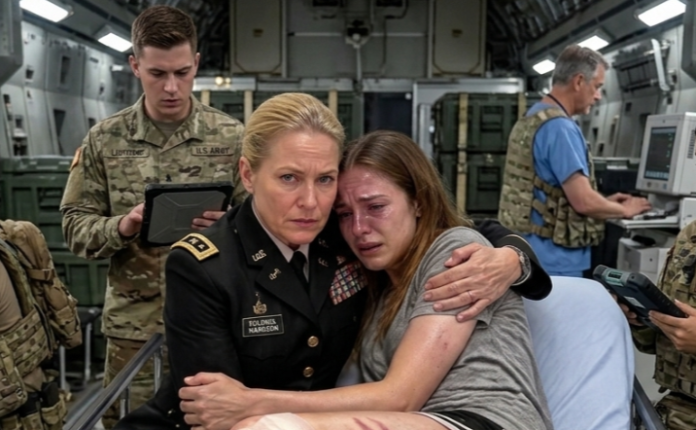
Afterward, in the hospital hallway, my mother collapsed to her knees. She cried openly, her hands shaking as she begged me to forgive her. Nurses slowed their steps. Strangers watched in silence. The moment felt heavy, unreal.
I helped her up and said quietly, “I’m doing this for my sister. Blood doesn’t turn into water.”

That moment changed everything.
Slowly, carefully, something began to heal. I was no longer treated like a mistake or an inconvenience. I was invited to dinners. I was introduced as family. My siblings hugged me like they’d been waiting for me all along. We shared stories, laughed awkwardly at first, then easily. Bonds formed faster than I ever thought possible.
For the first time in my life, I belonged.
Today, my bond with my three siblings is unbreakable. We protect each other fiercely, and we show up for one another without question. My mother—imperfect, remorseful, and learning—understands now what she almost lost and what she was given back.
I’m grateful I didn’t answer cruelty with cruelty. Compassion gave me something I thought I’d lost forever: healing, a second chance, and a real family I can love with my whole heart.
Note: This story is a work of fiction inspired by real events. Names, characters, and details have been altered. Any resemblance is coincidental. The author and publisher disclaim accuracy, liability, and responsibility for interpretations or reliance. All images are for illustration purposes only.