A few months ago, our new neighbors Maria and Luis moved in and created a gorgeous garden. My wife Teresa quickly bonded with Maria—they were inseparable. One night over dinner, Luis said, “We love it here, but someone’s destroying our garden—pulling plants, ruining the soil. We might have to move.” Teresa stiffened, gripping her wineglass. That’s when Teresa started going out at midnight to “water our plants.” Odd, right? That night, I quietly followed her. But boy…she wasn’t watering our garden at all! Instead, she was hunched over in Maria and Luis’s backyard, her knees pressed into the damp mulch, frantically digging holes with a small silver trowel by the dim glow of a flashlight clipped to her collar.
I stood in the shadows of the tall hedge separating our properties, my breath catching in the cool night air. For a moment, my heart plummeted. Was my wife—the woman I had shared forty years of life with—the one responsible for the senseless destruction that had been breaking Maria’s heart? I watched as she pulled a fresh, vibrant hydrangea from a burlap sack at her side and tucked it into the earth, tamping down the soil with shaking fingers. She wasn’t destroying anything. She was replanting. She was repairing.
Teresa wiped sweat and soot from her forehead, leaving a dark smudge across her brow. She looked exhausted, her movements slow and deliberate, the way she used to move when our children were infants and she was running on two hours of sleep. As I watched her move from one patch of ruined soil to the next, I realized she had a whole cache of replacement flowers hidden in our garage. She was single-handedly waging a secret war against whatever ghost was haunting our neighbors’ peace.
I couldn’t stay in the shadows any longer. As the floorboards of our deck creaked under my weight, I stepped out into the faint moonlight. “Teresa?” I whispered.
She jumped, nearly dropping her trowel, and let out a sharp, stifled cry. When she saw it was me, her shoulders slumped, and she sat back on her heels, the flashlight beam dancing across the roses. “Mark,” she breathed, her voice thick with unshed tears. “You weren’t supposed to see this.”
“Honey, what are you doing?” I asked, walking over and kneeling beside her. The smell of wet earth and night-blooming jasmine was heavy around us. “Luis said someone was destroying the garden. Why are you out here at midnight fixing it in secret?”
Teresa looked at the back door of Maria and Luis’s house, her eyes wide with a desperate kind of fear. “Because it’s not ‘someone,’ Mark,” she whispered, leaning in close so the wind wouldn’t carry her words. “It’s Maria.”
The silence that followed was heavier than the darkness. Maria? The woman who spent every morning meticulously deadheading her petunias? The woman who spoke to her lilies as if they were her own grandchildren?
“I saw her three nights ago,” Teresa continued, her voice trembling. “I couldn’t sleep, and I looked out the window. I saw her walk out here in her nightgown. She looked… different. Her eyes were empty, Mark. She started pulling up the marigolds she’d planted that morning. She wasn’t angry; she was just… lost. She was humming an old lullaby and tossing the plants over the fence. When she finished, she just walked back inside like nothing had happened.”
“Does Luis know?” I asked, glancing at the darkened windows of their bedroom.
“No,” Teresa said, a sob finally breaking through. “That’s the problem. Luis thinks it’s kids from the high school or a neighborhood grudge. He talks about cameras and police reports. But Maria… she doesn’t remember doing it. I had coffee with her yesterday, and she cried into her mug, asking why someone would hate her so much. If he finds out, Mark, he’ll take her to a doctor. They’ll talk about ‘facilities’ and ‘care homes.’ They just moved here to be happy in their retirement. I couldn’t let it end like this.”
I reached out and took my wife’s hand. Her skin was rough from the dry soil, but her grip was like iron. In that moment, I saw the girl I had married—the one who would always carry the world’s burdens on her own back if it meant sparing someone else a moment of pain. For those of us who have walked this earth for six or seven decades, we know that the most terrifying transition isn’t death, but the slow fading of the mind. We’ve seen it take our parents, our siblings, and our friends. It is a thief that steals the person long before it steals the breath.
Teresa had lost her mother to Alzheimer’s ten years prior. I remembered the long nights she spent sitting by her mother’s bed, listening to the same three stories over and over, watching the woman who raised her become a stranger. Teresa hadn’t been able to fix her mother’s mind, but here, in this garden, she felt she could fix the symptoms. She could buy Maria one more season of “normalcy.”
“I’ve been going to the nursery at the edge of town every afternoon,” Teresa explained, her voice gaining a steady, fierce quality. “I buy the exact same plants Maria had. I hide them in the trunk. Then, after Maria has her… her episodes at night, I come out here and put everything back. If I can keep the garden whole, Luis won’t worry, and Maria won’t be scared. Maybe it’s just the stress of the move. Maybe it will pass.”
We both knew it likely wouldn’t pass, but I couldn’t tell her that. Not while she was holding a silver trowel like a weapon against fate.
For the next two weeks, I became my wife’s accomplice. We became a team of midnight gardeners. It was backbreaking work for people of our age. My knees ached, and my lower back protested every time I hoisted a bag of topsoil, but we found a strange, rhythmic peace in the quiet. We watched for the flash of a white nightgown in the neighbors’ yard. When Maria emerged, we would retreat into the shadows of our porch, watching with heavy hearts as she undoed her own handiwork.
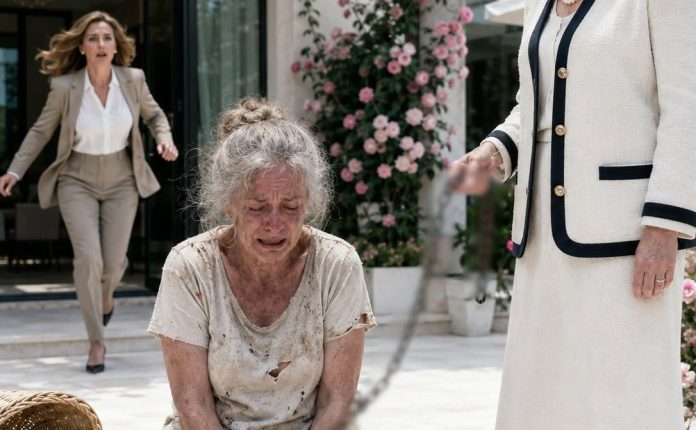
It was a tragic ballet. She would wander among the flowerbeds, her white hair glowing like a halo in the moonlight, gently pulling up the very things she loved. Once she returned to the house, we would spring into action. I would dig the holes, and Teresa would set the roots. By the time the sun began to peek over the horizon, the garden looked as if it had never been touched.
The neighborhood remained blissfully unaware. Maria and Luis would sit on their patio in the mornings, sipping tea and marveling at how “the vandalism had stopped.” Maria looked younger, her laughter ringing out across the lawn again. Luis seemed to stand taller, his hand frequently resting on Maria’s shoulder. They were happy, and Teresa was satisfied.
But secrets, like weeds, have a way of pushing through even the most carefully tended soil.
One Saturday evening, we were back around their dinner table. The mood was celebratory. Luis had prepared a magnificent paella, and the wine was flowing freely. “I don’t know what happened,” Luis said, raising his glass to us. “But whoever was hounding us seems to have moved on. Our garden has never looked better. In fact,” he paused, narrowing his eyes slightly, “it’s almost uncanny. Those hydrangeas Maria thought were pulled up last week… they look even healthier today. It’s like a miracle.”
Teresa laughed, though it sounded a bit thin to my ears. “Nature has a way of surprising us, Luis. Maybe they just had strong roots.”
Maria smiled, but the smile didn’t reach her eyes. She leaned over and touched Teresa’s arm. “You’re a good friend, Teresa. Sometimes I think you’re the only one who really sees me.”
The room went still. There was a weight in Maria’s words that suggested she might know more than she was letting on. Or perhaps she was starting to sense the gaps in her own reality.
Later that night, the inevitable happened. We were out in the garden, mid-replant, when the back porch light of the neighbors’ house snapped on. We froze, blinking in the sudden glare. Luis was standing at the screen door, wearing his bathrobe, staring at us with a mixture of confusion and dawning realization.
“Mark? Teresa?” he called out, shielding his eyes. “What on earth are you doing in our yard at two in the morning?”
Teresa dropped a pot of pansies. The sound of plastic hitting the dirt seemed as loud as a gunshot. We were caught. There was no way to explain away the burlap sacks, the flashlights, and the muddy knees.
Luis walked down the steps, his face hardening as he looked at the fresh holes we had dug. “Are you… were you the ones?” He looked at Teresa, his voice cracking with betrayal. “All this time? We invited you into our home! Why would you destroy her joy?”
“No, Luis! You have it all wrong!” I shouted, stepping forward to shield Teresa.
“I saw someone digging!” Luis cried, his anger rising. “I’ve been sitting in the dark waiting for the ‘kids’ to come back, and it’s you? My best friend?”
Teresa stood up, her face pale but determined. She didn’t look at Luis; she looked past him, into the house where Maria was surely waking up. “Luis, come into our house. Just for five minutes. Please. I’ll show you everything.”
We led a fuming, heartbroken Luis into our garage. When I flipped the light switch, he gasped. There were dozens of empty nursery pots, bags of specialized fertilizer, and a ledger Teresa had kept of every plant Maria had ever mentioned loving.
“We didn’t destroy it, Luis,” Teresa said, her voice soft and steady. “We’ve been replacing it. Every night for three weeks.”
Luis looked at the pots, then at the dirt caked under Teresa’s fingernails. “Why? Why would you do that?”
Teresa took a deep breath. “Because Maria is the one who pulls them up, Luis. She doesn’t know she’s doing it. She’s sleepwalking, or she’s in a state… I didn’t want you to have to lose her to a diagnosis yet. I wanted you to have a few more months of just being a couple with a beautiful garden.”
Luis sank onto a stack of mulch bags, his head in his hands. The silence in the garage was absolute. For an older man, a veteran who had faced countless storms, this was the one he couldn’t weather with a trowel or a paintbrush. He began to sob—quiet, racking sounds that spoke of a lifetime of love and the terror of a future he couldn’t control.
“I knew,” he whispered eventually, his voice muffled by his hands. “I think I knew, deep down. I saw the dirt on her nightgown. I saw the scratches on her hands. But I couldn’t say it. If I said it out loud, it would be real. I fought you because I wanted it to be a stranger. I wanted to hate a ‘vandal’ because I couldn’t bear to admit that my Maria was leaving me while she was still standing right in front of me.”
Teresa knelt before him, ignoring her own aching joints. “She’s not leaving you, Luis. She’s just changing. And you don’t have to face it alone. We’re your neighbors. We’re your friends. If the garden needs to be replanted every single night until the frost comes, then that’s what we’ll do.”
That night changed our neighborhood forever. We stopped the secret gardening, because the secret was no longer necessary. Instead, we started an “Evenings on the Porch” club. Every night, the four of us would sit together until Maria fell into a deep, safe sleep. Luis eventually took her to a specialist, and they began the journey that so many families have to take. But they didn’t move.
The neighborhood, which had once felt like a collection of separate boxes, became a true community. We told a few of the other long-time residents on the block, and suddenly, Maria’s garden was the most protected place in the county. If a plant went missing, a neighbor would “anonymously” drop a new one on the porch the next morning. If Maria was found wandering the sidewalk in her slippers, someone would gently guide her home, stop for a chat about the weather, and make sure she was safe.
I am seventy-five years old now, writing this from my porch swing. Maria passed away last autumn, peacefully, in the house she loved. Luis is still our neighbor. He’s older, slower, and his heart is heavy, but he never spent a single day of those final years feeling like a victim. He knew that even when the mind fails, the spirit of a community can hold a life together.
Teresa still goes out at midnight sometimes. Not to replant things, but just to sit in the garden and listen to the house breathe. She says the smell of damp earth reminds her that life isn’t about how long the flowers last, but about the hands that are willing to put them back in the ground when they fall.
To my fellow seniors, I want to say this: Do not fear the shadows that come with age. We spend so much of our lives building fences and protecting our “assets,” but the only thing that truly matters is the strength of the hands that reach across those fences. True wealth isn’t a gorgeous garden; it’s having a neighbor who will stay up until midnight to fix what you’ve broken in your sleep.
The meaningful story of Maria and Luis’s garden wasn’t about the flowers at all. It was about the “watering” of the human soul. We learned that compassion is a muscle that needs exercise, and that the most beautiful things in life are often the ones we have to fight for in the dark.
As I look at the garden today, now tended by Luis and Teresa together, I see the “Heritage Roses” they planted in Maria’s memory. They are deep red, vibrant, and they have the strongest roots I’ve ever seen. They remind me that love, when it is seasoned by decades of friendship and the grit of reality, is the only thing that never truly fades.
So, if you see a light in your neighbor’s yard at midnight, don’t be so quick to call the police or close your curtains. It might just be someone trying to save a piece of the world that is too precious to lose. It might just be the grace of a long-lived life, showing us that as long as we have each other, we are never truly lost.
The sunset is beautiful this evening—a deep, vibrant orange that looks like a fire burning on the horizon. It reminds me that even as the day ends, there is a beauty in the transition. We are all just walking each other home. Teresa comes out with two mugs of tea and sits beside me. She squeezes my hand, and I see the dirt still under her nails from her morning work. I smile. Those aren’t just stains; they are the marks of a life well-lived. And that, dear friends, is the most meaningful story of all. Welcome to the neighborhood. Here, we keep our lanterns lit, and we never, ever let our friends gardener alone. The roots are deep, the flowers are bright, and our hearts are finally, truly, at peace.