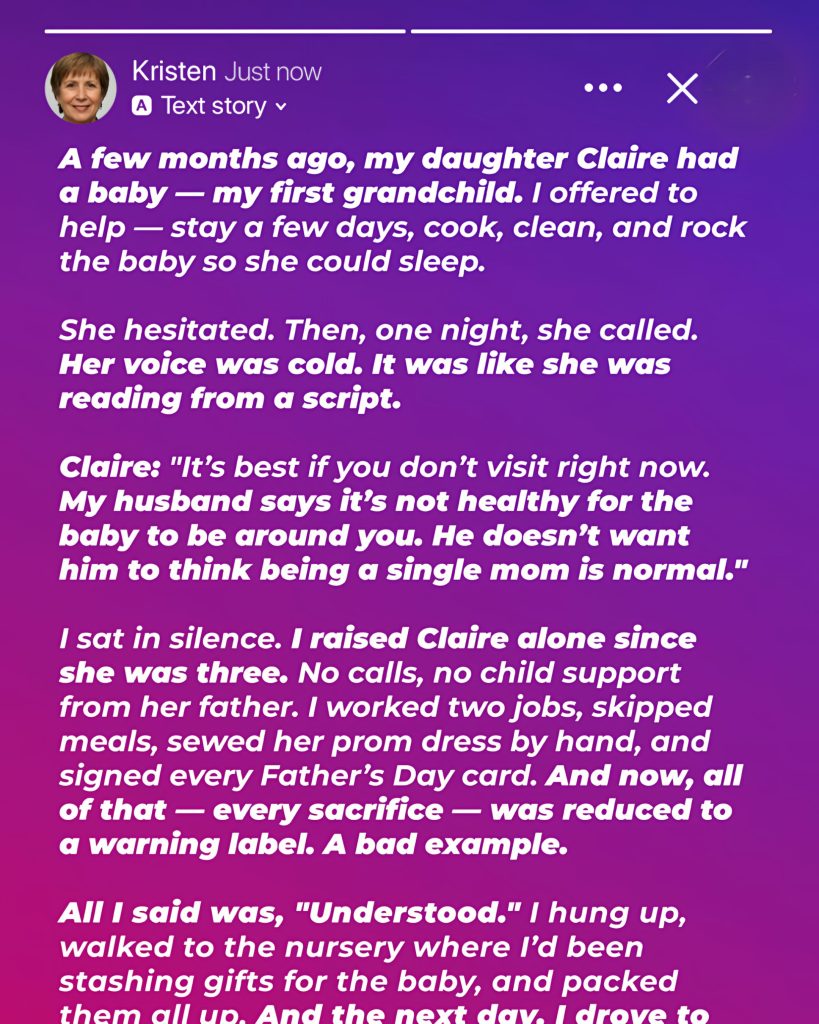
A few months ago, my daughter Claire had a baby — my first grandchild. I offered to help — stay a few days, cook, clean, and rock the baby so she could sleep. She hesitated. Then, one night, she called. Her voice was cold. It was like she was reading from a script. Claire: “It’s best if you don’t visit right now. My husband says it’s not healthy for the baby to be around you. He doesn’t want him to think being a single mom is normal.” I sat in silence. I raised Claire alone since she was three. No calls, no child support from her father. I worked two jobs, skipped meals, sewed her prom dress by hand, and signed every Father’s Day card. And now, all of that — every sacrifice — was reduced to a warning label. A bad example. All I said was, “Understood.” I hung up, walked to the nursery where I’d been stashing gifts for the baby, and packed them all up. And the next day, I drove to the local community center, specifically the wing that housed the crisis nursery for struggling young mothers.
The engine of my old sedan hummed, a familiar sound that had accompanied me through decades of early mornings and late nights. As I navigated the streets, my mind drifted back to 1994. I remembered the winter the furnace broke, and we lived in the kitchen with the oven door open just to keep Claire’s hands from turning blue. I remembered the taste of the generic peanut butter sandwiches I ate for six months straight so she could have fresh fruit and new shoes for school. To me, those weren’t just memories; they were battle scars from a war I won every single day because she turned out “fine.” She had graduated, married a man with a “solid” background, and bought a house in a zip code I couldn’t even afford to drive through. I thought her success was my reward. I didn’t realize she viewed my survival as a source of shame.
When I arrived at the shelter, I began unloading the boxes. Inside were the softest hand-knitted blankets, the little organic cotton onesies I’d spent two weeks’ grocery money on, and the heirloom silver rattle that had belonged to my own grandmother. I had imagined placing those items in a beautiful nursery, watching my grandson’s tiny fingers wrap around the silver. Instead, I handed them to a woman named Martha who ran the center.
“These are beautiful, Kristen,” Martha said, her eyes softening as she touched the ivory wool of the blanket. “Someone is going to be very lucky. Why the sudden change of heart? I thought these were for your first grand-baby.”
“They were,” I said, my voice barely a whisper. “But it turns out I’m a ‘bad example.’ Apparently, my life is a cautionary tale, not a legacy.”
Martha, a woman who had seen the worst of humanity and still believed in the best, simply took my hand. “A cautionary tale? Honey, a woman who builds a castle out of the bricks thrown at her isn’t a bad example. She’s a blueprint. If they can’t see that, it’s because they’re looking at the wrong map.”
I started volunteering at the center three times a week. I spent my mornings rocking babies whose mothers were out looking for jobs or attending court hearings. I spent my afternoons teaching nineteen-year-olds how to make a budget stretch or how to sew a button back on a shirt. In those halls, no one called me a bad example. They called me “Ma” or “Auntie.” They asked for my advice. They looked at my calloused hands with respect, knowing that those hands knew how to hold a family together when the world was trying to tear it apart.
For the older generation reading this, you know that our lives are defined by what we do when the lights go out. We were taught that you don’t walk away from family, and you sure as heck don’t forget the person who carried you on their back across the mud. But the world has changed. Somewhere along the line, “proper” became more important than “presence.” My son-in-law, Greg, came from a world of country clubs and inherited wealth. To him, the struggle was a choice, and a woman who couldn’t keep a husband was clearly lacking in character. He didn’t see the bravery in my single motherhood; he only saw a lack of “stability.” And Claire, my sweet Claire, had traded her own history for a seat at his table.
Months passed. I saw photos of the baby—little Leo—on social media. I saw Greg’s parents in the background of images, dressed in cashmere and sipping tea. They looked the part of the “perfect” grandparents. I felt a hollow ache in my chest every Sunday, the day I used to make a big pot of pasta for Claire. Now, I sat alone with a bowl of soup, watching the sunset and wondering if Leo would ever know my name.
Then, one Tuesday evening, my doorbell rang. It was raining, a cold, biting drizzle that reminded me of those lean years in the 90s. I opened the door to find Claire standing there. She wasn’t wearing her designer coat. She was wrapped in a thin cardigan, her hair disheveled, and she was clutching Leo to her chest. He was crying, that frantic, hungry cry that only a mother can truly feel in her marrow.
“Mom,” she sobbed. “I didn’t know where else to go.”
I didn’t say “I told you so.” I didn’t remind her of the cold script she read over the phone. I opened the door wide and took the baby. As I rocked him, my movements felt as natural as breathing. I walked her to the kitchen, sat her down, and put the kettle on.
She told me her “normal” life was a cage. Greg’s parents were overbearing, dictating every move she made. Greg himself was never home, and when he was, he was critical of her appearance, her parenting, and her “background.” That morning, they had a massive row. Greg told her that if she couldn’t handle the baby without complaining, she was “just like her mother” — a woman who couldn’t make a marriage work. He told her she was lucky he had “plucked” her out of her messy life to give her a “real” family.
“He called you a failure, Mom,” Claire whispered, her tears falling into her tea. “And for a second, I almost believed him because I was so scared of losing the life he gave me. But then I looked at Leo, and I realized I didn’t want him to grow up thinking that a man who belittles his wife is ‘normal.’ I didn’t want him to think that love is something you have to earn by being perfect. I wanted him to be like you. I wanted him to be someone who could survive a storm.”
I looked at my daughter, really looked at her. The “script” was gone. The coldness was replaced by the raw, jagged truth of a woman finding her spine.
“Being a single mom isn’t easy, Claire,” I said, my voice steady. “It’s the hardest job on the planet. I never wanted it for you, not because it’s shameful, but because I know how much it hurts to eat your dinner standing up so you can keep working. But don’t you ever think that my life was a mistake. I didn’t have a husband, but I had you. I didn’t have a fancy house, but I had a home. And I didn’t have child support, but I had a God-given strength that turned me into a lioness.”
She stayed with me that night. We didn’t have a nursery anymore—the gifts were long gone to the shelter—but we made a pallet on the floor, and we slept the way we used to when she was small. Safe.
The next day, Greg showed up. He didn’t come to apologize. He came to collect his “assets.” He stood on my porch in his tailored suit, looking at me with the same disdain he’d used for months.
“Give me the child, Kristen,” he said. “Claire is having a nervous breakdown. This environment is exactly what I warned her about. It’s unstable. It’s… inferior.”
I stepped out onto the porch and closed the door behind me. I realized in that moment that I wasn’t the “bad example.” He was. He was the example of a man who thought money bought meaning. He was the example of a person who didn’t understand that the strongest trees are the ones that have to grow against the wind.
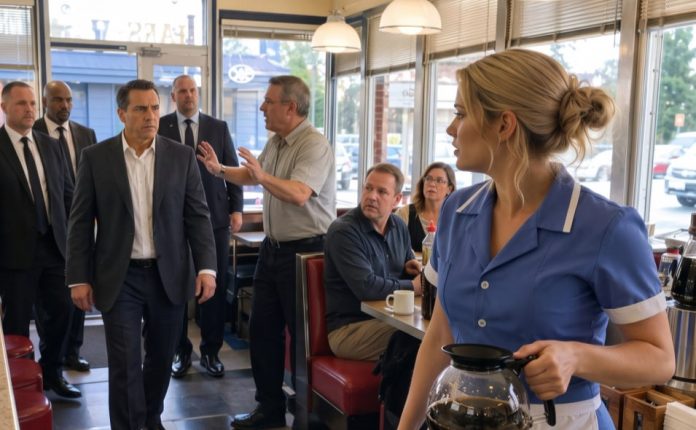
“Greg,” I said, moving my hand to my hip, my old ‘waitress stance’ returning. “You’ve spent a lot of time talking about what’s normal. But in this house, normal means respecting the woman who gave birth to your son. Normal means honoring the mother who gave up everything to ensure your wife had a future. You see a single mom and you think ‘broken.’ I see a single mom and I see a masterpiece of resilience. You can leave now. My lawyer—a man I helped through night school while waitressing on the weekends—will be in touch.”
The look on his face was worth every skipped meal of 1996. He hadn’t counted on a “bad example” having teeth.
Claire stayed with me for three months while the divorce proceedings began. It wasn’t always easy. There were nights when she cried, fearing she had ruined her life. But every morning, she saw me. She saw me get up at 5:00 AM to bake bread to save on the grocery bill. She saw me volunteer at the shelter. She saw me handle the legal paperwork with a calm that only comes from decades of managing crises.
One afternoon, we were back at Sarah’s Haven, the crisis nursery. Claire was sitting on the floor with two young girls, showing them how to swaddle their babies. She looked at me across the room and mouthed the words, “Thank you.”
She finally understood that my life wasn’t a warning; it was a testament. Every struggle I went through was a brick in the foundation of her own strength. By raising her alone, I hadn’t made single motherhood “normal”—I had made resilience “necessary.” I had shown her that a woman’s worth is not a variable of her marital status, but a constant of her character.
Eventually, Claire moved into a small apartment of her own. She started working as a teacher, finding her own path and her own voice. Greg disappeared into the background, his “perfect” life revealed to be a hollow shell of control and vanity. He still sees Leo, as he should, but Leo knows that his grandmother’s house is a place of magic, where stories are told about the “Big Blue Dress” I sewed for his mother’s prom and the silver rattle that traveled through time.
To the grandmothers and mothers sitting in their armchairs today, perhaps feeling a bit tired or a bit unappreciated, I want to say this: Do not let the modern world diminish your sacrifice. If you raised your children with nothing but your own hands and a prayer, you are a hero. If you survived the lean years and are still standing, you are a monument to human endurance. Never apologize for taking up space in this world, and never let a “script” written by someone who has never struggled define who you are.
My nursery at home is full again. It’s not just full of gifts; it’s full of a grandson who knows that being around his grandmother is the healthiest place in the world. He knows that here, he is allowed to be messy, he is allowed to be human, and he is loved unconditionally.
Claire came over for dinner last Sunday. We sat on the porch, watching Leo try to catch fireflies. The air was warm, smelling of jasmine and the history of our family.
“Mom,” she said, leaning her head on my shoulder. “I’m sorry I ever let anyone call you a bad example. You’re the best example I could have asked for.”
“I know, honey,” I said, patting her hand. “I’ve known that for a long time. I was just waiting for you to see it, too.”
The sunset was beautiful that night—a deep, vibrant orange that looked like a fire burning on the horizon. It reminded me that even as the day ends, there is a beauty in the transition. We are all just walking each other home, following the maps laid down by the ones who went before us. My map was rough, full of detours and jagged edges, but it led me exactly where I needed to be. I am Kristen. I am a single mother, a grandmother, and a survivor. And I am, by every measure that matters, a masterpiece.