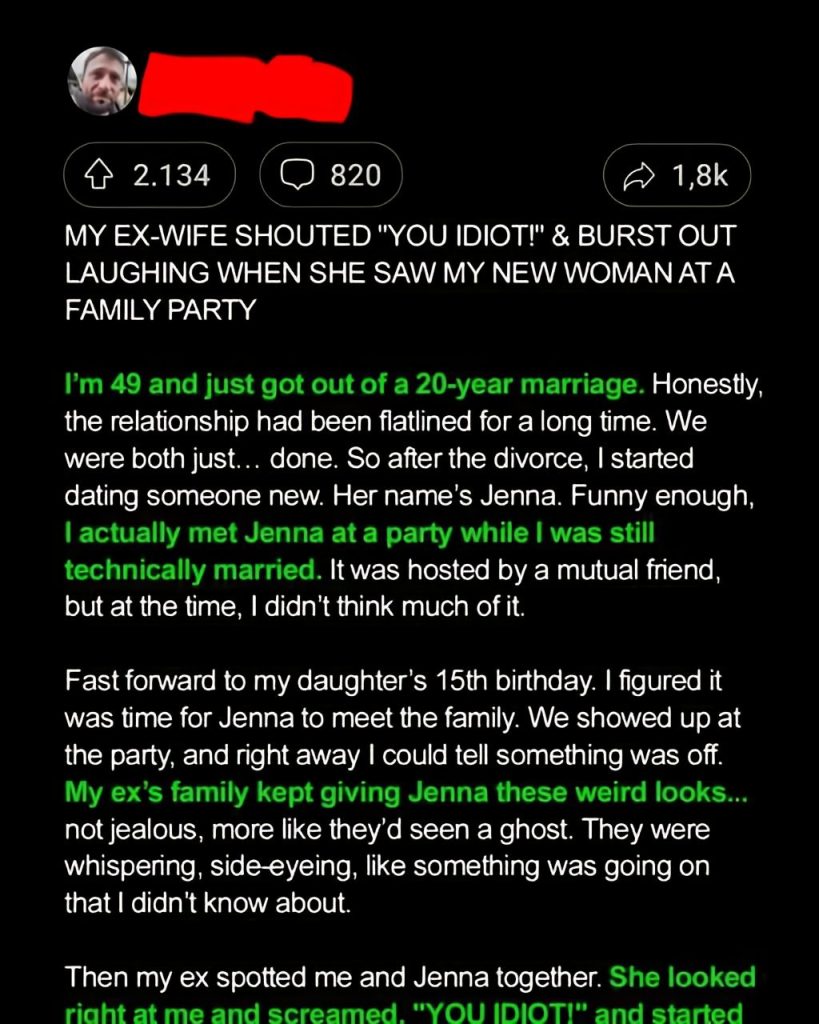
I’m 49 and just got out of a 20-year marriage. Honestly, the relationship had been flatlined for a long time. We were both just… done. So after the divorce, I started dating someone new. Her name’s Jenna. Funny enough, I actually met Jenna at a party while I was still technically married. It was hosted by a mutual friend, but at the time, I didn’t think much of it. Fast forward to my daughter’s 15th birthday. I figured it was time for Jenna to meet the family. We showed up at the party, and right away I could tell something was off. My ex’s family kept giving Jenna these weird looks… not jealous, more like they’d seen a ghost. They were whispering, side-eyeing, like something was going on that I didn’t know about. Then my ex spotted me and Jenna together. She looked right at me and screamed, “YOU IDIOT!” and started laughing hysterically, tears of dark, cynical amusement streaming down her cheeks.
The laughter was a jagged, ugly sound that seemed to slice through the humid afternoon air of the backyard. My daughter, Chloe, stood by the tiered strawberry cake, her hands frozen mid-air, looking between her mother’s sudden explosion and my confused face. Jenna, who had been so nervous about this day—the “big debut” as she called it—shrank back slightly, her fingers tightening on my sleeve. I felt a surge of protectiveness, the same steady fire that had carried me through two decades of a marriage that felt more like a cold war than a partnership.
“Diane, what on earth is wrong with you?” I demanded, my voice low and controlled, though my heart was beginning to thump a rhythmic warning against my ribs.
Diane doubled over, her hands on her knees, the sheer volume of her mirth attracting every guest in the yard. Her parents, George and Martha—my former in-laws whom I had always respected for their quiet, old-world dignity—didn’t join in the laughter. They were deathly pale. Martha had dropped her paper plate, the potato salad spilling onto the grass, her eyes wide and fixed on Jenna’s face as if she were staring into an open grave.
“Oh, Robert,” Diane wheezed, finally straightening up, though her face was still contorted with a cruel kind of delight. “You really have no idea, do you? You spent twenty years being the most observant man in the room, and you managed to find the one woman in this entire city who makes this divorce the most delicious irony of my life!”
I looked at Jenna. She was thirty-four, with deep auburn hair that caught the sunlight and eyes the color of moss after a rainstorm. I had met her at a low point, drawn to her quiet stillness and her ability to find beauty in the small things. She was a landscape architect, a woman who spent her days making things grow, a stark contrast to Diane, who spent hers analyzing the flaws in everything around her.
“What is she talking about, Jenna?” I asked, my voice trembling now.
Jenna looked as lost as I was. “I… I don’t know, Robert. I’ve never met these people before. I swear.”
George, my former father-in-law, stepped forward. He was eighty-two now, a man of the earth who had spent his life in the timber industry. He moved with a heavy, deliberate gait, his presence usually a source of calm. But today, his hands were shaking so violently he had to shove them into his pockets. He looked at Jenna, and for a moment, the years seemed to fall away from his face, leaving behind a raw, primal sorrow.
“Child,” George said, his voice a gravelly whisper. “Where did you grow up? And what… what was your mother’s name?”
The yard fell into a suffocating silence. Even the kids had stopped playing by the fence. Jenna blinked, her voice small and brittle. “I was raised in a group home in Seattle until I was twelve. My mother… her name was Miriam. Miriam Vance. She passed away when I was very young. Why is everyone looking at me like I’ve committed a crime?”
Martha let out a strangled sob, a sound of such profound grief that it made my hair stand on end. She reached out a gnarled, spotted hand, her fingers hovering just inches from Jenna’s cheek before she pulled back, as if afraid the vision would vanish if touched.
To those of you who have lived through the long decades, you understand that family secrets are like seeds buried deep in the frozen ground. You think the winter will last forever, that the past is safely entombed under layers of silence and “moving on.” But then comes the spring—or in this case, a 15th birthday party—and the truth pushes its way into the light, unyielding and sharp.
Miriam Vance.
I remembered that name from the early years of my marriage. Miriam had been the “black sheep” of Martha’s family, her younger sister who had been the darling of the household until the summer of 1974. There had been a falling out—something to do with a man, a suitcase, and a defiant exit from the front door that George had slammed shut in a fit of righteous, old-fashioned anger. For forty years, the family had pretended Miriam didn’t exist. They had scrubbed her from the photo albums and the Sunday dinner conversations. They had chosen pride over blood, a decision that I now saw had been a slow-acting poison in Martha’s heart.
Diane’s laughter had died down, replaced by a look of stunned realization. Even her cynicism had its limits. “My God,” she whispered, her eyes darting from Jenna to her mother. “It’s really her. She’s the girl Miriam had.”
Diane looked at me, and for the first time in years, the bitterness was gone, replaced by a haunting clarity. “Robert… you didn’t just find a new girlfriend. You found my cousin. You found the girl my mother has been crying for in her sleep for forty years.”
I felt the ground shift beneath me. I was the “idiot” not because I had done something wrong, but because I had inadvertently acted as the hand of fate. In a city of millions, I had found the one person who carried the DNA of a family’s greatest regret. I had brought her into the very house that had exiled her mother, unknowingly completing a circle that had been broken decades ago.
The party didn’t end, but it transformed. The music was turned off. The kids were sent inside to watch a movie. The adults gathered on the porch, the golden hour light stretching long and thin across the lawn. Jenna sat in the middle of it all, clutching a cup of tea that Martha had insisted on making for her, her eyes wide with the shock of discovering a history she had never known.
Martha spoke first, her voice a fragile thread of memories. She talked about Miriam—how she used to sing to the radio, how she could bake a pie with her eyes closed, and how she had a temper that was as fierce as her love. She talked about the man Miriam had run away with, a drifter who had promised her the world but ended up leaving her alone in a city where she knew no one.
“We tried to find her, Jenna,” George said, his head bowed, his voice thick with the weight of four decades of shame. “After the first year, when the anger cooled, I went looking. I hired people. I traveled to three states. But Miriam didn’t want to be found. She had changed her name to Vance—her grandmother’s maiden name—and she had vanished into the shadows. We thought she was gone forever. We thought we had killed the only sister Martha ever had.”
Jenna listened, her tears falling silently into her tea. She told them about her mother—the woman who had worked three jobs to keep them in a tiny apartment, the woman who had told her stories about a “magic garden” back home but never named the town or the people in it. She told them about the night Miriam died of a sudden illness, leaving a ten-year-old girl with nothing but a locket and a sense of profound displacement.
Looking at Jenna, I realized that her quietness, her sense of being an “observer” in her own life, came from this void. She had been a tree with no roots, floating on the surface of the world. And now, in the most unlikely of places—her boyfriend’s ex-wife’s backyard—she had finally found the soil.
The irony wasn’t lost on any of us. Diane, who had spent the better part of our marriage telling me I was “unperceptive” and “clueless,” sat in the corner, nursing a drink, her face unreadable. I had spent twenty years being the “rational” one, the man who believed in logic and planning. And yet, the most significant event of my life had been a total accident. Or was it?
To those of you who believe in the guiding hand of the universe, you know that there are no accidents. Perhaps my marriage to Diane had to “flatline” so that I could be in that specific party on that specific night to meet a woman named Jenna. Perhaps my twenty years of being the “outsider” in Diane’s family had prepared me to be the bridge that brought their “black sheep” back home.
As the night deepened, the atmosphere shifted from shock to a profound, aching kind of healing. Martha and Jenna disappeared into the house for an hour, emerging with red eyes and a new, fragile bond. Martha handed me a small, faded photograph from her wallet—a picture of Miriam at seventeen, standing by the very same oak tree that now shaded our daughter’s birthday party. The resemblance to Jenna was undeniable. It wasn’t just a physical likeness; it was a likeness of spirit, a certain tilt of the head that signaled both vulnerability and strength.
“I’m sorry I called you an idiot, Robert,” Diane said softly, stepping out onto the porch to join me. “I mean, you are an idiot, but… in a way that I think we all needed. My parents haven’t breathed this deeply in forty years. You’ve done something for them that I never could.”
“I didn’t do anything, Diane,” I said, looking out at my daughter Chloe, who was now sitting on the grass with Jenna, looking at old family photos. “I just followed my heart. I didn’t know where it was leading.”
“Maybe that was the problem with us,” Diane mused, her voice devoid of its usual edge. “We were too busy following the rules and the expectations. We forgot to listen to the wind.”
I realized then that my divorce hadn’t been a failure. It had been a necessary clearing of the brush to allow something new to grow. My relationship with Jenna wasn’t just a “new woman” to replace the old; it was an entirely different kind of connection, one built on a shared sense of mystery and a mutual understanding of what it means to be lost.
To the elderly readers who are currently navigating the complexities of your adult children’s lives, or perhaps facing your own regrets, I hope this story serves as a reminder. It is never too late to open the door. It is never too late to say “I was wrong” or “I miss you.” The past is a heavy burden, but the truth is a light that can guide you home, even if that home is found in the most unexpected of circumstances.
The birthday party ended with a sense of peace that I hadn’t felt in twenty years. We didn’t solve everything that night. There were still lawyers to deal with, a divorce to finalize, and a complicated new family dynamic to navigate. But the “ghosts” were gone. Martha and George finally had their granddaughter. Jenna finally had a history. And Chloe? Chloe had a family that was suddenly much larger and much more honest than it had ever been.
I am forty-nine years old, and my life is just beginning. I am no longer just a man who “got out” of a marriage; I am a man who was chosen to be a part of a much larger story. As I drove Jenna home that night, the city lights twinkling like diamonds against the dark velvet of the sky, she reached over and took my hand.
“Are you okay?” she asked, her voice soft and steady.
“I’m more than okay,” I said. “I’m exactly where I’m supposed to be.”
I looked at the road ahead, realizing that the “flatlined” years were over. The heart of our family had started beating again, a slow, steady rhythm of forgiveness and discovery. Diane might still think I’m an idiot, and in many ways, I am. I’m an idiot who believed in love after twenty years of silence. I’m an idiot who brought a “ghost” to a party. But most of all, I’m an idiot who realized that the most meaningful things in life are the ones you never see coming.
To all of you who are watching the sunset today, take a moment to look at the people around you. Really look at them. You might just find that you’re surrounded by more miracles than you realize. You might find that the person you think is a stranger is actually a part of your own heart, waiting for the right moment to come home.
My daughter’s 15th birthday will go down in history as the day the Thorne-Vance family finally found its way back to itself. We didn’t need a tiered strawberry cake or expensive presents. We just needed a box of old toothpicks, a few yellowed letters, and the courage to stop laughing long enough to see the truth.
The lake of our shared history is deep, but the water is finally clear. And as I tuck myself into bed tonight, I whisper a silent thank you to Miriam Vance. Thank you for the eyes you gave your daughter. Thank you for the secret you kept until we were strong enough to handle it. And thank you for the “idiot” who was lucky enough to find you both. Life is long, and the story is far from over, but for the first time in a very long time, I am looking forward to every single chapter.
George and Martha now spend their weekends at our house, teaching Jenna the secrets of the garden and the stories of the sisters who once ruled this land. Diane is a regular visitor too, her cynicism replaced by a quiet, watchful respect. We are a “dumb fusion” family, a blend of the old and the new, the lost and the found. And in that fusion, we have found a strength that is unbreakable.
May we all have the grace to recognize our own miracles, and the wisdom to know that sometimes, the best thing you can be is the “idiot” who follows his heart. The stars are bright tonight, and the house is full of life. And that, dear friends, is the only “happily ever after” that really matters. The past is forgiven, the present is cherished, and the future is ours to build, one memory at a time.