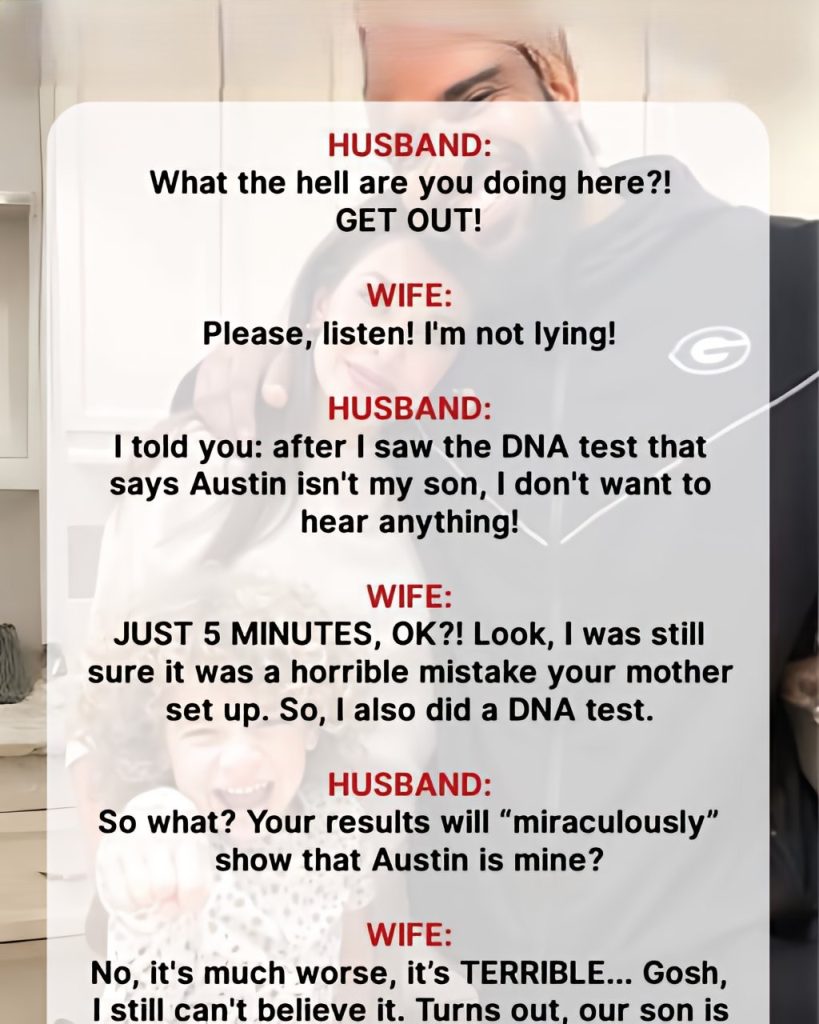
HUSBAND: “What the hell are you doing here?! GET OUT!” WIFE: “Please, listen! I’m not lying!” HUSBAND: “I told you: after I saw the DNA test that says Austin isn’t my son, I don’t want to hear anything!” WIFE: “JUST 5 MINUTES, OK?! Look, I was still sure it was a horrible mistake your mother set up. So, I also did a DNA test.” HUSBAND: “So what? Your results will “miraculously” show that Austin is mine?” WIFE: “No, it’s much worse, it’s TERRIBLE… Gosh, I still can’t believe it. Turns out, our son is… not mine either, Mark. He isn’t yours, and he isn’t mine. He isn’t our biological child at all.”
The silence that followed was so profound it felt like the house itself had stopped breathing. Mark, who had been standing by the door with a face like thunder, slowly let his hand drop from the handle. The legal document he had been clutching—the one his mother, Diane, had triumphantly produced two weeks ago—fluttered to the floor like a wounded bird. He looked at Elena, his wife of six years, and then at the small, curly-haired boy playing with wooden blocks in the corner of the living room. Austin was three years old, a bundle of energy and sunshine who had, until fourteen days ago, been the center of Mark’s universe.
“What are you saying, Elena?” Mark’s voice was no longer a roar; it was a fractured whisper.
“I’m saying that three years ago, when we were in that hospital during the New Year’s Eve storm, someone made a mistake,” Elena said, her eyes brimming with tears as she stepped into the foyer. She held out a thick envelope from a different laboratory. “I knew I had never been unfaithful to you. Even when your mother called me a liar in front of the whole family, even when you packed my bags and told me to leave, I knew the truth of my own life. So I didn’t just test your paternity. I tested my maternity. Austin has zero percent of my DNA, Mark. He is a stranger to both of us.”
For those of you who have lived through the decades—those who remember when family was a sacred, unshakeable bond—this is the kind of news that doesn’t just break a heart; it shatters a soul. Mark sank into the hallway chair, his head in his hands. He thought back to the night Austin was born. It was the “storm of the century” in 2022. The hospital had been understaffed, the power had flickered, and the maternity ward had been a chaotic blur of emergency c-sections and exhausted nurses.
But more than that, he thought about his mother, Diane. Diane had never hidden her disdain for Elena. To Diane, a woman of “old money” and rigid expectations, Elena was a girl from the “wrong side of town” who had trapped her golden son. When Austin didn’t inherit the famous “Vance blue eyes” that had been in Mark’s family for four generations, Diane’s suspicion turned into an obsession. She had secretly taken a lock of Austin’s hair and a swab from Mark’s toothbrush, sending them to a lab to “confirm” what she already believed. When the results said Mark wasn’t the father, she didn’t go to him privately. She waited for Sunday dinner, standing up to brand Elena a traitor in front of everyone they knew.
Mark had been weak. He had allowed his mother’s voice to drown out the six years of loyalty he had seen in Elena’s eyes. He had chosen blood over the woman who had walked beside him through every hardship. And now, the blood he was so proud of had betrayed him in a way he couldn’t have imagined.
“If Austin isn’t ours…” Mark looked up, his face pale and haunted. “Then where is our baby, Elena? Where is our son?”
That question hung in the air, heavy and terrifying. They spent the next forty-eight hours in a state of frantic, focused desperation. They didn’t call lawyers first; they called a retired nurse they knew, Mrs. Gable, a woman who had worked at that hospital for forty years. Mrs. Gable, now in her late seventies, met them at a quiet park. She remembered that New Year’s Eve vividly.
“The tags,” she whispered, her eyes clouded with the memories of that night. “There was a mix-up with the numbering system because the digital records went down. I remember two boys born within minutes of each other. One was yours, Elena. The other belonged to a young couple, the Millers. I remember thinking how much they looked alike in the dim light of the emergency generators.”
With Mrs. Gable’s help and the weight of their DNA results, they forced the hospital’s hand. Within a week, the truth was laid bare in a cold, sterile boardroom. There had been another family, the Millers, living only twenty miles away. They had been raising a boy named Leo, a child who had grown up with striking blue eyes that didn’t match his parents’ dark features, but who was loved with a fierce, quiet devotion.
The meeting between the two families took place in a neutral community center. It was a scene of unbearable tension and profound grief. Mark and Elena walked in and saw Leo sitting on his father’s lap. Mark let out a choked sob. Looking at Leo was like looking into a mirror of his own childhood photos. The boy had his chin, his forehead, and yes—the Vance blue eyes.
Across from them, Sarah and Tom Miller were clutching Austin—the boy Elena had carried and raised—as if someone were about to tear their limbs off. Austin reached out for Elena, crying, “Mama? Why are you over there?”
The room descended into a collective, agonizing sob. For the older observers—the social workers and the hospital ombudsman—this was a tragedy of epic proportions. To a younger generation, this might have been a legal battle over “biological rights.” But to those who understand the true meaning of a home, this was a battle of the heart.
“What do we do?” Sarah Miller asked, her voice cracking as she held Austin tight. “I’ve stayed up with this boy through every fever. I know the exact sound of his laugh when he’s dreaming. He is my son.”
“And Leo is mine,” Elena said, her eyes fixed on the blue-eyed boy she had never held. “But I don’t know him. I don’t know what he likes for breakfast. I don’t know his favorite book. Austin is the one who calls me Mama.”
They realized then that there was no “winning.” To take their biological children back would be to kill the parents the boys knew. To stay as they were would be to live a lie every time they looked in the mirror.
In the midst of this heartbreak, Diane, Mark’s mother, tried to interfere one last time. She showed up at the community center, her expensive silk scarf fluttering as she marched toward Mark. “Well, finally!” she exclaimed, ignoring the sobbing parents. “Now we can fix this. Mark, we’ll get the lawyers, we’ll get the Vance heir back, and we can put this… other child… back where he belongs. It’s a tragedy, but at least the bloodline is secured.”
Mark stood up. For the first time in his life, he saw his mother not as a matriarch to be respected, but as a hollow woman who had traded her humanity for a pedigree.
“Get out, Mother,” Mark said, his voice flat and final.
“Excuse me? I’m trying to save your legacy!”
“You tried to destroy my wife over a DNA test you stole,” Mark said, stepping toward her. “You broke our home because you were so obsessed with ‘purity’ that you couldn’t see the love that was right in front of you. Because of your ‘pedigree,’ we almost lost everything. Austin is my son. Leo is my son. And neither of them will ever have anything to do with a woman as cold as you.”
He watched his mother walk away, her heels clicking on the linoleum, for the last time. It was a hard choice, the kind of choice that people from a different era might find scandalous—to cut off a parent. But Mark realized that a family isn’t a museum where you preserve the past; it’s a garden where you protect the future.
The two families made a decision that many found shocking, but which they knew was the only way to survive. They didn’t “swap” the boys back. Instead, they moved. Mark and Elena sold their suburban home and moved to a farmhouse only a mile away from the Millers.
The two boys grew up as “brothers of the heart.” They spent every weekend together. Austin kept his name and stayed with the parents who had raised him, as did Leo. But the walls between the two households dissolved. They became one large, complicated, and beautiful family. Sarah and Elena became as close as sisters, sharing the secrets of motherhood and the unique bond of having “carried” each other’s children.
For the older readers who have seen the seasons turn many times, you know that the true test of a person isn’t how they handle the good times, but how they mend the broken ones. Mark and Elena’s marriage was forged in a fire that should have consumed it. Mark spent years earning back Elena’s trust, realizing that he had to be a husband before he was a son. He learned that the “Vance name” was nothing compared to the sound of Elena’s forgiveness.
Years later, at a combined birthday party for the boys, I saw them. Two teenagers, one with dark hair and one with blue eyes, wrestling in the grass. They didn’t look like a “mistake.” They looked like a miracle.
Austin, the boy who wasn’t Mark’s “blood,” was the one who inherited Mark’s love for old clocks and woodworking. Leo, the biological heir, was the one who shared Elena’s passion for music and her quick, Spanish wit. It was a living testament to the fact that while DNA might provide the blueprint, it is the love, the time, and the “feeding and bathing” that build the house.
To those of you sitting in your rocking chairs today, perhaps worrying about a family rift or a secret that’s come to light, remember this story. The truth can be “terrible,” as Elena said. It can pull the rug out from under your feet and leave you gasping for air. But if you hold onto each other—if you choose the person over the document—you can build something stronger than what you lost.
The hospital eventually paid a massive settlement, which the two families combined into a college fund for both boys. But the money was the least of it. The real wealth was the community they had built. They had turned a “horrible mistake” into an expansion of love. They had taught two boys that they were twice as lucky, twice as loved, and part of a story that was bigger than a lab report.
Mark often sits on his porch in the evenings, watching the sunset. He thinks about the night he tried to kick Elena out, and he shudders at the man he almost was. He realized that his mother’s “gift” of the DNA test was actually a test of his own soul—a test he had failed initially, but one he had eventually passed by choosing his wife.
“Love is the only DNA that matters,” Mark whispered to me once, many years later, as we watched the boys graduate. “The rest is just chemistry. But what we have? That’s spirit.”
Elena, now a grandmother herself, still smiles that quiet, knowing smile. She knows that she saved her marriage not with a lie, but with a truth that was hard enough to break a heart and soft enough to mend one. She is the anchor of a family that spans two houses and one soul.
To the grandfathers and grandmothers out there, I hope you see the beauty in the “imperfect” families. I hope you see that the “fusion” of different backgrounds, different bloodlines, and even different histories is what makes our world vibrant. Don’t be a Diane, looking for “purity” in a lock of hair. Be a Martha, looking for “grace” in a pair of blue eyes that reflect a father’s love.
The boys are men now. They have their own children. And sometimes, when the whole group gathers for a holiday, a stranger might look at them and be confused by the mix of features and names. But to those who know the story, it’s as clear as a summer morning. They are a family that was born in a storm, broken by a lie, and rebuilt by a truth that was “terrible” until it became beautiful.
Mark and Elena’s hair is white now, their steps a little slower, but their hands are always joined. They are a living reminder that the most meaningful things in life are the ones we fight for. They kept their five minutes, they listened to the “terrible” truth, and they found a way to make it their own. And in the end, isn’t that what we’re all trying to do? Just trying to find home, even when the keys we were given don’t fit the locks we were told were ours.
The story of the “mistake” is now a story of a masterpiece. A masterpiece of forgiveness, a masterpiece of resilience, and a masterpiece of a mother’s love that was brave enough to say, “He isn’t mine, but I am his.” That is the legacy they leave behind—a legacy that will outlast any name, any eye color, and any DNA test. They are finally, truly, and biologically irrelevant—because they are a family. And that is enough. That is everything. Mark looks at Elena, and for the first time in his long life, he doesn’t need a test to know exactly who he belongs to. He belongs to her. And they belong to the boys. And the boys belong to the world. A beautiful, “terrible,” wonderful world where love always has the final word.