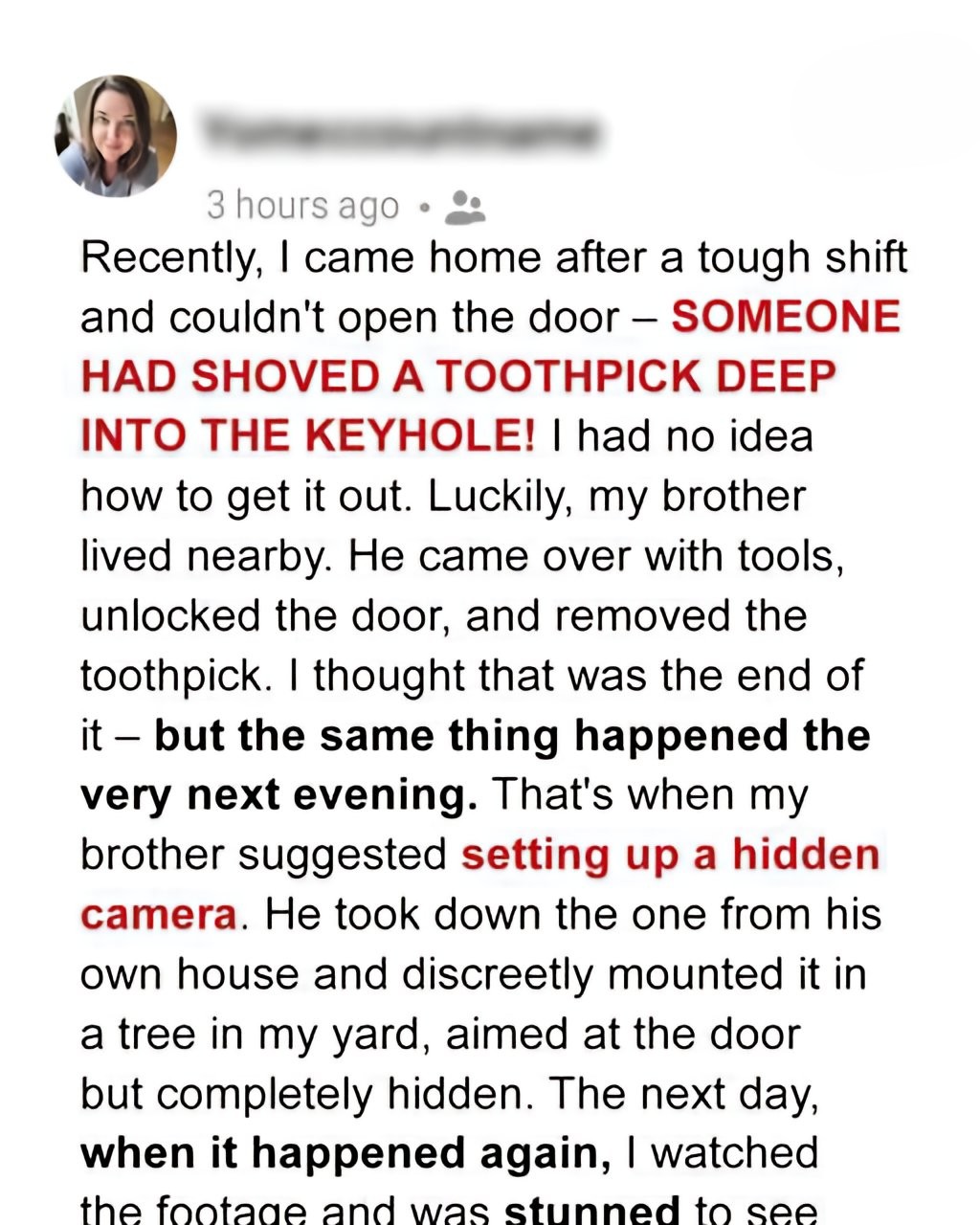
Recently, I came home after a tough shift and couldn’t open the door – SOMEONE HAD SHOVED A TOOTHPICK DEEP INTO THE KEYHOLE! I had no idea how to get it out. Luckily, my brother lived nearby. He came over with tools, unlocked the door, and removed the toothpick. I thought that was the end of it – but the same thing happened the very next evening. That’s when my brother suggested setting up a hidden camera. He took down the one from his own house and discreetly mounted it in a tree in my yard, aimed at the door but completely hidden. The next day, when it happened again, I watched the footage and was stunned to see a frail, familiar figure limping toward my porch in the dim glow of the streetlamp. It was Mrs. Gable, the eighty-year-old widow from three houses down, clutching a small box of wooden toothpicks in her shaking, translucent hands.
I sat on my sofa, the laptop screen casting a cold blue light over my living room, and replayed the footage three times. My heart, which had been racing with anger and the fear of a potential stalker or a malicious teenager, suddenly sank into a hollow ache. I watched her struggle. She didn’t look like a vandal; she looked like someone performing a desperate, sacred ritual. She would carefully slide the sliver of wood into the lock, whisper something to the doorframe, and then pat the wood gently as if she were tucking a child into bed. When she finished, she wiped a tear from her cheek with the corner of her floral housecoat and disappeared back into the shadows of the sidewalk.
Working as a night-shift nurse at the local hospice, I see a lot of things that break my heart. I’m used to the slow fading of memory and the way the mind tries to protect itself by retreating into the past. But seeing it happen on my own doorstep was different. Mrs. Gable had lived on this street since before I was born. She had been the woman who baked lemon squares for every new neighbor and kept the most beautiful rose garden in the county. Since her husband, Arthur, passed away five years ago, she had become a ghost in her own home. We all waved when we saw her fetching the mail, but none of us had truly stopped to ask how she was doing.
The next morning, I didn’t call the police. I didn’t even call my brother, Mark, who I knew would want to install a high-tech alarm system and perhaps have a stern word with Mrs. Gable’s distant relatives. Instead, I made a pot of tea and put some store-bought shortbread on a plate. I walked down the street, my legs feeling heavy with a mix of trepidation and guilt.
When I knocked on her door, it took a long time for her to answer. When the door finally creaked open, the smell of stale air and lavender drifted out. Mrs. Gable looked smaller than I remembered. Her eyes were clouded with cataracts and something far heavier—loneliness.
“Mrs. Gable? It’s Sarah, from down the street,” I said, keeping my voice soft and steady.
She blinked at me, her brow furrowing. “Sarah? The little girl with the red bicycle?”
I hadn’t had a red bicycle in twenty-five years, but I nodded. “That’s me. I brought some tea. May I come in?”
Her house was a museum of a life that had stopped moving. Dust danced in the shafts of light hitting the velvet armchairs. Photos of Arthur were everywhere—Arthur at the lake, Arthur in his Sunday suit, Arthur laughing with a young woman who must have been their daughter.
We sat in the kitchen, and for the first hour, we talked about the weather and the roses. But eventually, the silence grew too heavy to ignore. I reached into my pocket and pulled out the small bag of broken toothpicks my brother had extracted from my lock. I laid them on the lace tablecloth between us.
Mrs. Gable’s breath hitched. She looked at the tiny wooden shards as if they were diamonds.
“I’m not angry, Mrs. Gable,” I said gently. “But I need to understand. Why my door? Why the toothpicks?”
She began to cry then, a soft, whistling sound that made my own eyes sting. Her hands sought out the toothpicks, gathering them into a small pile. “I didn’t want you to leave,” she whispered. “I see you go out every night in your blue scrubs. You look so much like my Mary. My daughter used to work those same hours. She’d leave in the dark, and one night… one night she just didn’t come back. A car accident, they told me. Just three miles from the hospital.”
She looked up at me, her eyes wet and searching. “When I saw you leaving, I got so scared. I thought if I could just jam the lock, just for a little while, you’d stay inside. You’d stay where it’s safe. I thought if the key wouldn’t turn, the world couldn’t take you away like it took her.”
The weight of her words hit me like a physical blow. In her fractured mind, she wasn’t trying to lock me out of my home; she was trying to keep me inside a sanctuary. She was trying to rewrite a tragedy that had happened decades ago using nothing but toothpicks and hope. To an outsider, it was senility or property damage. To her, it was an act of maternal protection.
I reached across the table and took her hand. It felt like holding a bird made of dried leaves. “I’m safe, Mrs. Gable. I promise. I’m a nurse, and I go to the hospital to help people like Mary did. But I always come home.”
“Arthur used to check all the locks,” she continued, her voice drifting. “Every night at ten. He’d say, ‘The world is tucked in now, Rose. We’re safe.’ But when he died, the locks felt… empty. The house felt like it had no skin. I thought I was helping you. I’m so sorry, Sarah. I’ve made a mess of things, haven’t I?”
That afternoon, I realized that a hidden camera can show you what is happening, but it can never tell you why. We live in an age where we are more connected than ever by fiber optics and satellite feeds, yet we are starving for the simple connection of a neighbor’s touch. I had been so focused on my “tough shifts” and my own exhaustion that I had missed a woman drowning in grief just fifty yards away.
I spent the rest of the day with her. We went through her old photo albums, and she told me stories about Mary. Mary had loved old movies and hated broccoli. She had wanted to be a pediatrician. As Mrs. Gable spoke, the light seemed to come back into her eyes. The ghosts that had been haunting her were being replaced by memories shared aloud.
When I left that evening, I promised her I would stop by every day before my shift. But I knew I couldn’t do it alone. The next morning, I did something I hadn’t done in years—I went door-to-door on our street. I spoke to the young couple with the toddler, the retired schoolteacher, and even the grumpy man who always complained about overgrown lawns.
I told them about the toothpicks. I told them about Mary and Arthur. And I watched as the same look of realization washed over their faces. We had all been so busy “protecting” our own lives that we had forgotten to build a community.
Within a week, things began to change. The retired schoolteacher started taking Mrs. Gable for walks in the afternoon. The young couple invited her over for Sunday brunch, where she sat and watched their toddler play, a smile finally returning to her face. My brother, Mark, instead of installing an alarm, spent a Saturday fixing Mrs. Gable’s sagging porch and installing a bright, motion-sensor light so she wouldn’t feel so afraid of the dark.
And as for me, I no longer found toothpicks in my lock. Instead, I found small notes tucked into my doorframe. *“Have a safe shift, Sarah,”* one would say. *“I made too much chicken soup, please take some,”* said another.
Mrs. Gable became the grandmother of the street. She wasn’t a “vandal” anymore; she was our reminder that everyone carries a story that is often hidden behind a closed door or a locked heart.
Months later, as winter began to settle in, I found myself walking home after a particularly grueling night at the hospice. A patient I had grown fond of had passed away, and the world felt cold and unforgiving. As I reached my porch, I saw a familiar figure standing by my door. My heart skipped a beat for a second, a flash of the old “toothpick” fear returning.
But it was just Mrs. Gable. She was wearing a thick wool coat and holding a thermos.
“I saw your car pull in,” she said, her breath misting in the air. “I thought you might need something warm before you went to sleep. The world can be a hard place at four in the morning.”
I took the thermos, the warmth of the metal seeping into my chilled fingers. “Thank you, Rose.”
She looked at my lock and then back at me. “I don’t need the wood anymore, Sarah. I realized that keeping you inside doesn’t protect you. It’s the knowing that someone is waiting for you to come back that keeps you safe.”
I realized then that the “meaningful” story wasn’t just about a woman with dementia and a box of toothpicks. It was about the fact that we are all looking for a way to lock the people we love into safety. We use different things—money, rules, walls, or even wooden slivers—but in the end, the only thing that actually works is being present.
For the older generation reading this, you know that the “good old days” weren’t better because there was less technology, but because there was more accountability. People knew their neighbors’ names. They knew whose child was sick and whose husband was out of work. We’ve lost some of that in our hurry to be “secure,” but Mrs. Gable taught me that security is an illusion if it’s built out of isolation.
I still have that hidden camera in the tree. But I don’t use it to watch for intruders anymore. Sometimes, when I’m feeling lonely or overwhelmed by the heavy things I see at the hospital, I look at the footage from a sunny Tuesday afternoon. I see the neighbors stopping to chat by Mrs. Gable’s roses. I see the kids from the street running onto her porch to get a cookie. I see a community that was once held together by toothpicks and is now held together by love.
My door opens easily now. The key turns without resistance. But every time I hear that click, I think of Rose. I think of the Marys of the world who didn’t come home, and the Sarahs who do. And I am reminded that the most important “key” we will ever hold is the one that opens us up to the people living right next door.
So, if you ever find something strange at your doorstep—a broken lock, a misplaced item, or a neighbor acting in a way you don’t understand—don’t be too quick to call for help. Sometimes, the “problem” is just a person trying to tell you they are afraid. Sometimes, the toothpick in the keyhole is just a way of saying, “Please stay. Please be safe. Please don’t let the world take you away.”
And in a world as big and as lonely as this one, that is a message worth listening to. We are all just trying to find a way to make the locks hold against the night. But as Rose taught me, the light always finds a way in, as long as we are willing to open the door.