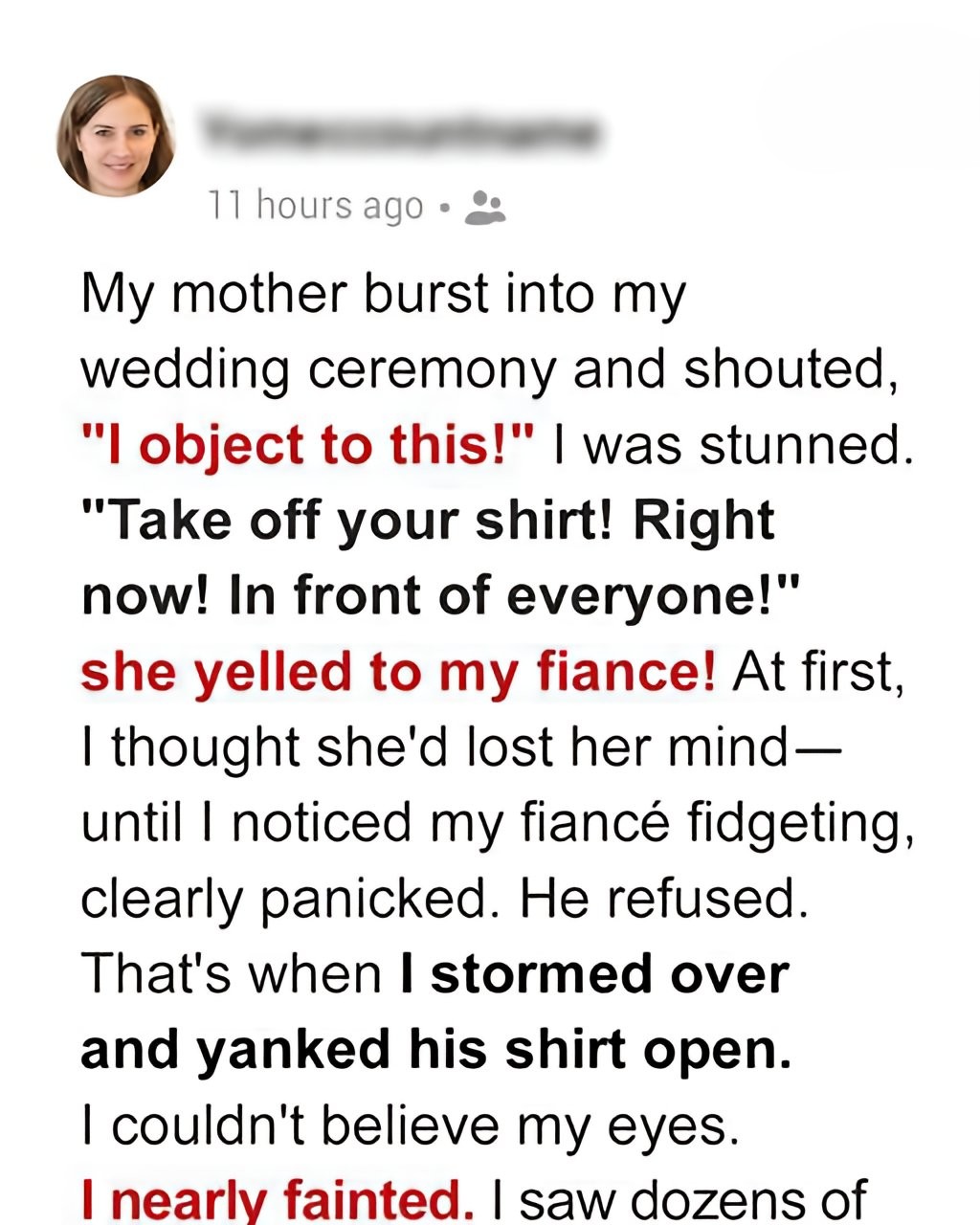
My mother burst into my wedding ceremony and shouted, “I object to this!” I was stunned. “Take off your shirt! Right now! In front of everyone!” she yelled to my fiancé! At first, I thought she’d lost her mind—until I noticed my fiancé fidgeting, clearly panicked. He refused. That’s when I stormed over and yanked his shirt open. I couldn’t believe my eyes. I nearly fainted. I saw dozens of tiny, intricate tattoos, each one a name followed by a date, etched in a fading, indigo ink that looked decades older than the man wearing them.
The chapel, which moments ago had been filled with the sweet scent of lilies and the soft hum of a string quartet, fell into a heavy, suffocating silence. My hands trembled as I held the fabric of Julian’s custom-tailored shirt. The man I was supposed to marry—the kind, soft-spoken architect I had known for three years—looked like he wanted the floor to swallow him whole.
My mother, Eleanor, stepped forward. Her face, usually etched with the gentle lines of a woman who spent her retirement gardening, was now a mask of cold, hard steel. She didn’t look at me. Her eyes were locked on Julian’s chest, specifically on a name near his collarbone: *Lukas, 1944.*
“Where did you get those, Julian?” she asked, her voice a low, dangerous whisper. “And don’t you dare lie to me. I recognize that handiwork. I saw it once before, when I was a little girl, on a man who vanished from our village and took my family’s peace with him.”
Julian’s breath hitched. He looked at me, his eyes brimming with a cocktail of guilt and profound sadness. “Maya, I wanted to tell you,” he choked out. “I swear, I was going to tell you after we were away from everyone. I didn’t want this to ruin today.”
“Ruin today?” I found my voice, though it sounded thin and brittle. “Julian, you have a ledger of the dead written on your skin! Who are these people? Why do you have my grandfather’s name on your chest?”
The “dozens” of names were more than just ink; they were a map of a history I had only heard about in hushed tones during late-night kitchen talks with my grandmother. My family had fled a war-torn region in Eastern Europe mid-century. Many hadn’t made it. My grandfather, Lukas, was one of the “disappeared”—men who were taken to work in the mines and never heard from again.
Julian took a deep breath, his shoulders sagging as if a literal weight had been placed upon them. He looked around the room at our guests—my elderly aunts in their Sunday best, his own parents who sat in the front row looking strangely calm, almost expectant.
“I am not who you think I am, Maya,” Julian began, his voice gaining a tragic sort of strength. “My real name is Julian Varga. My grandfather was the man who was forced to ink these names. He was the camp scribe. He was the one who recorded the men who didn’t survive the winter, the men whose families would never know where they were buried.”
A gasp rippled through the pews. My mother took a sharp breath, her hand flying to her throat.
“My grandfather felt the weight of those souls every day of his life,” Julian continued, tears finally spilling over. “He moved to this country with nothing but his memories and a notebook he had smuggled out. He spent his final years obsessed with the idea that if the names weren’t kept ‘alive,’ the people would cease to exist. On his deathbed, he made my father promise to keep the record. And when I turned twenty-one, I took the burden upon myself. I chose to carry them so they would never be forgotten.”
He looked at my mother. “I didn’t know you were Lukas’s daughter until two months ago, Eleanor. I saw an old photo in Maya’s album. I recognized the face from my grandfather’s sketches. I realized that I was marrying the granddaughter of the man whose name sits right over my heart.”
The room remained still, but the tension had shifted from anger to a profound, echoing grief. For the elderly guests in the room—those who had lived through the lean years, who had lost brothers and fathers to the shadows of history—this wasn’t just a scandal. It was a bridge to a past they had tried to bury.
My Great Aunt Martha, nearly ninety and thin as a reed, rose slowly from her seat. She hobbled toward the altar, her cane clicking rhythmically on the marble floor. Everyone watched, mesmerized, as she reached Julian. She reached out a gnarled, spotted hand and touched the ink near his shoulder.
“Peter,” she whispered, her voice cracking. “You have my brother Peter here.”
Julian nodded solemnly. “Peter. October 12th. He gave his bread to a younger boy the night before he passed. My grandfather wrote it in the margins of his book.”
Aunt Martha began to sob—not a cry of horror, but a release of seventy years of unanswered questions. She leaned her forehead against Julian’s bare shoulder, and the young man held her with a tenderness that broke my heart into a thousand pieces.
I looked at my mother. The fire in her eyes had been extinguished, replaced by a haunting clarity. She realized that this man wasn’t a villain or a liar in the traditional sense. He was a keeper of ghosts. He had kept his shirt closed not out of shame for his actions, but out of a desire to protect me from the darkness he carried. He wanted our wedding to be a beginning, unburdened by the endings he wore on his skin.
“Why didn’t you just tell us?” I asked, stepping closer, my hand reaching out to touch the ink that bore my grandfather’s name.
“Because how do you tell the woman you love that you are a living tombstone?” Julian replied. “I was afraid you would look at me and see only the tragedy of our people. I wanted you to see Julian the architect, Julian who loves jazz, Julian who wants to build a house with you. I didn’t want to be the man who reminded you of everything your family lost.”
My mother stepped forward then, her anger entirely gone. She looked at Julian, then at me, and then at the rows of elderly relatives who were now standing, drawn toward the altar by a magnetic pull of shared history.
“You foolish boy,” my mother said, her voice thick with emotion. “You thought we would be afraid of the truth? We have lived in the silence of those names for decades. The silence is what was killing us. The not-knowing was the wound that wouldn’t heal.”
She turned to the minister, who stood frozen with his Bible in hand. “Continue,” she commanded, though her eyes were wet. “But Julian, keep the shirt off. If you are to marry into this family, you marry us with your eyes open and your history bared. We do not hide our dead anymore.”
The ceremony that followed was unlike any wedding I had ever imagined. It was no longer a sterilized celebration of flowers and cake. It became a rite of passage, a communal healing. As we exchanged vows, I didn’t see the tattoos as macabre or strange. I saw them as an act of ultimate devotion—a man willing to mar his own skin to ensure that the “little people” of history were never truly lost.
When Julian said “I do,” he wasn’t just promising himself to me; he was bringing two fractured histories together. He was promising that our children would know their great-grandfather’s name, not as a tragedy, but as a mark of resilience.
After the “kiss,” the reception was transformed. Instead of the usual small talk, the tables were filled with stories. The older generation, usually so reserved about the “old country,” began to speak. They pointed to the names on Julian’s chest, and he told them the stories his grandfather had recorded in his secret journals. He told them about the bravery of Peter, the humor of Lukas, and the quiet dignity of dozen others.
As the sun began to set, casting long, golden shadows across the garden where we held the dinner, I sat next to my husband. He had finally put his jacket back on, but the secret was out, and the air between us felt lighter than it ever had.
My mother approached us, holding two glasses of wine. She handed one to Julian and leaned down to kiss his cheek. “I’m sorry for the scene, Julian,” she whispered. “But I had to know if you were a man who could carry the weight. Many men would have turned away from that burden. You chose to wear it.”
Julian took her hand. “I did it for them, Eleanor. But I’ll live my life for Maya.”
Looking around at the faces of our elders—the people who had built our world out of the ashes of the one recorded on Julian’s skin—I realized that love isn’t just about the future. It’s about having the courage to acknowledge the past, no matter how painful or scarred it might be.
The “objection” that had threatened to tear our wedding apart had instead become the foundation of our marriage. We weren’t starting a new book; we were finally finishing a chapter that had been left open for far too long. And as I danced with Julian under the stars, I knew that every name on his chest was a blessing, a reminder that we are never truly alone as long as someone is willing to remember.
The music played on, a slow, melodic waltz that seemed to echo through the generations. The old people tapped their feet, their eyes bright with a peace they hadn’t known in years. For in the middle of a modern wedding, we had found something ancient and sacred: the truth that love is the only thing strong enough to carry the dead into the light of the living.
I looked at my husband, the man with dozens of souls etched into his skin, and I realized I had never loved him more. He was a protector of the forgotten, and I was the woman lucky enough to walk beside him into a future where no one would ever have to hide their scars again. The wedding ended late into the night, but for our family, the healing was only just beginning.